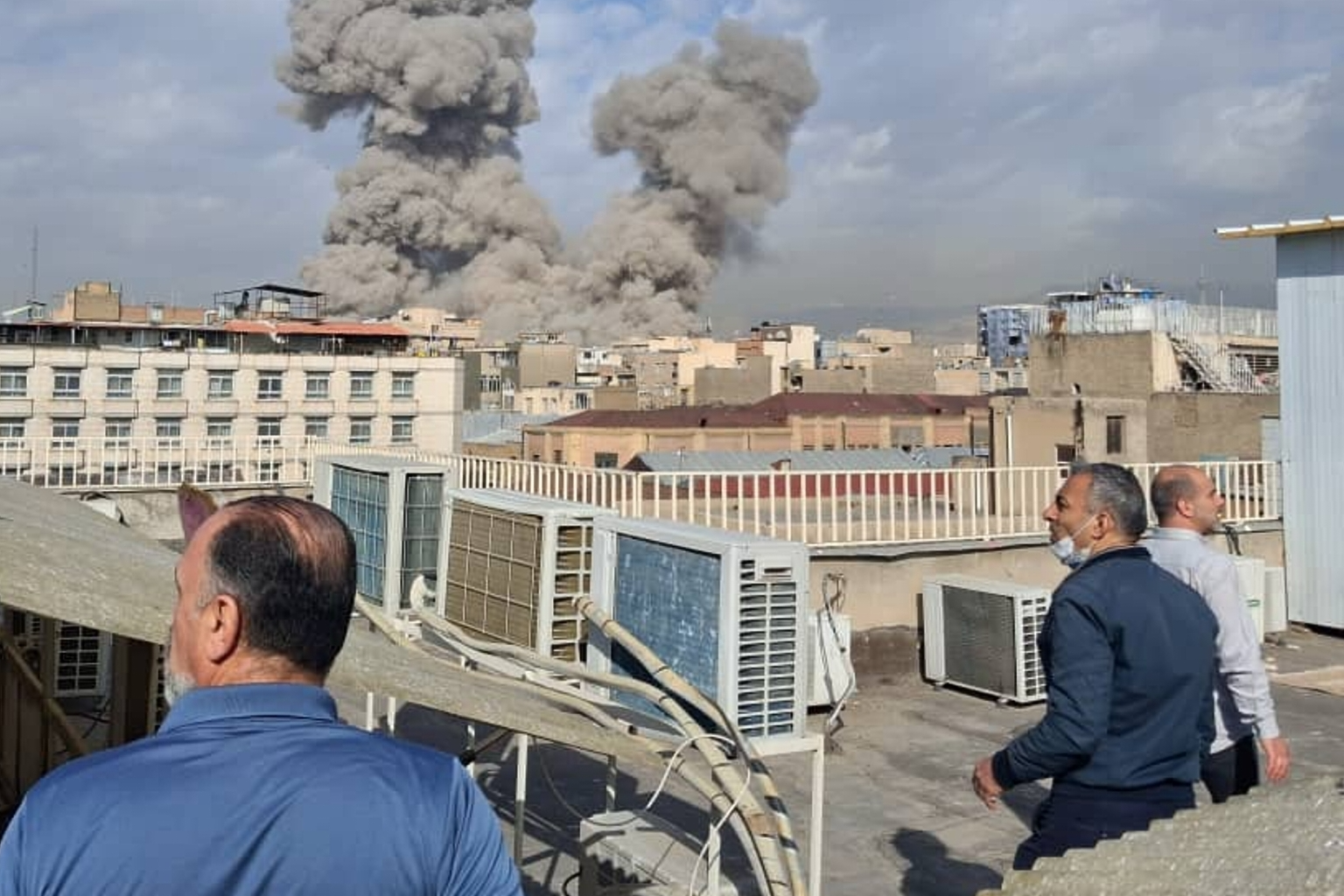
When the flames of war have not yet ignited and the smoke has not yet risen, a gamble about life and death has quietly been placed.
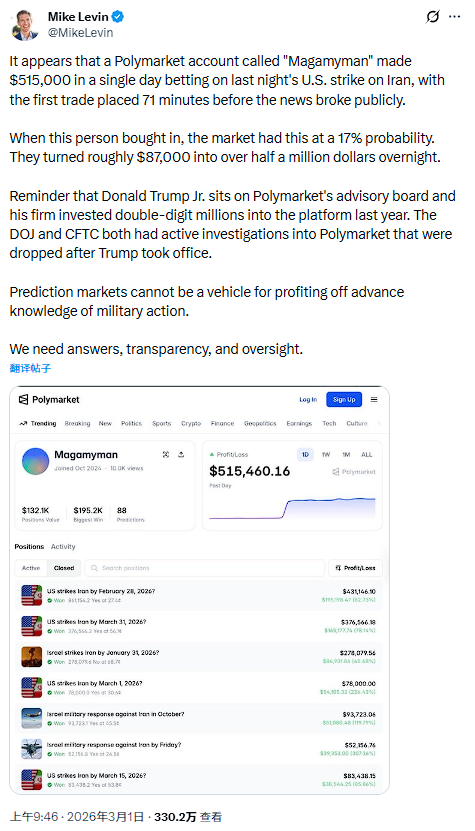
On February 28, news of a massive military strike by the U.S. against Iran shocked the world. However, 71 minutes before the sound of explosions began, a Polymarket account named “Magamyman” bet approximately $87,000 that “the U.S. will attack Iran today,” at a time when the market gave a probability of only 17%. After the news of the airstrikes was confirmed, this account made over $500,000 in profit overnight.
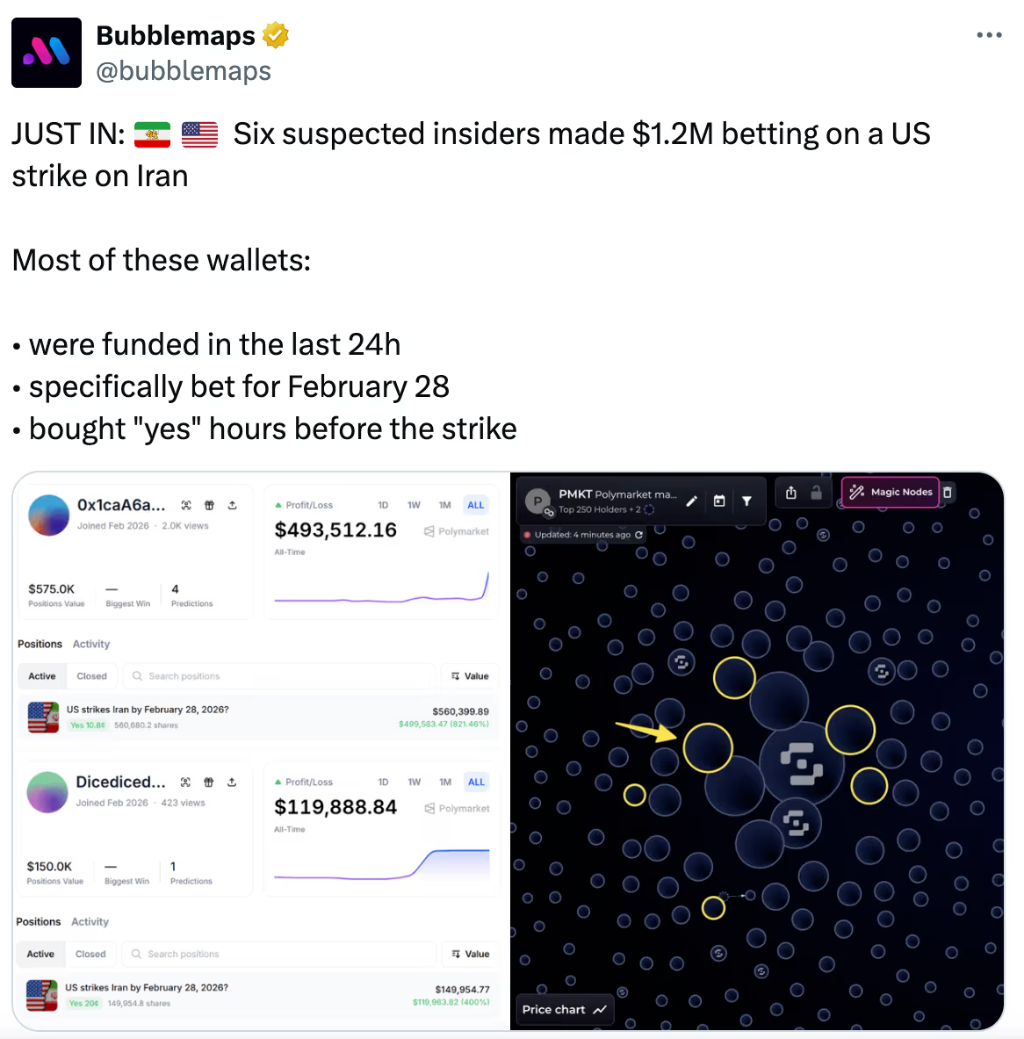
This is not an isolated incident. Blockchain analytics firm Bubblemaps tracked and discovered that six mysterious accounts made concentrated bets before this military action, collectively profiting about $1.2 million. With a precision that is breathtaking and highly consistent trading patterns, Polymarket has found itself at the center of insider trading suspicions.
1. The "Perfect Time Difference" of 71 Minutes
● The fund flow chart released by Bubblemaps reveals a thought-provoking trading pattern: all six accounts were registered in February, with most completing their first deposits within 24 hours before the attack, and there are no other trading records on these accounts besides this bet.
● One of the accounts purchased over 560,000 “yes” shares at approximately 10.8 cents each, ultimately making nearly $560,000 in profit; another account bought nearly 150,000 shares at 20 cents, also recording a six-figure profit. Bubblemaps CEO Nicholas Weiman told Bloomberg that the funding paths of these accounts are highly similar, with clear connections between the wallets.
● Even more eye-catching is the account named “Magamyman.” U.S. Democratic Congressman Mike Levin disclosed on social platform X that the first transaction of this account occurred 71 minutes before the related news was made public.
● “In cases involving war or conflict, relevant information may circulate within small circles before being made public,” Weiman analyzed, “The Polymarket platform typically requires just a cryptocurrency account for trading, providing a high level of anonymity, which may encourage participants with insider knowledge to act early.”
2. “Profiting from War and Death”
● As details of the trades emerged, anger quickly grew in American political circles. Connecticut Senator Chris Murphy fumed on social media: “This behavior is actually legal, it's absolutely absurd. People around Trump are profiting from war and death. I will propose legislation to thoroughly ban such trading as soon as possible.”
● Arizona Senator Ruben Gallego used even harsher language: “This is blatant insider trading and must be classified as illegal. These scoundrels are profiting from our fallen soldiers; this behavior is both disgusting and immoral.” It is reported that three U.S. soldiers have already died and five were seriously injured since the commencement of the strike.
● Congressman Mike Levin specifically mentioned a detail when exposing this matter: Donald Trump Jr. is currently a member of the Polymarket Advisory Committee, and his company invested tens of millions of dollars in the platform last year. He called for relevant parties to provide an explanation of the situation and urged for transparency and regulatory follow-up.
● In response to the fierce criticism, a White House spokesperson defended to the media, “The only special interest guiding the decisions of the Trump administration is the greatest interest of the American people.”
3. Regulatory Red Line: CFTC's Warning and Kalshi's "Forced Liquidation"
This incident comes at a time when U.S. regulatory agencies are intensifying scrutiny of insider trading in prediction markets.
● Just three days before the airstrikes occurred — on February 25 — the Enforcement Division of the Commodity Futures Trading Commission (CFTC) issued a specific warning, clearly stating that they would crack down severely on insider trading in prediction markets. The announcement referenced two enforcement cases on the Kalshi platform: one political candidate was penalized $2,246 and banned for five years for betting on an election contract related to their own candidacy; another visual effects editor for a MrBeast show was fined over $20,000 and banned for two years for trading based on non-public information regarding the show’s results.
● The CFTC emphasized in its announcement that trading platforms have a “sole independent responsibility to maintain audit trails, conduct market surveillance, and enforce rules prohibiting misconduct.” Jay Clayton, U.S. Attorney for the Southern District of New York, further stated, “Just because it is a prediction market does not mean you can be exempt from fraud allegations.”
● The prediction platform Kalshi, regulated by the CFTC, is facing compliance questioning in this incident. The contract regarding “Will Khamenei step down?” launched by the platform sparked tremendous controversy after the Iranian Supreme Leader was killed in the airstrike. Former U.S. SEC Chief of Staff Amanda Fischer criticized, “This essentially provides a backdoor prediction market for assassination.”
● In the face of overwhelming allegations, Kalshi CEO Tarek Mansour announced that they would refund all transaction fees incurred by users participating in the controversial market, and that positions established prior to Khamenei's death would be forcibly settled at the last trading price. However, this “forced liquidation” decision did not quell the uproar, with many users complaining on social media that they felt “tricked” by the platform.
4. This is Not the First Time: Shadows from Maduro to Axiom
In fact, the accusations of insider trading on the Polymarket platform are not the first to arise.
● In January this year, just hours before the Trump administration announced a raid on Venezuela and the arrest of President Maduro, a newly created mysterious account made over 1200% profit by betting on Maduro's ouster, turning approximately $32,000 into over $400,000 in less than a day.
● Just a week before the disclosure of the airstrike incident against Iran, blockchain investigator ZachXBT released an investigative report accusing employees at the Axiom crypto exchange of trading on non-public information. Prior to the report's release, a contract betting on “which company will be named” appeared on Polymarket — 12 wallets had heavily bet on Axiom before the investigative results were made public, collectively profiting over $1 million.
● Analysis by Lookonchain showed that the biggest winner was an account named “predictorxyz,” which accumulated 477,415 contracts at an average price of $0.14, ultimately making a profit of $411,000. ZachXBT himself admitted that prior to the release of the report, he had contacted Axiom for comment and conducted several interviews, and that information leaks “may have been unavoidable.”
5. Anonymity and Regulatory Dilemma
Polymarket's operational model poses unique regulatory challenges.
● The platform is based on blockchain technology, allowing users to trade with just a cryptocurrency wallet without needing to verify their identity. This high level of anonymity makes it extremely difficult to trace insider traders. Weiman admitted to Bloomberg: “Polymarket typically requires just a cryptocurrency account for trading, providing a high level of anonymity, which may encourage participants with insider knowledge to act early.”
● It is worth noting that the main trading infrastructure of Polymarket is located outside the United States and does not accept U.S. residents as customers, and thus is not directly regulated by the CFTC. Last month, two Israelis — a reserve soldier and a civilian — were charged for allegedly betting on Polymarket using confidential military operation information.
● At the same time, Polymarket faces regulatory tides worldwide. Countries such as the Netherlands, Hungary, Belgium, France, Italy, Romania, Poland, Singapore, and Portugal have banned or restricted the platform after deeming its event contracts as unlicensed online gambling rather than financial transactions.
6. A New Legislative Battle
The cloud of insider trading allegations on the eve of the airstrike is pushing the U.S. Congress to take action.
● Congressman Richie Torres has previously introduced the “Public Integrity in Financial Prediction Markets Act of 2026,” which aims to prohibit elected officials, political appointees, and government employees from trading contracts linked to government policies or political outcomes while possessing non-public information. Senator Murphy has also stated he will propose legislation to fully ban such trading as soon as possible.
● From traditional financial markets to the cryptocurrency sector, from stock insider trading to bets on war predictions, the regulatory red line is extending to this emerging “casino”. The CFTC's warning, Kalshi's “forced liquidation,” and Congressional legislative motions all convey the same message: no matter how the shell of trading changes, the bottom line of market integrity cannot be trampled.
● As for those six mysterious accounts that precisely entered the market 71 minutes before the war, and the winner named “Magamyman,” their true identities may remain a mystery forever. But the trading records they left behind have become the starkest footnote of this era: in the face of war and death, some see not tragedy, but opportunity.
Join our community to discuss and grow stronger together!
Official Telegram community: https://t.me/aicoincn
AiCoin Chinese Twitter: https://x.com/AiCoinzh
OKX benefits group: https://aicoin.com/link/chat?cid=l61eM4owQ
Binance benefits group: https://aicoin.com/link/chat?cid=ynr7d1P6Z
免责声明:本文章仅代表作者个人观点,不代表本平台的立场和观点。本文章仅供信息分享,不构成对任何人的任何投资建议。用户与作者之间的任何争议,与本平台无关。如网页中刊载的文章或图片涉及侵权,请提供相关的权利证明和身份证明发送邮件到support@aicoin.com,本平台相关工作人员将会进行核查。