Author: Zen, PANews
Regarding crazy investments, Koreans are serious. The historic surge that began in the South Korean stock market in the first half of last year once again proves this point.
As of the end of February 2026, the Korea Composite Stock Price Index (KOSPI) has cumulatively risen nearly 50% this year, becoming the best-performing stock market in the world.
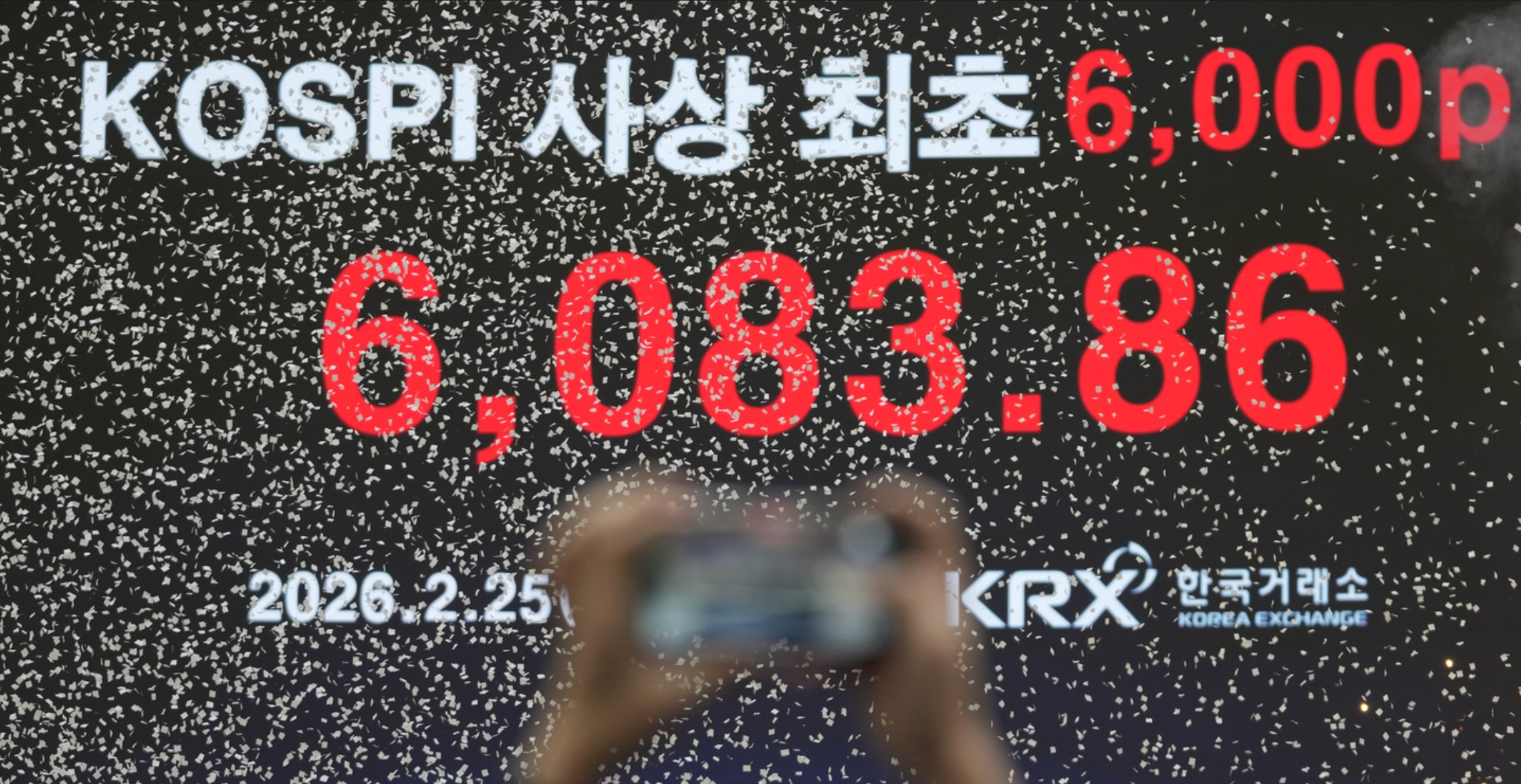
On February 25, the KOSPI index first broke through the 6000-point mark during trading; the next day, it closed for the first time above 6300 points, recording increases on 10 of the past 11 trading days, continuously setting new historical highs. On February 28, Samsung Electronics' market value exceeded $1 trillion, making it the first Korean company to enter the "trillion-dollar club."
As the founder of on-chain data analysis platform CryptoQuant said: "We Koreans love to gamble; do not underestimate this country."
Market Reform: An Indispensable Catalyst
The rise of the South Korean stock market is a result of a series of government reforms and the resonance with global industrial dividends.
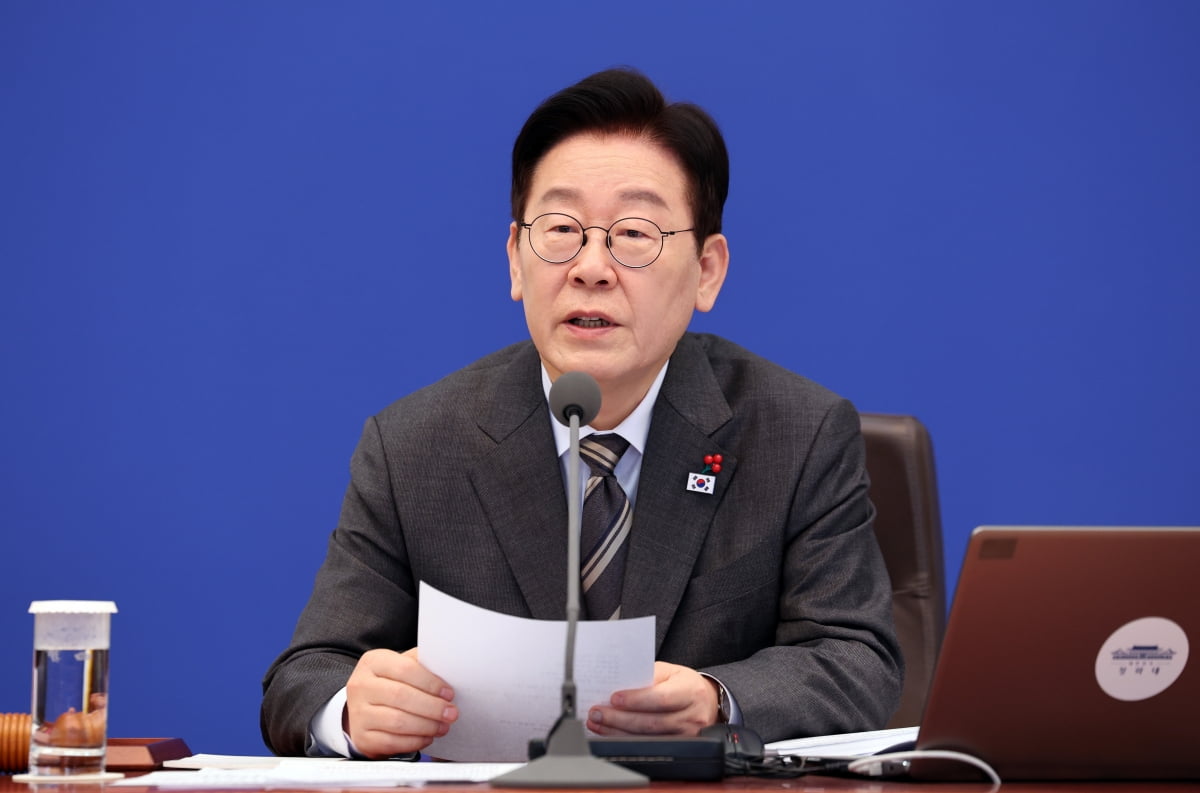
On January 22, South Korean President Lee Jae-myung had lunch with members of the South Korean Democratic Party's "KOSPI 5000 Special Committee." Coincidentally, on the same day before lunch, the KOSPI index first broke the 5000-point mark in trading. Entering the "KOSPI 5000 Era" has been a goal repeatedly emphasized by Lee Jae-myung during his presidential campaign. Now, this promise has been fulfilled, even better than expected.
In less than a year, the South Korean stock market rose from 2300 in April of last year to currently over 6200. However, perhaps Lee Jae-myung did not anticipate that the South Korean stock market would be so crazy, completing in a few months what took other countries years or even decades.
This surge may still be far from over, with strong upward momentum pushing the KOSPI index to constantly set new highs. Earlier this month, JPMorgan and Nomura Securities both raised their target points for the South Korean composite index. JPMorgan predicts the KOSPI will reach 7500 this year, while Nomura expects the KOSPI to hit 8000 in the first half of 2026.
Behind the strong and crazy South Korean stock market is undoubtedly benefiting from the global AI boom. The "arms race" among tech giants in the field of AI has continually increased the prices and strategic positions of the two main types of storage chips: DRAM and NAND, as well as high-bandwidth memory (HBM) products. In this context, major storage chip manufacturers Samsung Electronics and NVIDIA's primary high-bandwidth memory supplier SK Hynix have both achieved over 60% growth.
If the fundamental demand for AI business supports the rise of the South Korean stock market, then the stock market reforms led by the South Korean government are the catalysts driving the market surge.
The real structural change in the South Korean stock market is the government's focus on addressing the long-standing "Korea Discount" as a policy target. South Korea is pursuing a series of reforms in corporate governance, shareholder returns, market systems, and trading infrastructure to attract foreign investment and long-term capital, willing to grant higher valuation multiples.
Since taking office in June last year, the Lee Jae-myung administration has promoted a set of more aggressive capital market reform measures:
- Promoting the expansion of the application of the fiduciary duty of boards of directors to strengthen accountability towards shareholders and capital efficiency;
- Proposing adjustments to the tax system related to dividends to encourage listed companies to increase dividends and improve shareholder returns;
- Simultaneously enhancing enforcement resources and regulatory tools to strengthen the crackdown on insider trading, market manipulation, and other violations, and announcing a roadmap to seek inclusion in MSCI developed markets.
Before Lee Jae-myung took over the Blue House, South Korea had already initiated reforms to its trading system in March of last year. The country launched its first alternative trading system Nextrade (NXT), which extended stock trading hours to 8:00–20:00 (including pre-market and after-hours trading) and attracted participants with lower fees and longer trading hours. At the same time, South Korea ended its longest-ever short-selling ban, emphasizing enhancing market transparency and price discovery efficiency through systemic reform and stricter enforcement, which is an important plus for foreign investment as it offers predictable market rules.
Considering these factors together, the soaring South Korean stock market is not only riding the tailwind of AI but also involves a set of purposeful policy reforms. To some extent, the industrial narrative raises profit expectations, while institutional reforms are responsible for raising valuation limits.
The rise of the KOSPI is not merely a simple AI-themed market trend; behind it, there is also the South Korean government guiding institutional reform and value reassessment.
Slow Progress of South Korea's New Crypto Policy
Compared to the rapid changes in the stock market, the new cryptocurrency policies appear more cautious and even somewhat slow.
As an extension of the "de-Korea discount" and capital market repricing plan, South Korea's management approach towards the cryptocurrency industry is also changing. It has shifted from the early emphasis on combating fraud and anti-money laundering (AML) through passive regulation to a systematic approach that protects users, regulates the market, and institutionalizes the paths of the capital market.
In terms of exchanges and market order, the "Virtual Asset User Protection Act," which will take effect in July 2024, clearly requires virtual asset service providers to securely store user deposits and virtual assets, establish stricter custodial and management obligations, and set legal bases for punishing "unfair trading" such as insider trading and price manipulation. To some extent, this aligns with the direction of increasing "transparency and accountability" in its stock market reforms.
Last year, the Financial Services Commission (FSC) explicitly stated in a policy briefing to the "National Planning and Coordination Committee" that it would develop a plan to introduce a spot ETF for virtual assets and advance a regulatory framework for stablecoins. This set of reforms in South Korea's cryptocurrency industry does not mean an immediate full embrace of cryptocurrency assets. On the contrary, it is characterized by a tiered opening, cautious advancement, and even somewhat slow progress.
The FSC released a regulatory roadmap in February 2025, planning to allow about 3,500 listed companies and licensed investors to trade virtual assets starting in the second half of last year. However, according to reports from the Seoul Economic Daily, the draft "Listed Company Virtual Asset Trading Guidelines" only entered the external communication and finalization process in January of this year, and its formal effective date can only be set to a broader timeframe within this year. The gap between announcement and execution further reflects the gradual approach taken by Korean regulators, which is somewhat slower in pace of implementation.
Regarding cryptocurrency ETFs, South Korea's attitude has long been conservative. In January 2024, after the United States approved Bitcoin spot ETFs, South Korean financial authorities stated that they would not assess the necessity of adopting such policies in the short term. However, in the past year, South Korea has shifted from outright rejection to acceptance. In its 2026 economic growth strategy, the South Korean government proposed establishing a comprehensive regulatory framework covering the issuance, circulation, and trading of digital assets through the "Basic Law on Digital Assets," and plans to introduce a digital asset spot ETF and establish a regulatory framework for stablecoins.
Discussions about the South Korean won stablecoin have been very heated in the past six months. However, official institutions still emphasize caution, and there has been no outcome yet. Currently, the biggest challenge faced by regulatory agencies is the debate over the issuers of stablecoins. The banking sector, represented by the South Korean central bank, has traditionally emphasized that without bank involvement, KYC/AML may not be effectively implemented, which could even affect the openness of South Korea's capital markets and financial stability.
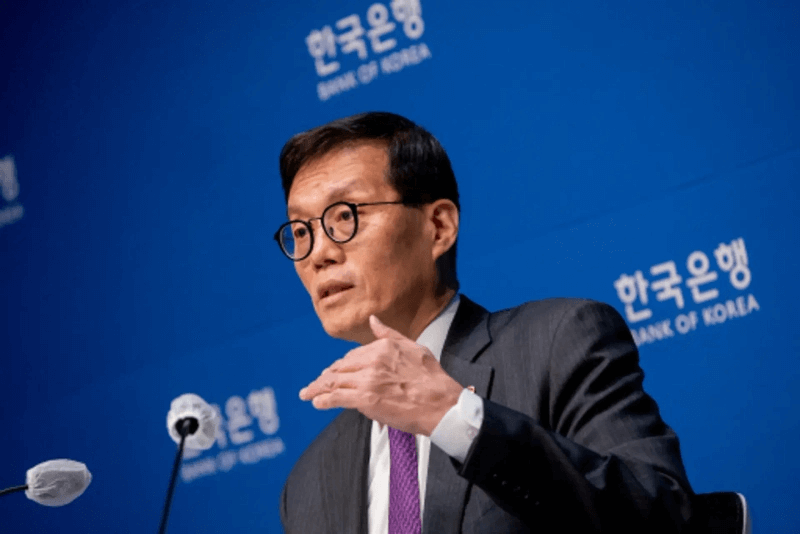
The Governor of the South Korean Central Bank Lee Chang-yong advocates that stablecoins should be bank-centered
The policy direction has become more flexible, and the legislative framework is still brewing, but on the regulatory and participant levels, it has yet to materialize—this is the true picture of the South Korean crypto market. Overall, South Korea adopts a similar regulatory engineering path in both capital markets and crypto assets. Both first establish boundaries of responsibility, disclosure, and enforcement tools, and then expand participant and capital scales through phased access and productization tools.
The Frenzied, Tenacious, and Wealth-Seeking Koreans
Beginning in mid-last year, when a large number of South Korean investors flooded into the country's stock market, mainstream media and social media occasionally portrayed a pessimistic sentiment of "Koreans no longer speculate in cryptocurrencies."
These reports and claims are partially corroborated by data released by the FSC— in the first half of 2025, the daily average trading volume of South Korea's five major exchanges was approximately 6.4 trillion won, a decrease of about 12% quarter-on-quarter; additionally, according to data submitted by the South Korean Financial Supervisory Service to Congress, the total trading volume of South Korea's cryptocurrency exchanges fell by about 11% last year. This indicates that the activity level of the South Korean cryptocurrency market has indeed declined.
However, when comparing to global trading volume, the situation is actually more complex. The global cryptocurrency market has already entered a winter, and it is not only the South Korean market that is shrinking.
On the contrary, against the backdrop of the global crypto winter, the resilience of the South Korean market remains striking.
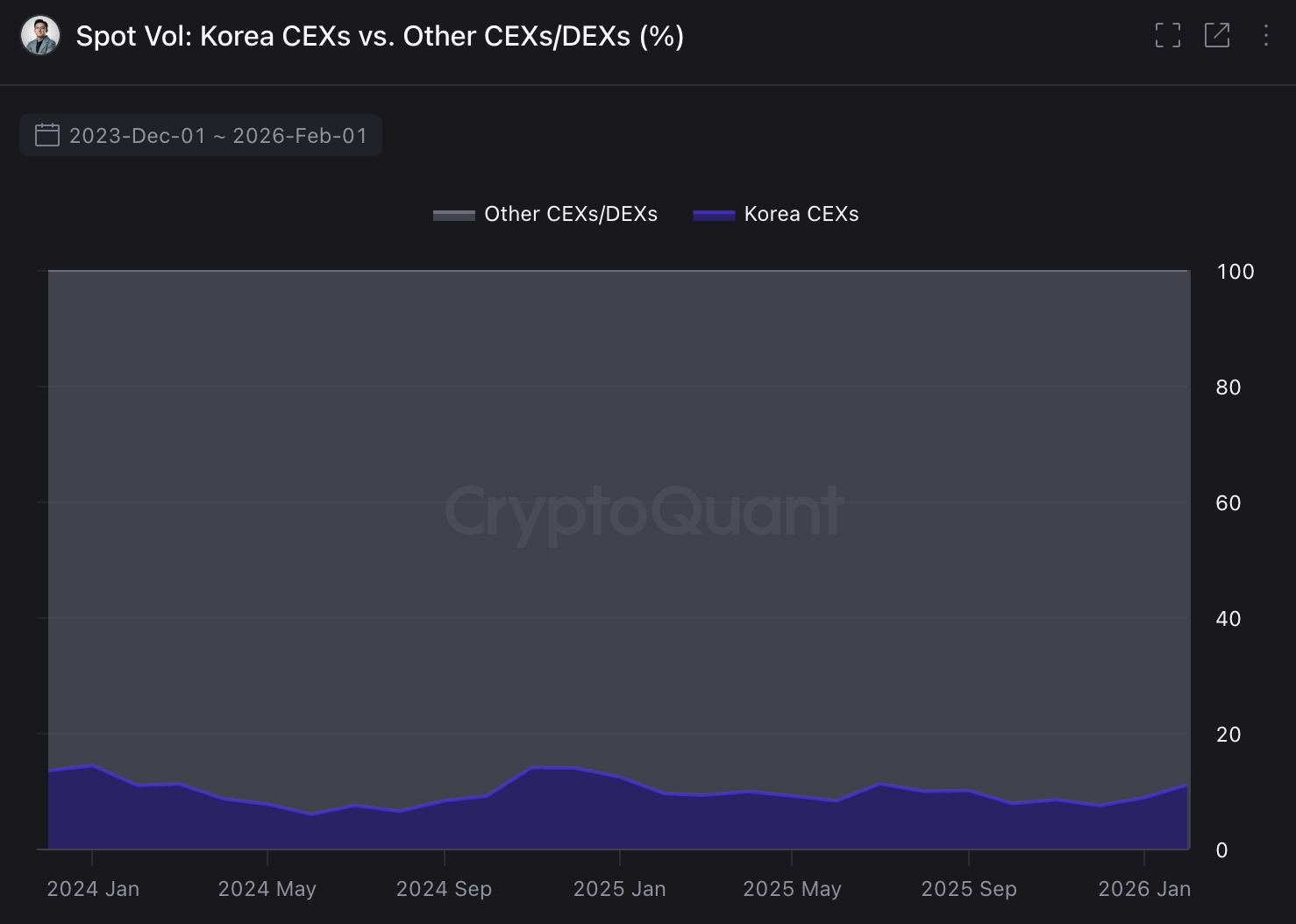
According to CryptoQuant data, after reaching a peak in the fourth quarter of 2024, starting in 2025, the share of the South Korean crypto market in the global market has generally remained stable in the range of 8%–11%. In the past few months, marked by negative sentiment and exhausted liquidity, the country's market share in the global market has unexpectedly seen a slight rebound.
Another indicator of resilience is the continuously growing user base of cryptocurrency in South Korea. According to a report by the FSS, the number of cryptocurrency trading users in South Korea increased from 8.91 million in 2024 to 9.91 million last year. Even though the total trading volume in the market has declined, the number of participants and market penetration continues to increase, indicating that the foundation of the market in the country remains solid.
The stock market and the cryptocurrency market have never been a zero-sum game.
In South Korea, whether it's the KOSPI, which has crossed the 6000-point mark, or the millions-strong cryptocurrency army, what’s reflected is the same social psychology: in a highly competitive society with gradually solidifying classes, ordinary people have an extreme desire to break barriers and achieve leapfrogged wealth.
Eliminating the "Korea discount" erases the valuation gap in capital markets, while the tireless investment craze of Koreans seeks to eliminate the "discount" on the fate of ordinary people. As the dividends from the stock market are being realized, nearly ten million Koreans who still hold expectations for the cryptocurrency market are perhaps patiently waiting for another "KOSPI 5000 Era" that belongs to cryptocurrencies.
免责声明:本文章仅代表作者个人观点,不代表本平台的立场和观点。本文章仅供信息分享,不构成对任何人的任何投资建议。用户与作者之间的任何争议,与本平台无关。如网页中刊载的文章或图片涉及侵权,请提供相关的权利证明和身份证明发送邮件到support@aicoin.com,本平台相关工作人员将会进行核查。


