Source: WeChat public account Giant Hard AI
Today, the Shemiran district in northern Tehran is shrouded in an extremely uneasy silence. For Iran's Supreme Leader Ayatollah Ali Khamenei, this silence usually signifies safety, but on this day, it became a prelude to death.
The operation codenamed “Operation Epic Fury” was not a large-scale bombing in the traditional sense, but rather a “surgical” strike woven from lower-level code, real-time remote sensing algorithms, and distributed computing. After the attack occurred, Trump confirmed Khamenei's death on social media.
This operation is significant as it represents the first high-level decapitation action in human history assisted by artificial intelligence (AI) in multiple rounds of the “kill chain.” At the command center in Tehran, Khamenei may have believed he had evaded satellites, but he was unaware that he was facing not a single weapon, but a global surveillance and strike network formed by Palantir, Anduril, and top language models (Claude). This network no longer relied on expensive traditional platforms but depended on “software-defined weapons.”
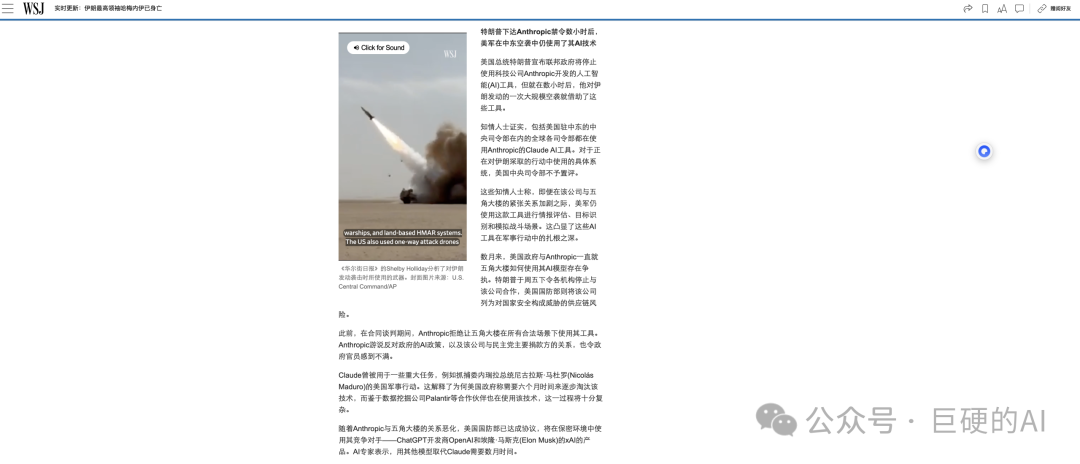
The Wall Street Journal reported that in this war, AI was no longer just an auxiliary tool; it had become an integral part of true decision-makers, trackers, and executors alongside humans.
Silicon Valley's “Warfare Operating System”: Palantir
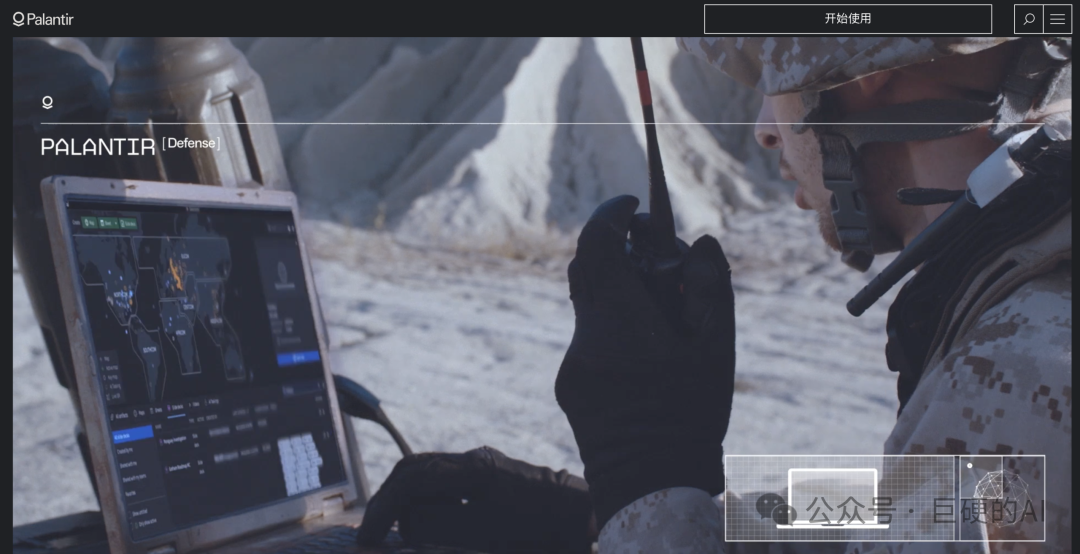
Behind the decapitation operation, Palantir's technology platform served as the “brain of the battlefield.” Founded by Peter Thiel, the company's core mission has always been to break down the data silos between intelligence agencies.
Breaking Down Silos with “Ontology”
Palantir's most powerful weapon is its Artificial Intelligence Platform (AIP) and flagship product “Gotham.” In traditional command systems, intelligence analysts needed to manually compare satellite images, communication interception records, and open-source social media data. But in “Operation Epic Fury,” Palantir's “Ontology” technology transformed these chaotic data into intuitive, real-world objects.
Ontology refers to mapping complex enterprise or battlefield data into easily understandable entities, such as “personnel,” “locations,” or “launch pads.” By integrating data from ERP systems, sensors, satellites, and network surveillance into a “Common Operating Picture” (COP), commanders no longer faced tedious reports, but rather a real-time digital twin of the battlefield.
Palantir Core Defense Platform | Function Definition | Core Technology Support |
Gotham | Core intelligence integration platform connecting dispersed heterogeneous databases | Semantic web, knowledge graph, association analysis |
AIP for Defense | Deploying large language models on confidential networks, automating instruction processing | LLM integration, RLHF, controlled logic agents |
MetaConstellation | Automating the scheduling of hundreds of commercial and classified satellites for monitoring | Edge AI, automatic task decomposition, orbital management |
TITAN | Army tactical intelligent target access node, AI-defined vehicles | Sensor fusion, multi-domain data synchronization |

Frontline Deployment Engineers: Programmers on the Battlefield
To ensure this complex system operated in Tehran's high-intensity electronic countermeasure environment, Palantir dispatched a group of special warriors—Forward Deployed Engineers (FDE). These engineers did not sit in air-conditioned rooms in Denver or Silicon Valley; they were outfitted in tactical vests, embedded directly into the U.S. Central Command (CENTCOM) operational units.
This wartime capability reduced what normally took months for system updates to just a few hours. When Khamenei was killed, it was the FDE who adjusted the scheduling logic of MetaConstellation in the background, ensuring that as soon as the target left the bunker, over three satellites conducted cross-validation simultaneously.
Starshield Appears: SpaceX's Super Battlefield Broadband
To understand this operation, one must first comprehend how the U.S. military broke through Iran's impenetrable electromagnetic lockdown.
Before the operation began, Tehran cut off ground internet and mobile communications throughout the area, attempting to blind U.S. military sensors. However, according to the Wall Street Journal, the U.S. military deployed SpaceX's most mysterious asset—“Starshield” and its underlying MILNET satellite constellation.
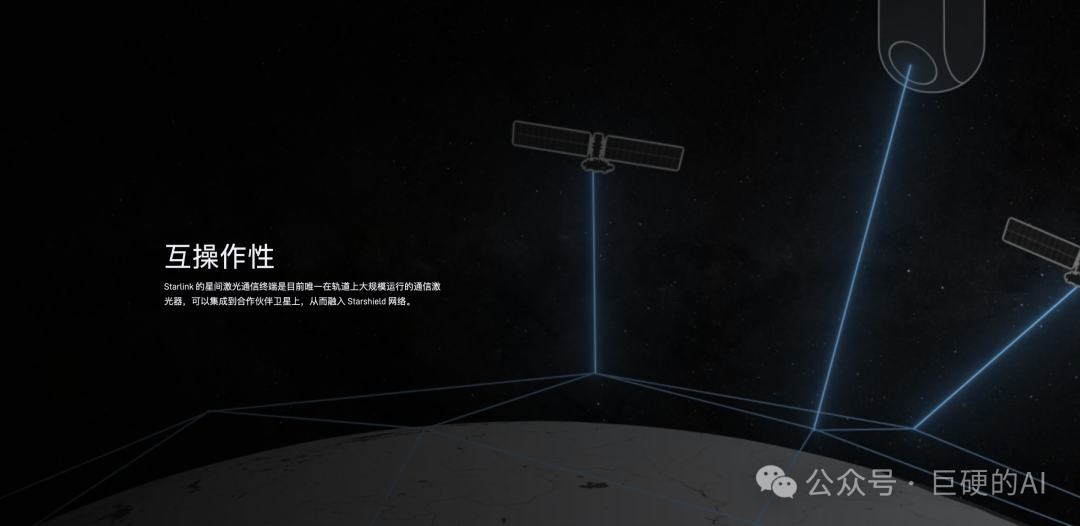
This was no longer the semi-civilian Starlink terminals used on the battlefield in Ukraine. Starshield consists of about 480 dedicated hardened satellites, integrating NSA-level security encryption protocols. In the operational logs of U.S. Central Command (CENTCOM), these satellites are vividly referred to as “digital oxygen”: when the Iranian Revolutionary Guard employed the Russian-made “Kalinka” jamming system to cut off frontline communications, Starshield established an uninterrupted airborne grid with inter-satellite laser links of up to 200 Gbps.
The most formidable piece is a compact terminal known as UAT-222. Measuring only two feet on each side, it can be carried by a single special forces operator. When this small cube is opened on the battlefield, terabytes of high-resolution images and electromagnetic signals, which would otherwise take hours to transmit, penetrate through the jamming smoke within seconds and directly feed into Palantir's analytical engine.
Claude: A Game of AI's Soul
However, during the process of AI killing Khamenei, an intense internal conflict over AI ethics erupted within the U.S. Given the controversy, the focus was on the top model developed by Anthropic, Claude.

As the only advanced model authorized by the Pentagon to operate on highly confidential, physically isolated networks, Claude had been the most relied-upon tool for military intelligence analysts. Its “Claude Gov” version excelled at processing vast amounts of intercepted Persian language confidential documents.
Claude's role in the operation was not to directly control weapons but to process immense amounts of unstructured war data. According to declassified materials, the U.S. military first extensively used Claude for “intelligence synthesis” in early 2026 during an operation against Venezuelan leader Maduro. Claude was able to rapidly read thousands of hours of intercepted Persian conversations, identify fissures in the command chain within the Iranian Revolutionary Guard, and generate dozens of scenarios for commanders under dynamic game theory simulations.
Analysts no longer needed to write lengthy briefs; they merely had to ask, as if ordering takeout: “If we implement electronic suppression on Tehran at this moment while simultaneously conducting airstrikes, what is the most likely escape route for Khamenei?” Claude would provide an optimized interception probability chart based on its extensive training in military theory and real-time injected intelligence streams.
However, according to an exclusive expose by the Wall Street Journal in February 2026, a public hostility erupted between the Trump administration and Anthropic CEO Dario Amodei. Defense Secretary Pete Hegseth demanded that Anthropic remove all of Claude's safety guardrails to allow it to be directly integrated into fully automated lethal weapon systems.

In its stead was OpenAI and Elon Musk's xAI. xAI was quickly placed at the core of the U.S. military's most secretive missions, promising to provide computational power “unbound by political correctness.” Ironically, during the operation against Khamenei, the Claude model running on the Palantir platform still played a crucial auxiliary role—even though it refused to directly pull the trigger, it had already cleared the intelligence fog for the final strike by processing previous clandestine actions against President Maduro and the PB-level data intercepted in Tehran.
“Where’s Daddy?”: Algorithms Tracking Everyone
If Palantir and Claude provided strategic-level intelligence, then the three AI systems developed by the Israel Defense Forces (IDF) unveiled the most chilling logic at the tactical level. These three systems are collectively referred to as the “mass assassination factory.”
Lavender and Habusallah
In the operation against Tehran, the U.S. military drew from algorithms honed in practical engagements in Gaza to better combine direct intelligence clues with AI discrimination.
- “Habusallah” (The Gospel): An AI system specifically recommending building targets. It can generate a strike list at a pace of 100 per day, whereas humans could only generate 50 in a year.
- “Lavender”: A system scoring millions of individuals by analyzing social networks, mobile trajectories, and call records, automating the marking of suspected militants. At its peak, it marked 37,000 targets.
Deadly “20 Second” Decisions
The most controversial aspect lies in the role of humans in the process. According to The Guardian, after these AI systems recommend targets, human commanders often only spend “20 seconds” to review them. These 20 seconds are merely enough to confirm whether the target is male.
More cruelly, there exists a system called “Where’s Daddy?” It does not track airplanes like traditional radar; instead, it tracks the association between targets and their family residences. The system automatically monitors when marked individuals enter their homes. Commanders believe that attacking when these individuals reunite with their families is easier than attacking military strongholds, even though this means that all civilians in the building could become “collateral damage.”
During Khamenei's assassination, this logic was elevated to the level of national leaders. The algorithms no longer looked for Khamenei's luxurious vehicle but sought every subtle characteristic of him.
Anduril and Shield AI: Software-Defined Air Superiority
To execute the final strike, the U.S. military no longer frequently employed expensive stealth aircraft but instead utilized inexpensive drone systems.
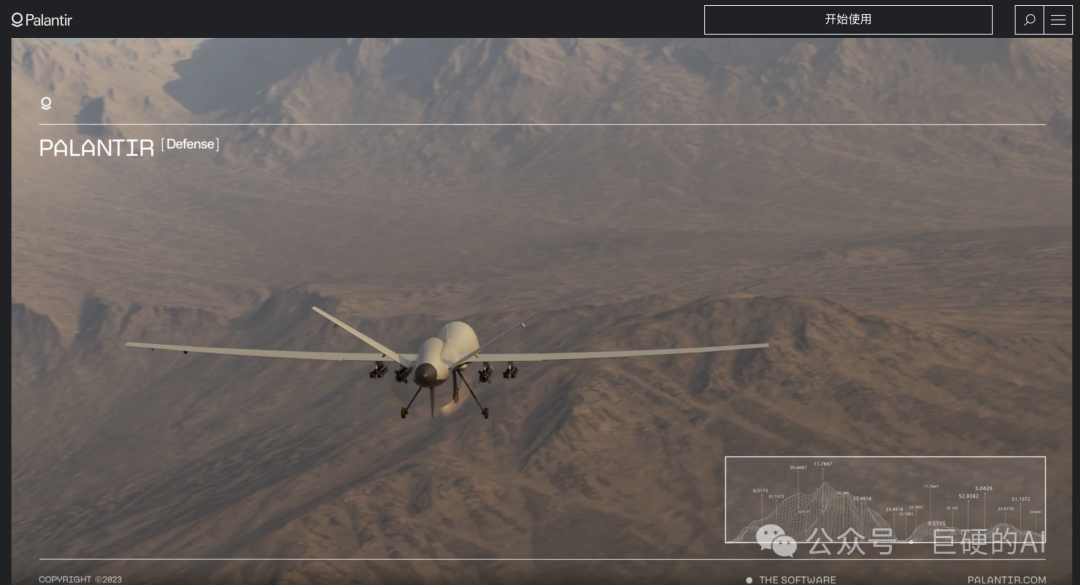
One technical highlight of this operation is that after entering Tehran's airspace, the drone swarm can autonomously adjust its formation based on real-time threat perception. The MQ-9B played the role of “surgeon,” using AI to identify and lock onto targets with ultra-long endurance, responsible for pinpoint eliminations; whereas LUCAS acted as the “swarm vanguard,” paralyzing the air defense network through inexpensive saturation attacks to clear the way for precision strikes. This “software push” style of warfare renders traditional hardware platform-centered defense systems awkward and outdated in the face of algorithmic iterations.
In future scenarios, Shield AI focuses on developing what it calls the “world's best AI pilot”—Hivemind. This software allows unmanned systems to perform complex tasks in the complete absence of GPS, satellite communications, and human operators.
The technical foundation of Hivemind is EdgeOS, a middleware environment specifically designed for high-performance real-time robotics. Its core features include:
| Technical Component | Function Description | Tactical Value |
| Hivemind Pilot | Core flight control algorithm library | Achieving autonomous tactical avoidance and maneuvering in contested airspace. |
| EdgeOS | Low-latency operating environment | Reducing inter-node communication latency to milliseconds through static configuration and local computing. |
| Hivemind Commander | Cooperative swarm command system | Managing multi-agent synchronization, allowing drone swarms to operate in coordination like human formations. |
| EOS Language Toolkit | Message patterns and system description | Supporting complex data structure integration, ensuring efficiency of storage and transmission. |
Airborne Mind Change: The Power of the A-GRA Framework
In February 2026, Anduril demonstrated a shocking experiment to the military: its YFQ-44A drones successfully switched between two completely different AI systems during flight. The first half of the flight was controlled by Shield AI's “Hivemind” software, allowing the drones to autonomously avoid obstacles and form formations; the latter half seamlessly switched to Anduril's “Lattice” system for final target locking.
This “airborne mind change” relies on a modular standard called “Authority-Referenced Autonomous Framework” (A-GRA). This means if an enemy develops electronic interference against a certain AI, the drone can instantly download and run another algorithm, just like updating an app on a phone.
EagleEye Headset: The Soldier's “Digital Teammate”
In the upcoming ground cooperation operations, U.S. special forces will wear the “EagleEye” mixed reality headset jointly developed by Anduril and Meta (formerly Facebook).
This headset is no longer a bulky bulletproof helmet; it is a holographic display system that integrates all data from the Lattice network. Soldiers can directly see enemy skeletal stances, obscured target outlines, and even real-time images relayed from airborne drones through the headset. Palmer Latch referred to it as the “digital teammate of soldiers,” giving every frontline fighter a god's-eye view synchronizing with the Pentagon.
New Military Technology Platforms | Core Hardware/Product | Changing the Way of War |
Anduril | Lattice Software & YFQ-44A | Software-defined weapons, algorithm updates measured in hours rather than decades |
Shield AI | Hivemind Autonomy | Autonomous flight and combat without GPS and satellite connections |
Meta & Anduril | EagleEye / IVAS | Decentralizing battlefield situational awareness to individual soldiers, eliminating radio chaos |
“New Military Industry”: How Venture Capital Reshapes the Arsenal
Behind Khamenei's assassination, there was also a hidden check.
For the past few decades, the arms business has been the territory of traditional giants like Lockheed Martin. However, now, Silicon Valley's venture capital is officially taking over the pace of battlefield R&D through the “American Dynamism” strategy.
The “New Military-Industrial Complex” of Sand Hill Road
Led by Andreessen Horowitz (a16z), venture capital firms completed a record-breaking $15 billion in financing in 2026. Their bets are no longer on takeout or social software but on hard tech companies like Anduril, Shield AI, and Saronic.
The operational logic of these companies is fundamentally different from traditional contractors:
- Speed: Traditional giants take ten years to develop a radar system; these companies can do it in just months through software simulations.
- Consumability: They do not aim to produce a $100 million F-35 but rather to manufacture 10,000 $10,000 autonomous drones.
- Software-first: In their eyes, weapons are just “code wrapped in aluminum shells.”
This shift in capital has given the U.S. a very high margin for error in operations against Iran. Even if a portion of the drones is intercepted, the remaining machines can still automatically fill the gaps through the distributed Lattice network.
Overview of Defense Technology Investment and Financing (2025 Part) | Data Metrics | Strategic Impact |
Total Venture Capital | $49.1 billion | Capital shifting from traditional manufacturing to software-defined defense |
Valuation of Defense Startups (Anduril) | $30.5 billion | Emerging giants now have the financial strength to challenge traditional contractors |
DoD Spending Growth on Startups | 2.3 times | Government procurement processes beginning to lean towards agile development |
Three Clocks: The Strategic Limitations of AI Warfare
After Khamenei's death, military strategists began to reflect on the cost of this victory. We use the “three clocks” theory to examine conflicts in the AI era.
- Military Clock: AI has greatly shortened the time from “sensor to shooter.” What used to require months of preparation for a decapitation operation can now be executed within seconds after algorithmic target confirmation. The military clock has been accelerated to the extreme.
- Economic Clock: Although AI weapons are cheap per unit, their very high consumption rates place exponential pressure on supply chains. If conflicts drag on, energy premiums, shipping risks, and inflation will backfire on the attacking side’s economy.
- Political Clock: This is the slowest clock. AI can accurately kill a controller, but it cannot automate winning the local people's consent or pacifying regional anger; we firmly oppose any form of hegemony.
Khamenei's death proves the invincible position of algorithms in the “Find, Fix, Finish” cycle. However, as war becomes as low-casualty and efficient as clicking a screen, the political threshold for humans to initiate wars has dangerously lowered.
The End of an Era and the Beginning: Software-Defined Geopolitics
This is the real process of AI killing Khamenei: no smoke-filled trench warfare, no heroic aerial combat, only the constantly pulsating data on the Palantir platform, the intelligence summaries produced by the Claude model after processing, and the red outlines delineated by the Anduril Lattice system on the HUD.
Khamenei's downfall marks a complete opening of the “software-defined geopolitics” era; we can only enhance our technological strength to meet such challenges, which underscores the importance of technological self-reliance and strength.
As noted in a Wall Street Journal commentary: We have entered a battlefield where human commanders do not even have time to feel fear.
So who is the winner? After all, no one wishes for war to become the driving force for AI development. (This article does not contain any political opinions and is solely an exploration of this attack from the perspective of the AI industry.)
免责声明:本文章仅代表作者个人观点,不代表本平台的立场和观点。本文章仅供信息分享,不构成对任何人的任何投资建议。用户与作者之间的任何争议,与本平台无关。如网页中刊载的文章或图片涉及侵权,请提供相关的权利证明和身份证明发送邮件到support@aicoin.com,本平台相关工作人员将会进行核查。


