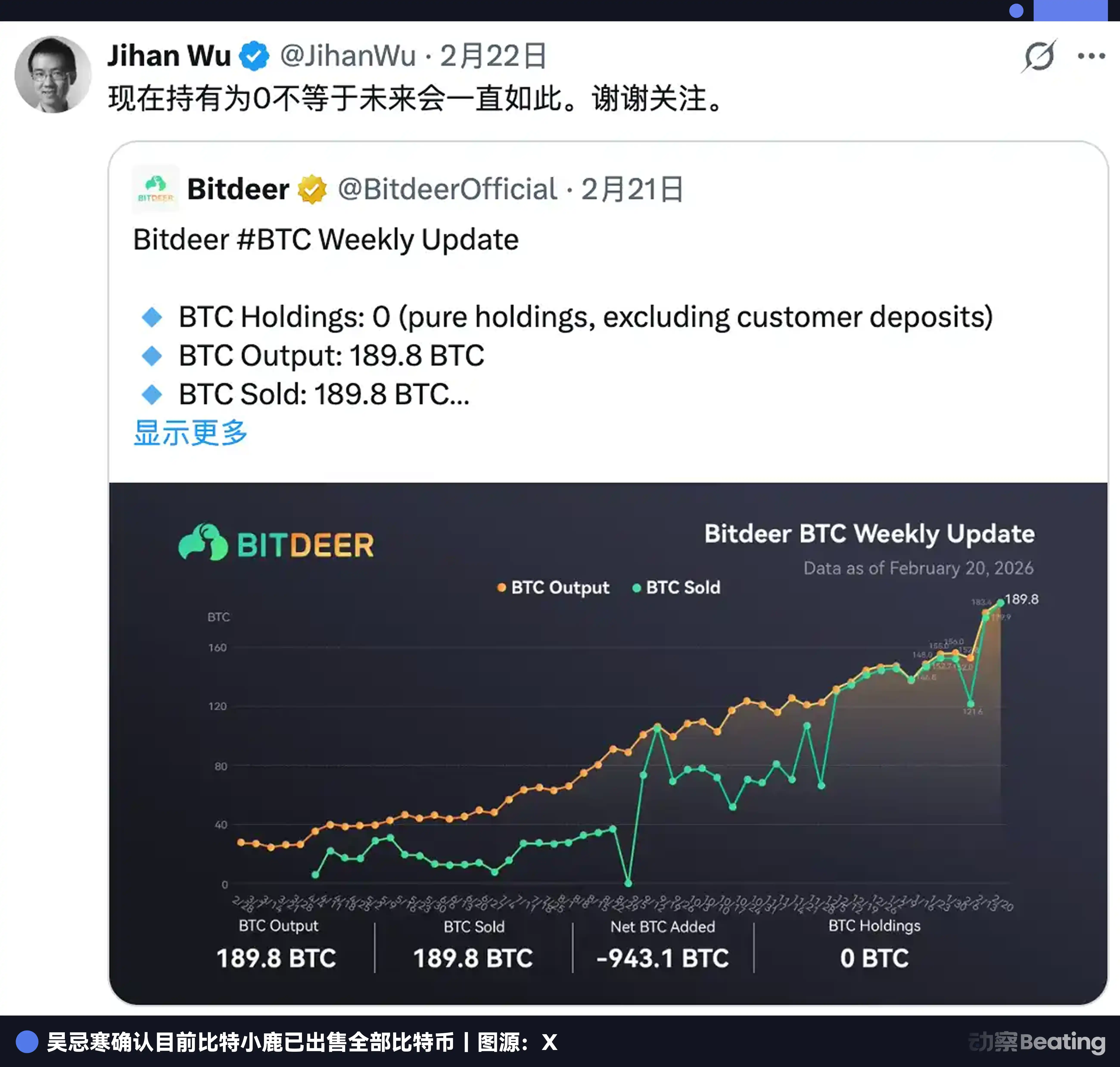
On February 20, 2026, Bitdeer released the weekly production update on X: 189.8 BTC mined that week, sold. Remaining inventory is 943.1 BTC, sold all at once.
Bitcoin balance: 0.
In fact, Bitcoin mining has been about time arbitrage since day one.
Using today’s electricity and machines to exchange for tomorrow's Bitcoin. A garage operation doesn’t require processing, customers, or branding. The investment is the immediate cost, betting on future prices. If the judgment is correct, time will help you make money.
This logic has been in play for over a decade. Now, Wu Jihan is changing the target of this logic.
The target has shifted from cryptocurrency prices to the long-term prices of computing power demand in the AI climate. The means have changed from using electricity to exchange for coins to borrowing to buy land. The objects of arbitrage have changed, but the structure of arbitrage has not.
In the same week of clearing Bitcoin, Bitdeer also completed the pricing of new debt worth $325 million.
According to Bitdeer’s financial report, as of December 31, 2025, Bitdeer's book borrowing was $1 billion. So the total debt is approximately $1.3 billion.
The debt is real, and buying land is real, but the outcome of this hard fight may not be revealed until 2029.
A. A mining company that doesn't want to do AI is not a good company
Bitdeer was established in 2018, starting as a mining machine sharing platform. It is currently one of the world’s largest listed mining companies, with a self-mining hash rate of 63.2 EH/s, the highest self-mining hash rate among publicly listed mining companies, accounting for about 6% of the entire Bitcoin network hash rate.
But now, Wu Jihan doesn’t want to sell hash rate anymore; he wants to focus on electricity.
Let us take a look at Bitdeer's financial report as of early 2026. Bitdeer's total global electricity pipeline scale is 3002 MW, with 1658 MW already operational and 1344 MW either under construction or planned. A single large data center from Microsoft or Google typically ranges from 100 to 300 MW.
In other words, 3002 MW is equivalent to packaging the electricity needs of 10 to 30 Google-scale data centers into one company. Therefore, on paper, Bitdeer's pipeline is quite impressive.
The main use of the $1.3 billion debt is to secure electricity land assets worldwide, paving the way for an AI data center transformation.
The first location is Rockdale, Texas, with 563 MW (including 179 MW expansion), operational and primarily focused on mining. This is the core business, providing stable cash flow.
Next, Clarington, Ohio, with 570 MW, under a 30-year lease, power contracts already signed, originally planned for completion in Q2 2027, positioned as a core HPC/AI site. This is the heart of the entire AI transformation plan. It's also currently the biggest risk, which we will detail later.
Then, Tydal in Norway, with 175 MW, is transforming the mining site into an AI data center, expected to be completed by the end of 2026, providing 164 MW of effective IT load. Hydropower resources are competitive in energy costs, and the transformation costs are much lower than new construction. Currently the fastest progress and lowest risk card.
Land, electricity, and data centers are referred to by the AI industry as “the hardest-to-replicate assets.” Bitdeer has accumulated these through ten years of mining operations.
It's worth mentioning a rarely discussed aspect: SEALMINER. Bitdeer is not only building data centers but also developing its mining chip. The SEAL series has already evolved to the third generation, SEAL03 has an efficiency of 9.7 joules per terahash, and the A3 Pro, set for mass production in September 2025, has entered the top tier globally. SEAL04 aims for 5 joules per terahash, surpassing all mass-produced mining machines on the market. The gross margin of self-developed chips exceeds 40%, significantly higher than that of mining itself.
This is reminiscent of what he did at Bitmain: going from buying someone else's shovels to making his own shovels.
B. How much has been borrowed, and how much revenue can AI generate
To pursue AI, Bitdeer’s book borrowing exceeded $1 billion by the end of 2025. Coupled with the $325 million new debt in February 2026, the total debt scale surpasses $1.3 billion.
In less than two years, multiple rounds of financing have taken place. In May 2024, Tether invested $100 million, becoming the second-largest shareholder, with warrants that could lead to an additional $50 million investment. Three months later, the first convertible bond of $150 million was issued with an annual interest rate of 8.5%. In November of the same year, the second bond of $360 million was issued, with the rate reduced to 5.25%.
In November 2025, there was a bundled round: $400 million in convertible bonds along with 14.84 million equity shares. In February 2026, another $325 million in convertible bonds plus 4.35 million equity shares were issued, including $135 million to repurchase the earliest batch of old debt due in 2029, extending the repayment period to 2032.
In total, over $1.4 billion. The funds are channeled into mining machines, data centers, and AI infrastructure, alongside rolling debt renewals.
However, each bond issuance leads to a 10% to 17% drop in Bitdeer’s stock price. This has become a fixed reflex in the market. Fortunately, the company has still managed to secure funding every time.
The core of the borrowing structure is convertible bonds. This new batch of bonds due in 2032 has an initial conversion price of about $9.93, which is a 25% premium over the simultaneous equity issuance price of $7.94. Once the stock price rises to that level, bondholders will convert into shares instead of demanding cash. The company actually does not need to repay the debt, it just needs the stock price to rise.
The logic of convertible bonds is a bet on the stock price increasing. This, in itself, is a gamble on whether the AI narrative can gain market acceptance. The interest burden, calculated on an average 5% interest rate with a $1.3 billion principal, results in annual interest expenses exceeding $65 million. Meanwhile, the AI/HPC cloud revenue for the entire year of 2025 is less than six months' worth of interest payments.
Currently, this interest is entirely rolled over by issuing more bonds. Saying pressure is not significant is impossible.
Given such a large investment, there must be a view toward more objective returns. So let’s see how much revenue AI can generate for Bitdeer.
The AI business currently earns $10 million a year, accounting for less than 2% of total revenue. For a company with a market value of nearly $2 billion, this figure is almost negligible.
Of course, this will not be the endgame.
Bitdeer’s GPU count has increased from 584 to 1792 in three months, tripling. Utilization dropped from 87% to 41%, primarily because machines were acquired too quickly; the B200/GB200 series is still in the client testing phase and has not yet started generating revenue. Electricity has been connected, and machines are being installed, with the denominator skyrocketing, but revenue has not kept pace.
How high is the ceiling?
According to Roth/MKM’s estimates, if HPC capacity is fully deployed, annual revenue potential could reach $850 million. Management is even more aggressive: dedicating 200 MW to AI cloud could yield over $2 billion annually, three times the total mining revenue for 2025.
However, both of these numbers come with three prerequisites: timely completion of construction, securing long-term contracts at hyperscaler levels, and full GPU utilization.
As of now, none of these conditions have been met.
This is the battle that Bitdeer is currently fighting: mining supports AI, while AI paints a picture of potential success, whether it can materialize will depend on the execution over the next two to three years.
C. The hard battle is how narrow the time window is
$1.3 billion in debt sounds dangerous. But Bitdeer’s debt structure is designed to be more stable than it appears on the surface.
High-leverage companies typically fail for the same reason: debt concentration at maturity, insufficient cash, and a forced sell-off.
Bitdeer has set staggered maturity dates for three batches of convertible bonds in 2029, 2031, and 2032.
To some extent, this creates a deliberate buffer zone. By the time the first batch matures, both Tydal and Clarington should theoretically be operational; by the time the second batch matures, AI revenue should be able to start speaking; by the time the third batch matures, the market will have its own judgment on what the company truly is. Three nodes, three opportunities for renegotiation.
However, convertible bonds provide time, but Wall Street does not pay for that. Keefe Bruyette cut the target price from $26.5 to $14. The current stock price is about $8. The market's signal is very realistic: the transition story must see revenue to be credible.
But all this pressure has given Wu Jihan the most needed, yet cruelest thing: time.
The smooth path might look like this: by the end of 2026, the Tydal transformation is completed, the 164 MW hydropower data center in Norway goes online, and contracts from European clients start flowing in. In 2027, Clarington wins the lawsuit, construction for the 570 MW site in Ohio officially begins, and major American clients follow suit. By 2028 to 2029, both core assets are fully operational, moving towards $1 billion in revenue, and analysts relabel Bitdeer from a mining company to one with a premium tag in AI infrastructure. By 2029, the first batch of bonds matures, and bondholders look at the stock price, likely opting to convert into shares rather than demanding cash.
In every single tough battle, Wu Jihan must hit the timing spot on.
Then there’s Clarington.
In the same industrial park in Ohio, there’s a steel manufacturer named American Heavy Plate Solutions that signed a 30-year lease for 9.9 acres of land in 2018. They are suing Bitdeer, claiming that the construction of the AI data center would interfere with shared power, roads, railways, and communication lines, thus violating restrictive clauses. Their demand is for the court to issue a permanent injunction preventing Bitdeer from proceeding with construction.
Clarington represents 42% of the operational pipeline. If stalled, the entire timeline must be rewritten.
So Bitdeer’s biggest single risk right now is not the debt or the stock price; it is a steel mill.
The mining side has not been idle either. In February 2026, Bitcoin network difficulty surged by 14.7%, the largest single jump since May 2021. With the same electricity costs, fewer coins are mined. The gross margin in Q4 has dropped from 7.4% a year ago to 4.7%. The mining leg is slowly shrinking.
The worst-case scenario is also clear: if the Clarington lawsuit drags on for two years, construction gets halted; Tydal experiences delays, GPU utilization continues to hover at 41%; by 2029, when the first batch of bonds matures, the cash on hand is insufficient, forcing another round of refinancing, causing stock prices to continue to dilute, making it increasingly difficult to meet conversion thresholds.
Both paths exist in reality.
D. Sold all the Bitcoin, and then what
There is a tradition in the mining industry: holding Bitcoin is a belief, a testament to the long-term value of Bitcoin.
MARA held 53,250 BTC, Riot held 18,000 BTC, Strategy held 710,000 BTC. The more you hold, the more the market believes in you.
Bitdeer currently holds zero.
The official explanation is: selling Bitcoin is to provide liquidity for land purchases. This statement is reasonable. Peers are moving in the same direction, with Riot selling $200 million worth of Bitcoin for AI expansion, Bitfarms abandoning the 'Bitcoin company' positioning, and MARA also getting into HPC.
But there is something more fundamental than identity iteration involved here.
The mining industry has been betting on the same thing since day one: that some future value will be more expensive than today’s costs. Ten years ago, mining was betting that coin prices would rise. Now, buying land is a bet that demand for computing power will explode.
The object has changed, but the logic of time arbitrage has never changed.
What Wu Jihan has truly acquired is a position of "no matter who wins, they must pay me rent for electricity."
Not betting on the track, but blocking the entrance of the track. Amazon didn’t bet on which internet company would win; it just rented servers to everyone. AT&T doesn’t care about what you’re talking about on the phone, just whether you made the call.
From selling products to selling services to collecting rents, the evolution of the industry has always followed this pathway.
The difference lies in whether you walk there actively or are pushed there.
Wu Jihan has bought this window for over a billion dollars. He is waiting for AI revenue to catch up with the speed of debt.
免责声明:本文章仅代表作者个人观点,不代表本平台的立场和观点。本文章仅供信息分享,不构成对任何人的任何投资建议。用户与作者之间的任何争议,与本平台无关。如网页中刊载的文章或图片涉及侵权,请提供相关的权利证明和身份证明发送邮件到support@aicoin.com,本平台相关工作人员将会进行核查。


