Author: Yuan Hong, Global Times
On February 26, a latest report jointly released by the National Computer Virus Emergency Response Center and other departments in China showcased the process by which the United States utilizes technological hegemony to harvest global virtual currency assets. According to incomplete statistics, from 2022 to 2025, the United States has confiscated global virtual currency assets worth over 30 billion USD through various cases, of which the Chen Zhi case alone accounted for 15 billion USD, representing 50% of the total.
On the 26th, the National Computer Virus Emergency Response Center, the National Engineering Laboratory for Computer Virus Prevention Technology, 360 Digital Security Group, and Antiy Technology Group Co., Ltd. jointly released the report titled “Number One Player—In-Depth Analysis of the Global Virtual Currency Asset Harvesting Operations Under American Technological Hegemony.” The report combines typical cases such as the Chen Zhi case and the Zhao Changpeng case, analyzing the background of blockchain technology and security risks, systematically dissecting the logical processes and technical details by which the United States utilizes technological hegemony to harvest global virtual currency assets, deeply deconstructing its national-level cyber attack methods and underlying political motivations, providing reference for countries around the world to respond to digital hegemony threats.
Senior Engineer Du Zhenghua from the National Computer Virus Emergency Response Center introduced the background of the report's release in an interview with the Global Times: International organizations publicly report that by the end of January 2026, the total market value of global virtual currency assets was approximately 27.3 trillion USD, with Bitcoin's total market value reaching 1.57 trillion USD. At the same time, the value of gold reserves held by various central banks was approximately 5.83 trillion USD. “The market value of virtual currency assets has reached about 47% of the total market value of global official gold reserves, indicating that the market value of virtual currency assets has become a new type of financial asset that cannot be ignored.”
Against this backdrop, the U.S. government's policy evolution regarding virtual currencies has shifted from initial neglect to gradual regulation, culminating in comprehensive legislation by 2025. "The latest report showcases the United States' ability to construct a 'technological advantage—regulatory binding—institutional execution' trinity system through detailed content and specific cases, leveraging its pioneering technological advantages, industrial clustering advantages, and sound regulatory framework, with the virtual asset domain as a key focus. Through means such as cyber attacks, regulatory blockades, strategic deceptions, targeted harvesting, and oceanic fishing, it has implemented precise and large-scale digital plunder, severely harming the technological sovereignty, economic interests, and political security of countries worldwide," Du Zhenghua stated.
The report reveals that the United States is the “number one player” in this large-scale "gambling game" of international virtual currency and has long occupied the "banker" position. In the virtual currency asset field, the United States controls the core research and development rights, key node control rights, and on-chain data analysis technical advantages of mainstream global blockchain protocols, with leading blockchain companies (such as Chainalysis and Elliptic) dominated by the U.S., holding over 90% of the global on-chain traceability market share. The U.S. leverages its technological advantages and regulatory authority, and with the cooperation of allied countries, incorporates global virtual currency asset transactions into its own regulatory and long-arm jurisdiction enforcement systems, large-scale invading foreign virtual currency assets through civil forfeiture, criminal accountability, and fine recovery methods.
The Chen Zhi Case and Zhao Changpeng Case: The U.S. Profited Nearly 20 Billion USD from Two Major Cases
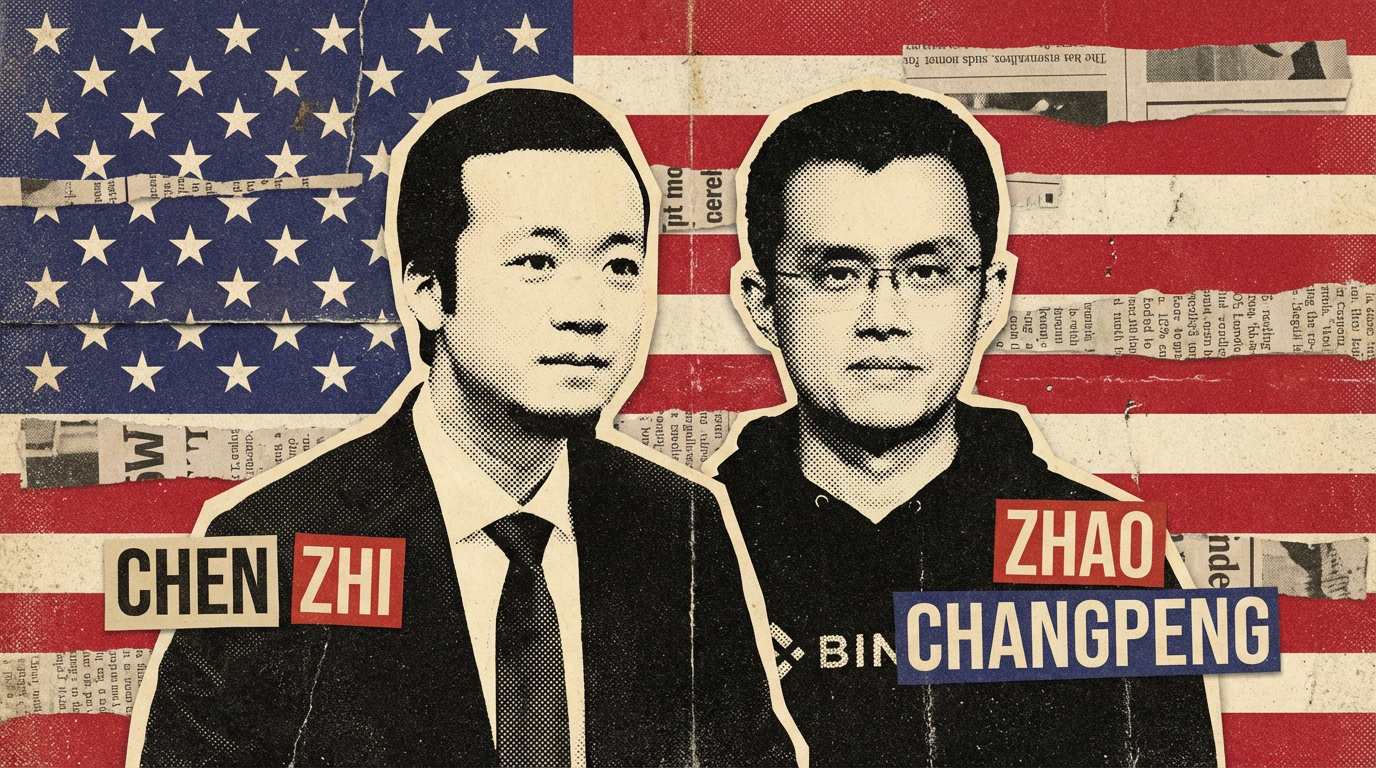
The Chen Zhi case and the Zhao Changpeng case are two typical examples of how the U.S. exploits its technological hegemony to harvest global virtual assets. The report states that these two cases fully display the U.S.'s "technological advantage—regulatory binding—institutional execution" harvesting cycle, highlighting distinct characteristics of hegemonism in their logical processes and technical details.
On January 7, the Ministry of Public Security escorted Chen Zhi (Chinese nationality), the leader of a major cross-border gambling fraud group, back to China from Phnom Penh, Cambodia. Chen’s criminal group is suspected of numerous crimes including opening casinos, fraud, illegal operations, and concealing illegal income. Chen Zhi has been subjected to legal coercive measures, and related cases are under further investigation.
The report indicates that in October 2025, the U.S. Attorney’s Office for the Eastern District of New York announced criminal charges against Chen Zhi, the founder of the Cambodian Prince Group, involving telecommunications and internet fraud, money laundering, etc., while making a high-profile announcement to confiscate roughly 127,000 Bitcoins controlled by him, valued at about 15 billion USD at the time of the market price, setting a historical record for the largest virtual asset confiscation by the U.S. judicial system.
According to the report, "According to incomplete statistics, from 2022 to 2025, the United States has confiscated global virtual currency assets valued at over 30 billion USD through various cases, with the Chen Zhi case alone accounting for 50% of the confiscated assets."
"From a geopolitical strategic perspective, this action goes beyond the surface's 'law enforcement for justice' and combating Southeast Asian fraud networks, but is a systematic and precise harvesting example executed against potential competitors or gray forces’ assets by the U.S. leveraging rule-making authority, technical tracking advantages, and global intelligence networks. Under the banner of 'protecting victims' rights,' the U.S. directly converts the involved virtual currency assets into strategic financial reserves under its control, completing a glamorous legalistic transfer from the end of the criminal chain to national assets,” said Zhou Hongyi, founder of 360 Group, in an interview with the Global Times.
Zhou Hongyi commented that such unilateral harvesting behavior by the U.S. not only undermines law enforcement activities in other countries, leading to secondary losses for victims, but also disturbs the global flow of virtual currency assets, destabilizes financial stability in emerging market countries, with the ultimate goal of consolidating the dollar’s hegemonic position in the field of digital finance.
The case of Binance, a globally renowned virtual currency exchange, along with its founder Zhao Changpeng, is another typical example of the U.S. using judicial hegemony and technical surveillance to compel global virtual asset platforms to comply with its regulatory rules, achieving economic harvesting and rule exportation.
From 2023 to 2025, the U.S. initiated "civil + criminal" dual accountability against Zhao Changpeng, ultimately resulting in Binance paying a fine of 4.3 billion USD according to a plea agreement.
"During the investigation into the case, the U.S. employed comprehensive technical surveillance methods, achieving extensive infiltration and evidence collection on Binance’s operational data, user data, and transaction data, showcasing its technical advantages in monitoring digital asset platforms,” Du Zhenghua further explained, adding that the U.S. infiltrated Binance's internal servers through hacking technology, acquiring core operational data and executive communications, confirming that Binance executives knowingly evaded compliance requirements despite being aware of U.S. regulatory rules.
Du Zhenghua analyzed that the law enforcement logic of this case exhibits distinct characteristics of "rule preset—technical evidence collection—fine harvesting," meaning: the U.S. first incorporates global virtual asset platforms into its long-arm jurisdiction regulatory scope through domestic regulations, then utilizes technical means to solidify evidence of platform violations, ultimately achieving economic harvesting through hefty fines while compelling the platform to accept U.S. compliance transformation, thus reinforcing the U.S. rule dominance in the realm of virtual currency assets.
He also stated, "Throughout the entire law enforcement process, for many scam victims, it amounts to a mantis catching a cicada, unaware of the oriole behind. The U.S. has indulged telecommunications fraud, and a substantial portion of the immense profits garnered through technological hegemony hasn’t been returned to the victims, constituting indirect plunder of the assets of other countries.”
The U.S. Government Supports Hacking Organizations to Target Over 20 Global Virtual Currency Asset Exchanges
The report indicates that, well-known as a genuine "hacker empire," the United States possesses the world’s largest national-level hacker force. From 2023 to 2025, hacker organizations with the support of the U.S. government have launched targeted attacks against over 20 mainstream virtual currency asset exchanges globally, employing methods such as implanting backdoors, spear phishing, and supply chain infiltration, focusing on stealing user wallet private keys, platform transaction flows, and compliance regulatory information, with attack targets encompassing platforms across various countries and regions in Asia, Europe, and Africa.
Xiao Xinguang, founder of Antiy Technology Group Co., Ltd., analyzed that "based on the timeline comparison, certain attack actions are correlated with the law enforcement actions of U.S. Department of Justice and the Office of Foreign Assets Control (OFAC) against the virtual asset sector."
Xiao Xinguang stated that the U.S.'s behavior of extracting interests during virtual currency law enforcement processes has precedents; the historically infamous "Silk Road" case exemplifies the utilization of law enforcement and technical means to trace, seize, stockpile, and auction third-party assets, subsequently transforming them into U.S. government assets—a classic "harvesting" example that has become a common tactic for the U.S. to seize global wealth and alleviate its economic crises. On another note, by controlling the regulatory rules and trends of virtual assets, the U.S. integrates the digital financial system into the USD-dominated global financial framework, obstructing countries subject to its sanctions and blockades from using virtual currency assets to bypass the dollar for settlements, thereby reinforcing its long-arm jurisdiction.
The report cites data from the U.S. Department of Justice indicating that through law enforcement actions in the virtual asset sector, hundreds of billions of dollars in fiscal revenue can be generated annually, while also reinforcing global virtual currency asset trading's reliance on the dollar, further consolidating the dollar’s position as an international currency.
"In fact, the Bitcoin that has been auctioned off is merely a drop in the ocean of what has been extorted; most have become strategic Bitcoin reserves. The U.S. government aims to hedge against the global trend of de-dollarization by controlling ‘digital gold’. The U.S. leverages its technological hegemony to harvest global virtual assets, with the fundamental goal of consolidating its economic hegemony and the international status of the dollar," said Xiao Xinguang.
The report concludes that this article systematically reveals the sinister scheme of the U.S. government to rely on technological hegemony, hide under the guise of financial innovation, utilize virtual currency assets as a vehicle, and pursue the goal of maintaining and upgrading the dollar hegemony system, with the fundamental purpose of continuing to harvest the entire world.
免责声明:本文章仅代表作者个人观点,不代表本平台的立场和观点。本文章仅供信息分享,不构成对任何人的任何投资建议。用户与作者之间的任何争议,与本平台无关。如网页中刊载的文章或图片涉及侵权,请提供相关的权利证明和身份证明发送邮件到support@aicoin.com,本平台相关工作人员将会进行核查。


