The announcement came Feb. 24 at the Linux Foundation Member Summit in Napa, California, where the Agentic AI Foundation confirmed the addition of 18 Gold Members and 79 Silver Members, bringing total participation to 146 organizations.
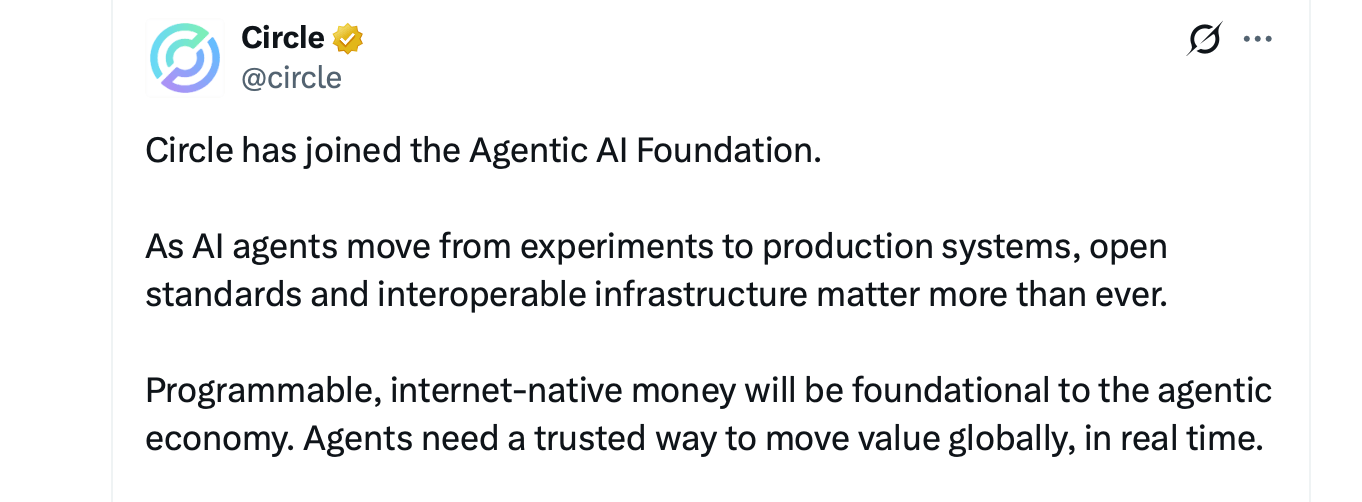
Among the new Gold Members are companies such as Akamai, American Express, Autodesk, JPMorgan Chase, Huawei, Red Hat, Servicenow, Uipath and Workato. Circle’s entry places programmable digital finance alongside the emerging “agentic” software stack.
Launched Dec. 9, 2025, under the umbrella of the Linux Foundation, the Agentic AI Foundation was created as a nonprofit, vendor-neutral hub to guide the development of autonomous artificial intelligence (AI) systems. Agentic AI refers to systems capable of planning, reasoning, using tools, and taking action independently — a marked evolution from chat-based assistants to software that executes complex tasks in live environments.
The Foundation was co-founded with backing from companies including OpenAI, Anthropic, and Block, alongside support from Amazon Web Services (AWS), Bloomberg, Cloudflare, Google, and Microsoft. The premise: prevent fragmentation and vendor lock-in before autonomous agents become embedded in finance, healthcare, software development, and beyond.
Three foundational open-source contributions anchored its formation. Anthropic donated the Model Context Protocol, or MCP, a standard for connecting AI models to external tools and data. Block contributed goose, an extensible agent framework. OpenAI provided AGENTS.md, a markdown-based standard designed to give coding agents consistent context across repositories.
Those projects were transferred into neutral governance to ensure community-driven evolution rather than corporate control. Today, MCP alone supports thousands of integrations and has been adopted across major AI platforms, reinforcing the Foundation’s bet that shared protocols will matter more than proprietary silos.
Governance is led by a board chaired by David Nalley of Amazon Web Services, appointed on Tuesday. Nalley’s mandate is to steer strategy while maintaining neutrality — a delicate balancing act when competitors collaborate under one roof.
“Agents are rapidly maturing from experimental prototypes to production-ready systems that are fundamentally transforming how we build applications and conduct business across industries,” Nalley said.
Membership is tiered, with Platinum backers including AWS, Anthropic, Block, Bloomberg, Cloudflare, Google, Microsoft, and OpenAI, while Gold and Silver tiers broaden participation across startups and global enterprises. The structure mirrors other Linux Foundation initiatives that successfully standardized infrastructure, such as Kubernetes and Linux itself.
The rapid climb to 146 members reflects an industry consensus: if AI agents are going to transact, authenticate, coordinate, and execute tasks autonomously, they need interoperable rules of engagement. Research cited in the announcement notes that 89% of organizations adopting AI rely on open-source infrastructure, reinforcing the demand for shared governance.
Circle’s involvement hints at what may come next — programmable money interacting with programmable agents. In that scenario, AI systems could not only reason and act, but also transact.
“As software increasingly coordinates economic activity, open standards and trusted financial infrastructure are essential,” Circle’s Chief Technology and AI Officer, Li Fan explained. “At Circle, we believe programmable, internet-native money is foundational to this shift and will be the basis for the emerging agentic economy.”
The Circle executive added:
“ Stablecoins enable automated systems to move value globally and in real time, and joining the Agentic AI Foundation reflects our commitment to open collaboration and interoperable infrastructure.”
The larger ambition is straightforward: build the rails before the traffic explodes. In the emerging agentic economy, standards are not bureaucracy. They are infrastructure.
- What is the Agentic AI Foundation?
A Linux Foundation-backed nonprofit advancing open, interoperable standards for autonomous AI agents. - When was the Foundation launched?
It was formally announced on Dec. 9, 2025, under the Linux Foundation. - How many members does AAIF have?
As of Feb. 24, 2026, the Foundation has 146 member organizations. - Why is Circle’s membership significant?
It connects programmable financial infrastructure with emerging autonomous AI systems.
免责声明:本文章仅代表作者个人观点,不代表本平台的立场和观点。本文章仅供信息分享,不构成对任何人的任何投资建议。用户与作者之间的任何争议,与本平台无关。如网页中刊载的文章或图片涉及侵权,请提供相关的权利证明和身份证明发送邮件到support@aicoin.com,本平台相关工作人员将会进行核查。


