Organized & Compiled: Deep Tide TechFlow
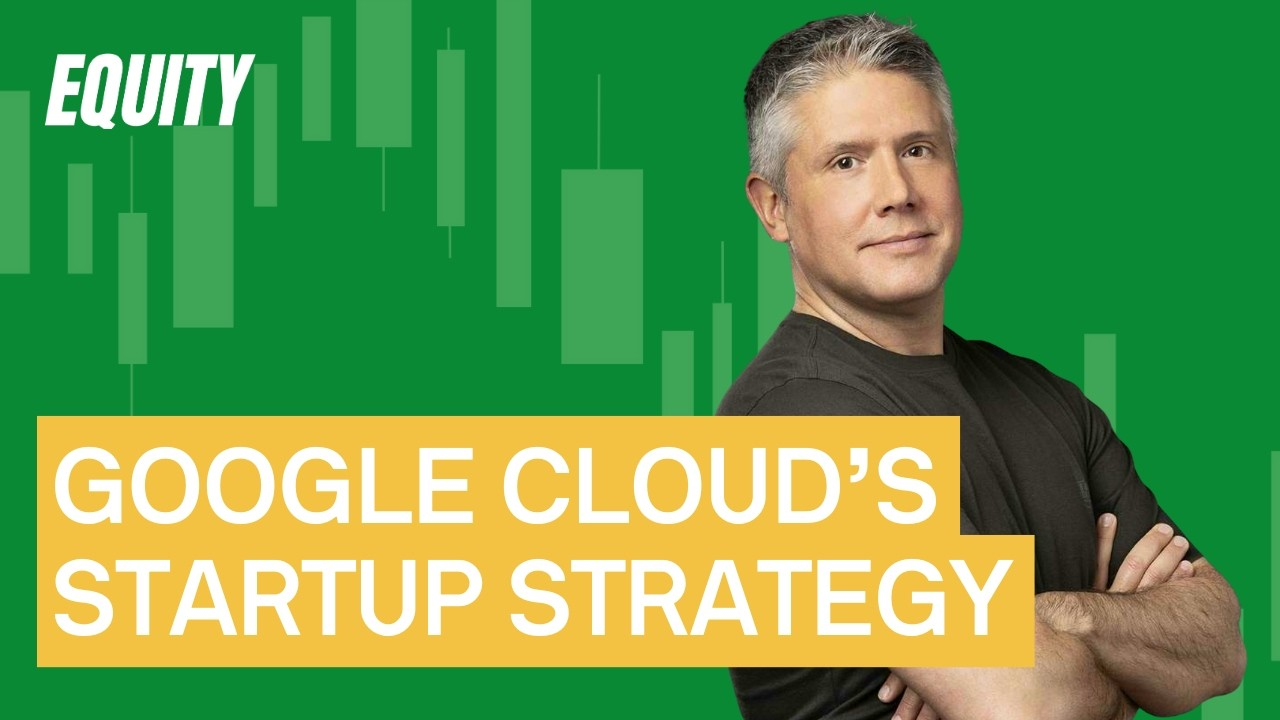
Guest: Darren Mowry, Vice President of Google Cloud
Host: Rebecca Bellan
Podcast Source: TechCrunch
Original Title: Is your startup's check engine light on? Google Cloud's VP explains what to do | Equity Podcast
Broadcast Date: February 19, 2026
Summary of Key Points
Founders of startups are facing unprecedented pressure: with funding becoming tighter and infrastructure costs continuously rising, they not only need to accelerate innovation but also must prove at an early stage that their products can attract the market. While the popularity of cloud service credits, GPUs, and foundation models (pre-trained models that support generative AI) has made entrepreneurship easier, these early infrastructure choices may bring unexpected challenges when the free credits run out and actual cloud service fees need to be paid.
In this episode of TechCrunch’s Equity podcast, Rebecca Bellan talks with Darren Mowry, Vice President of Google Cloud Global Startups, about the trade-offs and challenges faced by startups during rapid expansion. As a key figure in the global startup ecosystem, Mowry shares his observations on industry trends, how Google Cloud attracts AI startups in a competitive environment, and the key issues founders need to pay attention to when scaling their businesses.
Highlights of Insights
- While cloud service credits are standard practice in the industry, they are not particularly special. We all know credits are indeed important for startups, but what founders really need is deeper engineering resources and technical support.
- Whether based on TPUs or GPUs, our goal is to help founders find the solutions that are best for them rather than forcing them down a fixed path. We find that this freedom of choice is very important for founders and is a significant advantage for us.
- Today, startups are beginning to shift their focus from chips (like GPUs and TPUs) to more emphasis on data models and intelligent agents. Currently, about 10% to 15% of discussions still revolve around chips, but the vast majority, around 80% to 85%, has already focused on the development of models and agents.
- Intelligent agents can solve complex customized problems, and their application scenarios are very broad. In the future, there may be thousands of intelligent agents developed.
- We are seeing an increasing number of emerging founders, who come from top universities, Y Combinator, and some well-known AI research institutions like OpenAI, Anthropic, and DeepMind. These new founders bring more innovative energy.
- When talking about AWS and Microsoft... their market positioning leans more towards being distributors of technology, rather than directly providing advanced technology solutions like Google does. Google not only develops world-class AI technology but can also support third-party capabilities as a first-party provider, which makes us unique in the competition.
- Startups are changing the economic logic of traditional enterprise IT in the rapid development of cloud computing and AI. In the past, we usually thought that companies with a larger number of employees were the biggest customers... but now, some smaller startups, like Cursor, Lovable, and Open Evidence, even with fewer employees, consume technical resources far exceeding their own size. These companies are engineering-driven and push our platform to new technical limits.
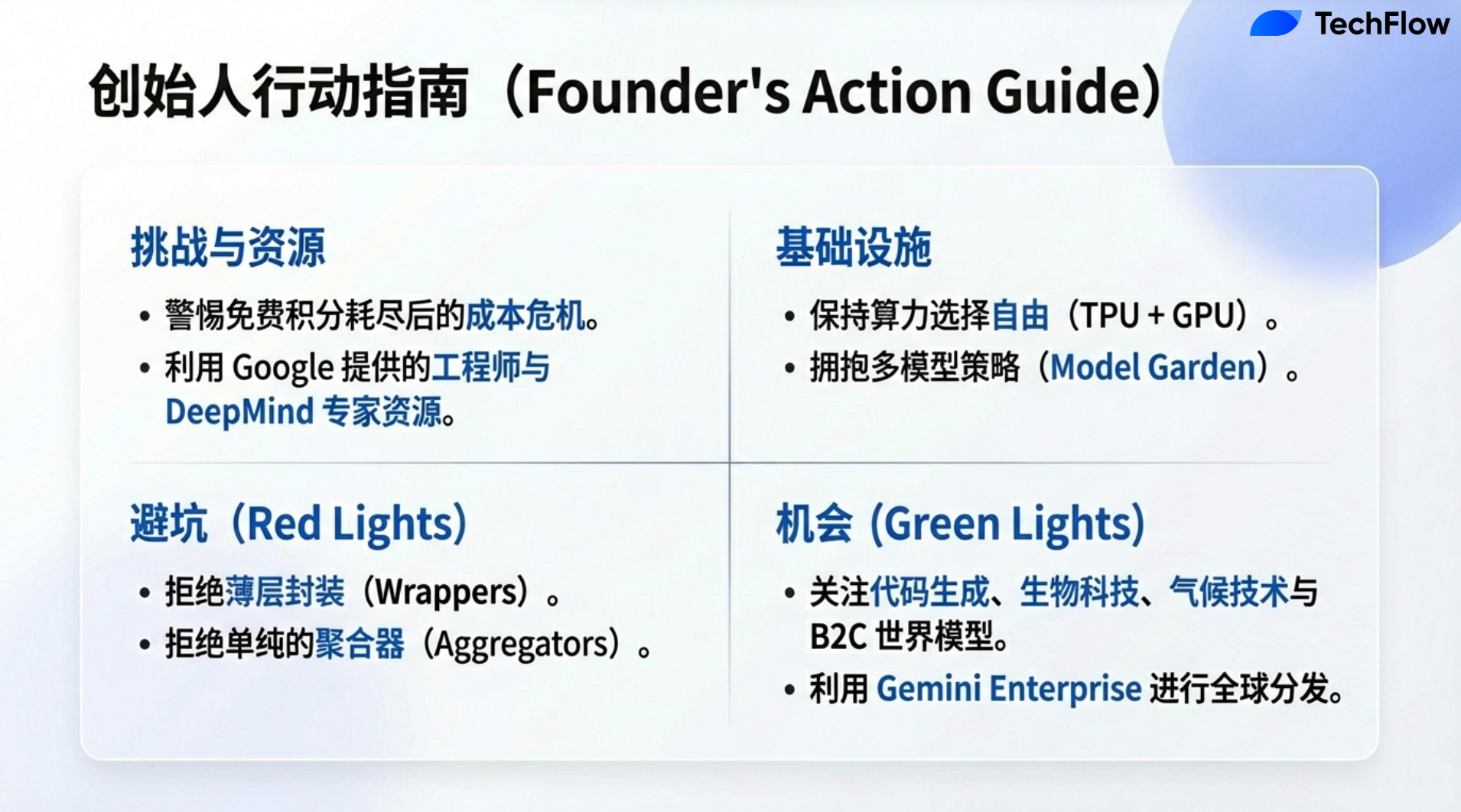
- The first phenomenon is the "LLM encapsulation" phenomenon. Encapsulation refers to adding a layer of functionality or intellectual property around models like Gemini or GPT-5 to form an application layer. However, we find that the industry's demand for simple encapsulation is rapidly declining. If a startup merely relies on backend models to do all the work and is essentially just rebranding the models, this approach is becoming increasingly hard to gain recognition.
- Another notable trend is the challenge of the "aggregator" model. Aggregators refer to systems that attempt to build a layer over multiple models or platforms to help users select models... We find that the growth of this aggregator model is not significant, as users want to see more intelligent functionalities rather than just a simple selection layer.
- Biotechnology, climate technology, and consumer experience are key areas we are focusing on. These industries are rapidly developing, and we see significant growth, strong retention rates, and increasing interest in the ecosystem.
How Startups Join the Google Cloud Ecosystem
Rebecca: How do startups become part of your ecosystem? How do they get involved? What support do you provide for them?
Darren:
It is a two-way interactive process. We attract startups to join our ecosystem through both push and pull factors. When I joined Google Cloud five years ago, the cloud computing market was primarily dominated by AWS. AWS made it easy for founders to use compute, storage, and databases to build products through a frictionless credit card-style model, while Google Cloud was more positioned as a "third choice," with a relatively traditional competitive environment.
But in the past 18 to 20 months, with the rapid development of AI, the situation has changed dramatically. AI is no longer a buzzword but has become a viable technological solution. Google has invested heavily in AI technology, such as our advanced large language model Gemini, which has powerful natural language processing capabilities and supports many startups with technology. It is these technological advantages that have led more and more founders to actively choose to build products on Google Cloud from the very beginning, which has become a strong pull factor.
To help these startups, we launched the Google Cloud for Startups program. Founders can find this program through a simple online search and learn more about it. We provide customized cloud service credits based on the different stages of development that startups are in. These credits are free trial allowances provided by Google Cloud, designed to support startups in quickly launching projects in their early stages. Whether they have just completed their first round of financing or have entered a more mature development stage, we provide corresponding technical resources and services according to their needs and the situation of their supporters to help them achieve rapid growth.
Beyond Cloud Service Credits: Engineering Resources and Technical Support
Darren: I want to emphasize that while cloud service credits are standard practice in the industry, they are not particularly special. We all know credits are indeed important for startups, but what founders really need is deeper engineering resources and technical support. For example, they want direct guidance from DeepMind experts or want experienced customer engineers to be involved in product definition. Therefore, we have strengthened our technical support model and put resources directly into the core needs of startups. From early stages to later stages, we provide technical expert support for startups, which is a unique advantage of Google Cloud and a highlight of our program.
In addition, we also provide additional support for startups, including promotional activities, free use of Workspace (Google's office suite, which includes Gmail, Google Drive, and Google Docs), and solutions that help startups bring their minimum viable product (MVP) or first-generation products to market. All of these are included in the Google Cloud for Startups program. So I’m glad you mentioned this issue because many people mistakenly think that this program is just about providing credits, but in fact, it goes far beyond that.
Rebecca: So how many startups are currently participating in this program? How do you provide engineers and researchers' resources for these startups?
Darren:
There are currently thousands of startups participating in this program. This year, we see significant growth, largely due to Google's technological appeal, including the leading capabilities of Gemini and DeepMind. More importantly, we view startups from a lifecycle perspective. We know that when startups exhaust their credits or cannot continue using them, they face a critical moment of transition. To help them transition smoothly, we provide commercial and economic support, allowing them to remain in our ecosystem.
While I cannot share specific retention rates, we rigorously measure the number of startups that remain on the Google Cloud platform after their credits run out. From an industry perspective, our retention rate is very high, something I have never seen in my career. And this number is increasing each quarter, indicating that even after their credits run out, startups continue to choose to stay on our platform.
TPUs and GPUs: Freedom of Choice in Building
Rebecca: A notable advantage of Google Cloud is that you have your own TPUs (Tensor Processing Units), right? So how much differentiated advantage do TPUs have in attracting startups? At the same time, does this pose potential issues, such as startups having difficulties when switching to GPUs after getting used to building on TPUs?
Darren:
That’s a great question. The core issue you mentioned actually reflects an important philosophy of ours: providing freedom of choice for startups. We believe this flexibility is currently a major competitive advantage for us.
From a chip perspective, TPUs are one of Google's core technologies. We have developed to the seventh generation and will soon launch the eighth generation. Unlike some competitors who have just entered the chip field, Google has been deeply involved in this area for many years. Our TPUs perform exceptionally well and have a strong business and economic model, which leads many startups to choose to build their products on TPUs from the outset.
At the same time, I want to emphasize that we not only provide TPUs but also have established close partnerships with NVIDIA. Right behind me, I’ve had in-depth conversations with the startup team leaders from NVIDIA. Many startups have a lot of confidence in NVIDIA’s technology, and we hope that through our collaboration with NVIDIA, we can provide startups with more options. Whether based on TPUs or GPUs, our goal is to help founders find the solutions that are best for them, rather than forcing them down a fixed path. We find that this freedom of choice is very important for founders and is also a significant advantage for us.
What to Do When Costs Surge After Cloud Service Credits Run Out
Rebecca: You mentioned that many startups choose to stay on your platform after using up Google's cloud service credits, and the retention rate seems very high. But I’ve also heard some founders complain that they knew the credits would run out, but they didn’t expect them to run out so quickly, and the resulting surge in costs caught them off guard. Generally, switching cloud services may take months, but startups often don’t have that kind of time. The rising infrastructure costs, combined with cloud service providers' enhanced bargaining power, could put startups at risk of closure before their income covers costs. Have they expressed concerns about feeling trapped to you? If so, does Google have a responsibility to help startups through this, or provide more free resources to alleviate their pressure?
Darren:
This is a very important issue, especially in the past six to eight months, where we indeed found some new usage patterns, particularly in AI applications. We have noticed that there may be a surge in costs after cloud service credits run out, and to address this, we have taken some measures to help startups better manage costs.
For example, we have deployed technical tools and programmatic mechanisms in projects that enable founders to monitor resource usage and costs through their consoles to avoid budget overruns. The console is a management interface for cloud services where startups can see resource consumption and expenses in real time. Our goal is to help them self-manage, as there are thousands of startups in the project, and I cannot communicate with every founder individually. Therefore, we must provide solutions that require no human intervention to help them manage resources more efficiently.
At the same time, we have invested a lot of resources in the early stages of startups to help them make development decisions, platform choices, and architecture designs. This advance involvement significantly reduces unexpected situations regarding costs for two main reasons. First, our engineers not only focus on technical issues but also consider the cloud service credits allocated to the startup, funding burn rate, and overall financial condition. Second, we are very aware that letting startup costs spiral out of control is not beneficial for either side. We want to establish long-term partnerships with startups, rather than letting them exit due to exhausted funds. Therefore, our engineers not only provide technical support but also help founders optimize resource use from economic and business perspectives, ensuring they can transition smoothly after their credits expire.
The Shift from Chips to Models and Intelligent Agents
Darren: Recently I’ve noticed a very interesting phenomenon where the focus of startup discussions is shifting rapidly. Today startups are beginning to shift from focusing on chips (like GPUs and TPUs) to placing more emphasis on data models and intelligent agents. Currently, about 10% to 15% of discussions still revolve around chips, but the vast majority, around 80% to 85%, has already focused on the development of models and intelligent agents.
This shift profoundly changes the economic model of startups. For example, the cost of using Google's Gemini model for tasks shows significant differences compared to the costs of traditional cloud computing. Gemini is an advanced large language model developed by Google, focused on generative AI applications. It helps startups complete more tasks at lower costs and faster speeds.
Therefore, we need to help startups shift their focus from an excessive concentration on chips to discussing the development of data models and intelligent agents.
Trends in AI Adoption Among Startups
Rebecca: What trends have you observed recently? What changes are there in AI adoption among early-stage companies? How do you define success?
Darren:
The way AI technology is adopted is changing rapidly.
First, compared to the past, startups show new characteristics in funding sources and founder backgrounds. During the era of cloud computing, we mainly focused on startups that gained significant investments, usually supported by well-known venture capital institutions like A16Z, Sequoia, Gradient, and GV. These organizations are known for discovering excellent founders and projects. However, now we see more and more first-time entrepreneurs emerging, who come from top universities, Y Combinator, and some renowned AI research institutions like OpenAI, Anthropic, and DeepMind. These new founders bring more innovative energy, and at the same time, we need to be prepared for more complex and larger-scale support needs.
Second, in the past 18 to 20 months, there has been a significant change in the focus of startups. Initially focused on chip technology (like GPUs and TPUs), now they’re more focused on the development of data models and intelligent agents. Intelligent agents are AI systems that can learn and execute complex tasks autonomously, usually in conjunction with large language models (LLMs). We have found that the demand for models is growing rapidly among startups, such as Google's Gemini model. Gemini is an advanced large language model focusing on generative AI applications that can help startups accomplish complex tasks at lower costs and faster speeds.
Additionally, we have noticed other companies are developing excellent models, such as Claude from Anthropic and Sonnet from Meta. To meet the increasingly diverse needs of startups, we launched a flexible platform that integrates these models through Marketplace and Model Garden. Model Garden is a model integration platform provided by Google where startups can select and integrate various AI models. This flexibility allows startups to use multi-model solutions while fully leveraging the Google Cloud platform for integration and development.
Finally, although chips and models remain the focus of discussion, we believe the key to the future lies in the development of data, applications, and intelligent agents. Intelligent agents can solve complex customized problems, and their application scenarios are very broad, with potentially thousands of intelligent agents being developed in the future. In contrast, there are fewer competitors in the chip field, while the potential for intelligent agents is enormous. Google and Alphabet have a deep technical accumulation in data, developer support, and application areas, which gives us a unique advantage in driving the development of intelligent agent technology. I believe this trend will continue to promote the adoption of AI technology by startups and enable more efficient innovation.
Have Intelligent Agents Started to Generate Actual Revenue?
Rebecca: Have intelligent agents started to translate into actual revenue? Have you seen this phenomenon?
Darren:
We indeed see this trend. Intelligent agents are gradually shifting from scientific experiments to practical applications. Although this transition is still in its early stages, it has already shown tremendous potential.
For example, with Google’s intelligent agent platform, Gemini Enterprise, we are helping large enterprises around the world, such as Walmart, Wells Fargo, and Verizon, gain intelligent agent solutions. These agents can be developed by Google or built by IT teams within other companies to solve actual problems for enterprises. For these companies, intelligent agents have already created real value in optimizing processes and improving efficiency.
For startups, the significance of Gemini Enterprise is even more unique. It not only supports startups in building intelligent agents using Google’s technology but also provides a global distribution channel. For instance, if you are a startup founder who has developed an automated podcast intelligent agent platform and wish to promote it to more users, then Gemini Enterprise can help you distribute your solutions to thousands of enterprises around the world. These companies can use intelligent agents to solve actual problems, thereby bringing revenue and user growth to the startup. Although this model is still in its early stages, we believe this market and distribution opportunity is invaluable in the enterprise space and represents an important opportunity for startups.
Rebecca:
So this really is a complete ecosystem from concept to market launch. Clearly, your computing architecture is very centralized, but I’ve noticed that some startups are trying to use decentralized computing to reduce costs and avoid lock-in effects. Do you think this approach can become a true alternative to centralized cloud infrastructure or is it more of a supplement to it?
Darren:
As it stands, we believe that decentralized computing is not a complete substitute for centralized cloud infrastructure. Depending on specific use cases and the needs of founders, we find that centralized computing and distributed computing can be used in combination. Distributed computing can indeed reduce costs and decrease reliance on a single service provider in certain cases, but it currently serves more as a supplement to centralized cloud infrastructure rather than a mainstream solution. We will continue to monitor developments in this area, but for now, it remains an additional option.
Competition with AWS and Microsoft
Rebecca: From the current competitive landscape of the cloud market, besides alternatives like decentralized computing, there are other major players, such as hyperscale cloud providers (Hyperscalers), like AWS and Microsoft. In the startup space, their services are somewhat similar to yours. Beyond what you’ve already mentioned about what makes Google unique, what other factors set you apart in the competition?
Darren:
This is a great question. I think the current competitive landscape of the cloud market is changing rapidly, and it can even be said that there has been a significant transformation.
First, when it comes to AWS and Microsoft, we have great respect for them. These companies have deep technological legacies, excellent talent, and strong funding support, making them worthy competitors. However, their market positioning leans more towards being distributors of technology rather than directly providing advanced technological solutions like Google does. Google not only develops world-class AI technology but can also act as a first-party provider supporting third-party capabilities, making us unique in the competition.
Recently, at an event for startups we hosted in Mountain View, one founder focused on climate technology shared his experience. He had worked with AWS but found that AWS’s services were more inclined to distribute other technologies, whereas Google was able to provide advanced AI technology support directly. This distinction gives us a unique advantage in competing with other hyperscale cloud providers.
Secondly, the focus of startups is also changing. In the past, our discussions with founders primarily centered around chip supply, such as GPUs and TPUs. But now, more attention is shifting towards AI models and intelligent agent development. For instance, Google’s Gemini model is a large language model (LLM) focused on generative AI applications that helps startups complete complex tasks at a lower cost. Meanwhile, other companies are also developing excellent models, such as OpenAI’s GPT-5 and Claude from Anthropic. Claude is an intelligent agent model focused on automating complex tasks. We find that many startups are integrating the use of both Gemini and Claude models to optimize their solutions, which is very unique.
Additionally, in the past, our discussions with founders were more focused on the chip level, such as the supply of GPUs and TPUs, but now the discussions have shifted to AI models. Gemini is an advanced large language model developed by Google, while Claude is Anthropic’s intelligent agent model. We find that many startups are using both Gemini and Claude simultaneously, and this integration is quite unique.
Lastly, I want to mention our special relationship with Anthropic. Anthropic is both our partner and our competitor. This dual relationship of collaborating and competing is very common in the current market, but it also complicates the competitive landscape. We are closely monitoring these dynamics every day, as the pace of market evolution is very fast.
Startup Usage vs. Ongoing Payment Demand
Rebecca: The conversion path from startups to cloud customers is part of Google’s customer acquisition in the cloud, right? So when Google talks about strong growth in cloud usage, how do you distinguish between the usage funded by credits for startups and the actual ongoing payment demand?
Darren:
Startups are changing the economic logic of traditional enterprise IT in the rapid development of cloud computing and AI. In the past, we generally believed that companies with a larger number of employees were the biggest customers because they would purchase more products. But now, some small startups, like Cursor, Lovable, and Open Evidence, even with smaller employee numbers, consume technical resources far exceeding their own scale. These companies are engineering-driven and push our platform to new technical limits. For example, they offer model optimization suggestions to DeepMind and provide feedback for cloud functionality improvements to Google Cloud, fundamentally overturning traditional enterprise IT models.
Back to your question, we have different metrics for startups and enterprise customers. For startups, we focus on their actual usage; we measure how many startups are building products on our platform, how much they are using the Gemini models, and how many third-party models they have integrated. We have shifted our focus from procurement to actual usage. Now, I can discuss with our CRO (Chief Revenue Officer) and COO (Chief Operating Officer) about the usage of advanced services by startups, not just the raw data. These growth metrics are a key focus for me every day.
Additionally, we pay special attention to those startups that graduate from the cloud credits program, ensuring that they can transition smoothly to the ongoing payment phase and achieve long-term development. We support startups from the early stages of technological building to later stages of market promotion, helping them create transaction opportunities and achieve revenue growth. Our goal is to help these companies succeed on both technical and economic fronts in a balanced manner.
Potential Issues: LLM Encapsulation and Aggregators
Rebecca: You mentioned that many startups are using cloud credits. How confident are you today that AI workloads can translate into long-term cloud revenue for Google, rather than just more credits and more usage?
Darren:
This is a very important question and one of the most exciting parts of my work. Every day I wake up with the opportunity to engage with founders who are fully committed to building products they believe in. This engagement fills me with confidence and anticipation for the future.
Recently, there are two phenomena I want to particularly alert entrepreneurs to. The first is the “LLM encapsulation” phenomenon. Encapsulation refers to adding a layer of functionality or intellectual property around models like Gemini or GPT-5 to form an application layer. However, we find that the industry's demand for such simple encapsulation is rapidly declining. If a startup merely relies on backend models to do all the work and is almost just doing brand-labeling of the models, this method is becoming difficult to gain recognition. Nowadays, startups need to build deep moats through innovation, whether through horizontal differentiation or focusing on specific vertical markets, developing unique solutions. Those startups that only engage in simple encapsulation typically struggle to achieve long-term growth.
Another trend worth noting is the challenge of the “aggregator” model. Aggregators refer to systems that attempt to build a layer over multiple models or platforms to assist users in selecting models. This model previously appeared in the cloud computing field; for example, some companies attempted to build a selection service layer over multiple cloud platforms, or hardcoded into a certain model. However, we find that the growth of this aggregator model is not significant, as users want to see more intelligent features and not just a simple selection layer. Users want the system to genuinely understand their needs and recommend the most suitable models through intelligent functionality, rather than merely providing a thin layer of options.
Key Focus Areas: Biotechnology, Climate Technology, and Consumer Models
Darren:
In some areas, we see some very exciting trends, such as code generation and developer platforms. The year 2025 is full of miracles, and my collaborations with Replete, Lovable, and Cursor are incredibly exciting, as these companies are completely reshaping the code generation and development tools space.
Besides this, biotechnology is also a field full of potential. We believe the intersection of technology and biology is key to solving major health issues, such as cancer treatment. Biology alone cannot achieve such tasks, and the addition of technology is changing the landscape. Personally, I have a special emotional connection to this area. My daughter is pursuing a Ph.D. in biomedical engineering at a nearby university, and she is using the AlphaFold model, an AI tool developed by DeepMind to predict protein structures in her lab. This tool enables her to complete research tasks that were previously impossible. The biotechnology and digital health fields are experiencing explosive growth, and we see some astonishing innovations.
Another hopeful area is climate technology. While we have long anticipated breakthroughs in climate technology, we are finally seeing significant progress. Venture capital is flooding into this space, and startups are innovating using massive amounts of data. By integrating these data, these companies can tackle climate issues in ways that were previously unimaginable, making climate technology one of the fastest-growing sectors we observe.
Finally, there is innovation regarding consumer experiences. Technology is redefining how we bring advanced tools directly to consumers. My other daughter is a film and television major, and she has used VO and our latest models to create many works. These technologies enable her to realize creative projects that were once challenging to complete. Now, we’re able to help more people realize their dreams, which excites me greatly.
Currently, biotechnology, climate technology, and consumer experiences are the key areas we focus on. These industries are rapidly developing, and we see significant growth, strong retention rates, and increasing interest within the ecosystem. This is a time filled with opportunities, and we are optimistic about the future.
Conclusion
Rebecca: You believe current challenges and slower-growing areas have some potential issues, such as the aggregator model. In contrast, long-term growth will come from emerging industries like biotechnology, global models, and film creation. Can you give some examples of startups that are rapidly growing into important customers for Google Cloud?
Darren:
Of course. We have mentioned Harvey multiple times, a startup focused on professional services and law that is quickly growing to be an important customer for us. Additionally, there’s a climate technology startup Watershed, with whom we have deep cooperation. As for developer platforms, the companies I previously mentioned, like Replete, Lovable, and Cursor, are also rapidly developing. We will continue to showcase these startups through various channels, including podcasts like this one, and the upcoming Google Cloud Next event in April this year. This is an annual technology conference held by Google Cloud, focused on showcasing the latest cloud technologies and case studies. At the same time, we will also provide more exposure opportunities for these startups at our own events to help them grow.
免责声明:本文章仅代表作者个人观点,不代表本平台的立场和观点。本文章仅供信息分享,不构成对任何人的任何投资建议。用户与作者之间的任何争议,与本平台无关。如网页中刊载的文章或图片涉及侵权,请提供相关的权利证明和身份证明发送邮件到support@aicoin.com,本平台相关工作人员将会进行核查。


