Author: The Kobeissi Letter
Compiled by: Felix, PANews
The stock market has evaporated $800 billion in market value as the consensus emerges that AI is "taking over the world." This viewpoint seems too obvious, and often, "obvious" trades do not ultimately win.
The reason this apocalyptic rhetoric is spreading wildly is that it touches on some deep pain point within people. It portrays AI as a macroeconomic destabilizer rather than a productivity tool and suggests it will trigger a negative feedback loop: layoffs lead to weak consumption, weak consumption leads to more automation, and automation accelerates layoffs.
The obvious fact is that AI is not just another software feature or efficiency improvement. It is a general capability shock that simultaneously affects the workflows of all white-collar jobs. Unlike any revolution in history, AI is enhancing capabilities across all aspects at the same time.
But what if the apocalyptic rhetoric is wrong? It assumes that demand is fixed, that increases in productivity will not expand the market, and that the system cannot self-adjust faster than the rate of disruption.
The second path is seriously underestimated. What seems like a sign of systemic collapse, the "disruptive blow" from Anthropic, may ultimately mark the beginning of the largest productivity expansion in history.
While the analysis that follows is not a foregone conclusion, remember: humanity always finds a way to win, and free markets always self-regulate.
Anthropic's "Disruption" is Real
First, we cannot ignore the market. Anthropic is disrupting the world with Claude, causing hundreds of billions of dollars to evaporate from the market capitalization of Fortune 500 companies.
This is a story we've seen multiple times since 2026: Anthropic releases a new AI tool, Claude makes substantial progress in coding and workflow automation, and within hours, the market in the target industry collapses. If you haven't been paying attention, here are some examples:
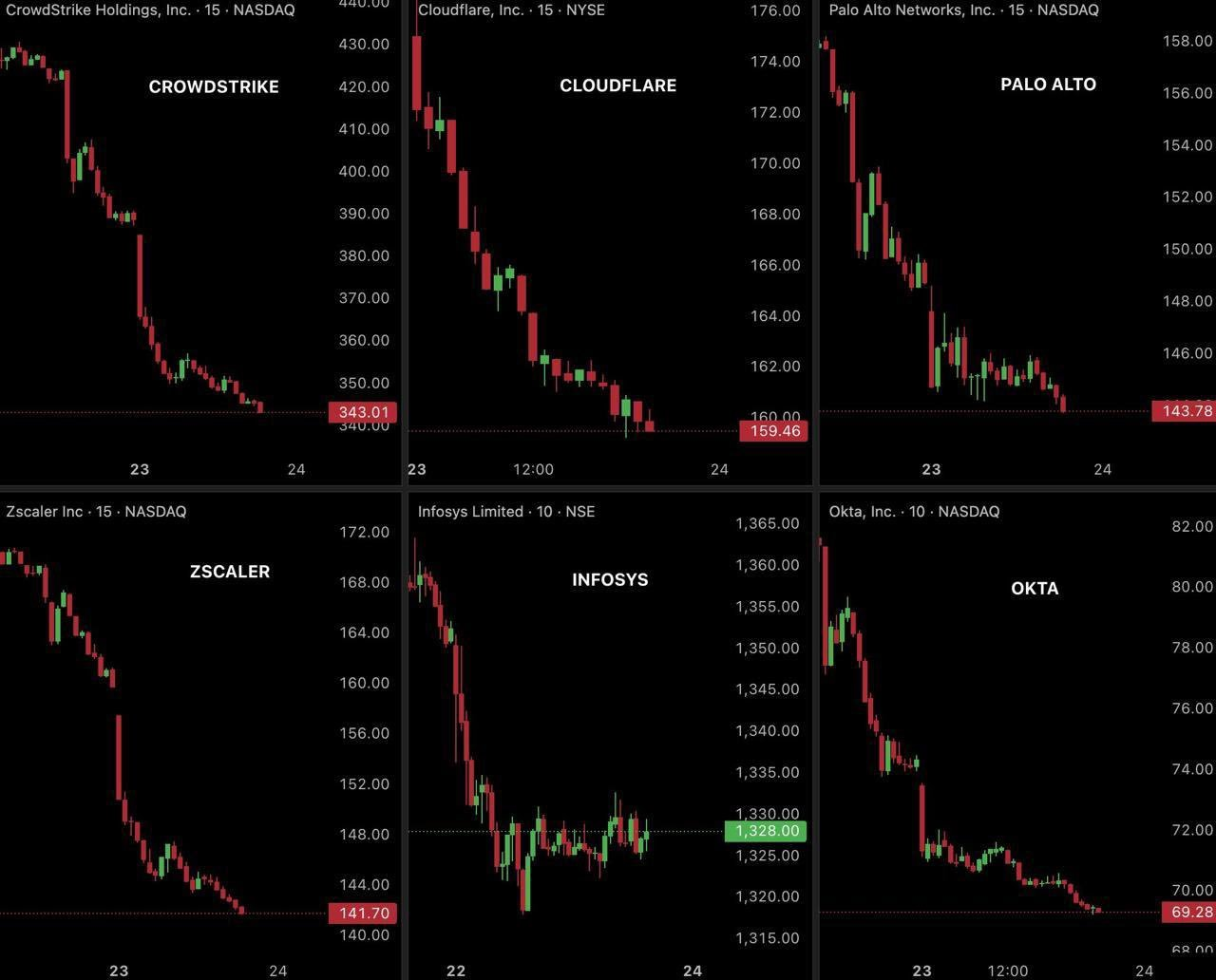
The stock market reacts to Claude-related announcements
IBM's stock price saw its largest single-day drop since October 2000 after Anthropic announced Claude could simplify COBOL code.
Adobe's stock price has dropped 30% year-to-date due to generative features compressing creative workflows.
The cybersecurity sector plummeted after the release of "Claude Code Security."
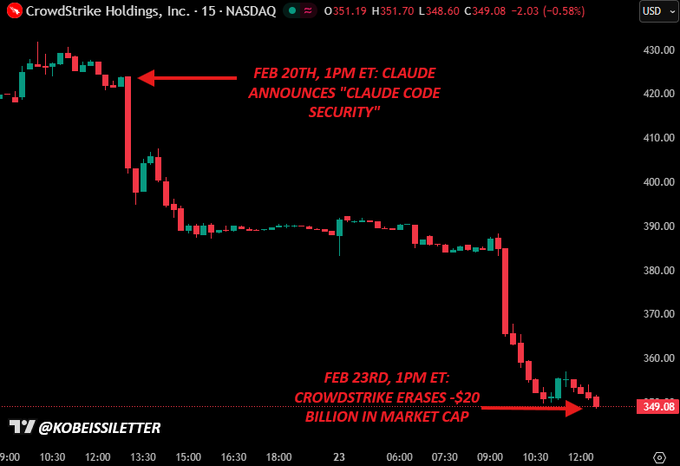
In the example above, CrowdStrike's stock price plummeted almost the moment Claude announced "Claude Code Security."
At 1 PM EST on February 20, Claude announced this tool. It is an automated AI tool that can scan for vulnerabilities in codebases.
Just two trading days later, CrowdStrike's market value evaporated by $20 billion due to this.
These reactions are not a loss of sanity. The market is trying to factor in real-time profit margin compression into pricing. When AI replicates workers' tasks, pricing power shifts to buyers. This is the first wave of impact, and it is very real.
Commoditization does not equal collapse. On the contrary, it is a means by which technology lowers costs and expands access. Personal computers commoditized computation, the internet commoditized distribution, the cloud commoditized infrastructure, and AI is commoditizing cognition.
There is no doubt that some traditional workflows will face margin compression. The question is whether the reduction in cognitive costs will lead to economic collapse or trigger a dramatic economic expansion.
The Assumption of "Vicious Cycle" Where Demand is Fixed
The bearish cycle is built on a simplified linear model: AI becomes stronger -> companies cut employees and wages -> purchasing power declines -> businesses reinvest in AI to maintain profits -> the vicious cycle repeats. This model assumes a completely stagnant economy.
Historical experience shows just the opposite. When the cost of producing something drops significantly, demand rarely stays the same but rather expands. When computing costs decline, the same amount of computing power is not consumed at a cheaper price but several orders of magnitude more computing power is consumed, creating entirely new industries on that basis.
As shown below, the price of personal computers today is 99.9% cheaper than in 1980.
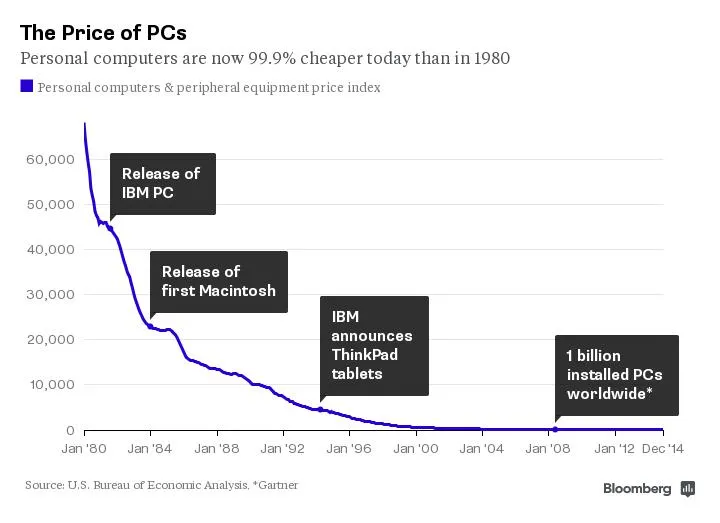
Personal Computer Prices: 1980-2015
AI lowers costs across every industry, and when service costs decline, purchasing power increases regardless of whether wages rise.
The vicious cycle would only dominate if AI replaces human labor without meaningfully expanding demand. If cheaper computing and higher productivity give rise to entirely new categories of consumption and economic activity, a more optimistic scenario will unfold.
The Real Impact is Price Collapse, Not Layoffs
Compared to price compression, layoffs are a story that is easier for investors to sell to the public, but the decline in service pricing is the more important news. Knowledge-intensive work has always been expensive because knowledge is scarce - it sounds simple, yet it's true. A rich supply of knowledge will lead to a decrease in the price of knowledge work.
Consider medical management, legal documentation, tax planning, compliance, marketing, basic coding, customer service, and educational tutoring. These services consume significant economic resources mainly because they require trained personnel. AI lowers the marginal cost of this input.
In fact, as shown below, the contribution of the US service industry to US GDP is close to 80%.
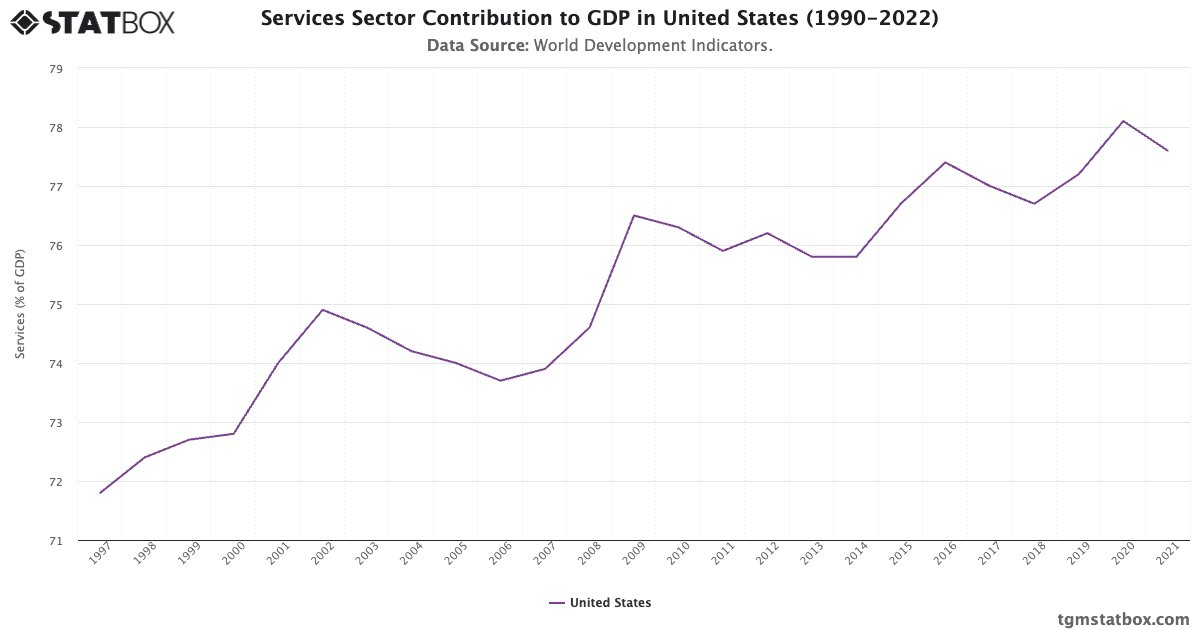
If operational costs decrease for businesses, it becomes easier to start small businesses; if the cost of accessing services declines, more households can participate. In a sense, advancements in AI can act as a "invisible tax cut."
Companies whose profits rely on high-cost cognitive labor may suffer losses, but the overall economy will benefit from reduced inflation in services and increased real purchasing power.
From "Ghost GDP" to "Prosperity GDP"
The bearish viewpoint relies on "Ghost GDP," which is output that appears in data but does not benefit households. The optimistic perspective calls it "Prosperity GDP," meaning output growth combined with lower living costs.
"Prosperity GDP" does not require a surge in nominal income; it requires the pace of price decreases to outstrip the pace of income declines. If AI reduces the costs of services that are critical for many, even if household wage growth slows, their real income will increase. Therefore, productivity increases will not disappear but will be transmitted through lower prices.
This may explain why productivity has consistently outperformed wage growth over the past 70 years.
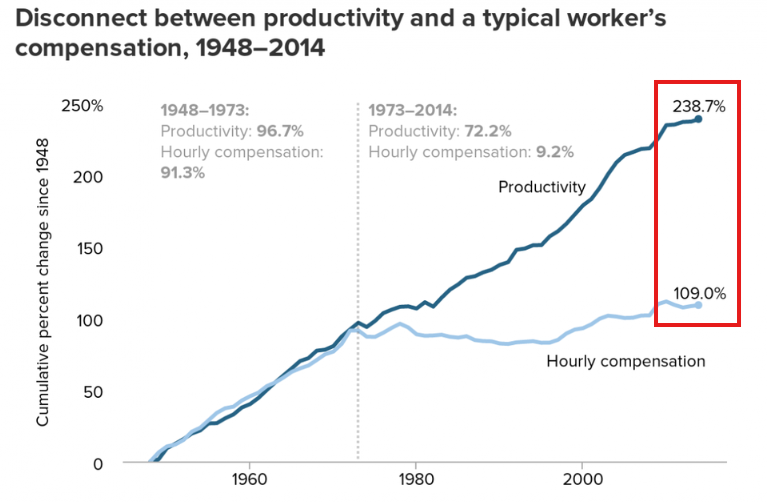
Despite the disruptive and volatile nature of the internet, electricity, mass manufacturing, and antibiotics at the time, each technology provided new ways to expand output and lower costs. However, looking back, these changes permanently raised the standard of living for the populace.
A society that can reduce the time wasted on system operations and repetitive services will become wealthier.
Reorganization of the Labor Market, Not Disappearance
A core concern is that AI will disproportionately affect white-collar employment, which drives discretionary consumption and housing demand. This is a fact and a reasonable concern, especially considering the current wealth gap is so vast.
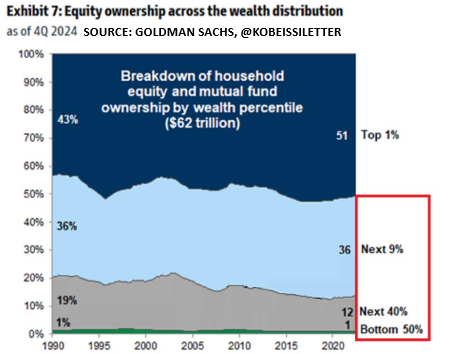
However, AI still struggles with the flexibility of handling the physical world and human identity recognition. Technical jobs, those requiring hands-on healthcare, advanced manufacturing, and experience-driven industries still maintain structural demand. In many cases, AI is a complement to these roles rather than a replacement.
More importantly, AI lowers the barriers to entrepreneurship. When an individual can automate accounting, marketing, support, and coding tasks, starting small businesses becomes easier.
In fact, eliminating entry barriers through AI could be a remedy for the current wealth gap issue.
The internet eliminated some job categories but also created entirely new ones. AI may follow a similar pattern, compressing some white-collar functions while expanding the scope of autonomous economic participation in other areas.
The "Demise" of SaaS Story
AI is clearly putting pressure on traditional SaaS business models. Procurement teams are finding negotiations more difficult, and some long-tail software products face structural resistance. However, SaaS is a delivery mechanism, not the endpoint of value creation.
Next-generation software is adaptive, agent-driven, results-oriented, and deeply integrated. The winners will not be the unchanged tool providers but those companies that can best adapt to changes.
Every technological change reshapes the tech stack, and companies that price based on static workflows will struggle. Companies that master data, trust, computation, energy, and verification may thrive.
Profit compression at one level does not mean the collapse of the entire digital economy; it simply marks a transformation.
AI Reshaping Markets for Business
The bearish narrative believes that agentic commerce will disrupt intermediaries and eliminate fees. This is true to some extent. When friction decreases, it becomes harder to collect fees.
As shown below, even before AI became widespread, the trading volume of stablecoins had already surged. Why? Because the market always favors efficiency.
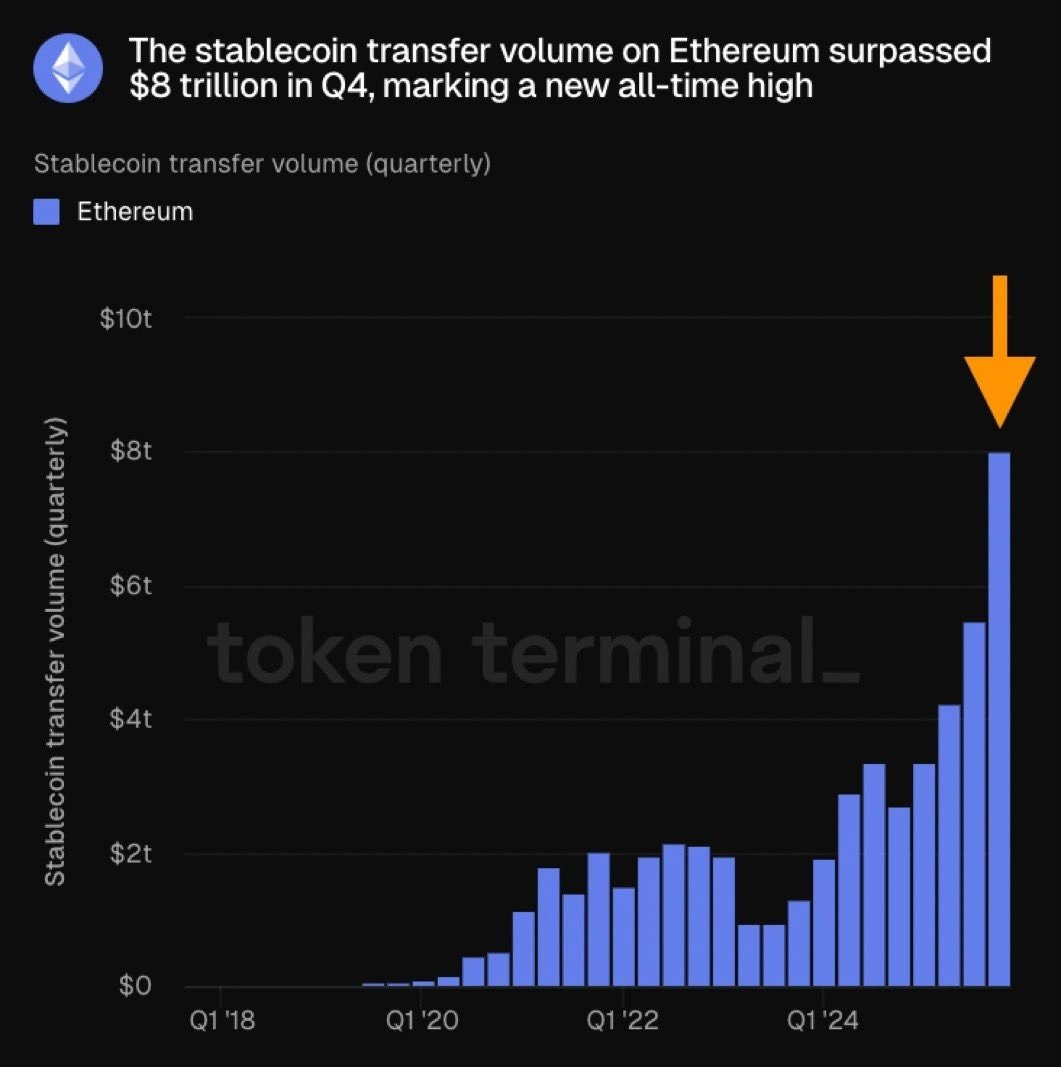
Reducing system friction will also expand trading volumes. When price discovery mechanisms are improved and trading costs decline, economic activity becomes more vibrant. This is a positive trend.
Agents acting on behalf of consumers may compress the profit margins of user habit-based platforms. However, they can also increase overall demand by lowering search costs and improving efficiency.
Productivity is the Core Variable
The ultimate factor determining optimistic outcomes is productivity. If AI can continually enhance productivity in healthcare, government management, logistics, manufacturing, and energy optimization, the end result will be a wealth of resources and more opportunities for everyone.
Even if productivity continues to grow by just 1-2%, the compounding effects a decade later could be enormous.
As shown below, AI is accelerating productivity improvements. In the third quarter of 2025, US labor productivity growth reached its highest level in two years:
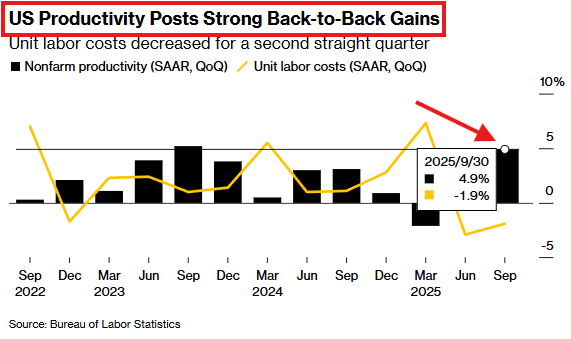
The pessimistic view holds that productivity gains will only benefit those building AI models and will not translate into broader benefits. The optimistic viewpoint believes that price compression and the creation of new markets can transmit gains more widely.
Abundance Reduces Costs and Conflict
One often-overlooked impact of AI-driven prosperity is its geopolitical implications. For most of modern history, wars have been fought over scarce resources: energy, food, trade routes, industrial capacity, labor, and technology. When resources are scarce and growth is a zero-sum game, nations compete. But abundance changes everything.
If AI can significantly lower production costs across energy, manufacturing design, logistics, and services, the global economic pie will grow. When productivity increases and marginal costs decline, the reliance on economic growth achieved at the expense of others decreases. This could end wars and potentially bring about the most peaceful era in human history.
Economic warfare is the same; for example, the ongoing trade war that has lasted for a year.
In today's world, nations' industries struggle in cost competition, and tariffs become a form of protection. But if AI can drastically reduce global production costs, why need tariffs? In an environment with abundant resources, protectionism will become economically inefficient.
History shows that periods of rapid technological advancement tend to reduce global conflict. The industrial expansion post-World War II diminished the incentives for direct confrontation among great powers.
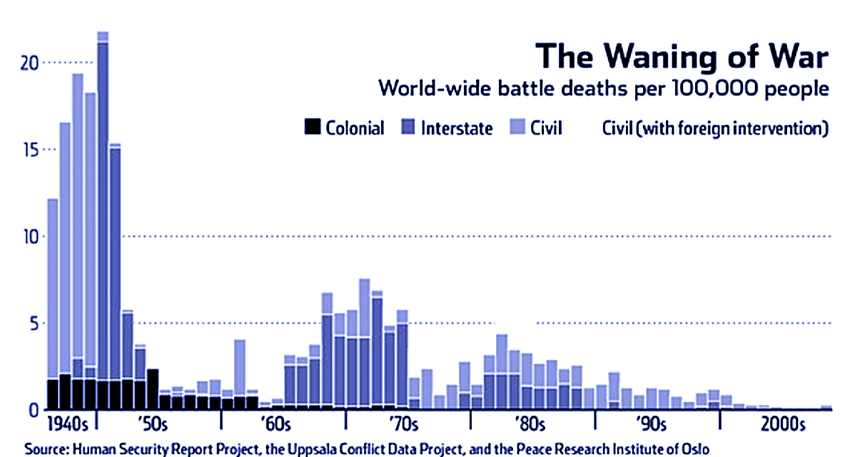
Decrease in war deaths post-World War II
AI-driven prosperity could accelerate this trend. If energy management is more efficient, supply chains are more resilient, and production becomes more localized through automation, nations will become less vulnerable. As economic security improves, geopolitical aggressions will also become less rational.
The most optimistic outcome for AI is not just higher productivity or higher stock indices. It signifies a world where economic growth is no longer a zero-sum game.
Conclusion: What if the "Apocalypse" Doesn’t Arrive?
AI will amplify various outcomes. If institutions fail to adapt, it will increase vulnerabilities; if productivity growth surpasses the shocks brought about by change, it will also foster prosperity.
The signals of disruption from Anthropic indicate that workflows are being repriced and cognitive labor costs are decreasing, signaling a clear transformation.
However, transformation does not equate to collapse, as every significant technological revolution initially appears destructive.
The most underestimated possibility today is not dystopia but prosperity. AI may compress rents, reduce friction, and reshape the labor market, but it could also bring about the largest real productivity growth in modern history.
The distinction between "global intelligence crisis" and "global intelligence prosperity" lies not in capability but in adaptation.
And the world always finds a way to adapt.
Related Reading: A memo from 2028: What will we lose if AI wins?
免责声明:本文章仅代表作者个人观点,不代表本平台的立场和观点。本文章仅供信息分享,不构成对任何人的任何投资建议。用户与作者之间的任何争议,与本平台无关。如网页中刊载的文章或图片涉及侵权,请提供相关的权利证明和身份证明发送邮件到support@aicoin.com,本平台相关工作人员将会进行核查。


