Strategy (Nasdaq: MSTR) CEO Phong Le shared on social media platform X on Feb. 19 a call for U.S. regulators to review Basel capital rules. He pointed to bitcoin’s 1,250% risk weight under Basel III standards. Le argued that this capital treatment materially affects how banks handle the asset.
He wrote:
“The Basel Accords set global bank capital standards and risk-weighting rules for assets. These frameworks materially shape how banks engage with digital assets, including bitcoin.”
Le added: “They are developed by the Basel Committee of central banks and regulators across 28 jurisdictions — the US is just one.” He further stated: “If the US wants to be the Crypto Capital of the World, our implementation of Basel capital treatment deserves careful review.”
His comments responded to Chief Risk Officer Jeff Walton of Strive, who also shared on X: “If the US wants to be the ‘ crypto capital’ of the world, the banking regulations need to change. Risk is mispriced.”
A chart shared by Walton illustrates Basel III-style risk weights under a standardized U.S. approach. It listed cash, physical gold, and sovereign debt at 0%. Investment-grade corporate debt ranged from 20% to 75%, while unrated corporate loans were shown at 100%. High-yield corporate debt carried a 150% weight. Public equity ranged from 250% to 300%, and private equity was listed at 400% or more. Bitcoin, categorized as unsecured crypto exposure, was shown at 1,250%, the highest level on the chart.
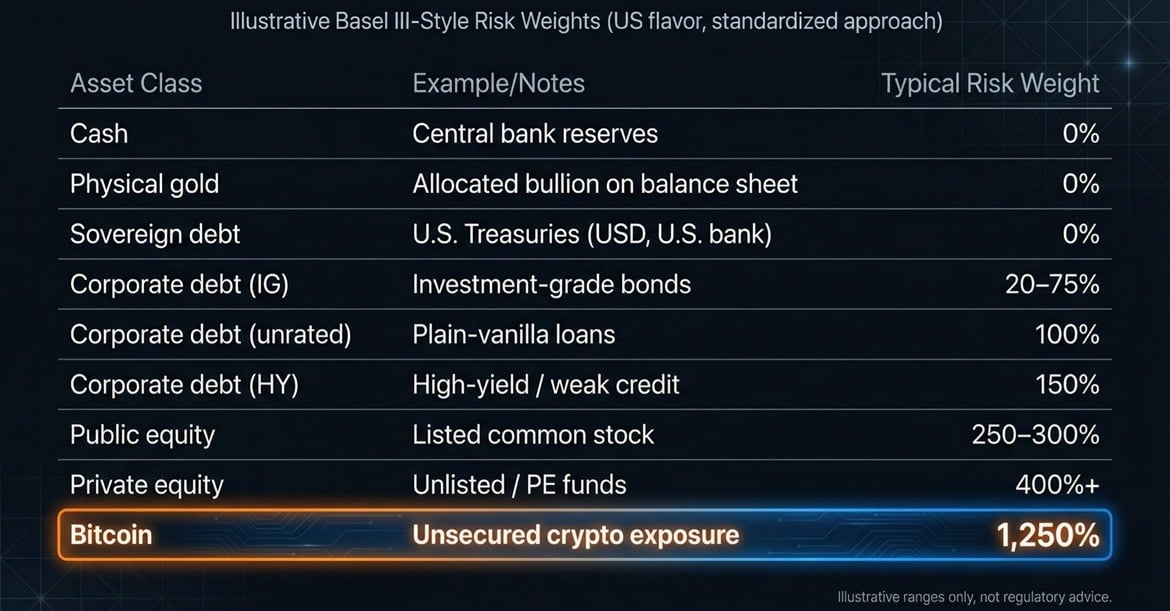
Illustrative Basel-III-style risk weights showing bitcoin, shared by Walton.
Under current Basel guidance, higher risk weights require banks to hold proportionally more regulatory capital against specific assets. This affects balance sheet allocation and return on equity. A 1,250% risk weight significantly increases capital charges relative to traditional asset classes. That treatment can limit banks’ willingness to hold bitcoin directly or expand custody, trading, and lending services tied to digital assets.
Supporters of reassessment argue that market infrastructure, custody solutions, and institutional participation have matured. Others emphasize price volatility, liquidity dynamics, and operational considerations as reasons for conservative standards. The debate reflects broader policy questions about financial stability and the United States’ ambitions in the global digital asset market.
- Why is Phong Le calling for a review of Basel capital rules?
He argues that current Basel risk-weighting standards materially affect how U.S. banks handle bitcoin and digital assets. - How do Basel risk weights impact banks’ bitcoin exposure?
Higher risk weights increase the capital banks must set aside, discouraging bitcoin holdings and related services. - What comparison did Jeff Walton highlight about bitcoin’s risk weight?
He cited gold at 0%, public equity at 300%, and bitcoin at 1,250% under current regulatory treatment. - Why does the Basel debate matter for the U.S. crypto market?
It shapes domestic banking requirements that influence America’s competitiveness in the global digital asset market.
免责声明:本文章仅代表作者个人观点,不代表本平台的立场和观点。本文章仅供信息分享,不构成对任何人的任何投资建议。用户与作者之间的任何争议,与本平台无关。如网页中刊载的文章或图片涉及侵权,请提供相关的权利证明和身份证明发送邮件到support@aicoin.com,本平台相关工作人员将会进行核查。


