Original Author: Todd Wenning
Original Translation: Deep Tide TechFlow
Introduction: Academic financial theory categorizes risk into systematic risk and idiosyncratic risk. Similarly, stock drawdowns can also be divided into two types: market-driven systematic drawdowns (such as the 2008 financial crisis) and company-specific idiosyncratic drawdowns (like the current software stock crash caused by AI concerns).
Todd Wenning highlights with FactSet as an example: during systematic drawdowns, you can leverage behavioral advantages (patiently waiting for the market to recover); but during idiosyncratic drawdowns, you need analytical advantages—having a more accurate vision of the company a decade from now than the market.
In the current situation where AI is impacting software stocks, investors must distinguish: is this a temporary market panic, or is the moat truly collapsing?
Do not use blunt behavioral solutions to tackle problems that require nuanced analysis.
The full text is as follows:
Academic financial theory identifies two types of risk: systematic and idiosyncratic.
- Systematic risk is unavoidable market risk. It cannot be eliminated through diversification, and it is the only type of risk for which you can receive a reward.
- On the other hand, idiosyncratic risk is company-specific risk. Because you can cheaply purchase a diversified portfolio of unrelated businesses, you will not be rewarded for bearing this type of risk.
We can discuss modern portfolio theory another day, but the systematic-idiosyncratic framework is very helpful to understand the different types of drawdowns (the percentage decline from the peak to the trough of an investment) and how we as investors should assess opportunities.
From the moment we picked up our first value investing book, we have been taught to take advantage of Mr. Market's despair during stock sell-offs. If we remain calm when he loses his mind, we will prove ourselves to be resilient value investors.
However, not all drawdowns are the same. Some are market-driven (systematic), while others are company-specific (idiosyncratic). Before you take action, you need to know which type you are looking at.

Generated by Gemini
The recent sell-off in software stocks due to AI concerns illustrates this point. Let’s take a look at the 20-year drawdown history between FactSet (FDS, blue) and the S&P 500 (measured by the SPY ETF, orange).
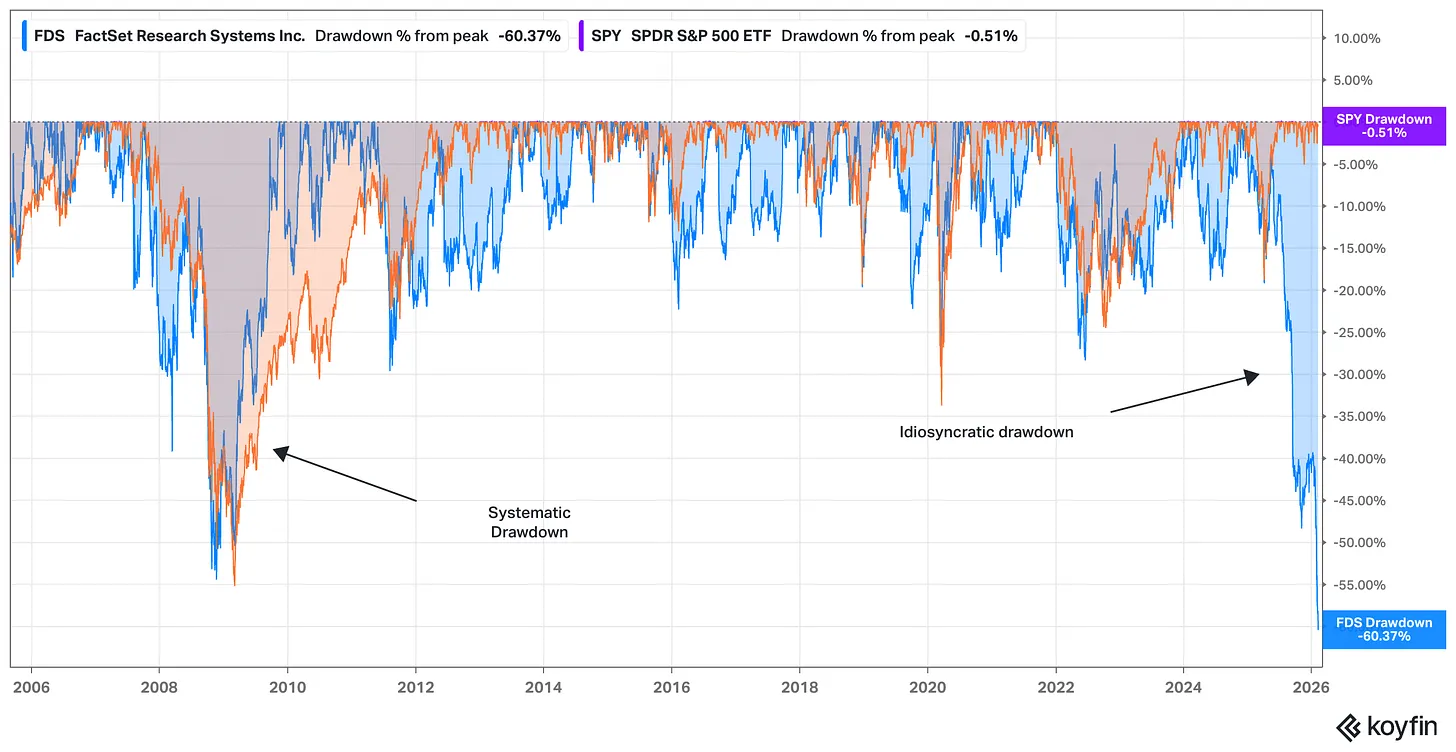
Source: Koyfin, as of February 12, 2026
FactSet's drawdown during the financial crisis was primarily systematic. In 2008/09, the entire market was concerned about the durability of the financial system, and FactSet could not escape these concerns, especially because it sold products to financial professionals.
At the time, the stock’s drawdown had little to do with FactSet's economic moat and was more about whether FactSet's moat mattered if the financial system collapsed.
The FactSet drawdown in 2025/26 was the opposite situation. Here, concerns were almost entirely focused on FactSet's moat and growth potential, as well as widespread worries about the accelerating AI capabilities disrupting software industry pricing power.
In a systematic drawdown, you can make a more reasonable time-arbitrage bet. History shows that the market often rebounds, and companies with complete moats may even be stronger than before, so if you are willing and able to remain patient when others panic, you can leverage a strong appetite to capitalize on behavioral advantages.

Photo by Walker Fenton on Unsplash
However, in an idiosyncratic drawdown, the market tells you that something is wrong with the business itself. Specifically, it implies that the business's terminal value is becoming more uncertain.
Therefore, if you wish to capitalize on an idiosyncratic drawdown, you need to possess not only a behavioral advantage but also an analytical advantage.
To succeed, you need to have a more accurate vision of what the company will look like a decade from now than what the current market prices imply.
Even if you know a company well, this is not easy to achieve. Stocks do not typically fall 50% relative to the market without reason. Many once-stable holders—even some investors you may respect for their in-depth research—must capitulate for such a situation to occur.
If you are to step in as a buyer during an idiosyncratic drawdown, you need to have an answer to explain why these informed and thoughtful investors selling out are wrong, and why your vision is correct.
There is only a fine line between conviction and arrogance.
Whether you are holding a stock that is in drawdown or looking to start a new position in one, it is important to understand what type of bet you are making.
Idiosyncratic drawdowns may tempt value investors to start looking for opportunities. Before you take the risk, ensure you are not using blunt behavioral solutions to tackle problems that require nuanced analysis.
Stay patient, stay focused.
Todd
免责声明:本文章仅代表作者个人观点,不代表本平台的立场和观点。本文章仅供信息分享,不构成对任何人的任何投资建议。用户与作者之间的任何争议,与本平台无关。如网页中刊载的文章或图片涉及侵权,请提供相关的权利证明和身份证明发送邮件到support@aicoin.com,本平台相关工作人员将会进行核查。