Author: Zhu Yu, Jin Shi Data
After experiencing disappointing results in 2025, the US labor market has shown remarkable resilience at the start of the new year. The latest non-farm payroll report exceeded expectations, alleviating market concerns about a rapid economic recession and prompting traders to reassess the Federal Reserve's policy path, with traders fully pricing in a rate cut by the Fed in July, instead of the previously expected June.
In January, the seasonally adjusted non-farm payrolls increased by 130,000, significantly higher than the market median expectation of 70,000, marking the largest increase since April 2025. The unemployment rate in the US for January recorded 4.3%, slightly below the market expectation of 4.4%, reaching a new low since August 2025.
The number of non-farm jobs added in November was revised down from 56,000 to 41,000; the number of non-farm jobs added in December was revised down from 50,000 to 48,000. After revisions, the total number of jobs added in November and December was 17,000 lower than before the revisions.
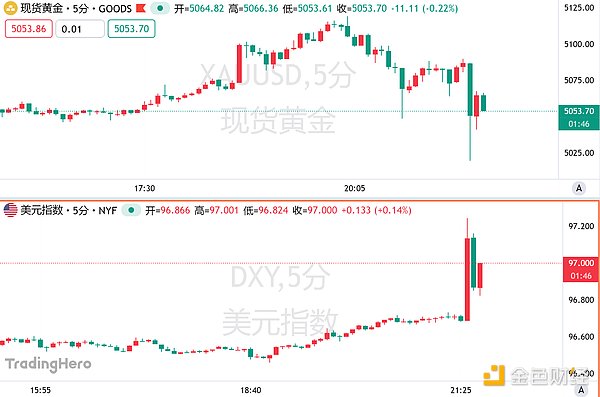
After the non-farm data was released, spot gold briefly plummeted nearly $40, and US Treasury bonds fell across the board following the non-farm employment data release. Non-dollar currencies generally fell sharply, with the euro against the dollar briefly dropping more than 60 points; the pound against the dollar briefly declining more than 70 points; and the dollar against the yen briefly rising nearly 100 points.
The structural improvement in the job market is also evident. As a key indicator of potential purchasing power, average hourly wages rose by 0.4% month-over-month, outperforming expectations; average weekly hours also rebounded to 34.3 hours. Additionally, the labor force participation rate increased slightly from 62.4% to 62.5%, and even the long-beleaguered manufacturing sector finally turned a profit, adding 5,000 jobs in January.
Bloomberg industry research strategists pointed out that the dual growth of wages and hours is more critical than merely the increase in job numbers, because it means that the consumption capacity of residents can be maintained, further increasing the possibility of a soft landing for the economy.
"A Heavy Blow to" Wall Street
The January employment growth data almost defeated all estimates compiled by Bloomberg, with only Citigroup and Santander’s earlier forecasts (increasing by 135,000 and 130,000, respectively) being close to the actual situation. Morgan Stanley economist Michael Gapen noted that this report is "genuine," and the data on average hourly wages indicate that the newly added jobs are of high quality.
From a sectoral perspective, the healthcare industry continues to lead, adding 82,000 jobs in the month, becoming the undeniable backbone of the economy. The construction industry also performed well, adding 33,000 jobs.
Particularly noteworthy is the counter-cyclical recovery of the manufacturing sector. The industry added 5,000 jobs in January, marking the first positive growth since September 2024, completely overturning the market's previous pessimistic forecast of "a decrease of 7,000 jobs." While it remains to be seen whether this growth can form a long-term trend, it is undoubtedly a positive signal after a period of noticeable downturn in the manufacturing sector.
However, not all sectors are expanding. Under the continuing impact of the "Department of Government Efficiency" (DOGE) effect, federal government employment significantly decreased by 34,000, showing the direct impact of fiscal tightening policies on public sector employment.
CPI May Bring "Hawkish" Surprises
Despite the strong performance of the January data, and the upward revision of the data for November and December by 17,000 jobs, the underlying foundation of the US labor market remains fragile when viewed over a longer period.
First, the annual data is not optimistic. The total employment growth for the entire year of 2025 was only 181,000. If excluding the exceptional years during the COVID-19 pandemic and the "Great Recession," this is the worst annual performance since 2003 (when the US was in a recovery period following the bursting of the dot-com bubble).
Second, massive benchmark revisions revealed that previous data was inflated. After seasonally adjusting, historical data was significantly revised down by 898,000 jobs (unadjusted was 862,000). The average monthly job growth in the US in 2025 was only 15,000, which is considered "bleak" compared to previous years.
This means that there were not as many new consumers created in the past year to drive economic spending. This revised data also largely explains why, despite seemingly "hot" employment data, the consumer confidence index consistently indicates anxiety about the job market.
Kay Haigh, an analyst at Goldman Sachs Asset Management, stated that there are some initial signs of the labor market tightening again, but there’s still a long way to go before full tightening occurs. Given the economy's continuous performance exceeding expectations, the FOMC's focus will shift to the inflation situation. "We still believe there are two more rate cuts available for the Fed this year; however, if the CPI released on Friday unexpectedly rises, it could tilt the Fed towards a hawkish stance."
免责声明:本文章仅代表作者个人观点,不代表本平台的立场和观点。本文章仅供信息分享,不构成对任何人的任何投资建议。用户与作者之间的任何争议,与本平台无关。如网页中刊载的文章或图片涉及侵权,请提供相关的权利证明和身份证明发送邮件到support@aicoin.com,本平台相关工作人员将会进行核查。


