Original | Odaily Planet Daily (@OdailyChina)
Author | Dingdang (@XiaMiPP)

The year 2026 began with a blow to DAT (Digital Asset Treasury) companies.
BTC retreated from the peak of $120,000 in December 2025 to around $60,000, a decline of nearly 50%. ETH similarly did not escape, dropping below the $2,000 mark, almost erasing all gains since May 2025. This was precisely when a group of DAT companies, represented by SharpLink and Bitmine, announced high-profile strategic transformations and heavily allocated cryptocurrency assets.
What does this mean? It means that those publicly listed companies or institutions that previously treated BTC and ETH as “strategic reserves” now find themselves collectively stuck in a quagmire of unrealized losses, with paper losses often exceeding hundreds of millions or even tens of billions of dollars. Leading players like Strategy and Bitmine are still gritting their teeth to increase holdings, attempting to maintain the narrative stability of being “long-term believers”; however, many small to medium-sized or highly leveraged DAT companies have already begun to show substantive reductions in holdings or even phased liquidation actions.
Crypto has never lacked stories; if 2025 was the year of “writing belief into financial reports,” then 2026 is the test of “how belief survives a bear market.” When prices retreat, leverage tightens, and the financing environment reverses, can these DAT companies still stand by their balance sheets?
Odaily Planet Daily will successively break down several representative cases that have already started to “sell coins to stop bleeding.” We will explore how much they sold, why they sold, and where they will go after selling.
Cango Inc. (NYSE: CANG): The Leveraged Limits of the Mining Model
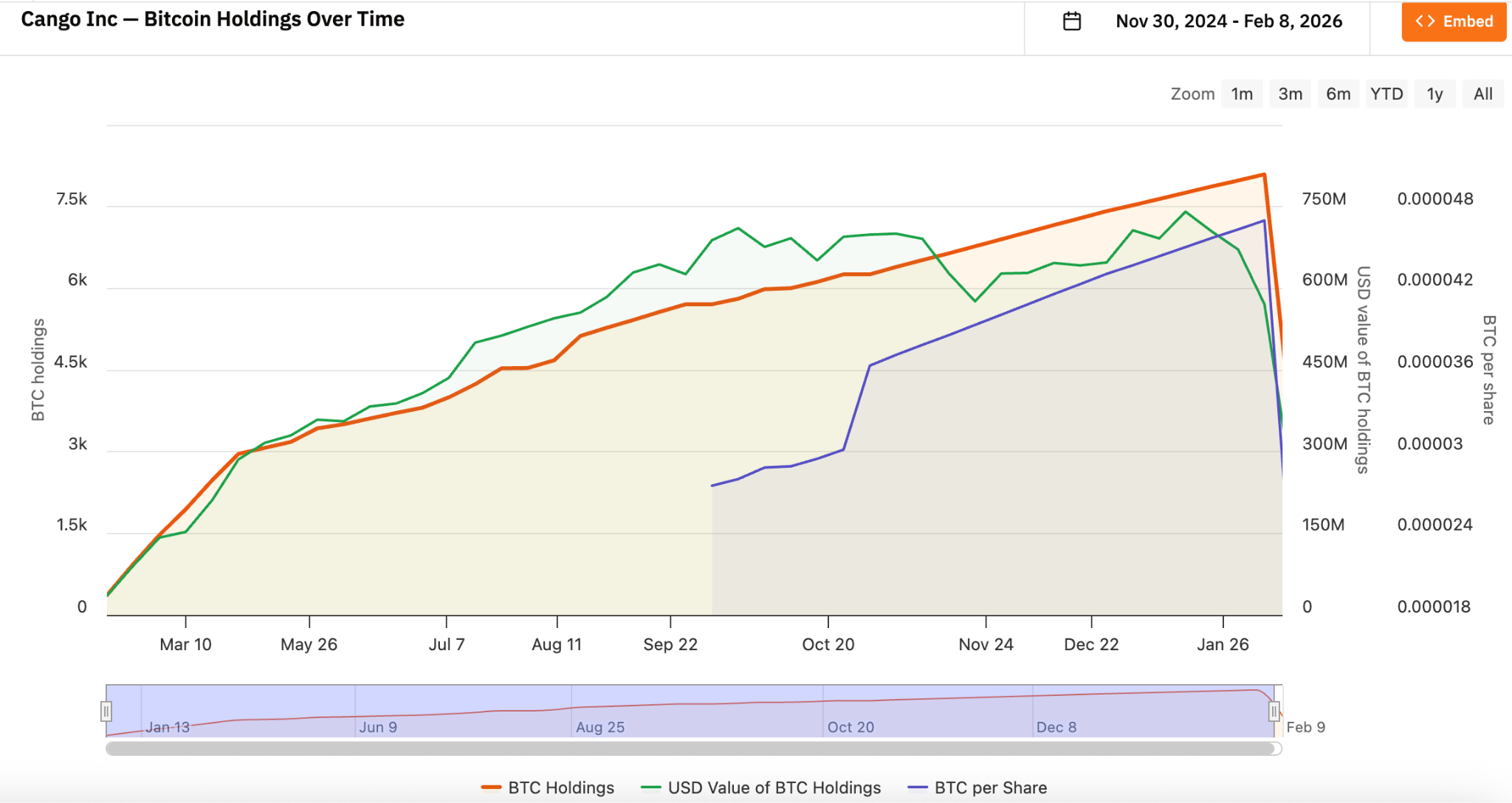
On February 9, Cango disclosed that it had sold 4,451 bitcoins on the public market, netting approximately $305 million, and all proceeds will be used to repay a loan collateralized by BTC. This transaction size approaches half of its previous holdings, leaving only 3,645 BTC on the books after the sale.
Cango was established in 2010 and is headquartered in China. Initially, it was a well-known automotive trading service platform. As of November 2024, Cango officially entered the digital asset field, transforming into a Bitcoin mining company through business restructuring and strategic shifts, and viewing BTC as its core reserve asset. Cango's Bitcoin strategy initially leaned towards HODL + mining accumulation, meaning not selling coins and relying on computing power to continuously increase holdings. This model can self-reinforce during price-up cycles: rising coin prices increase net asset values, enhanced net asset values improve financing capabilities, which in turn support computing power expansion.
Cango began to accumulate Bitcoin continuously from November 2024, and at one point, its Bitcoin holdings made it the second largest mining company in the world, only behind MARA Holdings.
Related reading: “Looking for potential crypto U.S. stocks: How did Cango leap from an automotive company to becoming the world's second largest Bitcoin mining company?”
However, mining is inherently a leveraged industry. The procurement of mining machines, construction of mining sites, and power contracts all require upfront capital expenditure. Mining companies often use their held BTC as collateral to obtain equipment from manufacturers and delay payments or borrow USD/stablecoins from institutions/platforms for expanding mining sites, procuring equipment, and maintaining operations. The downside of this model is that when BTC prices decline sharply, collateralization rates swiftly deteriorate, amplifying leverage risks, while fixed costs such as electricity, maintenance, and equipment depreciation do not decrease, leading to extreme cash flow pressure.
According to Q3 data released in December 2025, Cango's average mining cost (including depreciation) was approximately $99,000/coin, with cash costs (excluding depreciation) around $81,000/coin. Bitcoin prices have fallen far below their shutdown price, forcing them to reduce BTC holdings to “stop the bleeding” and improve their balance sheet and lower financial leverage.
Notably, Cango has announced shifts in resource allocation towards artificial intelligence computing infrastructure, seeking business diversification to reduce dependence on a single asset price.
Empery Digital Inc. (NASDAQ: EMPD): Reverse Pressure of Bull Market Financing Logic
Empery Digital was founded in February 2020 (originally named Frog ePowersports Inc., later renamed Volcon Inc.), based in Texas, USA, and initially focused on all-electric off-road motor vehicles.
In July 2025, the company announced its Bitcoin treasury strategy. Looking back, this time was just around the high point of the Bitcoin price this round. The company raised approximately $450-500 million through private placements and credit financing, gradually increasing holdings of about 4,000 bitcoins during July-August 2025, with an average cost of about $117,000/coin. By current price calculations, the unrealized loss is close to 57%.
On February 6, Empery Digital announced the sale of 357.7 BTC, at an average price of about $68,000/coin, raising about $24 million for share repurchase and partial debt repayment. It has now repurchased over 15.4 million shares at an average price of $6.71, aiming to narrow the NAV discount. Currently, Empery's remaining holdings are approximately 3,724 bitcoins.
The case of Empery Digital actually reflects the typical predicament faced by small to medium-sized DAT companies. They initially took an aggressive transformation and relied on bull market financing, but when prices fell, they could only be forced to “sell coins to repurchase and deleverage.” Compared to Cango’s mining background, Empery resembles more of a “pure financial play.” Its original main business became unsustainable, leading to vast BTC purchases financed at the peak of the bull market in an attempt to replicate Strategy’s path; however, the significant BTC price correction exposed its leverage risks, while lacking long-term increases and capital market operational space. Should the price continue to decline, continued reductions in holdings will almost become a necessary option.
Bitdeer Technologies Group (NASDAQ: BTDR): From Price Betting to Cash Flow Priority
Bitdeer was founded in December 2021 by crypto OG Wu Jihan (former co-founder of Bitmain) and ranks alongside MARA and Riot as a major global Bitcoin mining company.
Bitdeer provides full-chain solutions from equipment procurement, logistics, data center design/construction, equipment management to daily operations through a vertically integrated model, while also expanding into cloud computing, hosting services, and in-house ASIC mining machine R&D. This has shifted Bitdeer’s business from pure mining to diversified high-performance computing, which somewhat buffers against Bitcoin price volatility.
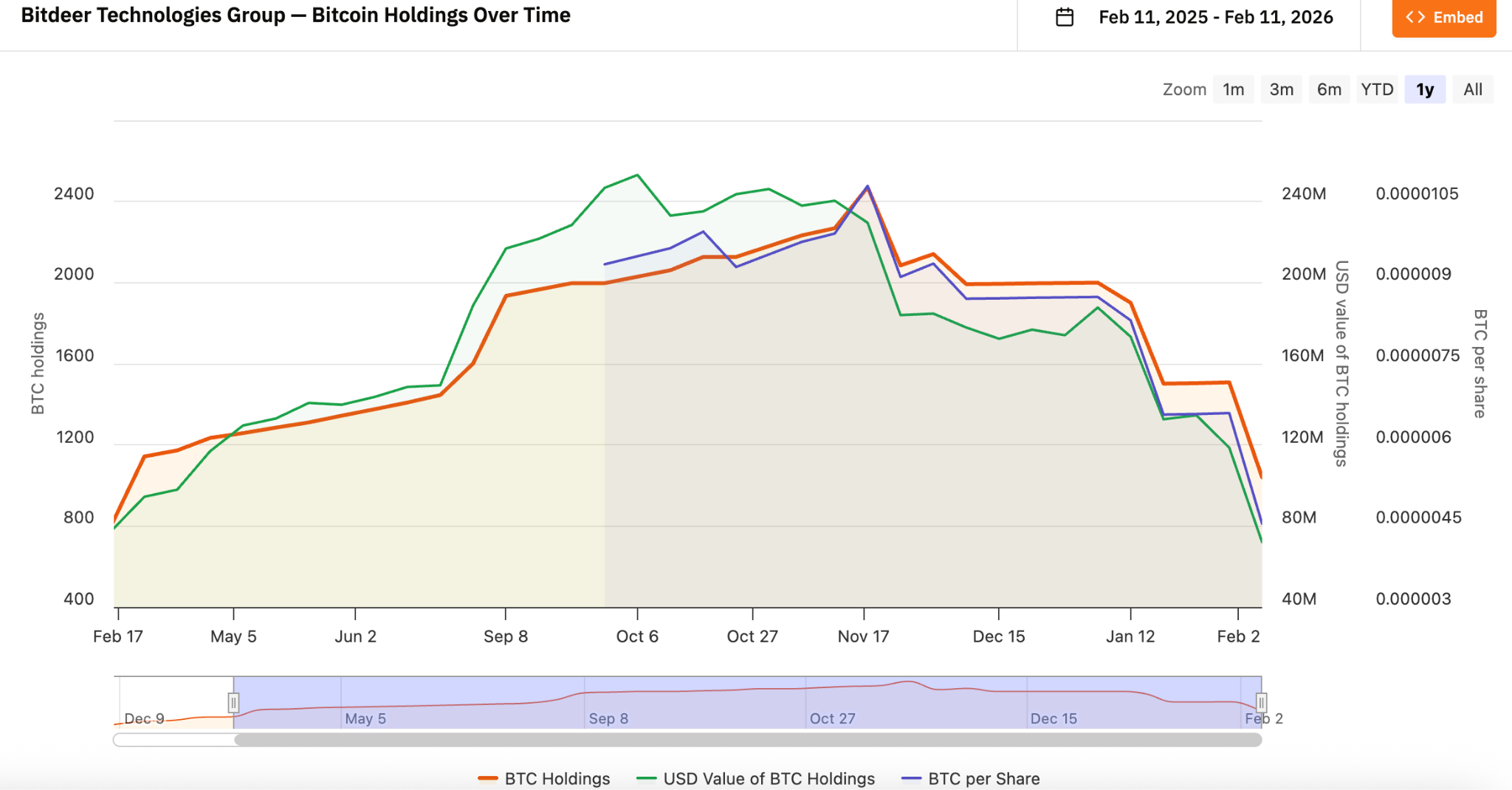
According to data from bitcointreasuries.net, since November 2025, Bitdeer's BTC strategy has shifted to "mining while selling," no longer fully HODLing, but rather maintaining cash flow and operational stability through partial monetization. Prioritizing cash flow over long-term holdings—is this the sensitivity of an industry veteran who has experienced multiple bull-bear transitions?
Sequans Communications S.A. (NYSE: SQNS): Selling Coins to Repay Debt Becomes an Industry Turning Point
Sequans was founded in October 2003 and was originally focused on wireless cellular technology chips and modules. In June 2025, the company raised approximately $380 million through private equity and convertible bonds to accumulate Bitcoin, transforming itself from a pure IoT chip vendor to a hybrid of “IoT + BTC DAT.”
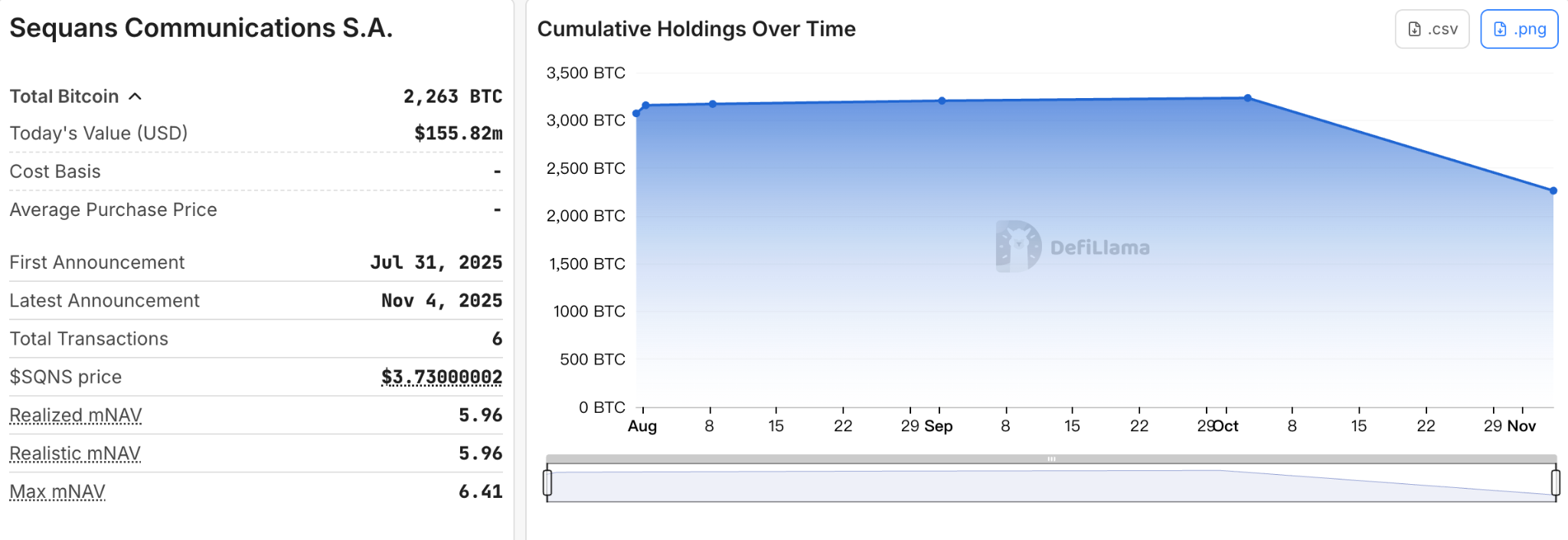
From July to October 2025, Sequans cumulatively increased holdings by 3,233 bitcoins, roughly estimating an average cost of about $116,000.
In November 2025, it first significantly reduced holdings by 970 BTC to redeem about 50% of its convertible bonds, reducing the company’s total debt from $189 million to $94.5 million. The company described this as a “strategic asset redistribution,” not abandoning the strategy. However, the market saw Sequans as the starting point of the “bubble burst” of BTC treasury—the first publicly acknowledged DAT company that needed to sell coins to repay debt.
ETHZilla Corporation (NASDAQ: ETHZ): A De-Leveraging Sample of the ETH Treasury
ETHZilla Corporation was originally a clinical-stage biotech company focused on drug development and therapies for chronic pain, inflammation, and fibrosis. The company faced problems like cash shortages, poor liquidity, and slow R&D progress, leading to persistently low stock prices.
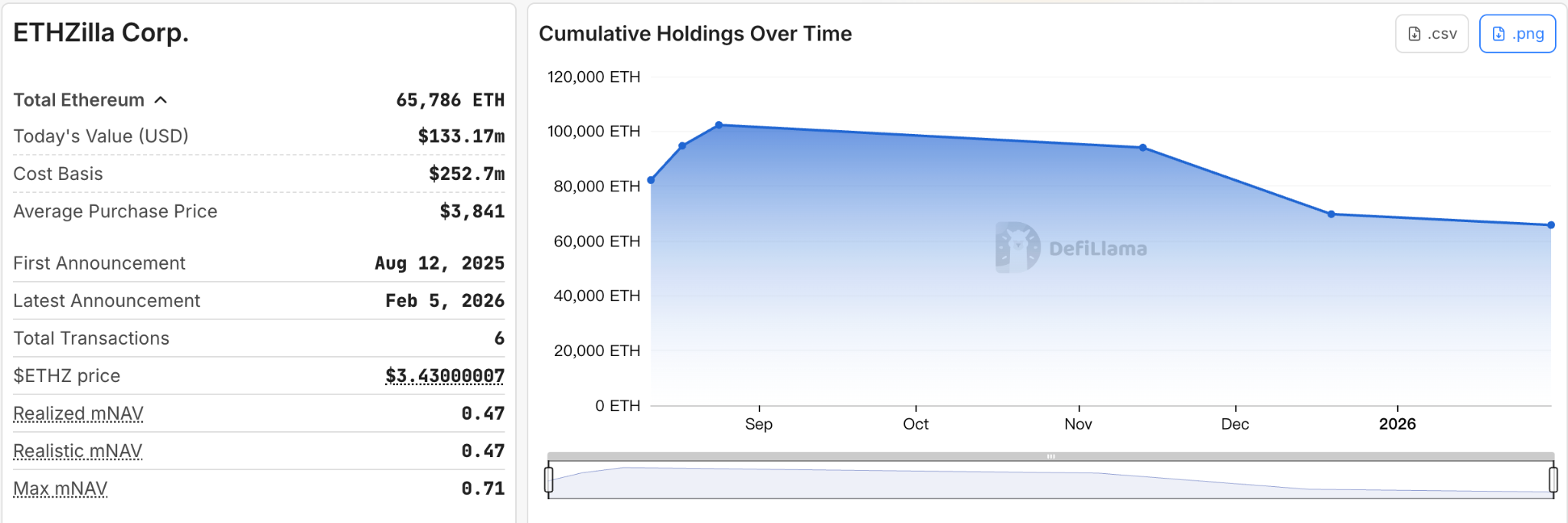
In August 2025, it raised $425-565 million through private placement, with investors including Electric Capital, Polychain Capital, GSR, and entities related to Peter Thiel holding about 7.5%. This funding was directly used to purchase ETH and establish an Ethereum treasury. At its peak, ETHZilla once held about 102,000 ETH, valued at about $210 million, with a single acquisition cost of $3,841.
On November 13, 2025, ETHZilla began its first reduction in holdings of 8,293 ETH; on December 25, ETHZilla disclosed it had sold 24,291 ETH for approximately $74.5 million. This transaction was part of redeeming outstanding secured convertible notes and also marked the first sample of ETH treasury reduction. Currently, ETHZilla's ETH holdings are about 65,700.
Similar to Empery, ETHZilla is also on a forced path of selling coins to deleverage. However, the company is accelerating its transition towards RWA (Real World Asset Tokenization), focusing on areas like auto loans, home mortgages, and land/commercial real estate, with plans to launch its first RWA token product in early 2026, attempting to reshape value through business innovation.
Conclusion
These are just a few representative samples; most are in the middle segment of the industry, holding neither the market pricing power of Strategy nor the ability to exit the stage quietly like the smallest companies. Beyond them, some smaller, structurally weaker DAT companies have already quietly disappeared in this round of pullback; while others that initially planned to transform and had not yet fully implemented treasury strategies have pressed the pause button after the sudden tightening of financing conditions, even announcing termination before their projects could start.
The pullback of 2026 serves as a mirror, reflecting the vulnerabilities and resilience of the DAT model. Companies that solely relied on “storytelling + leverage” are now paying the price for their aggressive expansions. Crypto belief may still exist, but it ultimately needs to coexist with the reality of cash flow, leverage management, and business sustainability.
The gap between leading players and small to medium-sized companies is continually widening in this process. Rather than saying this is the end of the DAT model, it would be more accurate to say it is the starting point of its stratification stage.
免责声明:本文章仅代表作者个人观点,不代表本平台的立场和观点。本文章仅供信息分享,不构成对任何人的任何投资建议。用户与作者之间的任何争议,与本平台无关。如网页中刊载的文章或图片涉及侵权,请提供相关的权利证明和身份证明发送邮件到support@aicoin.com,本平台相关工作人员将会进行核查。