HSBC launched a distributed ledger gold platform, and J.P. Morgan achieved cross-border collateral settlement of tokenized gold bars through the Onyx network, marking the beginning of a reconstruction of underlying assets initiated by traditional financial giants. This trend has been directly validated in the capital markets: Ondo Finance (SLVon) received significant investments from Founders Fund under Peter Thiel and Coinbase Ventures; while PAXG has brought the trust of traditional payment systems directly into the digital asset space through deep compliance collaboration with PayPal and Mastercard.
This article uses recent market trends in gold and silver as samples to illustrate why institutions are increasingly preferring tokenized assets.
As we enter February 2026, the global gold and silver markets are undergoing a stress test. After the gold price hit a peak of $5,600 at the end of January, the market suffered a brutal shortsqueeze due to the hawkish remarks from Federal Reserve officials. As of yesterday (February 5), the spot gold price, after rebounding yesterday, has once again fallen into high-level fluctuations, currently retreating to around $4,980, failing to maintain the critical $5,000 mark; silver's performance has also been tumultuous, currently reported at $86.5.
This price correction after a vertical decline has become the best practical battlefield for RWA assets. It not only tests the holding endurance of investors but also reveals how on-chain investments supported by giants fundamentally enhance capital control, enabling professional investors to have better disposal efficiency than traditional physical assets in extreme market conditions.
1. Liquidity Premium During Price Volatility
In traditional physical or paper gold trading, price corrections are often accompanied by significant liquidity lags. First, there is a dual limitation of trading time and space: the repurchase of physical gold is usually constrained by business hours and physical geographical location, even gold ETFs cannot cope with the waves of selling triggered by macro news such as Kevin Warsh's nomination as Federal Reserve Chair during weekends or off-trading hours.
Secondly, the bid-ask spread during volatile periods is particularly pronounced. Traditional channels see the repurchase premium asymmetrically widen during price declines, causing investors to face not only book losses but also pay a higher liquidation spread. Coupled with the T+n settlement system of the traditional financial system, it severely limits the rapid rotation of capital between asset classes. In contrast, gold and silver assets under the Web3 architecture offer 24/7 immediate settlement capabilities, and this liquidity has extremely high risk-averse value during correcting market conditions.
2. Three Positions and Deep Advantages of On-Chain Assets
Through research on currently mainstream RWA projects, we can classify on-chain precious metals into three complementary investment tracks based on their underlying architecture and functional attributes and explore the comparative advantages relative to traditional models.
Category A: Digitalized form of physical ownership (PAXG, XAUt, CGO)
The core logic of this track is to achieve the securitization of physical ownership through blockchain technology. Its advantages firstly manifest in very low operational thresholds and asset flexibility. Compared to the typical 3%-5% physical premium and high insurance costs encountered in physical gold transactions, on-chain assets significantly reduce friction costs.
- Quantitative Support: Represented by Comtech Gold (CGO), it supports an initial investment of 1 gram (approximately $160), while the standard entry threshold for institutional vaults is usually 12.4 kilograms (one delivery gold bar). According to data from January 2026, PAXG's 24-hour trading volume surged to $1.2 billion during the fluctuations in gold prices, demonstrating the real demand for institutions to utilize on-chain assets for “instant restocking” during extreme volatility.
- Audit Premium: On-chain proof (Proof of Reserve) transforms traditional quarterly sampling into minute-by-minute logical verification. PAXG, in combination with real-time reserve data provided by Chainlink oracles, maintains its secondary market premiums stable at ±0.1% in the long term, far better than the 2% bid-ask spread in traditional markets during panic periods.
Category B: Tokenized securitized products (SLVon)
As a mapping of traditional compliant financial products on-chain, SLVon (launched by Ondo Finance) demonstrates cross-market arbitrage and risk hedging dimensions. Its strategic value lies in bringing the stability of traditional securities assets into the 24-hour cryptocurrency trading logic.
- Quantitative Support: In early February 2026, when silver prices unexpectedly crashed during the closure of the U.S. stock market, SLVon's turnover rate on-chain reached 45% of its total supply, while traditional iShares Silver Trust (SLV) holders could only passively wait for the stock market to open.
- Efficiency Comparison: Traditional ETF settlement periods are T+1 or T+2, while SLVon based on Solana or Ethereum achieves instant settlement capabilities. This means that investors can immediately reinvest their funds into DeFi protocols capturing short-term volatility opportunities of over 15% after selling silver shares, achieving a capital turnover efficiency more than 50 times higher than traditional brokerage accounts.
Category C: Income-generating and high-efficiency collaborative assets (KAG, XAUm)
This track completely ends the history of zero income for precious metals, transforming them into a productive asset that generates cash flow. During correcting markets, this positive income characteristic serves as a buffer against currency price declines.
- Quantitative Support: The revenue-sharing model adopted by Kinesis Silver (KAG) provided coin holders with an average annual yield of 1.8% - 3.2% in 2025, covering not only the holding costs of gold but also achieving asset appreciation.
- Capital Reusability: The data performance of Matrixdock (XAUm) is even more significant. During this period of dramatic gold price fluctuations, XAUm's loan-to-value ratio (LTV) remained robust at 85%. This means holders can lend stablecoins to achieve liquidity mining with returns exceeding 10% without selling their gold positions. This strategy enables the internal rate of return (IRR) of the asset portfolio to maintain positive growth during price corrections, showcasing the collaborative depth of RWA assets under extreme market conditions.
3. Comprehensive Analysis of the Three Strategic Paths
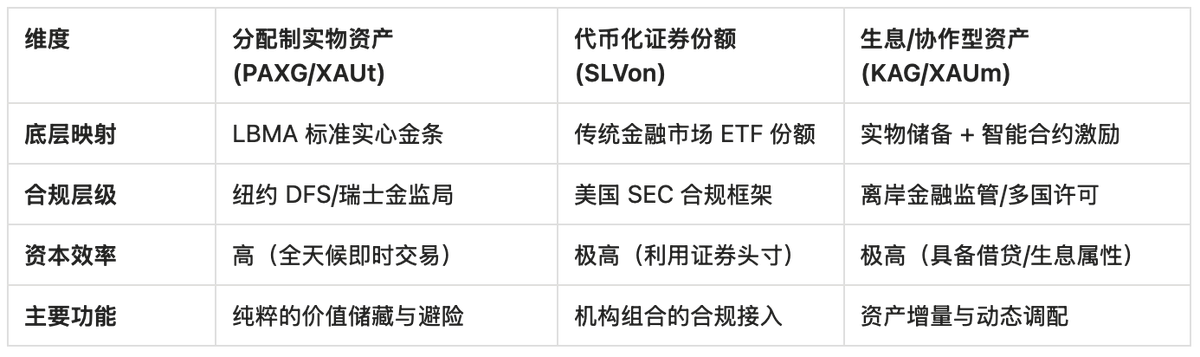
4. Conclusion: The Callback Period is an Opportunity for Asset Structure Upgrades
The market correction in early 2026 once again proves that the right of disposal and ownership of assets are equally important. The real value of on-chain assets lies in providing immediate risk hedging means when prices fall, providing asset productivity when prices stagnate, and offering seamless profit-taking pathways when prices rise.
For operators committed to establishing professional market analysis pages, emphasizing asset liquidity efficiency rather than solely price predictions will be the core logic for building professional barriers. The current price retracement provides a window to observe the liquidity performance of different on-chain metal projects under extreme stress tests, which is of great reference value for establishing long-term, robust asset allocation plans.
免责声明:本文章仅代表作者个人观点,不代表本平台的立场和观点。本文章仅供信息分享,不构成对任何人的任何投资建议。用户与作者之间的任何争议,与本平台无关。如网页中刊载的文章或图片涉及侵权,请提供相关的权利证明和身份证明发送邮件到support@aicoin.com,本平台相关工作人员将会进行核查。


