Original Title: "Binance Alpha Turns Airdrops into a 'Blind Box' Game"
Original Author: angelilu, Foresight News
On February 10, Binance Wallet launched the new mechanism of Alpha Box airdrops, where users can no longer determine which project's tokens they will receive, but can only "randomly draw" cryptographic airdrops, entering an era of "refined operation".
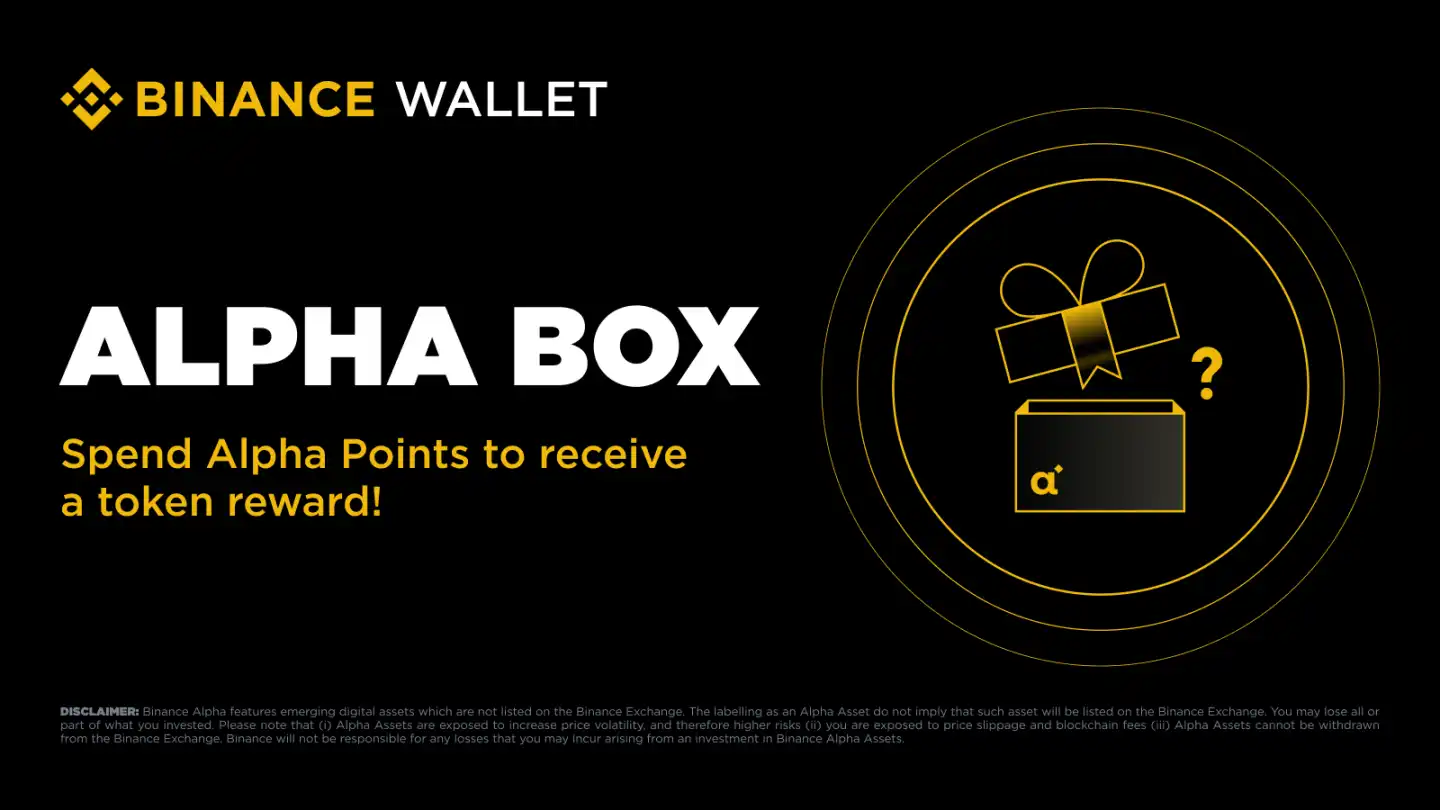
Every iteration of Binance Alpha's airdrop mechanism reshapes user behavior and project strategies. When you open the Binance Wallet to claim your airdrop, you cannot know in advance which project’s tokens you will receive. Can this kind of "blind box" uncertainty attract users to participate again?
Alpha Box Blind Box Mechanism
According to Binance’s official announcement, Alpha Box is "Binance's original new airdrop model," aggregating the tokens of multiple projects into a single event. Each Alpha Box event may contain rewards from up to 10 different projects. The specific number of participating projects and rewards may vary depending on the event.
The core mechanism involves users consuming 15 Alpha points to participate, but each box only contains one type of token—you won’t know which one until the moment of receipt. Users cannot choose which token to claim.
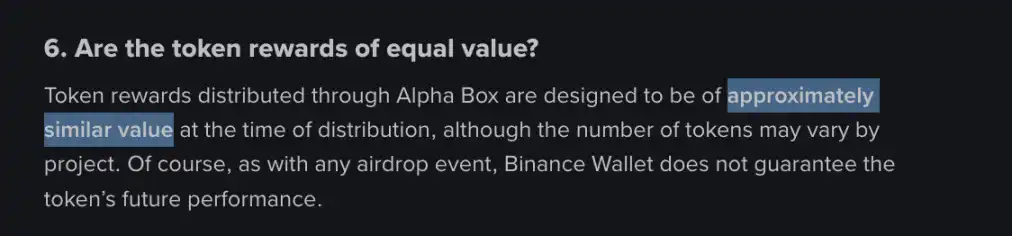
The official emphasizes that users will receive tokens of "approximately similar value," but the number of tokens from different projects may vary. But how is "equivalence" defined? Based on the valuation provided by the project party or according to the real-time market price? This ambiguity is worth pondering.
The first Alpha Box event will launch on February 11, adopting a first-come-first-served mechanism, with the points threshold automatically reducing by 5 points every 5 minutes until the airdrop pool is exhausted. This design creates a sense of urgency: will you spend high points to participate now, or wait for the threshold to drop but risk it being snatched up?
The success of Pop Mart indeed confirms the success of the blind box mechanism, so will the tokens distributed through blind boxes by Binance bring unexpected effects? For example, the holding period for users may be extended because they "don’t know which one it is", making them less eager to sell.
For project parties, traditional airdrops require directly sending tokens to users' wallets, with costs accounting for 5%-20% of the total token supply, but most users sell right after claiming, resulting in a retention rate of less than 10%. Under the Alpha blind box mode, project parties only need to provide the token pool to Binance, while the platform handles user screening and distribution. The advantage is higher user quality (incentive thresholds filter), while the cost is that project parties lose control over distribution—your tokens may be "mixed" with several other projects, and users won’t even know which airdrop they are participating in until the moment of receipt.
Self-Evolution of Binance Alpha: Rule Adjustments Five Times a Year
On December 17, 2024, Binance Alpha officially launched, and the initial mechanism was relatively simple: users accumulated points by holding assets and trading, with points calculated through a rolling window of 15 days. However, Binance quickly discovered that the rules needed constant adjustments.
On May 13, 2025, the first major reform: the introduction of a point consumption mechanism. Previously, users only needed to accumulate points to participate in airdrops "for free," but now they must consume points to claim—15 points for each claim. This seemingly simple change essentially shifted points from a "the more, the better" accumulation model to a "accumulated points will also be spent" deflationary model.
On June 6, 2025, the second adjustment: limiting the scope of trading. Only tokens from Binance Wallet or Binance Spot Market can accumulate Alpha points. This was a precise strike against "volume brushing arbitrage"—it was discovered that people could earn points by trading junk coins wildly on other DEXs, and Binance directly blocked this path.
On June 19, 2025, the third adjustment: launching a two-phase airdrop system. The first phase is only open to accounts that reach a high threshold X, and the second phase lowers the threshold to Y (YX), with a first-come-first-served approach. This design takes care of "points big holders" while leaving a glimmer of hope for ordinary users.
In September 2025, the fourth adjustment: new coin trading receives a 30-day points bonus. During the first 30 days after a new coin goes live, trading volume can earn 2-4 times the points. This is a typical "liquidity incentive"—rewarding users with the maximum points when the new coin needs liquidity the most.
On February 10, 2026, the fifth adjustment: launching the Alpha Box blind box mechanism. This was no longer a minor adjustment but a complete model innovation.
With rule adjustments happening five times a year, it exposed Binance's strategy: how to find a balance between "attracting user participation" and "preventing arbitrage by opportunists"? The answer is—constantly experimenting and adjusting.
Users Vote with Their Feet
Why change? Data is more persuasive than any narrative. According to data from the Alpha123 platform, the number of users on Binance Alpha has dropped from nearly 500,000 in November 2025 to about 200,000 in January 2026, a decline of over 60%.
The introduction of the blind box mechanism may be Binance's attempt to address this predicament. Will transforming "certainty" into "randomness" reignite user participation enthusiasm?
The first Alpha Box event on February 11 will test the answer to this question. A refined experiment on user screening, value distribution, and ecological governance is just beginning.
免责声明:本文章仅代表作者个人观点,不代表本平台的立场和观点。本文章仅供信息分享,不构成对任何人的任何投资建议。用户与作者之间的任何争议,与本平台无关。如网页中刊载的文章或图片涉及侵权,请提供相关的权利证明和身份证明发送邮件到support@aicoin.com,本平台相关工作人员将会进行核查。


