The market expects that tonight's new jobs will be only 70,000, but the real eye of the storm is that report that could erase nearly a million historical jobs due to benchmark revisions. Tonight at 21:30, the delayed U.S. January non-farm payroll report will unveil the truth. This data release has been referred to by Bank of America analysts as “the Super Bowl of employment reports”, not only because it will reveal the employment situation for the first full month of 2026, but also because it includes a comprehensive reassessment of employment data from the past year.
The market generally expects about 70,000 new jobs for January, with the unemployment rate remaining at 4.4%. However, the real focus of the market is on the annual benchmark revision, with initial estimates suggesting that the one-year employment data up to March 2025 could be revised down by about 911,000 jobs.

1. Delayed Data Release
● The U.S. non-farm payroll report was originally scheduled to be released in early February, but was delayed due to a partial government shutdown in the United States. Data collection work could only be resumed after an appropriation agreement was reached between the Trump administration and Senate Democrats.
● Although the shutdown has ended, the Department of Labor still needed time to complete data compilation and verification, ultimately confirming that the January non-farm report would be delayed until February 11.

● This delay not only affected the non-farm data, but also the January Consumer Price Index report that was originally scheduled for release during the same period, which has been adjusted to February 13. This means that the market will consecutively face two major data impacts this week, adding more uncertainty to the last trading week before the Spring Festival.
2. Market Expectations
● The market has reached a basic consensus on the expectations for the January non-farm data. The expected number of new jobs is concentrated between 60,000 and 85,000. Although these figures may appear below historical averages, they are viewed as a performance of “stability” trends in the current environment.
● The unemployment rate is expected to remain at 4.4%, in line with the previous value. Average hourly wage growth is projected to grow by 0.3% month-on-month, consistent with recent trends. If this prediction materializes, the annual growth rate of wages will drop to 3.6%, slightly lower than December's 3.8%.
● However, underlying these superficial figures are deeper signals. Some leading indicators have shown yellow or even red light signals in the labor market.
3. Report Focus
● The core focus of tonight's report is not the data for January but the annual benchmark revision of historical employment data. The U.S. Bureau of Labor Statistics will recalibrate the annual employment data up to March 2025 based on more comprehensive "Employment and Wage Quarterly Census" data.
● Initial estimates suggest that this revision could reach a downward revision of 911,000 jobs, setting a historic record. However, some analysts believe that the final correction figure might be around 720,000, slightly lower than the initial estimate.
● It is noteworthy that most of the corrections are concentrated in the second half of 2024, particularly in the leisure and hospitality industry, trade transportation, and professional and business services sectors. The updated "birth-death" model could bring an additional "downward revision of 20,000-30,000 people" to the monthly employment data starting from April.
4. Policy Game
● The potential impact of data corrections has sparked divisions within the Federal Reserve. On one hand, Powell believes that job growth may be overestimated but the overall economy still shows resilience; on the other hand, Governor Waller has explicitly stated that the revised data may indicate that last year's employment“barely grew”.
● Mary Daly, president of the San Francisco Federal Reserve Bank, recently stated that she believes “one or two more rate cuts may be needed” to address the weakness in the labor market.
● Daly pays special attention to the predicament faced by workers: rising prices eroding wage income while new job opportunities are scarce. She pointed out that the difficulties faced by recent college graduates in job hunting are worrisome indicators of a weak labor market.
5. Market Linkages
● The release of non-farm data shows a significant correlation with the cryptocurrency market. When employment data falls short of expectations, cryptocurrencies like Bitcoin tend to spike sharply, as market expectations for Fed rate cuts subsequently rise.
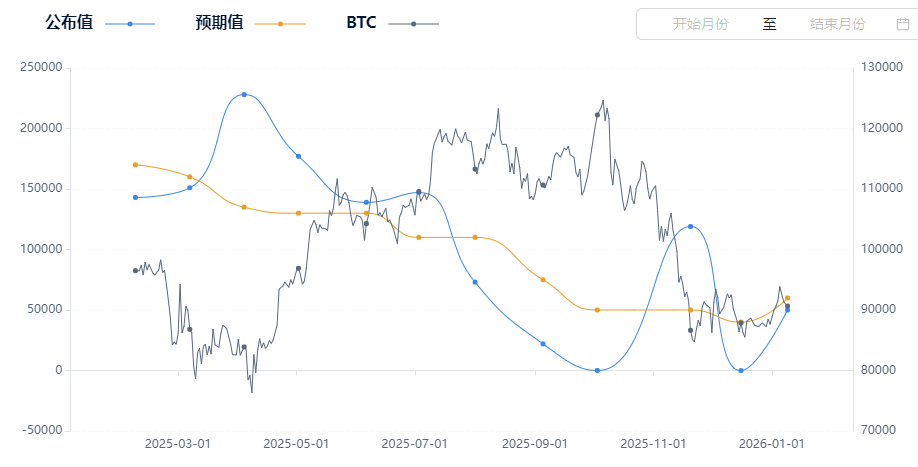
● As of the latest data, Bitcoin surged over 3%, reaching above $71,000, after previously dropping to around $68,500. Amid the volatility, data shows nearly 90,000 individuals faced liquidations in the past 24 hours.
● Bitcoin is currently viewed as a key indicator of market risk appetite. The current price maintains a range fluctuation, with around $80,000 representing a key structural resistance which indicates whether risk capital is returning; below $75,000 serves as an important support area reflecting the market’s bottom line during the deleveraging process.
6. Investment Strategy
● In anticipation of tonight's data release, market participants should prepare for various possible scenarios. If the data is strong, with new jobs exceeding 120,000, it could trigger a “sharp short-covering rebound” in the dollar, pushing the dollar index back to the 99.30 area.
● Conversely, if the data is weak, with new jobs below 50,000 or even negative growth, it will validate the dovish camp's viewpoint. This may push the dollar index to fall below the current support level to 97.60.
● Regarding the possibility of a Fed rate cut in March, the market currently prices this probability at about one-sixth. If tonight's employment data is weaker than expected or the downward correction is overly pronounced, combined with Friday's CPI report indicating a drop in price pressure, the probability of a rate cut could rise to over 33%.
The short-term trend of the dollar depends on tonight's non-farm report at 21:30. If new jobs exceed 120,000, the dollar index may soar to 99.30; if below 50,000, it may drop to 97.60.
Meanwhile, the cryptocurrency market is holding its breath in anticipation. Bitcoin is fluctuating around $71,000, with nearly 90,000 liquidations occurring in the past 24 hours of volatility. Regardless of the data, this night is bound to leave a mark in the memory of global capital markets.
Join our community to discuss and strengthen together!
Official Telegram community: https://t.me/aicoincn
AiCoin Chinese Twitter: https://x.com/AiCoinzh
OKX Welfare Group: https://aicoin.com/link/chat?cid=l61eM4owQ
Binance Welfare Group: https://aicoin.com/link/chat?cid=ynr7d1P6Z
免责声明:本文章仅代表作者个人观点,不代表本平台的立场和观点。本文章仅供信息分享,不构成对任何人的任何投资建议。用户与作者之间的任何争议,与本平台无关。如网页中刊载的文章或图片涉及侵权,请提供相关的权利证明和身份证明发送邮件到support@aicoin.com,本平台相关工作人员将会进行核查。