The pullback in January-February 2026 is not a rejection of digital assets, but a repricing within the constantly changing global monetary system.
Author: Dhruvang Choudhari (AMINA Bank)
Translation: Deep Tide TechFlow
Deep Tide Overview: January 2026 presents a paradox: cryptocurrency prices fell by 25%, yet the infrastructure supporting institutional adoption is accelerating. While Bitcoin dropped to a ten-month low of $73,000, BlackRock listed digital assets as a decisive investment theme for 2026.
While leveraged traders liquidated $2.2 billion in positions, depository trusts and clearing companies launched production-grade tokenization for U.S. Treasuries and stocks. Despite the sentiment index reaching extreme pessimism, Y Combinator announced it would begin funding startups with USDC.
AMINA Bank's analysis points out that this is not a rejection of digital assets, but a repricing within the constantly changing global monetary system. The divergence between price behavior and structural progress defines the current phase of the cycle.
Full Text:
Introduction
January 2026 presents a paradox: cryptocurrency prices fell by 25%, yet the infrastructure supporting institutional adoption is accelerating.
While Bitcoin dropped to around $73,000, a ten-month low, BlackRock listed digital assets as a decisive investment theme for 2026. While leveraged traders liquidated $2.2 billion in positions, depository trusts and clearing companies (DTCC) launched production-grade tokenization for U.S. Treasuries, large-cap stocks, and ETFs. Despite the sentiment index reaching extreme pessimism, Y Combinator announced it would begin funding startups with USDC.
The first two months of 2026 marked a decisive shift in the digital asset market. What initially seemed like chaotic selling was actually driven by sovereign risk, changes in the monetary system, and forced deleveraging globally. Unlike previous crypto downturns, this event did not originate from the digital asset ecosystem itself; it emerged from external factors.
January and February revealed a paradox that is now central to the institutional crypto era. Market prices deteriorated sharply, yet regulatory clarity, infrastructure deployment, and institutional commitment advanced at an unprecedented pace. This divergence between price behavior and structural progress defines the current phase of the cycle.
This update analyzes how macroeconomic shocks disrupted the crypto market structure, why Bitcoin faces identity challenges as a macro asset, and how institutional capital continues to build amidst volatility rather than retreat.
Institutional Expansion Amid Market Weakness
Despite the deterioration in spot prices, institutional participation is accelerating rather than slowing down. This acceleration reveals how mature allocators are fundamentally shifting their approach to digital assets: infrastructure maturity is now more important than price momentum.
Tokenization as a Core Strategy
BlackRock officially listed digital assets and tokenization as a decisive investment theme for 2026, alongside artificial intelligence as a structural driver of capital markets.
At Franklin Templeton, the innovation leadership described 2026 as the beginning of a wallet-native financial system, where stocks, bonds, and funds are directly held in digital wallets rather than through traditional custodial frameworks.
Y Combinator sent a key signal, announcing that from the Spring 2026 batch, startups could receive funding in USDC on Ethereum, Base, and Solana. Stablecoin settlements are now typically cleared in under a second, costing less than $0.01, providing a significant advantage over cross-border fiat rails.
Reduction in Regulatory Friction
Regulatory developments have quietly eliminated long-standing structural barriers. The SEC rescinded previous accounting guidance that hindered banks from providing digital asset custody services. Meanwhile, depository trusts and clearing companies (DTCC) launched production-grade tokenization programs for U.S. Treasuries, large-cap stocks, and ETFs, confirming the legal equivalence of tokenized securities and traditional securities.
This marks a shift from experimental adoption to upgrades in internal financial infrastructure.
Regional Competition for Crypto Capital
Jurisdictions are increasingly deploying policies as competitive leverage.
Hong Kong announced zero tax incentives on qualified digital asset gains for funds and family offices, positioning itself as a major institutional crypto hub in Asia. As of January 2026, 11 licensed virtual asset trading platforms are operational.
Meanwhile, Dubai continues to implement its blockchain-first government strategy, aiming for on-chain processing in 50% of public sector transactions by the end of 2026. The UAE's crypto penetration has reached approximately 39%, representing over 3.7 million users.
Macroeconomic Shocks Disrupting the Calm
Understanding why institutions continue to build requires understanding what drove the sell-off. The relative stability of 2025 fostered expectations that crypto had entered a low-volatility, institutionally anchored phase. These assumptions were shattered in January.
Liquidation of Japanese and Global Leverage
On January 20, 2026, the Japanese government bond market entered acute stress. The 30-year JGB yield surged over 30 basis points to 3.91%, the highest level in 27 years, as Prime Minister Fumio Kishida's fiscal comments intensified concerns about debt sustainability. Japan's debt-to-GDP ratio has exceeded 250%, becoming the focus of the global bond market.
Figure 1: Historical Yield of Japan's 30-Year Government Bonds
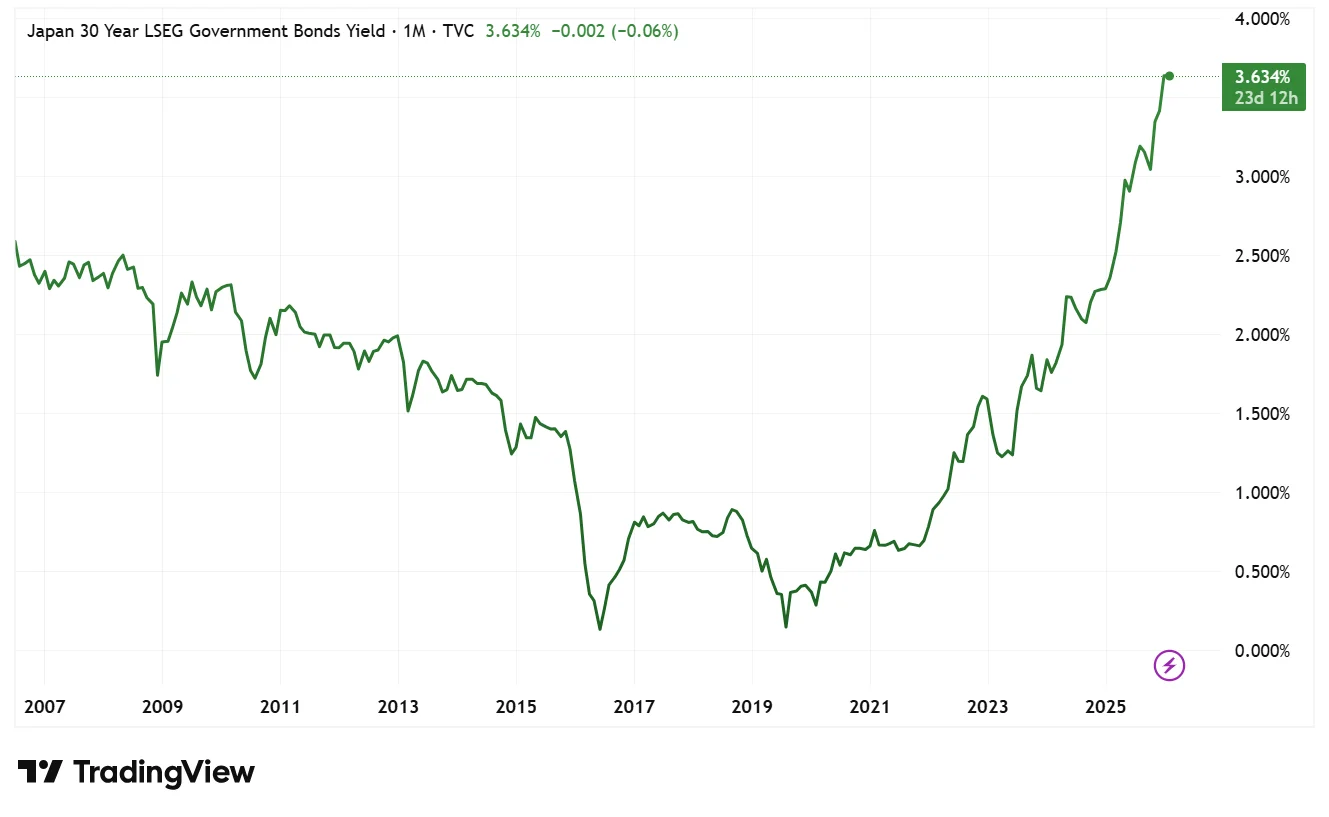
Source: TradingView
The direct consequence was the rapid liquidation of yen carry trades, one of the largest sources of cheap global leverage. As the cost of yen financing rose, investors were forced to liquidate risk assets to meet margin requirements. Bitcoin fell below $91,000, not due to crypto-specific weakness, but because it acted as a liquidity proxy for balance sheet repair.
Warsh Nomination and Monetary Repricing
This pressure escalated on January 30 with the nomination of Kevin Warsh as the next Federal Reserve Chair. Warsh's long-standing preference for higher real interest rates and significant reductions in the Fed's balance sheet was interpreted as a clear shift away from accommodative monetary policy.
Within 24 hours, the total market capitalization of cryptocurrencies dropped by approximately $430 billion. Bitcoin fell about 7% in a single trading day, while Ethereum and high-beta altcoins experienced double-digit percentage pullbacks. This trend reflected a repricing of expectations for global dollar liquidity rather than speculative panic.
Price Trends and Bitcoin's Identity Crisis
The macro shocks revealed an unsettling truth about Bitcoin's evolution as an institutional asset. The last week of January produced one of the most severe single-day dislocations in the institutional era.
On January 29, Bitcoin plummeted from $96,000 to $80,000, a single-day drop of about 15%. The crypto derivatives market liquidated over $2.2 billion in leveraged positions. The significance of this trend lies not in its magnitude, but in its correlation characteristics.
Bitcoin failed to decouple from stocks, instead trading in sync with high-beta tech stocks. During the global deleveraging event, it did not act as a defensive asset but rather as a liquidity-sensitive risk tool.
By early February, sentiment indicators reflected extreme pessimism. The Crypto Fear and Greed Index dropped to 19, while key technical levels, including the $85,400 0.786 Fibonacci retracement level, were decisively breached. The high $70,000 range became a major structural support area for the market.
Figure 2: Bitcoin Price Decline Driven by Global Macroeconomic Events (January-February 2026)
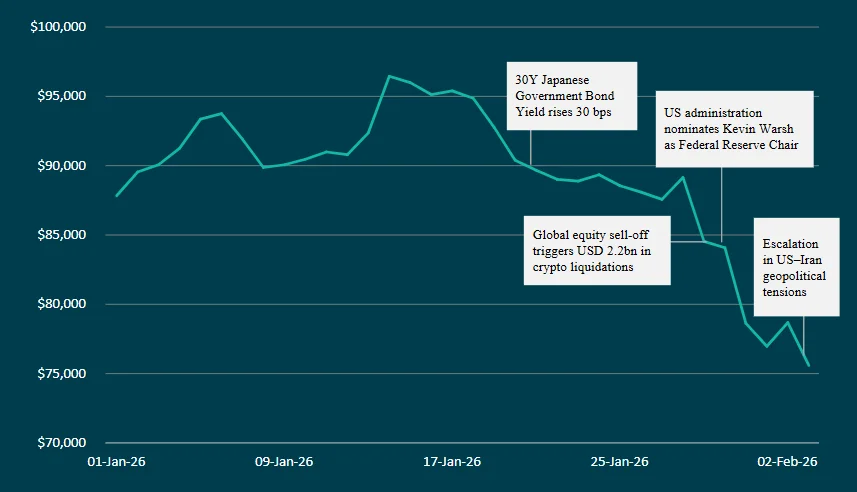
Source: AMINA Bank
The correlation characteristics raised fundamental questions about Bitcoin's role in institutional portfolios. If it behaves as a high-beta tech proxy rather than a defensive hedge during stress, the allocation argument must be adjusted accordingly. However, institutional commitments continue regardless, indicating that mature allocators are pricing Bitcoin's long-term structural role rather than its short-term correlation behavior.
Protocol Evolution and Competitive Differentiation
While prices fell and macro conditions worsened, foundational layer development continued uninterrupted. This showcases a key feature of the current cycle: infrastructure development has decoupled from price momentum.
Ethereum remains focused on scaling through execution efficiency, censorship resistance, and MEV mitigation. The upcoming Glamsterdam upgrade aims to raise the gas limit to 200 million, with theoretical throughput approaching 10,000 TPS.
Solana is pursuing aggressive performance enhancements. Its Alpenglow upgrade aims to reduce transaction finality from 12.8 seconds to approximately 100-150 milliseconds, positioning it as one of the fastest settlement layers in production.
These technological advancements continue regardless of market sentiment, reflecting long-term capital commitments and engineering developments independent of price behavior.
Security Losses Highlight Operational Risks
Even as institutional infrastructure matures, security incidents underscore ongoing operational vulnerabilities. January 2026 recorded over $370 million in stolen funds, the highest monthly total in nearly a year. Over $311 million of the losses stemmed from phishing and social engineering attacks, rather than smart contract failures.
The largest single incident involved over $280 million, related to AI-generated voice impersonation targeting hardware wallet users. These events highlight a structural shift in risk. Human and operational vulnerabilities now represent the primary attack surface for institutional crypto participants.
This pattern reinforces why custodial frameworks operating under regulatory oversight provide a competitive advantage beyond compliance. Operational security protocols, institutional-grade key management, and insurance frameworks have become essential requirements.
Conclusion
The pullback in January-February 2026 is not a rejection of digital assets, but a repricing within the constantly changing global monetary system. Crypto now directly responds to sovereign bond markets, central bank leadership, and geopolitical escalations. This sensitivity introduces volatility, but it also confirms integration.
Meanwhile, institutional adoption, regulatory clarity, and protocol development advance amidst the sell-off. Tokenization shifts from narrative to deployed infrastructure, and wallet-native finance moves from theory to implementation.
The beginning of 2026 did not mark the collapse of the crypto market. It marked the first true stress test of its institutional maturity. While prices failed the test, the underlying infrastructure passed with flying colors.
The divergence between price behavior and structural progress will not continue indefinitely, as institutional deployment, regulatory clarity, and infrastructure maturity will ultimately be reflected in market valuations.
免责声明:本文章仅代表作者个人观点,不代表本平台的立场和观点。本文章仅供信息分享,不构成对任何人的任何投资建议。用户与作者之间的任何争议,与本平台无关。如网页中刊载的文章或图片涉及侵权,请提供相关的权利证明和身份证明发送邮件到support@aicoin.com,本平台相关工作人员将会进行核查。


