Original Title: "BTC Halved, But Bitcoin Wallets Still Valued at $4 Billion"
Original Author: Lin Wanwan, Dongcha Beating
The price of Bitcoin has halved, but the company selling BTC shovels has announced plans to go public in the U.S.
In the early hours of January 21, 2025, in the small town of Villeron, central France.
David Balland was dragged from his sleep, and before he could grasp the situation, he and his wife were shoved into two cars. Ten minutes later, the two cars drove off in different directions.
What happened in the next 48 hours resembled a poorly made kidnapping film. The kidnappers cut off one of Balland's fingers, took a photo, and sent it to his former colleagues, demanding a ransom of $10 million in Bitcoin.
The French special forces GIGN deployed over 90 personnel, conducting simultaneous operations at two locations, ultimately rescuing the couple.
Balland is the co-founder of Ledger.
The story had a good ending. The kidnappers accepted part of the ransom in USDT, but Tether cooperated with law enforcement to freeze 95% of the funds. The on-chain transaction records were clear, and there was no escape. All ten suspects were captured and faced life imprisonment.
The kidnappers were able to find Balland because Ledger experienced a customer data leak in 2020, with names, addresses, and phone numbers posted on the dark web. As a founder, Balland's information was naturally included.
The reason the kidnappers did not directly steal coins from the blockchain is that they couldn't. The private keys were stored in offline devices, and without internet access, they couldn't be stolen. So they resorted to the most primitive method: kidnapping, forcing you to transfer the coins yourself.
This precisely illustrates one thing: hardware wallets are useful. The online hacking techniques are ineffective against them, forcing criminals to upgrade to offline crimes.
However, Balland's experience also serves as a reminder to all coin holders: protecting your private keys is just the first step; protecting your personal identity information is equally important. No matter how deeply you hide your coins, if others know who you are and where you live, trouble may come knocking.
Decoupling assets from identity is the core logic of self-custody in Bitcoin wallets. It is also the reason for Ledger's existence as a business.
After the kidnapping incident, the Financial Times reported that Ledger was preparing for an IPO in the U.S. Goldman Sachs, Jefferies, and Barclays teamed up to sponsor the listing, with the New York Stock Exchange chosen as the venue.
Meanwhile, the price of Bitcoin was undergoing another round of severe adjustments, dropping from a high of $126,000 in October 2025 to below $70,000.
The halving of BTC did not affect the industry's progress; by January 2026, Ledger's valuation exceeded $4 billion.
1. The Shovel Seller
The cryptocurrency industry is rife with stories of sudden wealth and total loss. Some have made hundreds of millions overnight, while others have woken up to find their wallets emptied.
Ledger is an anomaly in this industry. It does not issue coins, does not operate a trading platform, and does not engage in DeFi. It only does one thing: sells a small device that looks like a USB drive, telling you to store your private keys inside so hackers can't steal them.
What does Ledger do?
It sells hardware wallets, simply put, helping people safeguard their Bitcoin private keys.
At $79 each, it has sold over 7 million units in ten years.
There’s an old saying in the startup world: during a gold rush, the ones making the most money are not the gold miners, but those selling shovels and jeans. In simple terms, Ledger is the shovel seller in the crypto world.
The brilliance of this business lies in the fact that it does not have to bet on the rise and fall of coin prices.
During a bull market, newcomers flood in, needing to buy a wallet to safeguard their newly acquired coins. In a bear market, seasoned users who have experienced a crash cherish their remaining chips even more and also need a safe place to store them.
When coin prices rise, your assets become more valuable, making it worth spending $79 for protection. When prices fall, you are even less inclined to let hackers steal your assets, so you still spend $79 for peace of mind.
No matter how you calculate it, Ledger wins.
In November 2022, during the week of the FTX collapse, Ledger's website nearly crashed due to traffic. "Not your keys, not your coins," the saying that has circulated in the crypto punk community for years, suddenly became a consensus among the masses.
Trading platforms may run away, project teams may disappear, but an offline hardware device will not betray you.
To translate, when others are fearful, it is precisely when their business is at its best.
This ability to traverse cycles is a story Wall Street loves.
Ledger's list of investors reads like a directory of top institutions: 10T Holdings, Samsung Ventures, Morgan Creek, Cathay Innovation. It has raised a total of $575 million. In 2023, it was valued at $1.5 billion, and now it aims for a $4 billion valuation on the New York Stock Exchange. In less than two years, it has nearly tripled.
This calculation is actually quite straightforward. The total market value of global crypto assets, even during this adjustment period, is over $2 trillion. Ledger claims to safeguard about 20% of that, with over $100 billion in Bitcoin resting in users' devices.
Is a company safeguarding $100 billion in assets, valued at $4 billion, expensive?
Compared to traditional financial custodians, this figure is quite restrained.
2. Traversing Cycles
Ledger did not emerge overnight.
In 2014, a few French engineers founded the company in Villeron. At that time, the price of Bitcoin was hovering around a few hundred dollars, and most people thought it was a Ponzi scheme.
Ten years later, the company has gone through three complete bull and bear cycles: the frenzy of 2017, the crash of 2018, the madness of 2021, the crash of 2022, the ETF market in late 2024, and now the current adjustment.
In every cycle, Ledger has survived and grown larger.
The secret is quite simple: it sells a necessity.
Whether the price is $100,000 or $30,000, as long as you have coins, you need a safe place to store them. This demand does not disappear due to market conditions.
In 2025, the company's revenue reached a historic high, reaching the "hundreds of millions" level. This was stated by CEO Gauthier himself. Compared to over $70 million in 2024, the growth is quite significant.
More importantly, the revenue structure is changing.
In the early years, Ledger was simply selling hardware, making a profit of $79 per unit sold. Now the product line has expanded. The entry-level Nano S Plus is still $79, the mid-range Nano X with Bluetooth sells for $149, and the high-end Stax with an E Ink touchscreen sells for $279.
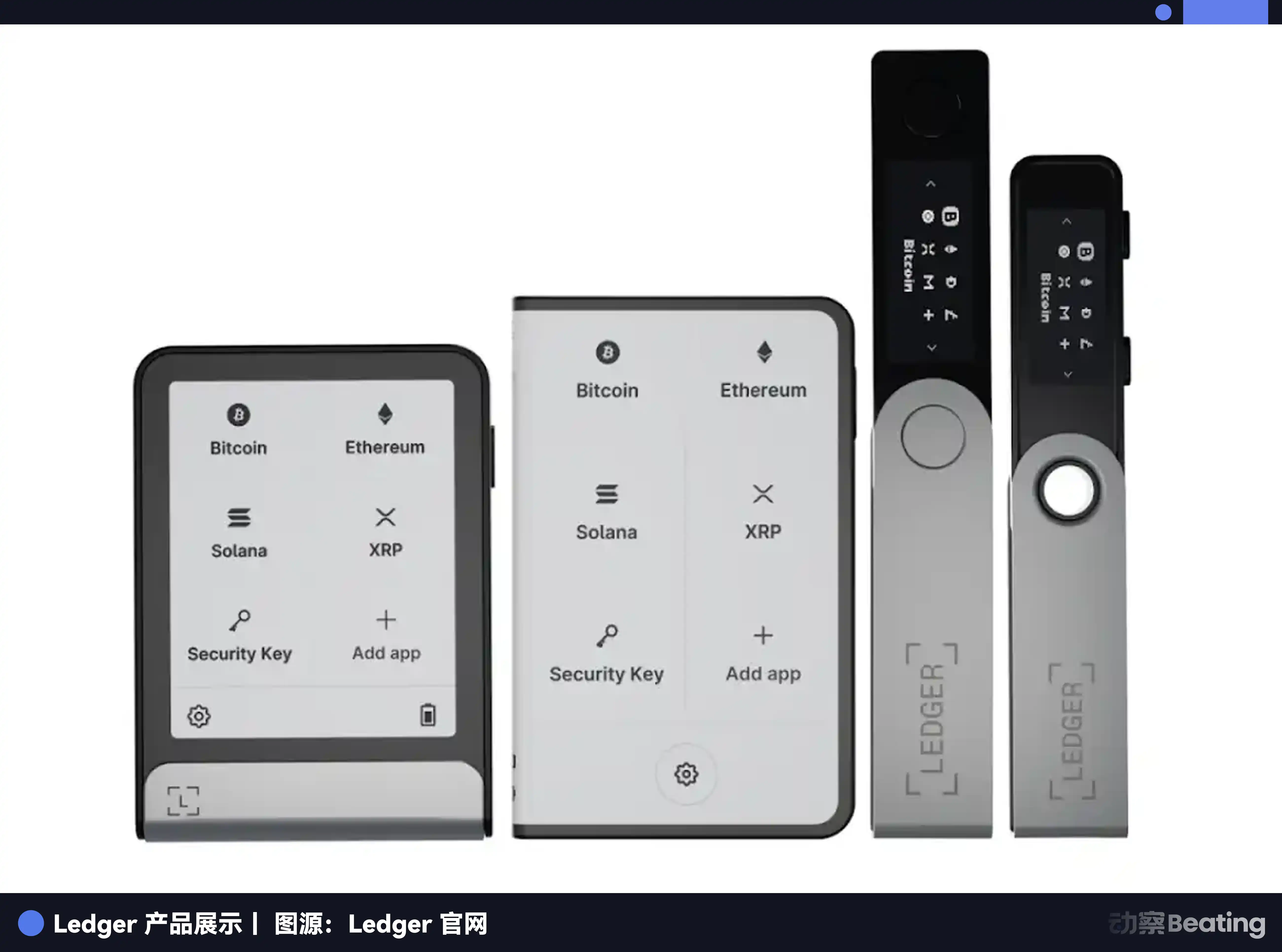
In addition to hardware, there is also software. The Ledger Live app allows users to buy, swap, and stake coins directly, with the company earning a commission on each transaction. There is also Ledger Enterprise, a service specifically for institutional clients, managing over $10 billion in assets for more than 100 clients.
From selling hardware to selling services, from one-time revenue to recurring revenue. Ledger has been on this path for ten years and is finally seeing results.
CEO Gauthier is not from a founding background. He previously served as COO at French ad tech company Criteo, helping the company reach a market value of €2.1 billion and successfully go public. He later spent a few years in venture capital before being invited to lead Ledger in 2019.
A professional manager with IPO experience is at the helm of a company preparing for an IPO. The configuration is quite reasonable.
After taking office, Gauthier did several things. He brought in Tony Fadell, the inventor of the iPod, to help design new products, upgrading the product line from geek toys to consumer electronics. The $279 Ledger Stax resembles a Kindle and can display your NFT collection.
The hardware wallet category has taken on a touch of luxury under his leadership.
In October last year, the company held a launch event called Ledger Op3n, unveiling the next generation product, Nano Gen5. It features a touchscreen and significantly upgraded user experience. Also released was the new version of the Ledger Live app, which integrates more functions.
From products to services to ecosystems, Ledger aims to be the gateway to the crypto world.

3. Ring the Bell
Ledger's plan to ring the bell on the New York Stock Exchange is not an isolated event.
In 2025, crypto companies raised a total of $3.4 billion through IPOs. Stablecoin issuer Circle raised over $1 billion, and trading platform Bullish also raised over $1 billion. Trading platform Gemini saw a 14% increase on its first day of trading. In January of this year, custody service provider BitGo went public on the New York Stock Exchange, with a first-day increase of 24.6%, pushing its market value to $2.6 billion.
A window that had been closed for three years has reopened.
During the winter of 2022, almost no one dared to mention IPOs. Luna collapsed, FTX imploded, Three Arrows Capital went bankrupt, and the entire industry was in disarray. At that time, surviving was already a feat; who was still thinking about going public?
The turning point occurred in 2024. The approval of Bitcoin spot ETFs allowed Wall Street money to officially enter the market. Trump promised to support the crypto industry during his campaign and signed an executive order after taking office. The SEC changed its chairman, and the regulatory attitude shifted significantly.
Now, there is a long list of companies waiting to ring the bell, with many successes, from Circle to various trading platforms. There’s also Kraken, the second-largest crypto trading platform in the U.S., valued at $20 billion, aiming for the first half of this year. Consensys, the parent company of the MetaMask wallet, is valued at $7 billion and has enlisted JPMorgan and Goldman Sachs as sponsors. South Korea's Bithumb has partnered with Samsung Securities, preparing to go public in Seoul.
The crypto industry is undergoing a collective "coming of age."
Over the past decade, this industry has grown wildly. ICOs, DeFi, NFTs, meme coins—waves of trends, with many making quick money and few doing solid work.
Now it’s different. Companies that have reached the IPO stage are survivors who have traversed cycles. They have real revenue, auditable financial statements, and compliant operational systems.
This is a sign of industry maturity.
Ledger is somewhat unique among these companies. It is not a trading platform, and its revenue does not rely on trading volume. It is not a stablecoin, so it does not have to worry about reserve audits. It is infrastructure, the "water, electricity, and gas" of the crypto world.
No matter what coins you trade or what chains you use, you need a safe place to store your private keys. As long as this industry exists and as long as there are people holding crypto assets, Ledger's business will continue.
This certainty is what the capital market values most.
Gauthier once said, "The money in the crypto industry is in New York today; there is no second place in the world."
A French company chooses to go public in New York. The founding team is in Paris, but the capital is in Manhattan. This has been a common path for global tech startups over the past decade.
When Bitcoin was born, Satoshi Nakamoto aimed to create a payment system that did not require trust in any institution. Sixteen years later, the companies that have grown around Bitcoin are now heading one by one to the largest capital market in the world, accepting the most traditional trust endorsement.
This should not be seen as a betrayal of the original intention; it is the industry growing up.
The phase of wild growth is over; the next stage is institutionalization, compliance, and mainstreaming. For those still in this industry, this is actually good news.
The price of Bitcoin is still fluctuating. But the infrastructure built around Bitcoin is gradually moving into the mainstream world.
After all, the halving of coin prices is just a brief comma in the process of this cycle.
免责声明:本文章仅代表作者个人观点,不代表本平台的立场和观点。本文章仅供信息分享,不构成对任何人的任何投资建议。用户与作者之间的任何争议,与本平台无关。如网页中刊载的文章或图片涉及侵权,请提供相关的权利证明和身份证明发送邮件到support@aicoin.com,本平台相关工作人员将会进行核查。


