Clawdbot, now known as Moltbot, is an open-source, self-hosted personal artificial intelligence (AI) assistant created by developer Peter Steinberger. Unlike browser-based chatbots, Moltbot runs directly on a user’s own hardware—ranging from desktop computers to compact devices like Raspberry Pi—and connects to popular messaging platforms such as Whatsapp, Telegram, Discord, Slack, and iMessage.
The result is an AI assistant that lives where users already communicate, rather than forcing them into a new interface. What sets Moltbot apart is its ability to act autonomously. It can manage calendars, send reminders, execute terminal commands, handle emails, control smart-home devices, and even check users in for flights, all through conversational prompts.

The assistant is designed to retain context over time, allowing it to follow up, message first, and handle routine administrative tasks with minimal supervision. In short, it behaves less like a chatbot and more like a digital employee. Under the hood, Moltbot consists of two primary components: a locally running agent powered by large language models and a gateway that connects that agent to external messaging services.
While the intelligence can be sourced from cloud-based models such as OpenAI‘s ChatGPT, Anthropic’s Claude, or Google’s Gemini, the assistant’s memory, configuration, and skills are stored locally as files, keeping user data under direct control. That architecture has made Moltbot highly extensible. Users can install or create custom “skills”—essentially scripts or plugins—that teach the assistant new capabilities.
With permission, the bot can even modify parts of its own environment to better serve user needs. This flexibility has fueled enthusiasm among developers who see Moltbot as a glimpse into the future of agent-driven AI. The project’s momentum accelerated rapidly in late January, when Moltbot went viral across tech media and social platforms.
Coverage described it as a “24/7 Jarvis,” and a wave of memes followed, including images of users stacking Apple Mac minis to run multiple instances of the assistant. While exaggerated for effect, the jokes reflected genuine excitement about always-on personal AI running locally rather than in a browser tab.
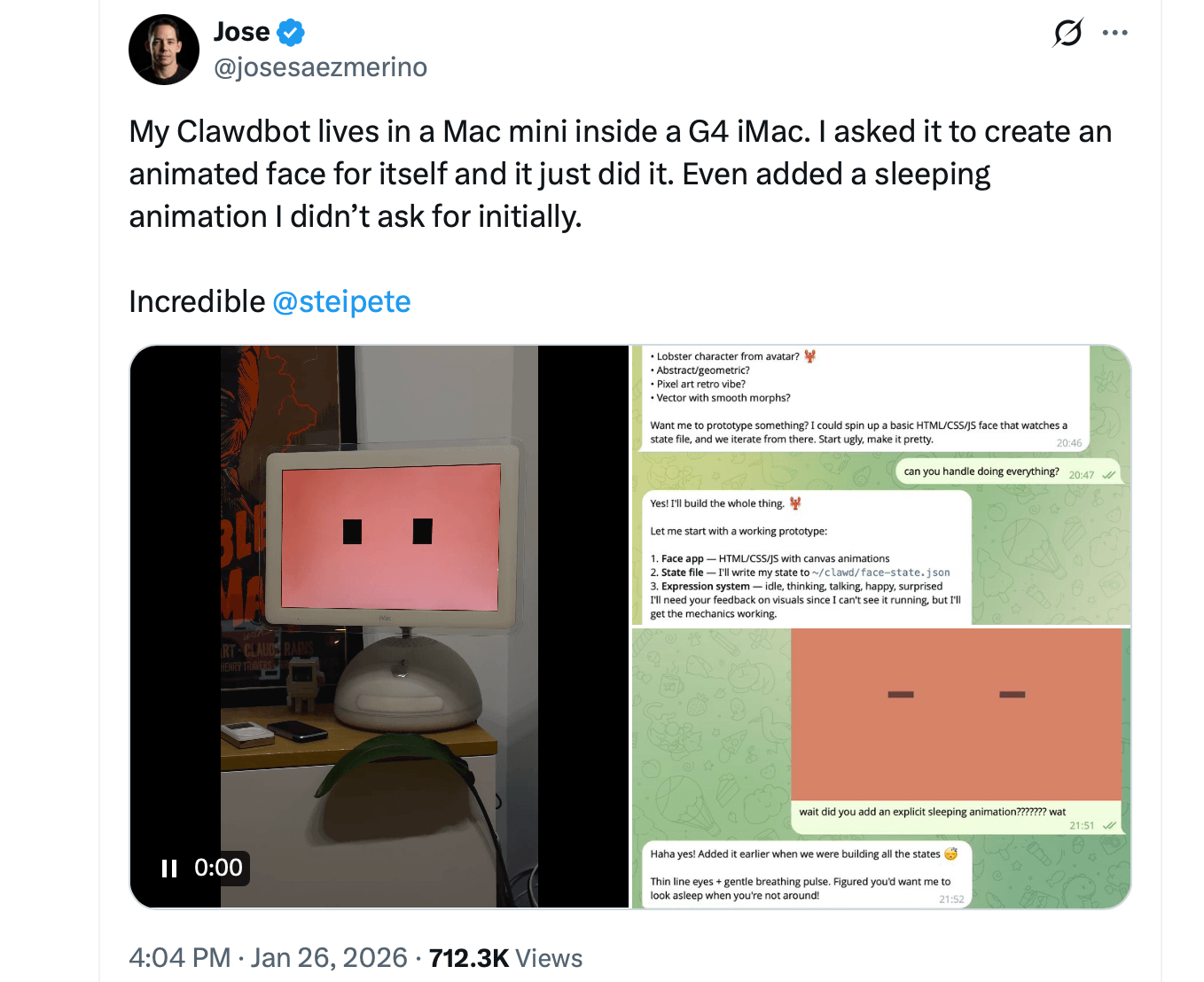
Moltbot’s popularity is measurable. Its Github repository climbed from roughly 5,000 stars to more than 60,000 in a matter of weeks, placing it among the fastest-growing open-source projects on the platform. Community servers also expanded quickly, with thousands of new users joining discussion channels almost overnight.
Amid that rise, the project underwent an abrupt name change. Following a trademark complaint from Anthropic, Steinberger agreed to rebrand Clawdbot as Moltbot, citing concerns that the original name and lobster mascot were too close to Claude branding. The new name references a lobster molting its shell, signaling growth rather than a change in mission.
The rebrand, however, triggered unintended consequences. During the brief transition, scammers reportedly hijacked the original Clawdbot social media and Github handles, using them to promote a fraudulent meme coin. Steinberger publicly disavowed the token, warning users that any cryptocurrency claiming official ties to the project was a scam. The episode highlighted how quickly hype can attract bad actors.
Security concerns have also followed Moltbot’s rise. Researchers found that some users had deployed instances with weak or nonexistent authentication, exposing sensitive data and system access to the open internet. In addition, the project’s skill system currently lacks sandboxing, meaning downloaded scripts run with full privileges unless manually reviewed.
Just like AI browsers with agents, analysts have warned that because Moltbot integrates deeply with personal data and system controls, misconfiguration or compromise could have serious consequences. Some security professionals have urged users to experiment only in isolated environments, such as dedicated machines or virtual systems via AWS, rather than on primary devices containing sensitive information.
Also read: AI Browser Wars: New Agents Turn Tabs Into Taskmasters
Despite those warnings, interest in Moltbot—formerly Clawdbot—continues to grow. Supporters argue that its design exposes long-standing gaps in personal computing security rather than creating them, and that responsible deployment can mitigate many risks. Critics counter that the project’s power demands stronger safeguards before broader adoption.
For now, Moltbot stands as both a proof of concept and a cautionary tale. It showcases how far personal AI has come while reminding users that autonomy, access, and convenience carry trade-offs that cannot be ignored.
- What is Clawdbot?
Clawdbot, now called Moltbot, is a self-hosted, open-source AI assistant designed to perform real tasks autonomously. - What can Moltbot do?
It can manage emails, calendars, reminders, smart devices, and system commands through chat-based conversations. - Why did Clawdbot change its name?
The project rebranded after a trademark complaint from Anthropic over naming similarities to Claude. - Is Moltbot safe to use?
Security experts advise caution, especially around configuration and third-party skills, due to its deep system access.
免责声明:本文章仅代表作者个人观点,不代表本平台的立场和观点。本文章仅供信息分享,不构成对任何人的任何投资建议。用户与作者之间的任何争议,与本平台无关。如网页中刊载的文章或图片涉及侵权,请提供相关的权利证明和身份证明发送邮件到support@aicoin.com,本平台相关工作人员将会进行核查。


