On January 28, the Ethereum mainnet will welcome a milestone technical upgrade—the official deployment of the ERC-8004 standard. This is not just the release of a technical protocol; it also signifies that Ethereum is attempting to evolve from an asset settlement layer into the ultimate application store and trust coordination layer for global AI Agents.
In the near future, how will we discover new AI Agents to use? What will a decentralized and more open AI ecosystem look like? How will AI Agents complete payments for us?
The new Ethereum technical standard ERC-8004, first announced in the summer of 2025, attempts to answer these questions.
Marco De Rossi, AI lead at MetaMask, Davide Crapis, AI lead at the Ethereum Foundation, Google engineer Jordan Ellis, and Erik Reppel, head of developer platform engineering at Coinbase, collaboratively created this protocol; it also incorporated feedback and contributions from numerous other crypto companies and projects.
Why develop the ERC-8004 standard?
ERC-8004 allows developers and users to mint AI Agents like NFTs and delegate them through the ERC-721 track. It makes AI Agents discoverable while also recording the Agents' reputation scores on-chain.
In the traditional internet environment, AI Agents are second-class citizens. They lack bank accounts, identification, and are entirely constrained by the APIs of centralized platforms. The emergence of ERC-8004 addresses the following issues:
1. Breaking the Island Effect: Current AI plugins or Agents are trapped in the private ecosystems of OpenAI or Google. ERC-8004 provides a neutral, public layer owned by no one, allowing Agents to exist across platforms.
2. Machine Credit Society: Agents are black boxes; you don't know if an automated financial advisor Agent is reliable. By recording reputation on-chain, negative reviews cannot be erased by vendors, while positive reviews are globally recognized.
3. Paying AI: AI cannot open bank accounts, but it can have an Ethereum address. ERC-8004, in conjunction with the x402 protocol, enables AI to autonomously purchase computing power, data, or hire other AIs through micro-payments, truly becoming an independent economic entity.
De Rossi stated in an interview, "It may be too early to fully discuss business models. Even though x402 is clearly the best monetization source for AI Agents, we should focus more on application scenarios rather than just infrastructure."
However, these Agents themselves will not be stored on Ethereum. Running AI Agents in that manner is very complex and would require a lot of additional overhead. Therefore, it will not be a completely decentralized form. But ERC-8004 indeed opens a middle path for developers: between a fully closed ecosystem and a completely open, decentralized system.
In this vision, users or enterprises host AI Agents on their own devices or servers; then, using 8004, they share their models with others like an open application store and receive ratings and feedback.
What changes will Ethereum experience in user experience after the upgrade?
When Agents have identities and wallets, Ethereum will transform from a cryptocurrency trading tool into a thriving machine-to-machine (A2A) marketplace.
1. AI Agent Mutual Assistance (A2A Economy): You hire a travel planning Agent, which realizes it is not good at finding low-cost flights, so it discovers a highly reputable flight-hunting Agent on-chain and automatically pays stablecoins to ask for help, all done in the background.
2. Fully Automated Asset Management: You can authorize a hedging Agent to monitor your wallet. When extreme market fluctuations or security threats occur, it can automatically allocate funds between different protocols based on on-chain verification logic, without you having to stare at the screen.
3. Decentralized AI Store: You can browse various functional Agents in the Agent browser like you would in an App Store. Since they are in ERC-721 (NFT) form, you can even buy, sell, rent, or stake these high-reputation, high-profitability Agents.
For ordinary users, the most intuitive change is the disappearance of friction and the reduction of trust costs.
In the past, using different AI services required registering multiple accounts, binding credit cards, and obtaining API keys. Now, your wallet is your passport. Agents settle directly through x402; you only need to pre-store a little stablecoin and no longer face complex subscription renewals.
Previously, you didn't know if a third-party Agent would secretly take your money or if the advice given was biased. Now, before using it, you can see the Agent's "transcript" on-chain—how many orders it has processed, success rates, user ratings. This trust is guaranteed by algorithms, not vendor endorsements.
The most significant change is from "tool interaction" to "intent interaction." In the past, you needed to swap coins on Uniswap and then deposit on Aave. Now, you just need to send a message to the Agent: "Help me deposit $1000 in the place with the highest yield and lowest risk." It will use the verification mechanism of ERC-8004 to filter the optimal path and complete all complex operations for you.
To truly attract a broad consumer base, a kind of AI Agent browser needs to be built, featuring a user-friendly front end for human users and integrating payment settlement processes. Currently, about half a dozen teams are advancing similar products. However, making the product usable for everyone while avoiding platform visibility restrictions on certain types of Agents will be a challenging line to walk.
Davide Crapis, AI lead at the Ethereum Foundation, stated that Ethereum has a unique advantage in providing security and settlement for AI-to-AI interactions. "The ERC-8004 standard will go live on the mainnet," he said, adding that this release is just the beginning. "February is the month of genesis—this will be crucial."
Which projects are expected to benefit from the ERC-8004 standard?
Ethereum Foundation engineer Binji interprets this upgrade from a broader perspective, believing that a large-scale AI society needs a common, truthful ledger.
"The reason civilization can scale is that humans can engage in implicit trust, which AI Agents cannot," he said, describing blockchain as the only viable underlying substrate for an Agent society. "ERC-8004 will solidify Ethereum and its L2 as such a blockchain."
The outside world generally expects this launch to benefit a growing number of crypto projects focused on AI, especially those working on Agent infrastructure, orchestration layers, and on-chain marketplaces.
Analysts and developers typically categorize potential beneficiaries into two main types:
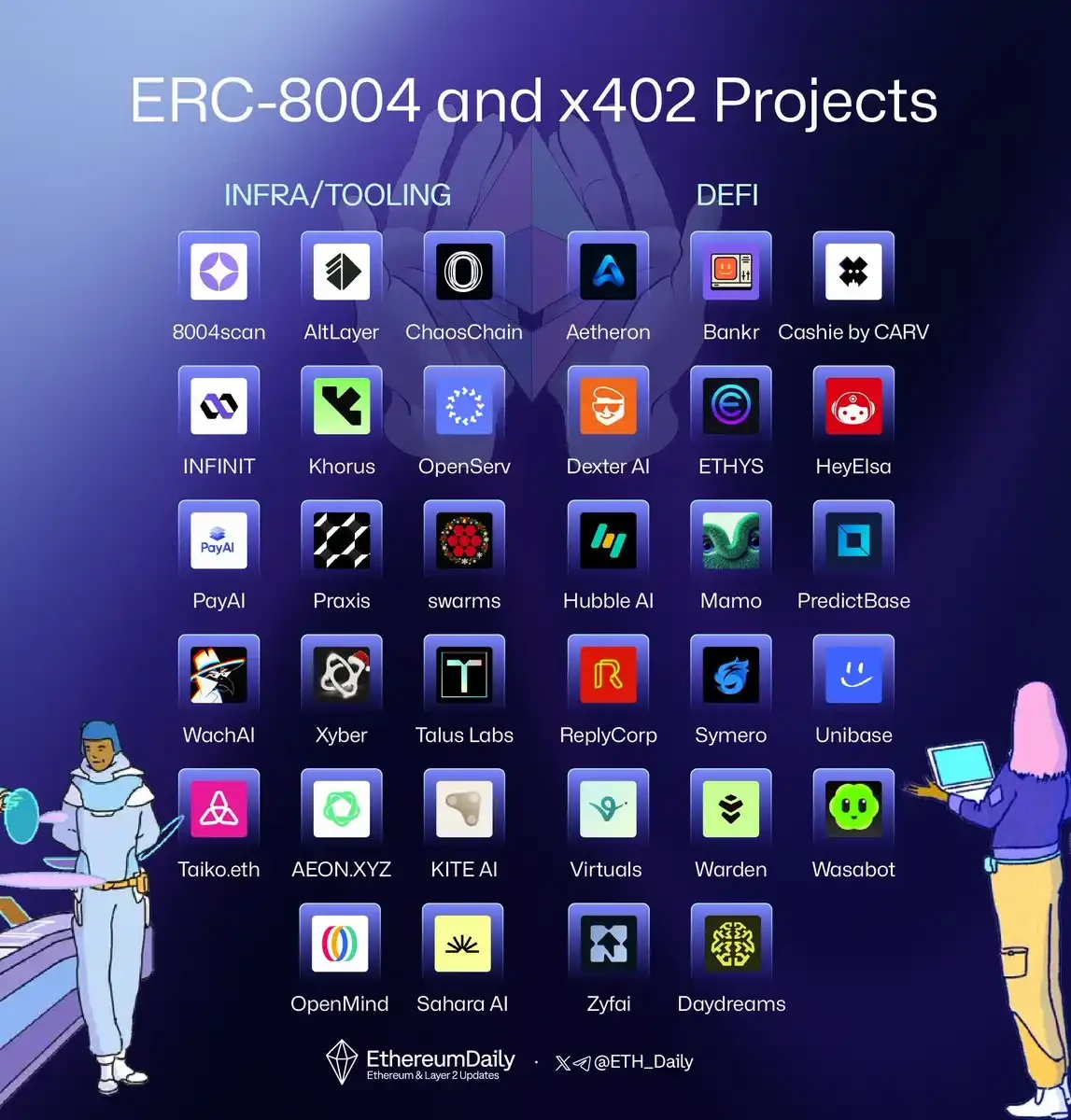
Infrastructure and Tool Layer
Including platforms for Agent discovery, orchestration, and reputation tracking. Ecosystem trackers often mention directions covering registries, settlement layers, interoperability, and scalability solutions on Ethereum and its Layer-2 networks.
- AltLayer
- ChaosChain
- Tascha
- Khorus
- OpenServ
- PayAI Network | x402 Facilitator
- Praxis
- swarms
- WachAI
- Xyber
- Talus Labs
- Taiko.eth
- AEON.XYZ
- KITE AI
- OpenMind
- Sahara AI
AI Agent Application Layer
Spanning scenarios such as DeFi, prediction markets, automated trading, and autonomous service robots. The Agents these projects rely on need to authenticate each other, exchange value, and coordinate actions on an open network, which is precisely what ERC-8004 aims to address.
Several ecosystem maps circulating among the developer community show that dozens of teams have aligned their products with this standard, suggesting early momentum has emerged before the mainnet activation.
- Aetheron
- Bankr
- Cashie by CARV
- Dexter AI
- ETHYS
- HeyElsa
- Hubble AI
- Mamo
- PredictBase
- ReplyCorp
- Symero
- Unibase
- Virtuals Protocol
- Warden
- Wasabot
- Zyfai
- Daydreams.Systems
The Synergistic Effect of x402
The influence of ERC-8004 may also be amplified by its close synergy with x402.
x402 is a protocol for "native internet micropayments" between Agents. It is built around HTTP 402 responses and stablecoin settlements, allowing Agents to pay directly for APIs, data, or computing resources without needing accounts, API keys, or intermediaries.
Market analysts believe that the combination of the portable reputation layer of ERC-8004 and the low-friction payment mechanism of x402 almost constitutes a complete tech stack for "decentralized AI commerce."
Some speculate that as adoption increases, the demand for tokens related to Agent infrastructure and payment channels may rise.
The global AI market is expected to exceed $1 trillion by 2031. Ethereum's bet is that open, neutrally usable infrastructure will have a better chance than closed corporate ecosystems. By anchoring identity, reputation, and settlement on-chain, ERC-8004 aims to position Ethereum as the "coordination layer" for autonomous Agents, rather than just an application platform.
Whether this vision can translate into sustained network activity and value capture will gradually become clear in the months following the launch. At least for now, ERC-8004 is Ethereum's most explicit attempt to date: to seize a place at the intersection of blockchain and AI.
免责声明:本文章仅代表作者个人观点,不代表本平台的立场和观点。本文章仅供信息分享,不构成对任何人的任何投资建议。用户与作者之间的任何争议,与本平台无关。如网页中刊载的文章或图片涉及侵权,请提供相关的权利证明和身份证明发送邮件到support@aicoin.com,本平台相关工作人员将会进行核查。


