Written by: Lawyer Liu Honglin
Introduction
Web3 entrepreneurs face risks beyond those encountered by traditional internet entrepreneurs, adding a hard mode challenge: Token issuance.
For the uninformed public, the highlight moment for Web3 projects is getting listed on an exchange, as it at least means they are a "public company," but the bittersweet experience is something only the parties involved can truly understand.
As a Web3 entrepreneur issuing tokens, one must not only guard against the risk of being deemed to have illegally issued securities by regulatory authorities and establish compliant operations such as setting up foundations for overseas projects, but also be wary of exchanges that list tokens, which can lead to significant pitfalls.
Meme coins on DEXs and legitimate projects on CEXs have become industry norms. Cryptocurrency exchanges have become the preferred choice for many entrepreneurs to issue tokens, thinking it adds prestige, but little do they know: the vast majority of cryptocurrency exchanges are just makeshift operations, rife with various bugs and human risks from startup companies. The most common issue is that internal employees of the exchange may manipulate token prices through false trading volumes to exploit project parties and retail investors, making it hard to guard against.
Lawyer Liu Honglin from Mankun Law Firm will share insights from his experiences, discussing the "dark forest rule" within the cryptocurrency exchange circle, providing psychological comfort and practical prevention advice for Web3 entrepreneurs preparing to list on exchanges.
Common Exploitation Tactics of Exchanges
Unlike the perception of friends in mainland China that getting listed on the A-share market is a difficult task, for a Web3 project, overall, getting listed on a cryptocurrency exchange is not particularly challenging, as long as you have the financial capability and are willing to pay the listing fees, you can generally walk into mainstream exchanges.
In terms of process, first, the Web3 project team needs to connect with the listing team at the exchange, fill out and submit the listing application form, and provide the project white paper, introducing the project's goals, technical solutions, team background, market analysis, and token economic model. Secondly, they need to provide tested and security audit reports, as well as a legal opinion letter from a professional lawyer to confirm the legality and compliance of the token.
Regarding fees, Web3 project teams typically need to pay listing fees, which vary by exchange, ranging from tens of thousands to hundreds of thousands of dollars. Additionally, they must pay for legal opinion letters and technical audits, with specific costs depending on the complexity of services and the provider's pricing standards, ranging from thousands to tens of thousands of dollars. Beyond the basic listing fees, exchanges will also create various clever ways to extract more from Web3 project teams, such as requiring the project team to provide a certain amount of tokens as market-making collateral to ensure liquidity in the crypto market and incentivize the exchange to provide a good market environment; or conducting airdrops and marketing activities to reward holders of the platform's tokens.
Do you think these explicit charges are all the income for cryptocurrency exchanges? No, there are also hidden grabs.
The main reason is that these centralized exchanges trading decentralized cryptocurrencies are merely centralized companies. Friends familiar with centralized large companies know that there are naturally issues like data opacity, internal operations, and conflicts of interest. As centralized platforms, they hold a large amount of trading data and user information, giving them strong market manipulation capabilities. Here are some common market manipulation tactics that can always find a way to exploit you.
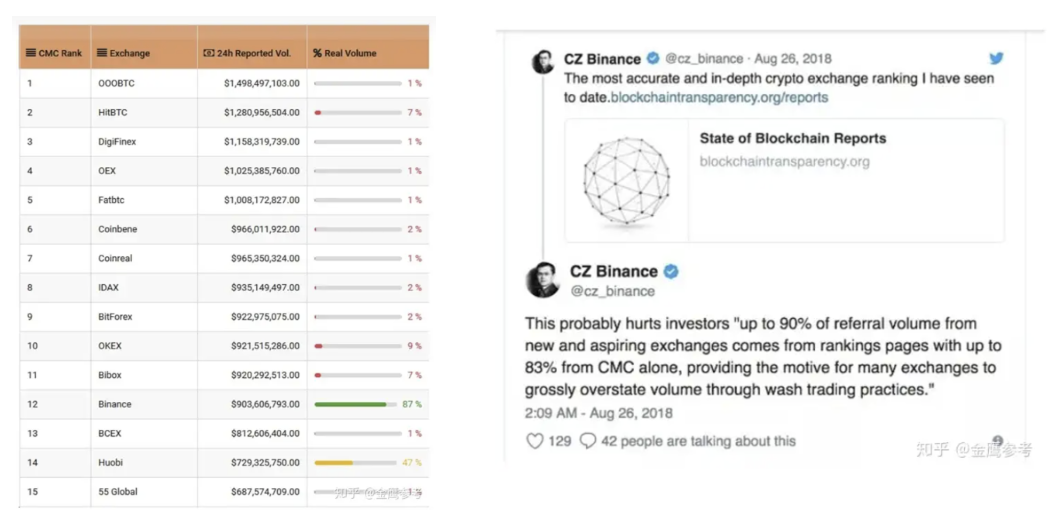
- Creating False Trading Volumes: "Excellent" exchanges never just exploit project parties; they also choose to exploit retail investors. The most common method is for internal employees or related parties of the exchange to create false trading volumes through a large number of buy and sell orders, attracting more retail investors to enter the market, thereby manipulating token prices. This behavior is often referred to as "wash trading" or "volume spoofing." A report released by the Blockchain Transparency Institute (BTI) previously indicated that over 80% of the trading volume among the top 25 exchanges globally was generated through false trading volumes. The report pointed out that the actual trading volume of certain exchanges was less than 1% of their reported trading volume. Shortly after the report was released, a head of a leading exchange shared and commented: This is the most accurate and profound ranking of crypto exchanges I have ever seen.
Data Manipulation: The so-called "my territory, I make the rules," exchanges can also directly modify specific project trading data through backend permissions, affecting the market performance of tokens. For example, manipulating K-line charts, trading volumes, and other key indicators to mislead investor decisions. Such operations often occur during significant market fluctuations to create a false market appearance, enticing investors to follow the trades. Recently, Lawyer Honglin noticed that a new token listing project was manipulated in price by a cryptocurrency exchange, with abnormal data for several consecutive days, leading many investors to suspect that this was due to internal trading and data manipulation by the exchange.
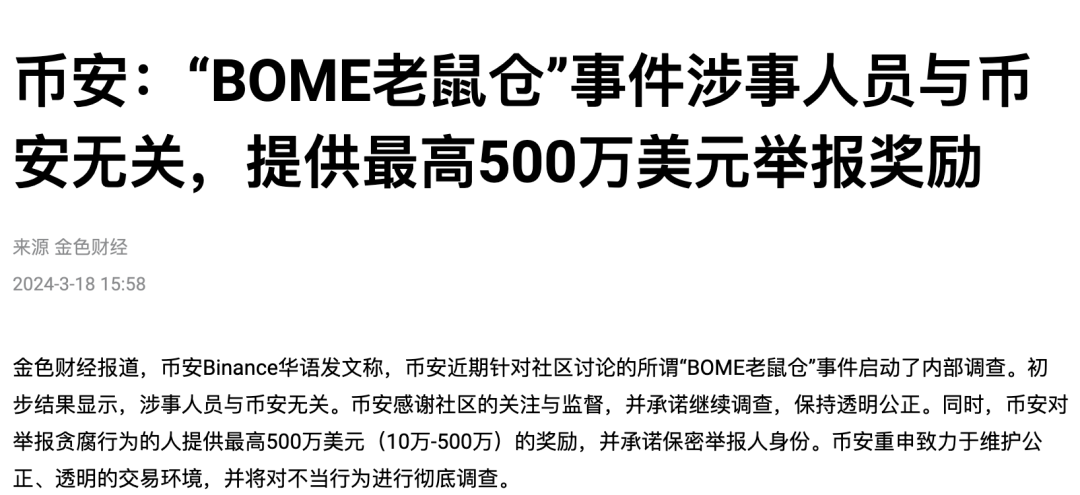
Insider Trading: Utilizing undisclosed market information for insider trading to gain illegal benefits. Exchange employees or related parties may engage in preemptive buying or selling operations by being aware of significant market movements, thus obtaining substantial profits. For example, when a new token is about to launch or a major announcement is imminent, they may buy or sell related tokens in advance. This year, in the project BOME (Book of Meme), which achieved the fastest listing on a certain exchange, media suspected that exchange employees engaged in insider trading. Before a certain announcement was made, an account withdrew approximately $2.3 million worth of SOL from the exchange platform and purchased 314 million BOME at a price of $0.0074. After BOME was listed on the exchange, its price surged over 1500%. Subsequently, the exchange initiated an internal investigation, claiming it had no relation to its internal employees.
- High-Frequency Trading and Arbitrage: Many exchanges also have their own trading teams or market-making service providers, utilizing high-frequency trading technology to conduct millisecond-level trading operations, profiting from small price differences. High-frequency trading typically employs complex algorithms and high-performance computing devices, capable of completing a large number of trades in a very short time. In 2017, a certain exchange drew widespread attention due to the Ethereum (ETH) flash crash incident. At that time, the price of Ethereum dropped from $319 to $0.10 within seconds, then quickly rebounded. Subsequent investigations revealed that this was triggered by high-frequency trading algorithms that activated a large number of sell and buy orders during extreme market volatility, leading to extreme price fluctuations.
How Should Entrepreneurs Respond?
Finding the cause of problems within oneself is a good strategy for adults to survive. Since external factors cannot be controlled, as entrepreneurs, we must be more cautious. In response to the above risks, Lawyer Honglin offers the following advice:
Choose Reputable Exchanges: When selecting an exchange, try to choose one with a good reputation and transparent operations, avoiding emerging or unknown platforms. It is recommended that entrepreneurs assess the exchange's reputation by reviewing public audit reports, user reviews, and ratings from third-party evaluation agencies. Additionally, they can communicate with other project parties to understand their actual experiences and feedback on different exchanges. It is also advisable to avoid listing tokens on only one exchange, as this makes it easier for that exchange to engage in opaque operations and price manipulation.
Sign Detailed Listing Agreements: When signing a listing agreement with an exchange, clearly define the rights and obligations of both parties, especially regarding data transparency and operational compliance, to protect one's interests. The agreement should include prohibitive clauses against false trading volumes, data manipulation, and set corresponding liabilities for breaches. Additionally, require the exchange to provide regular trading data reports for independent audits.
Monitor Market Trends in Real-Time: Utilize professional market analysis tools to monitor the market performance of tokens in real-time, promptly identifying abnormal trading situations and taking appropriate measures. It is advisable for entrepreneurs to use multiple independent data sources for cross-validation, avoiding reliance on data from a single platform. Furthermore, they can introduce third-party monitoring services to provide 24/7 market monitoring and risk alerts.
Involve Legal Advisors: The importance of a good legal compliance advisory team is on par with that of market makers, which is something many token-issuing project parties fail to realize. A practical suggestion is that once you are ready to issue tokens, you must hire lawyers with experience in the blockchain and cryptocurrency field to provide professional services. Professional legal advisors in the crypto industry can assist in handling legal matters related to exchanges, ensuring that all operations comply with legal regulations. They can participate in the formulation and review of listing agreements before the listing, help identify potential legal risks, and take timely legal action when issues arise. More importantly, they can strategize for various unexpected events after listing on exchanges, reducing unnecessary public relations crises.
Community Building and User Education: Those who gain the community gain the world; every successful Web3 project has a solid grassroots foundation. By hosting online and offline events, publishing educational content, and engaging in interactive communication, enhancing community cohesion and user investment preferences can be considered routine operations. When the market is good, community members are often led by big shots, but once the market turns bad, it is common for people to flip tables, curse, and threaten to report for rights protection. Therefore, Lawyer Honglin often advises the Web3 entrepreneurs around him to be cautious in community discussions, as overly confident statements can lead to self-dug pits. In the event of unexpected incidents involving exchanges or market makers, it is advisable to promptly synchronize event information on official media accounts to avoid causing panic among users.
Conclusion
Overall, there are indeed many old scythes looking to profit from Web3 entrepreneurs. For us entrepreneurs, in addition to facing legal and regulatory risks from different countries and regions, we should also be wary of the pitfalls set by cryptocurrency exchanges and market-making service providers as business partners. It is hoped that this article will help everyone better understand the stumbling blocks that centralized cryptocurrency exchanges set for us during the entrepreneurial process, recognize these risks, and exercise more caution and preparation during token issuance and trading. The path of entrepreneurship is inherently challenging, and may everyone navigate carefully to embrace more opportunities and development.
免责声明:本文章仅代表作者个人观点,不代表本平台的立场和观点。本文章仅供信息分享,不构成对任何人的任何投资建议。用户与作者之间的任何争议,与本平台无关。如网页中刊载的文章或图片涉及侵权,请提供相关的权利证明和身份证明发送邮件到support@aicoin.com,本平台相关工作人员将会进行核查。


