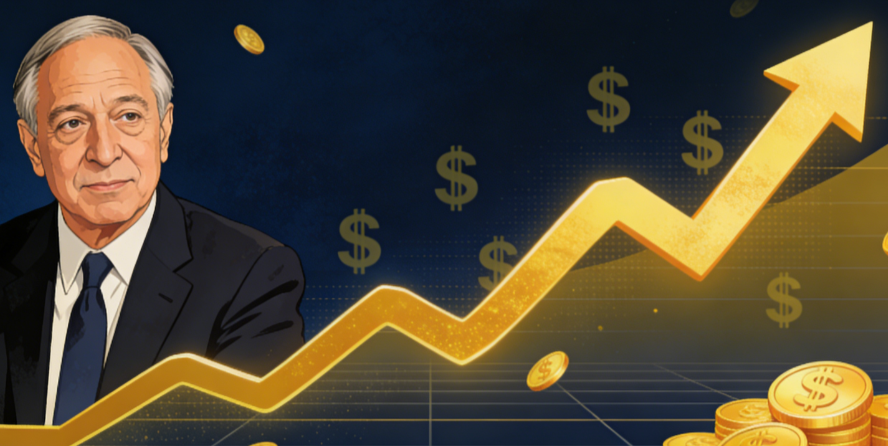
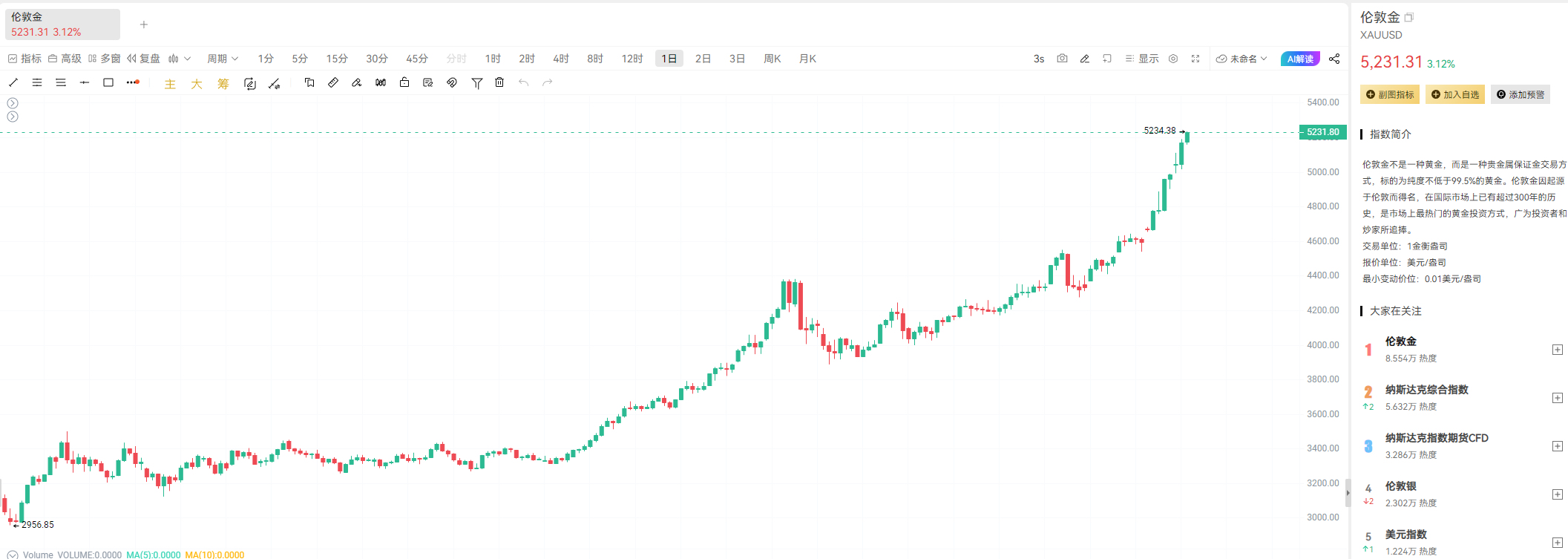
The price of gold has surged over 13% in just 14 trading days at the start of the year. Ray Dalio sounded the alarm at the Davos Forum, stating that the world is entering a more dangerous era of "capital wars" than trade wars. Gold has become the second-largest reserve currency held by central banks. As of January 22, 2026, the London spot gold price rose to $4,832.1 per ounce, with a gain of 11% over 14 trading days.
Behind the rise of gold is a stern warning from Ray Dalio, founder of Bridgewater Associates, at the globally watched Davos World Economic Forum, stating that "the global monetary order is collapsing."
1. Core Warning
● Dalio pointed out that global conflicts are escalating from traditional trade wars to more complex and dangerous "capital wars." As trade deficits and trade wars escalate, capital flows are inevitably affected, leading to a decline in foreign holders' trust in dollar assets.
○ He believes the current situation is not an isolated trade conflict; tariffs, sanctions, and financial restrictions are broader competitive tools for capital, trust, and liquidity.
● Dalio warned that the global monetary order is experiencing "structural disintegration." Fiat currencies and bonds, traditionally used as "piggy banks," may now be viewed as "landmines" by central banks. The U.S. public debt has reached $38 trillion, a common "symptom" of imperial decline.
● Dalio's greatest concern is the risk of imbalance in supply and demand for U.S. Treasuries. He analyzed: "One person's debt is another person's asset." "The world already has a lot of such debt, and then you keep selling more," he added. "Do you still want to buy more?"
2. Source of Turmoil: Debt, Conflict, and Disorder
The fundamental problem facing the U.S. is its ever-expanding debt. Dalio emphasized in June 2025 that if the deficit, which accounts for about 7% of GDP, cannot be reduced to 3%, the U.S. will inevitably face the risk of "running aground."
● At Davos, he further explained the dangers of the debt cycle: "When your debt is very low relative to income, you can increase debt without issue. But the more debt and repayment obligations you have, the more it squeezes your spending. That's when you start to get into financial trouble."
● The political polarization and social conflict within the U.S. are exacerbating economic risks. Commenting on the immigration conflict in Minnesota on January 27, Dalio pointed out that the U.S. is entering a more violent phase, like a "powder keg."
● In June 2025, Dalio expressed deeper concerns about the U.S. political system, believing that when democratic institutions become dysfunctional, society often turns to seek strong leaders to control the situation, which is the direction the U.S. is currently heading.
● On the international level, a series of policies from the Trump administration at the beginning of 2026 have impacted the old political and economic order of the world.
● Since January 2026, the U.S. has imposed or threatened tariffs on several European countries and announced the establishment of a "Peace Committee" that could "replace the United Nations," actions that are accelerating the "collapse of the old world order."
3. The Rise of New Currency: The Return of Gold and Central Bank Actions
In direct response to the aforementioned risks, global central banks are increasing their gold reserves at an unprecedented pace.
● Goldman Sachs predicts that the average gold purchases by central banks will reach 60 tons in 2026. According to earlier analysis from October 2025, Goldman Sachs forecasted that the net gold purchases by global central banks would average 80 tons and 70 tons in 2025 and 2026, respectively.
● This "currency devaluation trade"—the behavior of investors shifting assets from fiat currency to hard assets—has become the norm in the market in 2026. Long-term fiscal deficits have become a significant characteristic, further reinforcing the strategic allocation value of hard assets like gold.
● Dalio fundamentally redefined the role of gold: "In my view, gold is a currency, and it is indisputably the currency with the lowest risk of devaluation and/or confiscation." One of gold's main advantages over fiat currency is its lower risk of confiscation compared to other currencies and assets.
● Market data confirms the direct impact of central bank gold purchases. In 2025, the prices of gold and silver soared to historical highs, achieving the best performance since 1979.
Entering 2026, as of January 22, the London spot gold and COMEX gold futures settlement prices have increased by 11% and 13.5%, respectively, over 14 trading days. Dalio specifically pointed out that the highest gain in 2025 was not in tech stocks but in gold.
4. Capital Wars: Manifestations and Historical Lessons
The concept of "capital wars" proposed by Dalio refers to the escalation of conflicts between nations from the level of commodity trade to that of financial assets. When a country fears that its assets in the U.S. may be frozen or sanctioned due to political factors, the "capital war" has quietly begun. This trend of financial weaponization will significantly increase uncertainty in global markets.
● Dalio explained: "You can understand why buyers or holders of dollar-denominated debt might feel it is risky, either because of supply and demand or because you are in a war-like environment. If you are from another country, wouldn't you be concerned about the possibility of being sanctioned?"
● Potential risks have already emerged. The Danish pension fund AkademikerPension stated that due to concerns about the credit risk posed by the Trump administration, the fund will liquidate all U.S. Treasuries by the end of January 2026.
● Historical collapses of monetary systems provide a mirror for today's situation. Dalio recalled that throughout history, whenever currencies linked to gold or asset-backed currencies carried too much debt or commitments, the monetary system would collapse.
● He pointed out that after the emergence of central banks, such crises typically follow an "inflationary path," where nations break their promises to exchange gold at promised prices, creating large amounts of money and credit, leading to currency devaluation, higher inflation, and higher gold prices.
5. Individual Investors: How to Respond in the Era of Capital Wars
● For individual investors, Dalio provides clear asset allocation advice. He believes that wise investors should allocate 5%-15% of their portfolios to gold, and even more during times of war or fiat currency devaluation.
● He emphasized that his approach is vastly different from that of most investors, who tend to view gold as a speculative market. "I believe that everyone's starting point for investing should be to understand and hold the optimal portfolio, rather than relying on any tactical views of the market."
○ "In times of monetary system collapse, high risk of currency confiscation, and economic/monetary wars (such as sanctions), one should overweight, while in other periods, one should underweight."
● Dalio reminds investors to change their traditional views on gold: "When I think about how much gold one should hold in a person's portfolio, I first and foremost see it as a strategic asset allocation, rather than a tactical/market timing decision."
○ Besides gold, other precious metals and strategic minerals are also worth paying attention to. Silver, as a parity substitute for gold, benefits simultaneously. Uranium, copper, and rare earths are also listed as potential key minerals for 2026. Uranium benefits from the demand for nuclear power in the AI sector and favorable policies; copper prices surged in 2025 and are expected to reach new highs in 2026.
6. Future Outlook: Trends and Risks
Dalio believes that the world may face an extended transition period rather than a brief adjustment. During this transition period, asset allocation may lean more towards neutrality, scarcity, and durability being highly valued.
He expressed pessimism about the U.S.'s ability to resolve political issues, predicting in June 2025 that the likelihood of a "grand compromise" between the two parties to resolve the debt issue before the midterm elections in 2026 is extremely low.
● The risks brought about by capital wars and the reconstruction of the monetary order are multifaceted. If major holders of U.S. Treasuries reduce purchases or even sell off due to security concerns, it will disrupt the supply-demand balance, leading to a surge in U.S. Treasury yields.
● The gold market itself also carries risks. Although the long-term trend is upward, gold futures prices have pulled back more than $10 after reaching new highs. Analysts point out that the recent price pullback is mainly due to short-term trading sentiment and profit-taking.
● The "de-globalization trend" will further extend in 2026. Countries prioritize safeguarding sovereignty and supply chain resilience, thereby creating structural inflationary pressures and reshaping the flow of commodities.
● For investors, a key issue is finding alternatives to the dollar. Dalio pointed out that the main problem with the dollar is its increasing risks—both the risk of supply-demand imbalance and geopolitical risks. The greatest advantage of gold is that it is the "currency with the lowest risk of devaluation and/or confiscation."
As gold prices continue to rise, the U.S. bond market is facing a test of waning confidence from foreign holders. As the elites at the Davos Forum conclude their discussions and return to their respective countries, a Danish pension fund has already announced it will liquidate all U.S. Treasuries by the end of the month.
This is not an isolated financial decision but a signal that global capital is beginning to reassess risks. The "capital wars" that Dalio warned about are no longer a theoretical deduction but a reality that is happening.
The increasing gold in central bank reserves, along with the gradually decreasing dollar assets in U.S. Treasury accounts, together outline a clear picture of the reconstruction of the global monetary order.
Join our community to discuss and become stronger together!
Official Telegram community: https://t.me/aicoincn
AiCoin Chinese Twitter: https://x.com/AiCoinzh
OKX benefits group: https://aicoin.com/link/chat?cid=l61eM4owQ
Binance benefits group: https://aicoin.com/link/chat?cid=ynr7d1P6Z
免责声明:本文章仅代表作者个人观点,不代表本平台的立场和观点。本文章仅供信息分享,不构成对任何人的任何投资建议。用户与作者之间的任何争议,与本平台无关。如网页中刊载的文章或图片涉及侵权,请提供相关的权利证明和身份证明发送邮件到support@aicoin.com,本平台相关工作人员将会进行核查。


