Onchain analyst Willy Woo has entered the debate regarding bitcoin’s readiness for the looming quantum threat, claiming that significantly more work is happening behind the scenes than headlines suggest. While admitting that the initial response from bitcoin developers was slow, Woo insists the pace has accelerated, particularly during the second half of 2025.
“ Bitcoin dev response to quantum risks started in Jan. 2025 and accelerated midyear; we also saw the first Quantum Bitcoin Summit in July in SF,” Woo noted.
In a post on X, Woo shared archives from the bitcoin developers mailing list to support his argument. The data reveals that the share of messages discussing quantum resistance has consistently remained above 10% since June 2025, with October and November being the only exceptions.
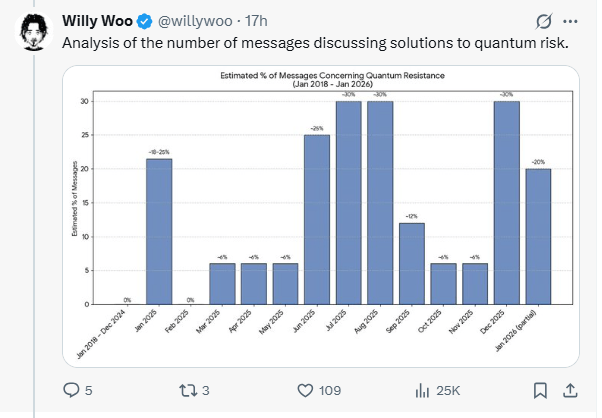
This defense comes amid growing alarm regarding the vulnerability of bitcoin addresses to quantum computing. Some analysts suggest these fears are already weighing on the market, contributing to bitcoin’s inability to break above the $100,000 mark for several weeks. Crypto advocate Nic Carter suggested that bitcoin’s recent price stagnation reflects a market waking up to long-term quantum risks. While developers may view the threat as distant, Carter argues institutional investors now see it as a legitimate “headwind.”
Read more: Is Quantum Computing Casting a Shadow Over Bitcoin’s Price?
This sentiment is gaining traction in traditional finance. Christopher Wood, a strategist at Jefferies, recently removed bitcoin from a recommended pension portfolio, citing the “existential technological threat” of quantum computing. On the other hand, Sergio Ermotti, the CEO of the financial services giant UBS, stated that bitcoin must overcome the quantum threat to maintain its long-term credibility as a store of value.
To counter the narrative of inaction, Woo’s analysis highlighted an “explosion” of technical discussions in 2025, following a period of near-total silence between 2018 and 2024.
The primary focus of these discussions—often exceeding 100 messages per thread—revolves around the vulnerability of ECDSA/Schnorr signatures to Shor’s algorithm. Key points of the current developer consensus include implementing voluntary transitions rather than forced protocol changes. There is an agreement to prioritize the maturity of the National Institute of Standards and Technology (NIST) post-quantum cryptography standards before integration.
Woo characterized the current atmosphere not as one of panic, but as “proactive engineering for a distant-but-real threat.”
- What is the quantum threat to bitcoin? Quantum computing could break Bitcoin’s cryptographic signatures, risking address security.
- How are developers responding? Bitcoin devs accelerated work in 2025, with discussions topping 10% of mailing list activity.
- Why is the market concerned? Analysts say quantum fears are weighing on Bitcoin’s price, stalling it below $100,000.
- What solutions are being explored? Developers favor voluntary transitions and NIST post‑quantum standards before protocol integration.
免责声明:本文章仅代表作者个人观点,不代表本平台的立场和观点。本文章仅供信息分享,不构成对任何人的任何投资建议。用户与作者之间的任何争议,与本平台无关。如网页中刊载的文章或图片涉及侵权,请提供相关的权利证明和身份证明发送邮件到support@aicoin.com,本平台相关工作人员将会进行核查。


