🧐 I'm ready to start: Three things every week | Why do you seem busy but feel empty inside?
Last time we talked about energy management;
After practicing intentionally for a while, I came to a rather counterintuitive conclusion:
In fact, within a week, to maintain a high level of energy over a long period, you first need to do subtraction, not planning;
Because in reality, I believe that for everyone, there are at most three to five truly important things in a week. Even someone at the level of Trump wouldn't have a dozen "must-do, must-handle immediately, far-reaching impact" tasks piling up in a week.
And this shift has a greater impact on energy levels than any time management technique by an order of magnitude.
I found that once I exceeded three items, each one would be diluted, attention would frequently switch, and ultimately all would "seem unfinished."
So I refined my management and started a sustained practice of: three things every week!
Here I continue to share with everyone:
1️⃣ What kind of things qualify to enter my "Three Things of the Week"?
Core One: Entry Criteria (must meet at least 2 conditions)
I currently use six filtering criteria; any task wanting to enter the "Three Things of the Week" must hit at least two of the following:
1) Completing it will make my decisions easier next week
→ Reducing future decision costs is essentially cognitive compounding.
2) Whether or not to do it will create a significant difference in 1-3 months
→ It can create a mid-term gap and has time leverage.
3) It can only be done by me (cannot be outsourced)
→ Irreplaceability, clearly defined personal boundaries.
4) Requires continuous, high-quality attention to advance
→ If it can progress intermittently, it doesn't need to occupy my best attention.
5) If not done this week, it will be harder next week, or the window will worsen
→ There is a clear time-based penalty.
6) Completing it will significantly reduce my internal noise
→ The value of some tasks is not in the output but in "shutting down a long-standing mental issue."
Core Two: Things that cannot enter (no matter how important)
Even if it sounds important, as long as it falls into the following categories, I will deliberately exclude it:
1) Daily replies and coordination
→ Can be delegated to others or compressed.
2) Maintaining relationships
→ Most relationships do not need deliberate maintenance; truly important relationships will happen naturally.
3) Tasks driven by others' deadlines
→ If the priority comes from others rather than my own judgment, it is usually not important.
4) "Optimizations that don't change anything"
→ Seemingly professional but actually energy-consuming.
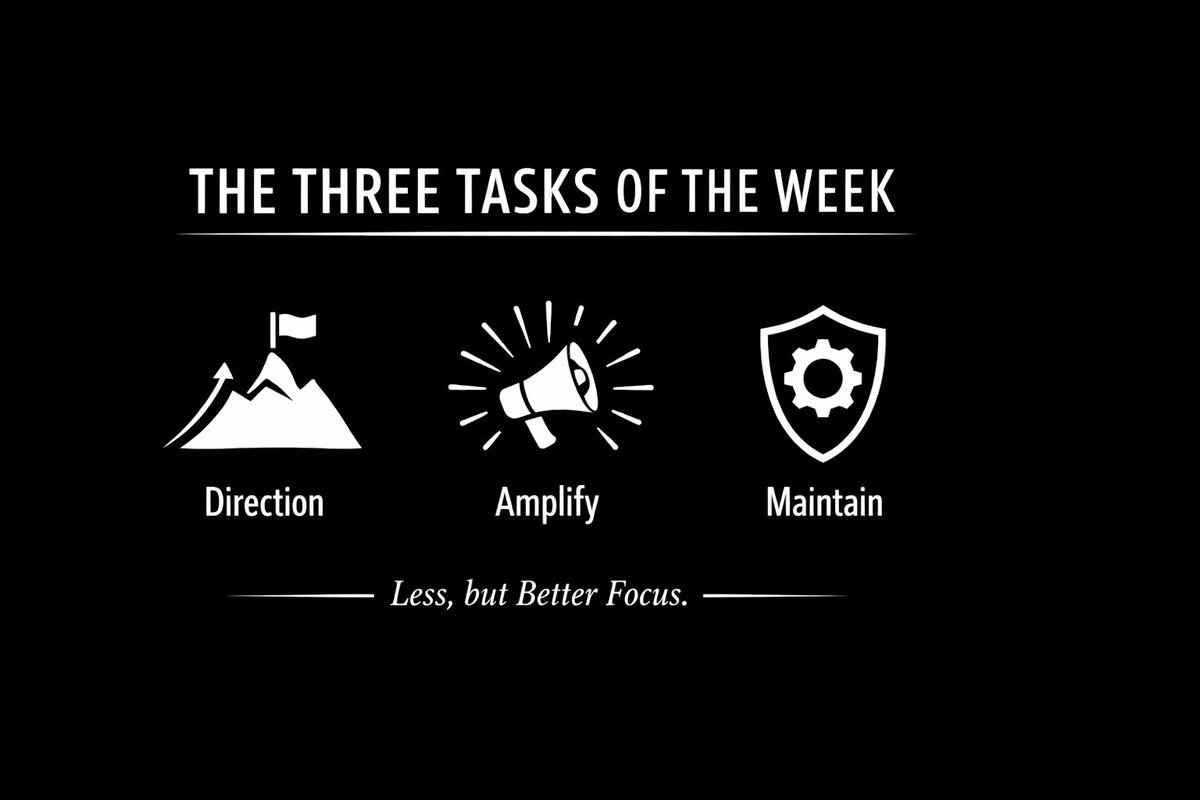
2️⃣ Core distribution of the three things each week:
1) Decide where you are heading (1 item)
Characteristics:
High cognition;
High uncertainty;
At most only 1 item per week.
Examples:
A core viewpoint takes shape (I found a new growth point)
A judgment on a long-term theme (this decision may change my next few years)
Whether to advance or abandon a certain direction (affects a long period)
2) Amplifier task (1 item)
Transform existing things into a larger impact
Examples:
Turning a thought into content;
Integrating scattered ideas into a structure;
Turning a judgment into a reusable template.
It relies on the first item but is "easier to tackle" than the first.
3) Steady-state task (1 item)
Ensure the system does not collapse: extremely high long-term value!
Examples:
Reviewing accounts/security/investments;
Clearing procrastinated tasks;
Organizing information sources.
3️⃣ The essence of "Three Things of the Week" is a defensive methodology:
Many people might think that the difficulty of this system lies in: not being able to choose? Can you stick to it? Is your self-discipline enough?
But I later found that these are not the key issues; the real determinant of success or failure is one thing: can you do subtraction and maintain those three items throughout the week without being eroded.
For example, if a sudden event distracts you, you might get caught up and forget the principles you set, like if someone really invites you to dinner, can you swallow your pride and say no to something unimportant;
Every week, there will be a continuous stream of: seemingly urgent demands, seemingly important requests, and seemingly "must-do now" trivial matters.
So I began to treat "Three Things of the Week" as a defensive system rather than an offensive plan.
4️⃣ Defensive Mechanism One: "Exclusive Rights" to High-Energy Time;
I set a very clear, even somewhat harsh rule for myself:
Any task that does not enter the "Three Things of the Week" is not allowed to occupy my best time slots.
I no longer ask: "Is this task important?"
I only ask: "Does it deserve to occupy the 2 hours of my day when I am the most alert and focused?"
If the answer is no, then it can only be:
Deferred
Compressed
Delegated to others
Or abandoned
This rule directly addresses the issue of "busy but not making progress."
5️⃣ Defensive Mechanism Two: Protocol for Handling Temporary Demands
I later realized a reality: "temporary" itself is a filtering signal. So I set a default handling rule for all "temporary insertions":
All temporary demands are considered unimportant unless they meet one of the following two conditions:
1) Directly related to the health and mood of my family;
2) If not handled immediately, it will directly disrupt the core task I am advancing;
3) It is important enough to directly replace one of my three things for the week.
If none of these conditions are met, it goes into the "next week's pool," no exceptions.
6️⃣ Defensive Mechanism Three: Forced Isolation of Emotions and Judgments:
This is a rule I added after stepping into many pitfalls.
I discovered a very stable pattern: 90% of self-doubt, direction denial, and life reflection occur during low energy times.
So I set a hard constraint for myself: in low-energy states, only execution is allowed, no judgment.
Specifically:
No directional decisions;
No investment decisions;
No rearranging of the three things for the week;
No denying already chosen core goals;
All judgments can only occur when:
Well-rested;
Energetically clear;
In uninterrupted time slots;
This rule greatly reduces the probability of self-sabotage.
7️⃣ A minimalist but deadly effective "Daily Execution Question"
To avoid being overwhelmed by daily tasks, I compressed my daily self-questioning into one sentence:
"Did I create a real advancement window for one of the three things this week today?"
It's not about how many tasks were completed, but whether there was even a 30-60 minute continuous advancement. As long as there is, the day is not considered a failure, and there will be a sense of achievement.
8️⃣ Weekly "System Calibration Process" (10 minutes)
I only do a review once a week, and it is very simple:
1) Which of the three things this week was frequently interrupted?
2) Was it a wrong choice of task, or was the defense not done well?
3) If I could only keep one for next week, which one would I choose?
The third question is the core calibrator of the entire methodology.
9️⃣ Applicability Boundaries of the Methodology (very important)
Finally, I want to say that this "Three Things of the Week" system is not suitable for everyone.
It is more suitable for these types of people:
Cognition-intensive workers;
Those for whom decision-making is more valuable than execution;
Those who value one correct judgment over ten instances of diligence.
If your value mainly comes from physical labor or repetitive execution, then you need a different system.
🔟 Conclusion—
There are not many people in this world who are willing to think; and even fewer are those who are willing to think deeply and long-term and adjust their life structure for it.
When you start to take your attention, energy, and decision-making power seriously, and let time revolve around "importance," many things will actually change.
Wealth is not a sudden miracle; it is more like a result—
When your judgments are clearer, consumption is less, and rhythm is more stable,
Opportunities will naturally gravitate towards you.
It's not that you chase the wind; it's that you stand firm, and the wind will blow your way.
免责声明:本文章仅代表作者个人观点,不代表本平台的立场和观点。本文章仅供信息分享,不构成对任何人的任何投资建议。用户与作者之间的任何争议,与本平台无关。如网页中刊载的文章或图片涉及侵权,请提供相关的权利证明和身份证明发送邮件到support@aicoin.com,本平台相关工作人员将会进行核查。


