Over the past 30 days, silver’s spot price climbed roughly 48%, rising from the low $50s in late November to nearly $83 by late December, one of the sharpest short-term advances in decades. The move capped a year that saw silver gain more than 150%, powered by tight physical supply, heavy industrial demand, and renewed interest from investors seeking refuge from inflation and policy uncertainty.
The rally’s tempo quickened in mid-December when silver finally punched through $60 an ounce, then kept running hard. Daily trading ranges widened, holiday liquidity thinned, and by the day after Christmas, silver printed an all-time high just shy of $83. Volatility, in other words, was no longer a footnote—it was the headline.
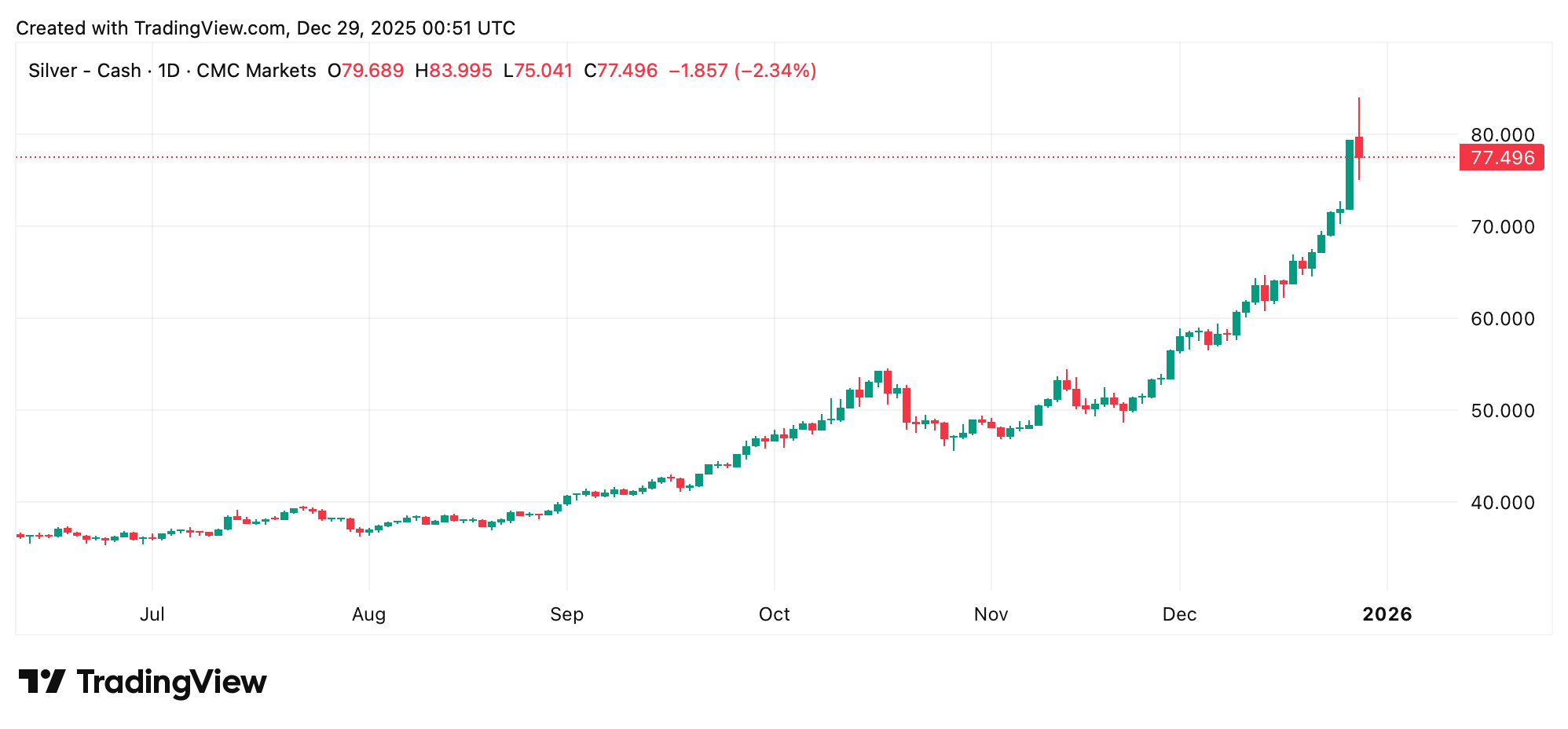
Silver markets opened Dec. 29, hitting nearly $83 per ounce, and since dropped to $77.49 after the high. Monday is looking to be a volatile ride for silver.
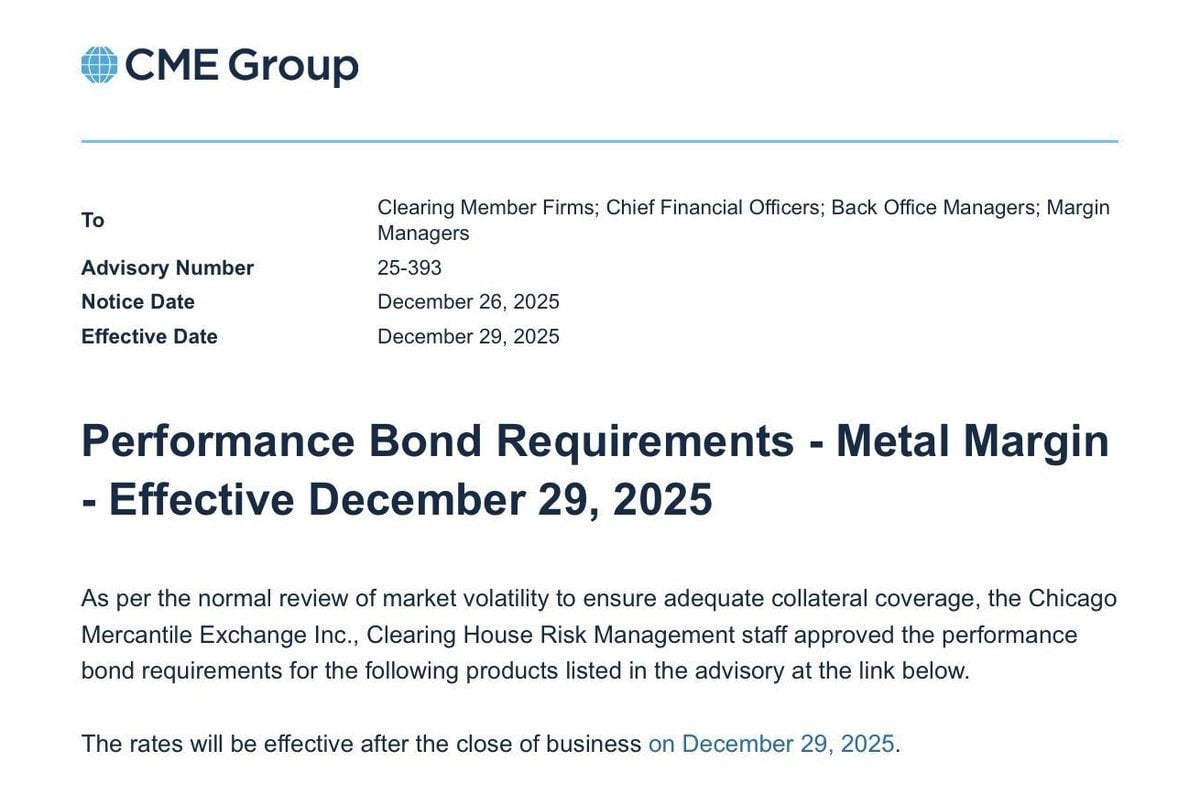
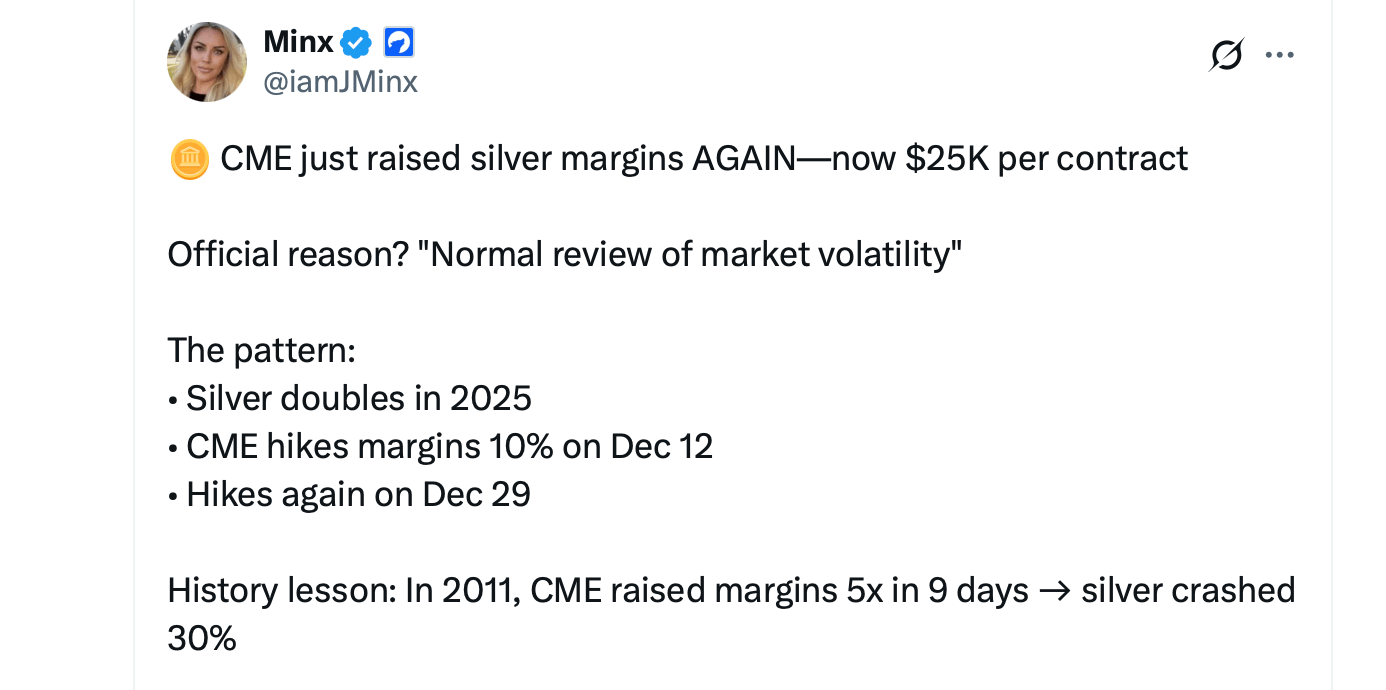
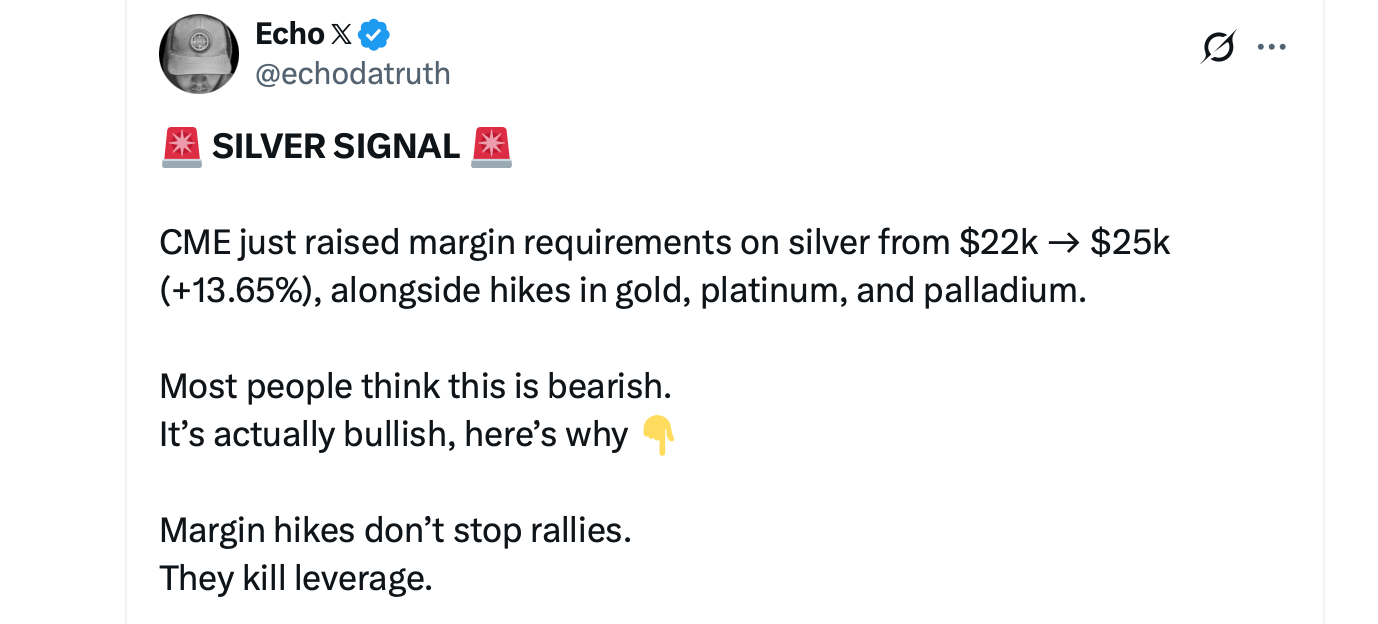
Enter the CME. As silver futures prices and volatility soared, CME, one of the largest financial exchanges in the world, announced another increase in margin requirements for silver (SI) futures contracts. Initial margins for front-month contracts were raised from $22,000 to $25,000 per contract, a roughly 13.7% increase, effective after the close on Dec. 29.
Maintenance margins rose in tandem, and similar hikes were applied across other metals, including gold and platinum. From the CME’s perspective, the move is textbook. Margin requirements exist to protect the clearinghouse from defaults during violent price swings. When volatility spikes, so do margins. This is not new, and it is not unique to silver. Exchanges are in the business of survival, not cheering on parabolic charts.
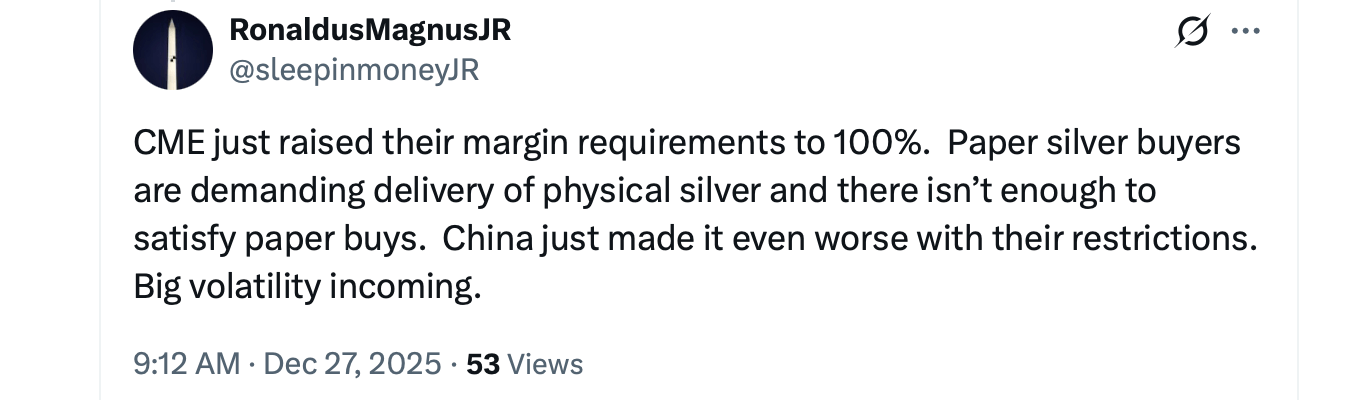
Still, the timing did silver no favors. The margin hike coincided with a brief pullback that saw an estimated 67 million ounces in leveraged futures positions liquidated, reinforcing the belief among silver bulls that the exchange stepped in just as the rally got interesting.
On X and in precious metals circles, the reaction was swift and familiar. Many framed the margin hike as deliberate interference designed to cool prices and protect large short positions, particularly those held by bullion banks. The argument goes like this: raise margins mid-rally, force leveraged longs to sell, knock the price down, and buy time for the paper market to catch its breath.
One post on X takes a pointed swipe at the CME, claiming it is quietly lending banks a helping hand. “The CME is helping banks cover shorts by forcing futures down (margin calls) so that they can go long by buying physical silver,” the social media user wrote. This narrative has deep roots. Silver enthusiasts point to repeated episodes—1980, 2011, and now 2025—where margin hikes arrived during strong rallies and were followed by sharp corrections.
To them, it looks less like neutral risk management and more like a well-worn playbook. The ghost that inevitably gets summoned in these debates is the Hunt Brothers. In the late 1970s, Nelson Bunker Hunt and William Herbert Hunt amassed massive silver positions through futures contracts and physical holdings, helping drive prices from roughly $6 an ounce to nearly $50 by January 1980.
Alarmed regulators and exchanges responded with aggressive rule changes, including steep margin hikes and restrictions that ultimately crushed the rally in what became known as “Silver Thursday.” To silver bulls, the parallels are irresistible. Margin hikes during a rally? Check. Forced liquidations? Check. Exchanges claiming risk control while prices implode? Check.
The comparison writes itself, especially for traders who believe today’s paper silver market dwarfs available physical supply. But history is less cooperative than social media slogans. The Hunt Brothers’ episode was a concentrated, leveraged attempt by a small group to dominate the market. Today’s silver rally, by contrast, is being driven by structural factors that extend well beyond futures traders.
Industrial demand from solar panels, electronics, electric vehicles, and medical applications has collided with years of supply deficits, leaving inventories tight and physical premiums elevated. To many, that distinction matters. Margin hikes can flush out leveraged speculation, but they do not conjure new ounces of silver. Physical buyers—manufacturers, governments, and long-term investors—are largely insulated from futures margin mechanics.
If supply remains constrained, price pressure has a habit of returning once the dust settles. There is also the inconvenient fact that the CME raised margins across multiple metals, not just silver. Gold, platinum, and palladium were all swept into the same advisory, undercutting the idea that silver was uniquely targeted. Volatility, not conspiracy, remains the simplest explanation.
Also read: How Much Is Logan Paul’s Pikachu Illustrator Worth? Polymarket Bets Tell the Story
None of this will satisfy silver’s true believers, and skepticism toward exchanges and banks runs deep for good reason. Past enforcement actions and opaque market structures have left lasting scars. Moreover, it’s worth recalling 2011 as well, when silver enjoyed a solid advance during that period, adding another chapter to its cyclical history.
During the 2011 silver price run-up, exchanges such as the CME sharply tightened margin requirements on silver futures contracts. The CME lifted margins repeatedly—up to five increases in nine days—effectively doubling requirements from roughly 4% to 10% of notional value, forcing leveraged traders to unwind positions and helping drive a steep 30% drop in prices from near $50 to about $26 per ounce.
Even so, saying that it is outright manipulation requires more evidence than uncomfortable timing and historical déjà vu. What this episode does point to is the risk of leverage in fast-moving commodity markets. Margin hikes are blunt instruments, but they are legal, predictable, and ruthless. Traders who rely on borrowed money inevitably find themselves at the mercy of rule changes that arrive precisely when volatility peaks.
Silver’s 30-day sprint into record territory has already cemented its place as one of 2025’s standout performers. Whether the rally pauses, retraces, or reloads will depend far more on physical supply, industrial demand, and macroeconomic currents than on a single margin notice. The debate over manipulation, meanwhile, looks set to outlast them all. Still, attention will center squarely on silver on Monday, with investors fixated on the so-called ‘poor man’s gold.’
- Why did silver prices rise so sharply in December?
Tight supply, strong industrial demand, and macroeconomic uncertainty drove aggressive buying. - What are CME margin requirements for silver futures?
They are cash deposits that traders must post to open or maintain leveraged futures positions. - Are CME margin hikes considered market manipulation?
Legally, they are standard risk controls, though many silver proponents remain skeptical. - How does this compare to the Hunt Brothers era?
Both involved margin hikes during rallies, but today’s move is driven by broader fundamentals rather than a single speculative corner.
免责声明:本文章仅代表作者个人观点,不代表本平台的立场和观点。本文章仅供信息分享,不构成对任何人的任何投资建议。用户与作者之间的任何争议,与本平台无关。如网页中刊载的文章或图片涉及侵权,请提供相关的权利证明和身份证明发送邮件到support@aicoin.com,本平台相关工作人员将会进行核查。


