Introduction: The Bull Market is Back, but What Truly Matters is the Change in Capital Structure
The bull is back. In the past week, global risk assets strengthened simultaneously, and the crypto market has returned to an upward trajectory with increased volume. Most people's attention is focused on how much more BTC and ETH can rise, but as researchers, we are more concerned with a deeper change behind this round of market: The capital entering the crypto world is no longer just speculative capital and retail investors; it is now a large amount of compliant capital and traditional financial funds from around the world; what they want to buy is no longer just BTC and ETH, but stocks, gold, foreign exchange, Pre-IPO shares, RWA—the entire spectrum of global assets.
This leads to the core judgment of this article: the role of $HTX is undergoing a fundamental change. It is the governance token of HTX DAO and the only designated cooperative token of Huobi HTX, playing a function similar to that of a platform token to some extent; in the past, its valuation was anchored to the trading volume of crypto spot and contracts; in the future, it should be re-understood as "the equity token for global assets entering the Crypto world"—when global funds pass through the gateway of the Crypto world, holding $HTX means holding a part of this door. To bring this judgment into practice, this article will provide a complete quantitative deduction beyond the narrative: how large is the volume of global traditional finance, how large is crypto currently, and based on the market share of Huobi HTX, even if only a small portion of global funds flow in, combined with the incremental growth rate of the TradFi sector this year, where should the market capitalization of $HTX land in five years.
1. Narrative Switch: Valuation Logic is Completely Unlocked
First, let's clarify the concept. What is the valuation logic of "exchange platform tokens"? It is very simple: the market cap ceiling of platform tokens = crypto trading volume × fee rate × revenue distribution ratio. Since $HTX plays a certain role as a platform token, it has long been compared with Binance's BNB, OKX's OKB, etc., under the same framework—whoever has a larger crypto trading volume and stronger buyback efforts will have a more valuable platform token. This framework was effective from 2020 to 2024 because it reflects the reality that crypto exchanges' revenue mostly comes from trading crypto assets.
But now this framework is failing. When an exchange’s trading targets expand from BTC and ETH to perpetual contracts of stocks from Nvidia, Apple, and other tech giants, to gold, silver, crude oil, the S&P 500 index, and then extend further into foreign exchange, Pre-IPO shares, and RWA, its revenue foundation switches from "crypto market trading volume" to "global financial market trading volume." The size difference between these two markets is of a different order of magnitude: the total market cap of the entire crypto market is about $2.3 trillion, while a single asset class in the global market can easily be in the tens of trillions or hundreds of trillions.
What does this mean? If $HTX is still only seen as a "platform token," its valuation ceiling is locked within the confines of crypto trading volume; but if $HTX is re-priced as "the equity token for global assets entering the Crypto world"—where every dollar of global asset trading volume passing through the Huobi HTX channel results in a portion being retained as value for $HTX holders through buyback and burn mechanisms—then its valuation ceiling is directly lifted. This is not just a price increase logic; it is a paradigm shift.
2. The Ocean of Global Financial Assets and the Drop of "Water" in Crypto
The premise of bullishness on $HTX is not how much crypto increases but rather what percentage of global assets enter crypto. First, let's make this denominator clear.
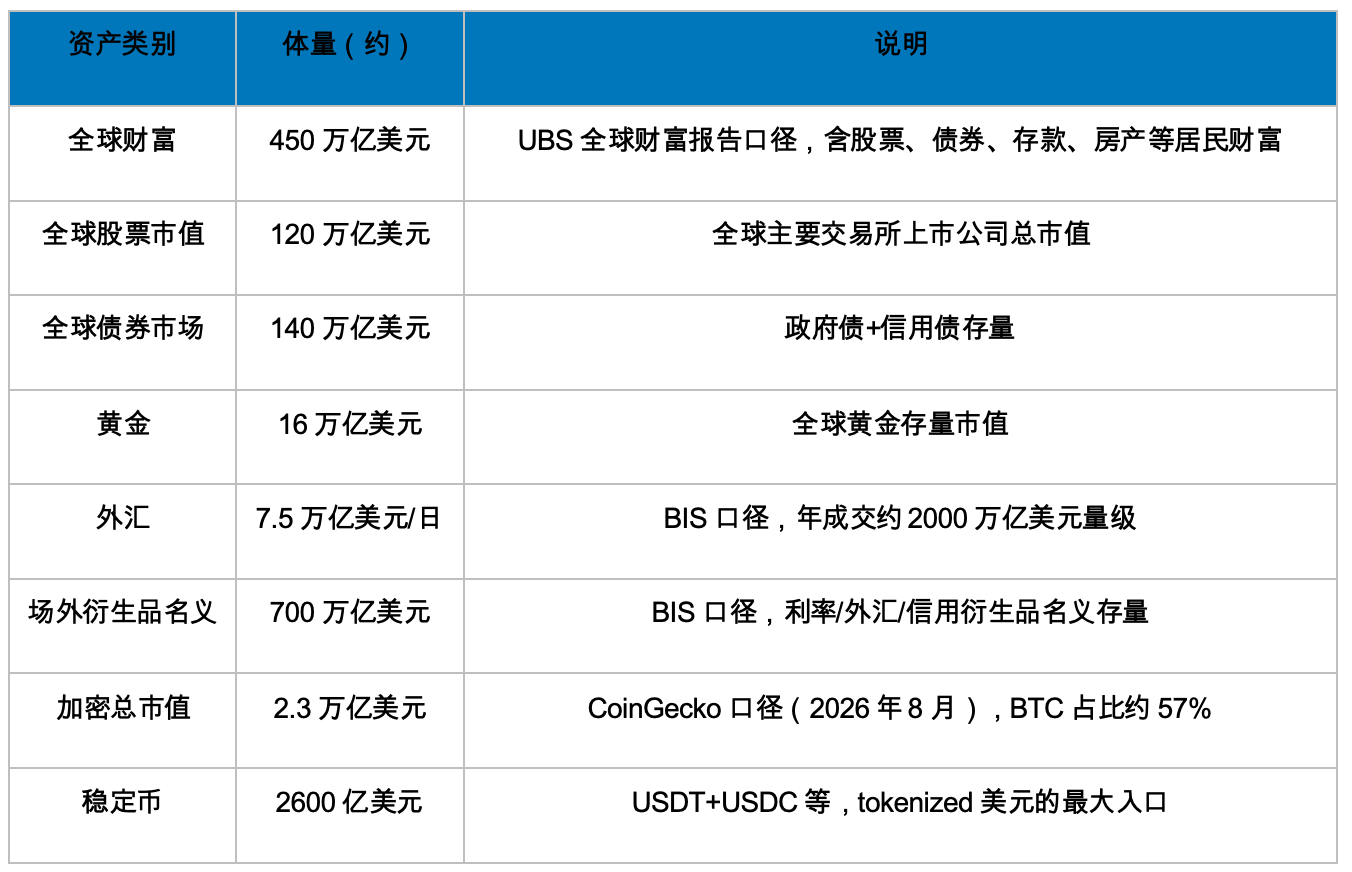
Table 1: The Size of Global Financial Assets and the Position of Crypto (Data is approximate figures for public markets)
Putting these two numbers together, the conclusion is very intuitive: the total crypto market cap is about $2.3 trillion, which is only 0.5% of global wealth and 1.9% of global stock market value. In other words, if only 1% of global wealth enters the crypto ecosystem in any form, this corresponds to an increment of $4.5 trillion—close to twice the current total crypto market cap. This is not a far-fetched notion: institutional predictions for asset tokenization are already within this range—Citi predicts that the tokenized securities market will reach about $4-5 trillion by 2030, 21.co estimates around $10 trillion, and BCG estimates tokenized assets could reach $16 trillion. Even realizing just the lower end of the predictions would represent a significant injection into the crypto industry.
And what Huobi HTX is doing is establishing the pathway for "how this 1% comes in and where it trades once it arrives" right at its doorstep. This is the fact we will discuss in the next section.
3. The Channel is Completed: The Explosion of the TradFi Sector is Not a Concept, It is the Turnover That is Happening
No matter how beautiful the narrative, it must be supported by data. The TradFi (traditional finance) sector of Huobi HTX is precisely one of the strongest business segments in 2026. According to Huobi HTX's official monthly report for July, the TradFi section added 56 new contract varieties that month, 51 of which are stock contracts covering tech giants, AI chips, storage, commodities, and precious metals; the average daily trading volume at the end of the month hit a historical peak, with over a tenfold increase from June, totaling approximately $2.5 billion. It should be noted that this was achieved in a month where the broader crypto spot market was overall sluggish, and industry trading volumes generally shrank—traditional financial assets are becoming the new engine for platform growth.
Even more critical are the customer acquisition and stickiness mechanisms. On August 5, Huobi HTX launched the second phase of the TradFi "Trade to Earn" event: selecting 28 highly liquid perpetual contracts covering stocks (NVDA, AAPL, GOOGL, MSFT, TSLA, etc.), indices (SPX500, QQQ), commodities (WTI crude oil, Brent crude oil), and precious metals (XAU, XAG, PAXG, XAUT). Users placing orders can receive 110% fee rebates, while those taking orders enjoy a 105% rebate—this is "negative fee trading": the more you trade, the more you earn. During the first phase, over 63 million USDT trading volume was generated in just ten days on specified trading pairs; the prize pool for the second phase was directly expanded to $80,000.
Pay attention to the most critical link in this design: during the event, all the fee income generated by users on all designated TradFi contracts will be fully used for repurchasing $HTX from the market, with the repurchased amounts incorporated into the quarterly burn mechanism for unified destruction. In other words, every fee from users trading U.S. stock contracts or gold contracts is being transformed into buy pressure and destruction volume for $HTX. For the first time, the trading volume of global assets is directly converted into value capture for $HTX in a systematic manner.
Looking ahead: the stock perpetuals have already been launched, indices, commodities, and precious metals are all in place, and next it is only logical to include foreign exchange, Pre-IPO shares, and RWA. When core global assets can be traded using stablecoin margin 24/7 without needing to open brokerage accounts, waiting for market openings, or participating in cross-border exchange, traditional funds entering the Crypto world will no longer need the "ritual of first buying BTC"—they will directly bring U.S. dollar stablecoins and trade familiar assets within the on-chain infrastructure. And Huobi HTX is becoming the channel itself.
4. Compliance and Traditional Capital: The Entry Tickets They Want are Being Issued One by One by Huobi HTX
Traditional financial capital possesses a characteristic that crypto-native capital does not: they are not short of money; what they lack is a compliant entry point. Whether institutional capital can enter the market depends on three factors—whether there are tradeable assets, whether there are compliant licenses, and whether there is trustworthy custody and reserve proof. Huobi HTX has completed all three tasks in the first half of 2026.
On the asset side, this involves the previously mentioned TradFi sector; on the trust side, Huobi HTX has publicly disclosed proof of reserves (PoR) for 46 consecutive months, maintaining a reserve ratio of over 100% for major assets like BTC, ETH, TRX, USDs, $HTX, XRP, DOGE, SOL, etc., with a strict 1:1 reserve ratio. This is one of the earliest and longest-standing practices of regular reserve disclosure in the industry—for institutions, this is more persuasive than any marketing. On the compliance side, in the first half of the year, Huobi HTX advanced its VASP license application after obtaining a no-objection letter from Pakistan's Virtual Asset Regulatory Authority (PVARA) and continues to align with Dubai VARA's regulatory framework. The global licensing landscape is getting pieced together in Dubai, Central Asia, and South Asia.
Looking at these three aspects together, you will see a complete layout: the assets that traditional funds need (TradFi sector), the channels they require (the global licensing network), and the trust they seek (46 months of PoR)—Huobi HTX has them all prepared. In the first half of the year, the platform's total trading volume approached $900 billion, in April it topped the global centralized exchange net inflow list, and in July the number of new registered users increased by 15% month-over-month—funds are already voting with their feet. And the market share of Huobi HTX itself is the best endorsement: CoinDesk’s 2026 April trading platform report shows that Huobi HTX’s spot market share has reached 3.79% (the top four Mandarin CEX), and its derivative share is 1.98%, with a monthly spot share increase of 0.88 percentage points, ranking third globally in growth rate. The share is rising, and the growth rate is leading; this is the starting point for the prediction in the next section.
5. Value Capture Loop: The Larger the Trading Volume of Global Assets, the Scarcer $HTX Becomes
The previous discussion proved the value of the "door"; now we will prove the value of the holders—how the global asset flows benefit $HTX holders? The answer is a closed loop that has been running for over two years and has been repeatedly validated: 50% of platform revenue is used for quarterly buyback and burn.
Look at the data: in the first quarter of 2026, despite the crypto market trading volume dropping sharply by 27%, HTX DAO completed the destruction of 10.83 trillion $HTX, valued at approximately $19.22 million; since the inception of the buyback in 2024, a total of 110.32 trillion tokens have been destroyed and donated, accounting for over 11% of the total issuance, with an average annual deflation rate of around 5.5%. Please note the meaning of this 5.5%: among mainstream governance tokens, it is one of the very few that accomplish a "transparent, large-scale, long-term public execution" destruction strategy, with its annual deflation rate significantly leading the vast majority of mainstream crypto assets. In a weak market, it remains so; in a bull market, the destruction will only be more aggressive.
The demand side is also tightening. Since April 1, $HTX has become the only fee deduction token on the Huobi HTX exchange, deeply embedded in the core trading scenarios; the $HTX staking function launched by HTX DAO offers an annualized return of up to 10% and adds governance rights; the rewards from both phases of the TradFi Trade to Earn program have all been issued in $HTX. On one hand is the revenue-driven continuous destruction (supply contraction), and on the other hand, a threefold expansion of demand through deduction, staking, and rewards—both sides are tightening supply and demand, which is the source of $HTX’s scarcity.
Now let's piece the entire closed loop together: global assets (stocks, gold, foreign exchange, Pre-IPO, RWA) go live in the TradFi sector → global compliant funds enter trading → platform fee income increases → 50% of income is used to repurchase and destroy $HTX → circulating supply continues to contract → holder equity is enhanced. In this loop, $HTX is essentially a call option on "global assets trading volume." Next, let’s calculate the exercise space of this option with numbers.
6. Five-Year Projection: How Much Global Funding Comes In, How Large Can the Market Cap of $HTX Reach
This section is the focal point of the entire article. We divide the projection into four steps: Step one determines the denominator (the penetration rate of global wealth entering crypto), step two determines the share (Huobi HTX's share of global crypto trading volume), step three determines the income (trading volume × fee rate), and step four determines the valuation (income × valuation multiple). Each step will provide conservative, neutral, and optimistic scenarios, laying out the assumptions so that readers can verify them themselves.
Step one, penetration rate. The current total market cap of crypto is about $2.3 trillion, accounting for 0.5% of global wealth (approximately $450 trillion). By 2030, if the penetration rate rises to 1% / 2% / 3%, the corresponding total crypto market cap would be about $4.5 / $9 / $13.5 trillion—this aligns closely with the projected range for tokenized assets by Citi, 21.co, and BCG ($4-16 trillion), reflecting a neutral estimation that is not an aggressive assumption.
Step two, share. Huobi HTX currently has a spot share of 3.79% and a derivative share of 1.98%, leading to an overall share of approximately 2.5%-3%. Considering two additional points: Huobi HTX is one of the few exchanges that made the "global asset channel" into a product matrix (the TradFi sector is leading), and its share growth rate is ranked third globally—by 2030, the overall share could rise to 4% / 5.5% / 8%.
Step three, trading and income. The annual turnover rate of the crypto market (combined spot and derivatives) is currently around 20 times. As market cap increases, and institutional proportion rises, turnover rates typically decrease, and we project it at 20 / 16 / 12 times subsequently; Huobi HTX's annual trading = total crypto market cap × turnover rate × share. The combined fee rates are estimated at 0.05% / 0.06% / 0.07% (negative fee marketing activities may have temporary dilution, but the overall fee structure for TradFi and derivatives remains stable). Step four, valuation. Referring to the valuation midpoints of comparable exchange assets, a P/S ratio of 3 / 5 / 8 is used—conservative estimates are close to traditional brokerage valuations, while optimistic estimates include a narrative reassessment premium for "equity token + global asset channel."
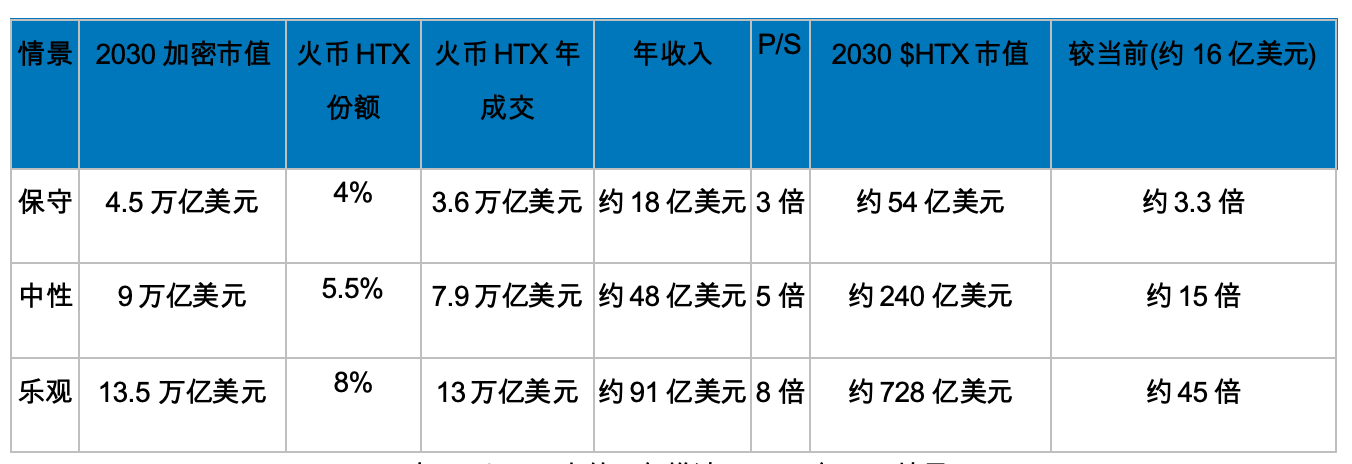
Table 2: Five-Year Projection for $HTX Market Cap (2030, three scenarios)
Note: This is a scenario projection, not a prediction. The core logic is the transmission chain of "Global Asset Penetration Rate × Huobi HTX Share → Trading → Income → Valuation"; any significant deviation from any assumption will significantly alter the results. However, even in the most conservative scenario, the market cap level of $HTX still has more than three times the space away from its current level.
This projection looks large in numbers, but every link is within the range supported by current data. To conduct a cross-validation: the neutral scenario implies that by 2030, the annual trading volume of Huobi HTX could reach around $7.9 trillion, of which if the TradFi sector accounts for about 30%, that would be around $2.4 trillion—meanwhile, the annual trading volume of the global stock market is in the range of $150-200 trillion, and foreign exchange trading volume is about $20 trillion, meaning that even achieving $2.4 trillion for Huobi HTX's TradFi would be only about 1.5% of global stock market trading. In other words, the global asset inflow needed for $HTX to reach a market cap in the billions would not even be a ripple in the ocean of global finance; what is truly scarce is not the funds but the channel—and this is precisely what Huobi HTX is building.
Additionally, let’s layer on the deflation effect from the supply side for verification: with the current annual deflation rate of 5.5%, in five years, the circulating supply of $HTX would contract by approximately 25%; if the full fee buyback and burn from TradFi continues to scale, and the base for destruction doubles from the current value, the annual deflation rate could rise to 8%-10%, leading to a five-year circulating contraction of 35%-40%. Based on the demand side projections in Table 2, if we apply a discount factor of 0.7-0.6 on the supply side, the market cap of $HTX in a neutral scenario would be even higher than shown in Table 2; it will not be lower.
Finally, we can anchor our perceptions with two comparable benchmarks. In the same track: BNB has a market cap of around $81 billion, which is 50 times that of $HTX (around $1.6 billion), while the gap in their spot shares is only about 10 times (Binance around 40% compared to HTX's 3.79%)—part of this gap is an ecosystem premium, while another part reflects the "narrative has not yet been reassessed" discount. As a channel: CME (global derivatives exchanges) has a market cap around $8 billion, and the Hong Kong Stock Exchange around $50 billion—these serve as pricing anchors for "the global asset channels of the traditional world"; what $HTX aims to become is "the CME of the crypto world." From $1.6 billion to any of these anchor levels, it is all about the ultimate imaginative space for equity token narratives.
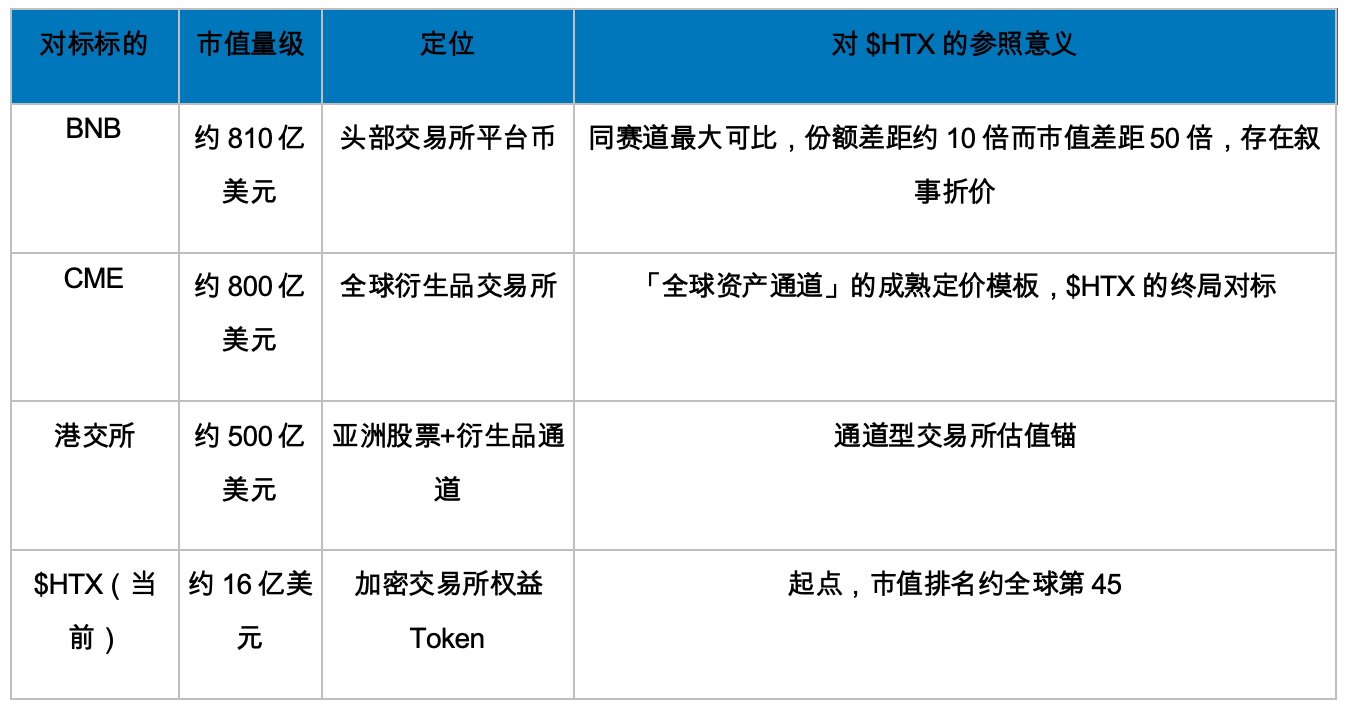
Table 3: Comparative Anchoring (Market caps are approximate figures from public data for magnitude perception)
7. Why Now: The Reassessment of Narratives in a Bull Market is the Biggest Alpha
Every bull market has two kinds of increases: one is Beta, where water rises, and BTC doubles, with most altcoins following suit, rising and then falling back; the other is Alpha, arising from narrative reassessment—where the market re-prices an asset with a new framework, moving the valuation center upwards, making it much harder to fall back down.
BNB’s independent trajectory in 2021 emerged because the market re-evaluated it from a "fee deduction voucher" to an "ecosystem equity certificate"; today’s $HTX stands at a grander reassessment starting point: from "collaborative token of crypto exchanges" to "equity token for global assets entering the Crypto world." The former's ceiling is crypto trading volume, while the latter's ceiling is the global financial market. All the elements catalyzing this reassessment—explosion of the TradFi sector, negative fee mechanism for attracting traffic, compliance licenses being secured, accumulated burn of 11%, status as the only fee token, third globally in share growth rate—are all in place by the summer of 2026.
The bull is back. Capital will chase every asset that rises in each round, but what is truly scarce is the ability to see where the channel is changing before the tide rises. The ocean of global financial assets is opening the gate to the Crypto world, and Huobi HTX has already built the channel to the gate, while $HTX is the equity of this channel itself. When global stocks, gold, foreign exchange, Pre-IPO, and RWA pass through the gateway of the Crypto world, $HTX is the share of this very door. This is the reason to be wholly bullish on $HTX.
HTX Research Analyst Cloud
Risk Warning: This article represents the views of HTX Research and does not constitute any investment advice. The quantitative projections in the text are based on a series of explicit assumptions (penetration rate, market share, turnover rate, fee rate, valuation multiple); any significant deviation from any assumption will significantly alter results; the prices of crypto assets and traditional financial derivatives are highly volatile, and regulatory policies have uncertainties; the sustainability of TradFi sector trading volumes needs further validation. Readers should fully assess their risk tolerance, view the market rationally, and make independent decisions.
About HTX Research
HTX Research is the exclusive research department under Huobi HTX, responsible for in-depth analysis across a wide range of fields including cryptocurrencies, blockchain technology, and emerging market trends, writing comprehensive reports, and providing professional assessments. HTX Research is committed to providing data-driven insights and strategic foresight, playing a key role in shaping industry perspectives and supporting informed decisions in the digital asset space. With rigorous research methods and cutting-edge data analytics, HTX Research remains at the forefront of innovation, leading the development of industry thought and promoting a deeper understanding of the ever-changing market dynamics. Visit us.
If you would like to communicate, please contact [email protected]
免责声明:本文章仅代表作者个人观点,不代表本平台的立场和观点。本文章仅供信息分享,不构成对任何人的任何投资建议。用户与作者之间的任何争议,与本平台无关。如网页中刊载的文章或图片涉及侵权,请提供相关的权利证明和身份证明发送邮件到support@aicoin.com,本平台相关工作人员将会进行核查。


