Author: Jae, PANews
Technological hardware has always been subject to rapid depreciation, but AI chips are attempting to break this financial iron law of "the faster the iteration, the quicker the devaluation." When a GPU begins to exhibit financial asset characteristics, it can continuously generate rental income, be used as collateral for financing, and have its residual value calculated based on future cash flows.
On August 10, Nvidia teamed up with Apollo, BlackRock, Blackstone, and four other major Wall Street institutions to plan the establishment of an AI infrastructure financing platform with a scale of up to $500 billion, moving this "computing power assetization" logic from concept to reality.
In fact, over the past six months, rental prices for GPUs in the non-hyperscale cloud (Neo-Cloud) market have collectively rebounded from previous lows, restoring capital market discount expectations regarding the future value of computing power.
Mortgage financing, rental curves, and second-hand residual values are forming an interconnected closed loop: GPUs enter the financial system as collateral, rental of computing power generates cash flow, and the future rental income is used to repay debts. If this cycle functions smoothly, GPUs may become a new class of standardized assets on Wall Street.
The Eve of Computing Power Assetization: Computing Power Rentals Rebound, GPUs Realize Asset Attributes
The prerequisite for computing power assetization is stable and predictable rental income. Silicon Data's Neo-Cloud market price index is showing clear signs of recovery.
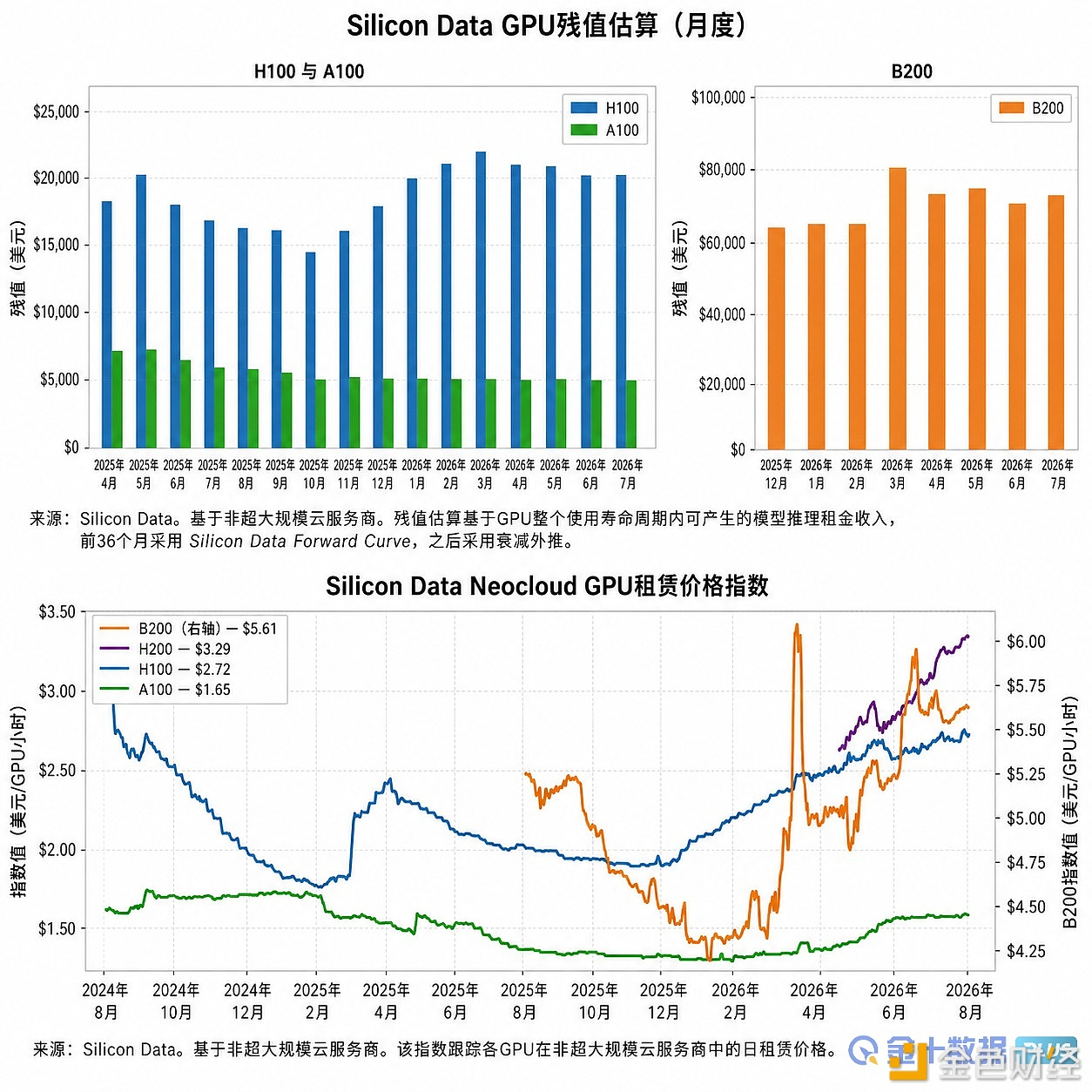
In the past six months, the rental rates for various generations of Nvidia's main GPUs have shown strong rebound trends from their lows. The H100, a key model for training and advanced inference, has seen its rental rate increase from around $2 at the end of last year to $2.72 per hour; the H200, equipped with larger memory and focused on long context inference, has reached a rental price of $3.29 per hour; the newly shipping Blackwell architecture B200, with initial capacity scarcity, has maintained a high of $5.61; even the A100, which has been in the market for six years, has stabilized at $1.65 per hour due to steady demand for inference and fine-tuning scenarios.
A startup under Coinbase, B3Labs, recently launched B3IQ, allowing users to rent-to-buy (30% down payment, then installment payments) servers equipped with Nvidia GPUs. During the payback period, users and the platform will share computing power income at a ratio of 3:7. After full repayment, if users choose to continue renting out computing power, the profit-sharing structure will reverse. While users rent out computing power, the platform will also earn revenue simultaneously.
More important than rental prices is the recovery of discount expectations for future value. Silicon Data's calculations based on a 36-month forward rental curve indicate that the estimated residual value of a single H100 has rebounded from approximately $14,000 last October to around $20,000 currently. Although this is only a theoretical valuation and not the actual transaction price in the second-hand market, it indirectly boosts financial institutions' confidence in viewing GPUs as collateral: when a piece of equipment can continuously generate stable cash flow, it lays the foundation for capitalization.
From Theory to Practice: Nvidia Teams Up with Six Wall Street Giants to Raise $500 Billion, GPU Mortgages May Launch
The recovery of rental curves aligns with Nvidia CEO Jensen Huang's proposed "computing power assetization" business model.
In the traditional capital expenditure model, the construction of data centers heavily relies on cloud vendors' cash flow or unsecured corporate debt, with expansion speed limited by their balance sheets. Huang's argument is: since GPUs can continuously generate rental income during their lifecycle, data centers possess characteristics of productive assets like commercial aircraft and large cargo ships, and can leverage future cash flow as collateral for leveraged financing.
On August 10, this idea entered the implementation phase. Nvidia announced a memorandum of understanding with Apollo, BlackRock, Blackstone, Brookfield, Goldman Sachs, and KKR to jointly create a computing power financing platform to raise over $500 billion in third-party capital for global AI infrastructure development.
In the design of this financing structure, some loans will be secured directly against purchased GPU equipment and physical data center facilities. To alleviate financial institutions' concerns about rapid hardware depreciation, Nvidia committed to providing up to 25% residual value support or credit guarantee in specific cases based on the equipment's residual value.
Neo-Cloud vendors can repay debts using future income from computing power rentals, forming a financing closed loop of "mortgage financing → GPU procurement → computing power rental → repayment of principal and interest."
In fact, this model already has predecessors. In August 2023, CoreWeave pledged its H100 cluster to Blackstone and Magnetar Capital, securing $2.3 billion in debt financing.
On August 12, CoreWeave's financial data showed its second-quarter performance exceeded expectations, confirming a surge in market demand for computing power. Since the financial report was released, its stock price has risen by about 18%. Since its public listing last March, CoreWeave's stock price has actually increased by over 1.65 times.
Returning to Nvidia's $500 billion financing platform, its significance lies in transforming case-by-case explorations into standardized financing tools at the industry level: it will significantly reduce the financing costs for Neo-Cloud vendors, attract more capital into the AI infrastructure sector, and in turn stimulate demand for GPU orders.
The launch of this financing platform may become a watershed moment for AI infrastructure to transition from a "heavy asset business" to "financialized expansion." Nvidia sells more chips, financial institutions earn from AI infrastructure investments, and Neo-Cloud vendors gain ammunition for business expansion, with all three parties collectively spinning the flywheel of computing power assetization.
Debate on Hardware Residual Value: Second-Hand Market Discounts, Inference Demand Sustains
Beneath the $500 billion financing narrative, divisions have never ceased. The focus of disagreement points directly to the foundation of computing power assetization: how long is the actual economic lifetime of GPUs? Is the residual value estimation reliable?
Opposing View: Hardware Depreciation Exceeds Expectations
Counterarguments come from actual transaction data in the second-hand market and adjustments in corporate accounting.
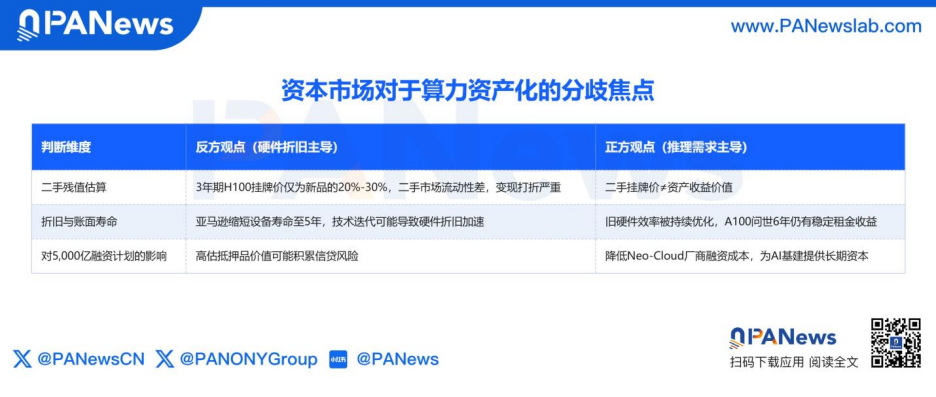
Silicon Data's second-hand trading data shows that second-hand H100s used for about three years are listed at only 20%-30% of their peak new prices, and the second-hand market has limited liquidity, meaning actual transaction prices often require further discounts. From a monetization perspective, the depreciation rate of GPU hardware remains high.
Corporate actions also reinforce this concern. At the beginning of last year, Amazon shortened the depreciation period for servers and networking equipment from six years to five years. This single measure added $1.4 billion in depreciation costs to its financial statements, reflecting the reality of rapid AI hardware iteration. Notable short seller Michael Burry bluntly stated that mainstream cloud vendors' financial reports seriously underestimate the depreciation rate of AI chips, concealing significant asset devaluation risks.
Conservatives believe that the "book residual value" derived from discounting future rental income is different from actual transaction prices in the second-hand market. Once a generational leap occurs in technology, the collateral value of high-end GPUs may collapse rapidly.
Supporting View: Inference Demand Reshapes Economic Lifetime
Supporters point out market misjudgments regarding second-order assessments: there is a common confusion between the economic value of GPUs at the "training end" and the "inference end."
Indeed, new architectures like Blackwell will impact old architectures at the training end, causing older chips to exit the high-end training market, but the explosive inference demand brought by commercialization is also significantly extending the economic lifetimes of GPUs.
The most typical example is the A100. Six years after its launch, it has long exited the high-end training market but maintains stable rental prices and strong demand in scenarios like model inference, low-cost fine-tuning, and specific domain computing; its unit economic efficiency and practical value have not been significantly diminished. This indicates that older GPUs will not be directly phased out by new generations but will sink into the inference market to continue generating cash flow.
In simple terms, the "real economic lifetime" of GPUs is far longer than the market-assumed 2-3 years. Growing inference demand will offset nominal devaluation brought about by technological depreciation.
Computing power assetization is entering a critical stage, which could either fuel industry acceleration or become a source of systemic risk. The rebound in GPU rentals offers short-term support, while inference demand provides long-term imagination; however, the speed of technological iteration remains a Damocles' sword hanging over asset valuation. Thus, computing power assetization could become a new lever for AI infrastructure expansion or a new entry point for risk transmission.
In this joint gamble between Silicon Valley and Wall Street, those who can more accurately measure the economic lifetime and residual value discount of computing power will hold the pricing power for the next stage of AI infrastructure.
免责声明:本文章仅代表作者个人观点,不代表本平台的立场和观点。本文章仅供信息分享,不构成对任何人的任何投资建议。用户与作者之间的任何争议,与本平台无关。如网页中刊载的文章或图片涉及侵权,请提供相关的权利证明和身份证明发送邮件到support@aicoin.com,本平台相关工作人员将会进行核查。


