Author: 🦊 A Fox in Web3
Translation: Deep Tide TechFlow
Deep Tide Guide: DeFi lending has long relied on floating rates, making it difficult for institutions and conservative users to plan costs, while Morpho's newly launched Midnight protocol has achieved truly market-driven fixed-rate, fixed-term lending on-chain for the first time, perhaps marking a key step for DeFi to take on the $200 trillion credit market off-chain. This release is deliberately conservative—there is only one trading pair, one chain, and a core contract, making it worth observing if it can break the curse of failure of previous fixed-rate projects.
Morpho is the largest player in the DeFi vault space and has in many ways become synonymous with this sector. Just last week, they launched a new type of market allowing users to earn fixed-rate yields, named Morpho Midnight.
Given that DeFi has never truly succeeded in running a market-driven fixed-rate product, this release is significant. Today, I decided to dive deeper into Morpho Midnight, to understand how it works and what new possibilities it brings to the DeFi space.
Morpho Midnight
Back in April this year, we introduced the basic principles of Morpho on the blog: it has "Markets" for borrowing, "Vaults" for lending, curators managing complexity, and independent markets to isolate risk. If you haven't previously encountered Morpho, I recommend reading my earlier articles first.
This article continues from there, as Morpho has just launched a new product called "Midnight," introducing an entirely new category of DeFi market—markets that offer fixed rates.
Currently, almost all DeFi lending operates at floating rates, with borrowing costs and lending yields fluctuating with market usage per block.
Protocols like Pendle have approximated fixed-rate loans, but they are not genuinely engaging in lending. If you want to learn more about Pendle, you can read the article I wrote last year.
Midnight represents Morpho's first real attempt at fixed-rate, fixed-term lending. By locking in a rate today, you will clearly know how much you will pay or earn within the set term—this is much closer to bonds or fixed-rate mortgages, rather than the typical floating-rate DeFi pools.
Blue has already allowed users to directly control risk instead of leaving it to a unified model from the entire protocol. Midnight takes it a step further, transferring risk, duration, and rates entirely to the market itself—allowing both parties to negotiate directly, instead of having rates predetermined.
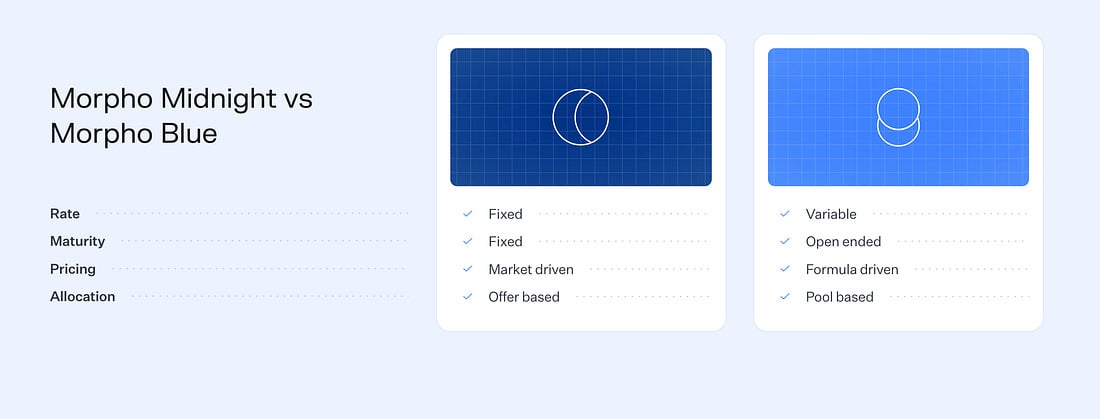
Image: Comparison of core differences between Morpho Midnight and Morpho Blue—Midnight completely hands over risks, duration, and rates to the market
DeFi lending has always given you control over "risk," but has never truly offered control over "rates" or "terms" simultaneously. Midnight is trying to give you control over all three, stepping into new territory.
Why Fixed Rates Have Not Been Achievable Before
There have been attempts at fixed-rate lending on-chain before, but most have failed for two main reasons.
First, they attempted to impose a fixed rate on existing floating-rate pools. This simply doesn't work, as predictability cannot be built on something that is continuously changing underneath.
Second, a quote-based fixed-rate market requires a sufficient number of participants to actively quote on both sides simultaneously—the lender needs to quote a rate they are willing to lend at, while the borrower quotes a rate they are willing to pay. Establishing this bilateral liquidity from scratch is very difficult; most early attempts never reached this point.
Midnight avoids both of these issues. It is constructed as an independent foundational primitive, rather than being layered on top of floating-rate pools; and it does not start from zero liquidity, but builds upon the existing active lenders and borrowers already using Blue.
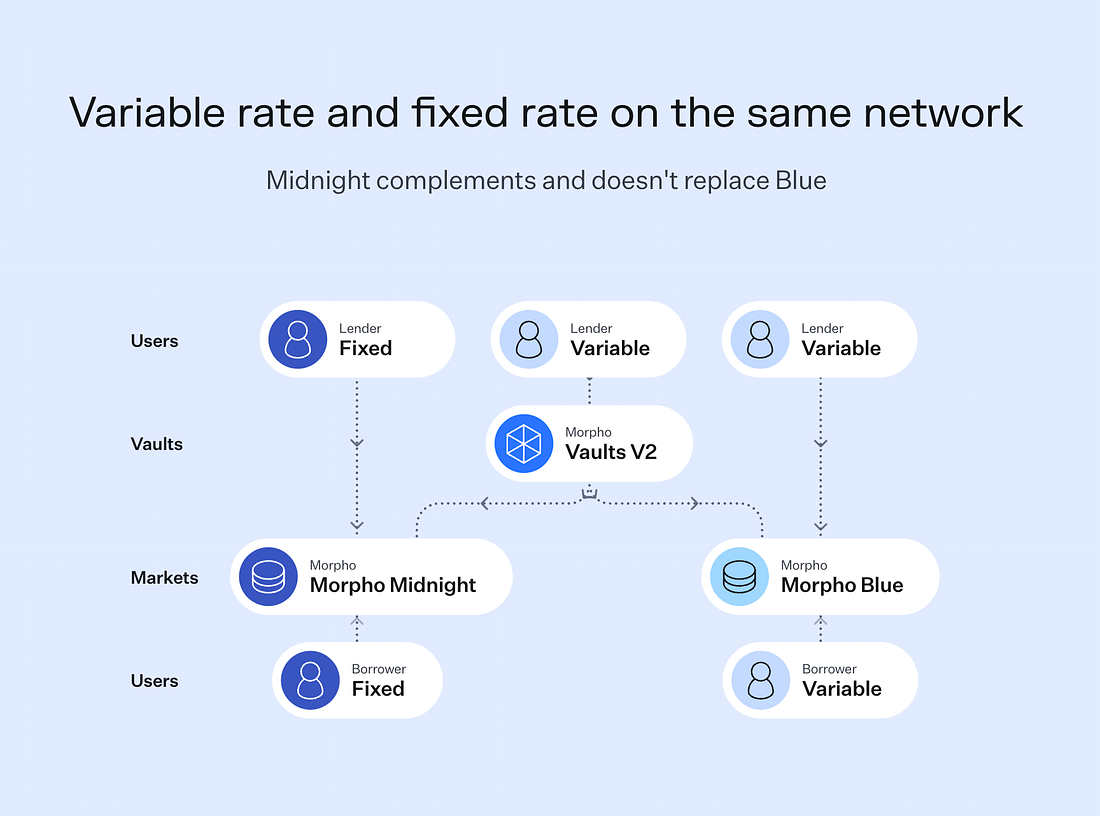
Image: Comparison of network structure between fixed-rate (Midnight) and floating-rate (Blue) in Morpho's lending market
Midnight can guide floating-rate lenders sitting in the vaults and fixed-rate lenders into the same market structure, providing a completely different experience for both lending and borrowing parties.
It is crucial to understand this point: floating-rate loans in Blue are still driven by formulas, with parameters set by curators; whereas Midnight behaves more like a market, with rates determined by market forces through an order book.
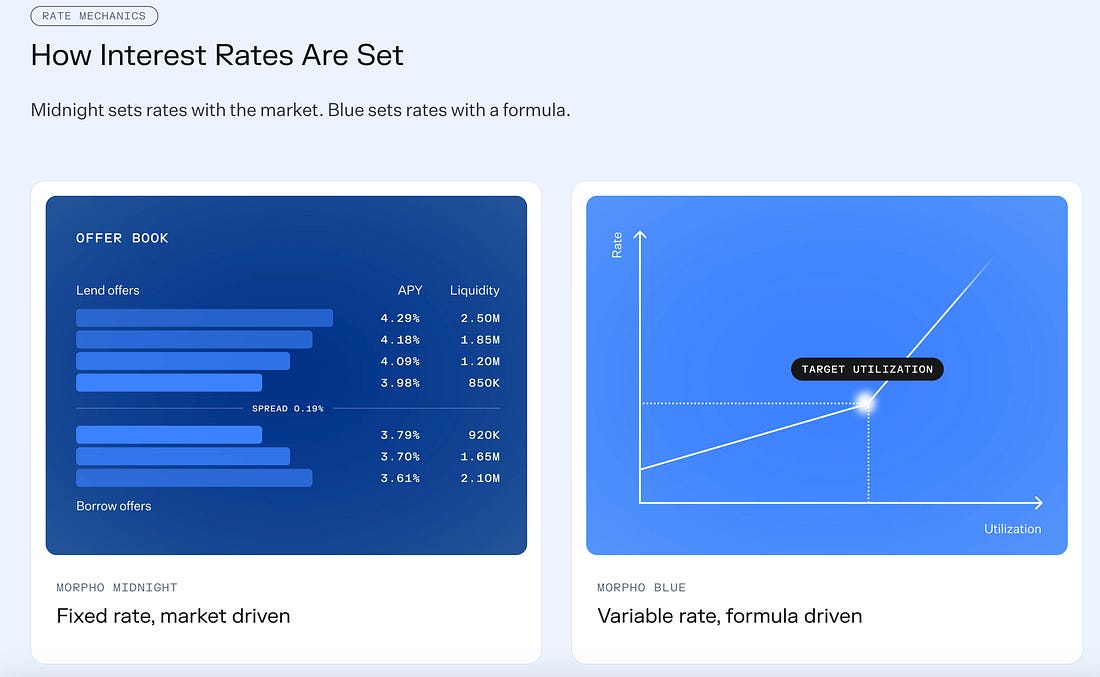
Image: Rate setting mechanism—left is Midnight's market-driven fixed-rate lending, right is Blue's formula-driven floating-rate
Midnight deliberately started on a small scale
Midnight went live on July 21 with only one market: cbBTC/USDC on the Base chain, offering several different term options. Morpho chose this market correctly, as it is already the largest single market of Blue, allowing Midnight to launch with a trading pair known to have strong demand.
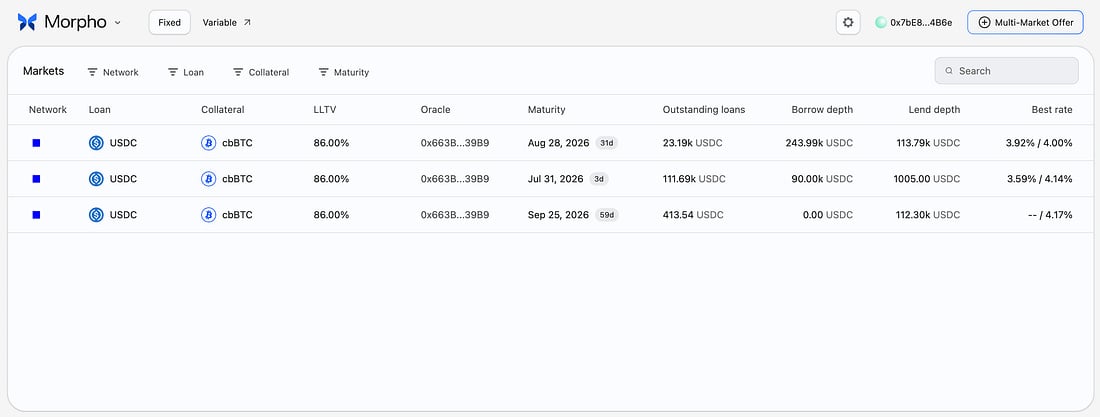
Image: Interface of the Morpho Midnight fixed-rate lending market, showcasing lending-related data
On the day I took the screenshot, you can see three different term options listed in the "maturity" column of the current market: 3 days, 31 days, and 59 days.
If you choose one of the markets, like the one with a 31-day term, you will see an order book showing the different rates that lenders and borrowers are willing to accept.
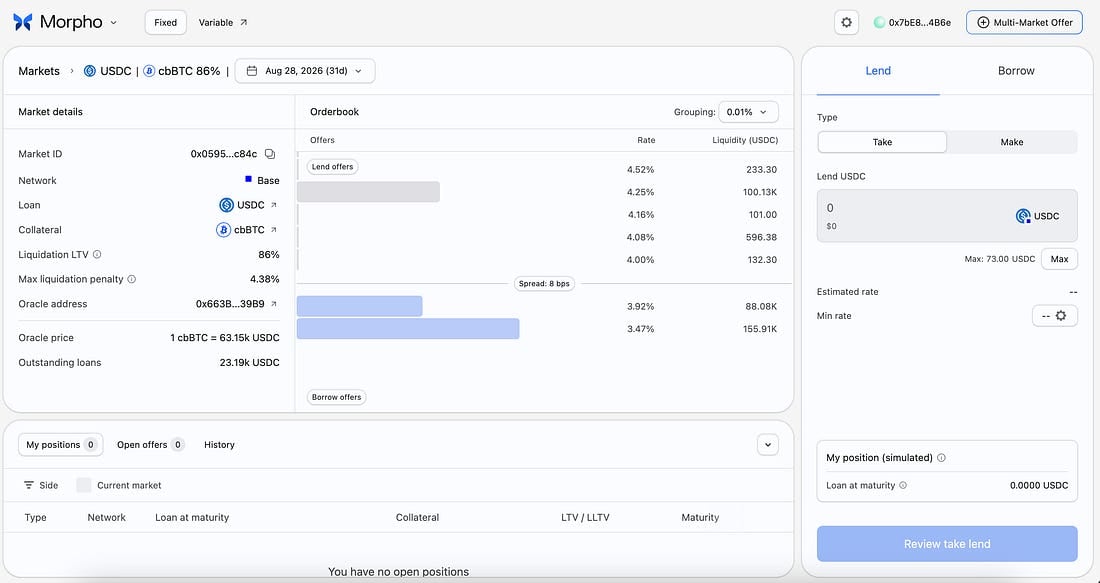
Image: USDC - cbBTC 86% market interface, with market details (network, loans, collateral) on the left
Selecting "Take" on the right will accept an existing order, while "Make" will add a new order to the order book. Note that you need to deposit at least 100 USDC to place an order.
If you decide to "Take" an available quote, the system will prompt you to confirm the market you want to lend into, then give a warning—withdrawal is not possible during the specified term, and after signing, the lending will be successfully completed.
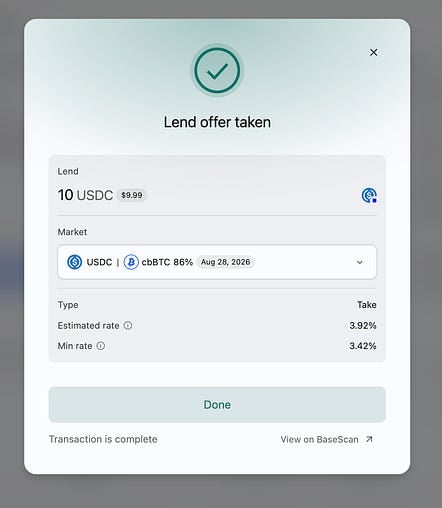
Image: Lending success interface—Lend
Note that once you have an active lending or borrowing position, you can see it at the bottom of the page. Additionally, once you have a lending position, you cannot borrow in the same market, and vice versa.
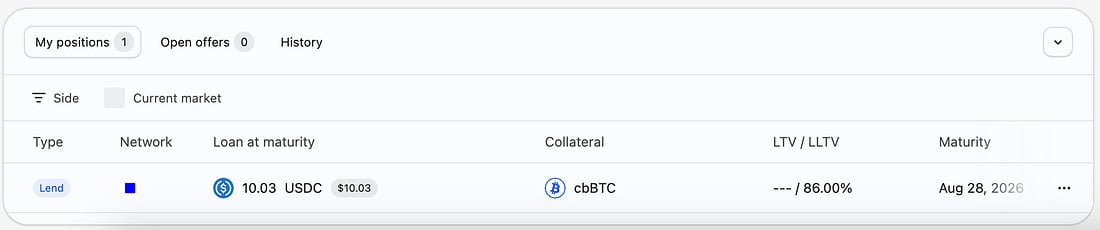
Image: Single lending transaction interface—Lend 10.03 USDC, collateral cbBTC, LTV 86.00%, due on August 28, 2026
Currently, there is only one USDC/cbBTC trading pair, offering three term options. The entire launch process is deliberately conservative—only the core contract has gone live, which is the basic lending and borrowing functionality. Features like automated rolling, callbacks, compliance gatekeeping, cross-chain, vault adapters, and cross-collateral are still not available.
Despite months of audits, an audit competition, and formal verification behind the code, Morpho still chose to slowly test in the production environment instead of launching all functionalities at once.
However, from day one, an additional feature called "multi-market offers" has gone live. Lenders or borrowers can submit a single quote across multiple independent markets, rather than breaking down liquidity piece by piece, without needing to spread funds.
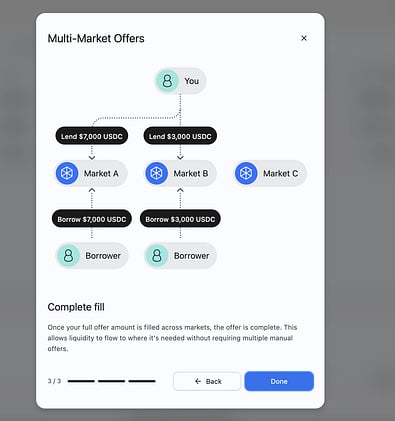
Image: Multi-Market Offers interface—allows a single quote to be split across multiple independent markets
For the features that are yet to be launched, there is a clear roadmap. More markets and chains are coming, along with vault adapters—which will allow the billions of funds already deposited in Morpho Vaults to quote fixed rates directly. Automated rolling and callbacks will be introduced later, as well as a secondary market for early position exits (without waiting for the entire term to end), and compliance gatekeeping for institutions with regulatory needs.
Who is Midnight for?
Midnight is not built solely for one type of user; different users will see different yields.
Institutional users gain a predictable term structure, with complete control over rates, risks, maturity dates, and market-level compliance settings. This enables them to establish long-term positions or build more customized trades—which is hard to achieve on floating-rate pools because rates could fluctuate at any time during their holding period.
Fintech companies can offer their users fixed-rate, multi-collateral credit products without having to build a credit engine from scratch.
Ordinary lenders and borrowers receive a definite rate during the loan term, can submit quotes to multiple markets simultaneously, and can still lend or borrow at floating rates while waiting for matching on Midnight.
Curators gain a new dimension of differentiation. Blue has already allowed them to manage risk, and Midnight adds dimensions of rates and terms to that.
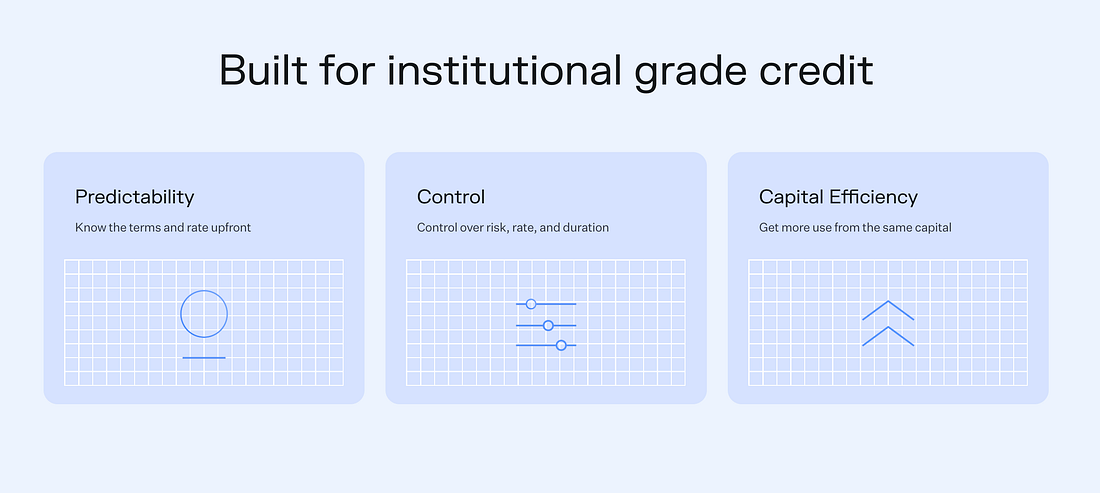
Image: The three major characteristics Midnight is built for institutional-level credit—predictability, control, and capital efficiency
The overall data from Morpho reflects the scale of all these happenings. As of writing, the total value locked is approximately $7.28 billion, total deposits are $11.3 billion, active loans are $4.16 billion, with over 10% growth in the last 30 days.
Recent growth has been partially driven by Robinhood Earn—launched on July 1, which directs user deposits straight into Morpho vaults, with an annual yield of about 7% for USDG. We also discussed the ecosystem of Robinhood Chain last week when talking about Uniswap Token Jar, as their new chain is making a significant impact in DeFi.
But most importantly: on-chain credit currently stands at about $60 billion, the majority of which is crypto-asset collateral lending like Morpho itself. Meanwhile, the off-chain credit market is sized at approximately $200 trillion annually. This is a massive gap, and Morpho's building of Midnight aims directly at this gap.
Why This Matters
The real test lies not in the release itself, but in whether such a fixed-rate foundational primitive can truly scale beyond a single market pair and a single chain.
Fixed-rate borrowing on-chain has previously failed to take off, and it is precisely because of the reasons mentioned earlier; Morpho is clearly aware of this—which is likely why they have launched so conservatively, starting from just one trading pair.
This cautious approach deserves attention: there is no automated rolling, no vault adapters, no secondary markets—and these functionalities have actually all been developed and audited already.
This is essentially an acknowledgment: fixed-rate, fixed-term lending is a more challenging problem to solve than floating-rate pools, and Morpho believes there is still a lot of work to be done before Midnight can be deemed successful.
But if it works, this won't just be "a new feature of Morpho"; rather, it will be more akin to an entirely new market structure for on-chain credit. It is the first genuine attempt to establish something resembling a fixed-rate bond market on-chain, directly targeting the hundreds of trillions of dollars that remain dormant off-chain in credit.
免责声明:本文章仅代表作者个人观点,不代表本平台的立场和观点。本文章仅供信息分享,不构成对任何人的任何投资建议。用户与作者之间的任何争议,与本平台无关。如网页中刊载的文章或图片涉及侵权,请提供相关的权利证明和身份证明发送邮件到support@aicoin.com,本平台相关工作人员将会进行核查。


