A single order of only one share in the Korean pre-market crashed the SK Hynix contract by 18%, triggering $80 million in liquidations.
Written by: ChandlerZ, Foresight News
At 07:01 on July 28, the marked price of the perpetual contract coded xyz:SKHYNIX on Hyperliquid plummeted from $1127.9 to $917.25, dropping about 18% in just a few seconds, before bouncing back above $1100. By the time the price recovered, the liquidation engine had already completed its work.
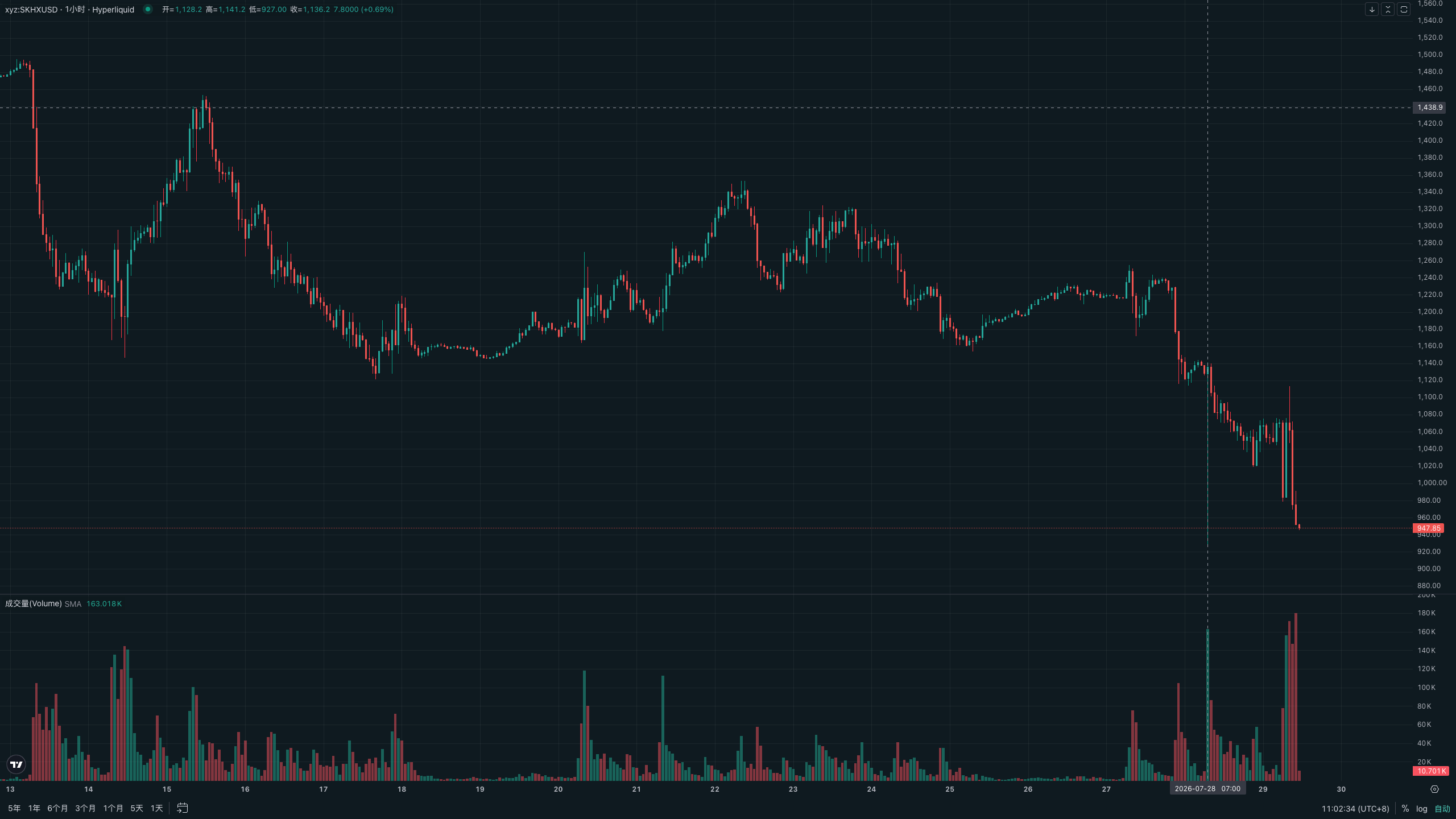
This point in time corresponds to just after 8 AM local time in Seoul, right in the Korean pre-market trading period. The trigger for the spike was a pre-market order on the Korean alternative trading platform NXT (NextTrade, an alternative securities exchange launched in March 2025) with a transaction volume of only one share, but priced at 1,272,000 Korean Won, about $876.
This lone transaction resulted in a drop of up to 30% due to poor liquidity, subsequently triggering a halt, and was forwarded by multiple data providers, entering the pricing chain of the on-chain contracts and causing liquidations exceeding $80 million.
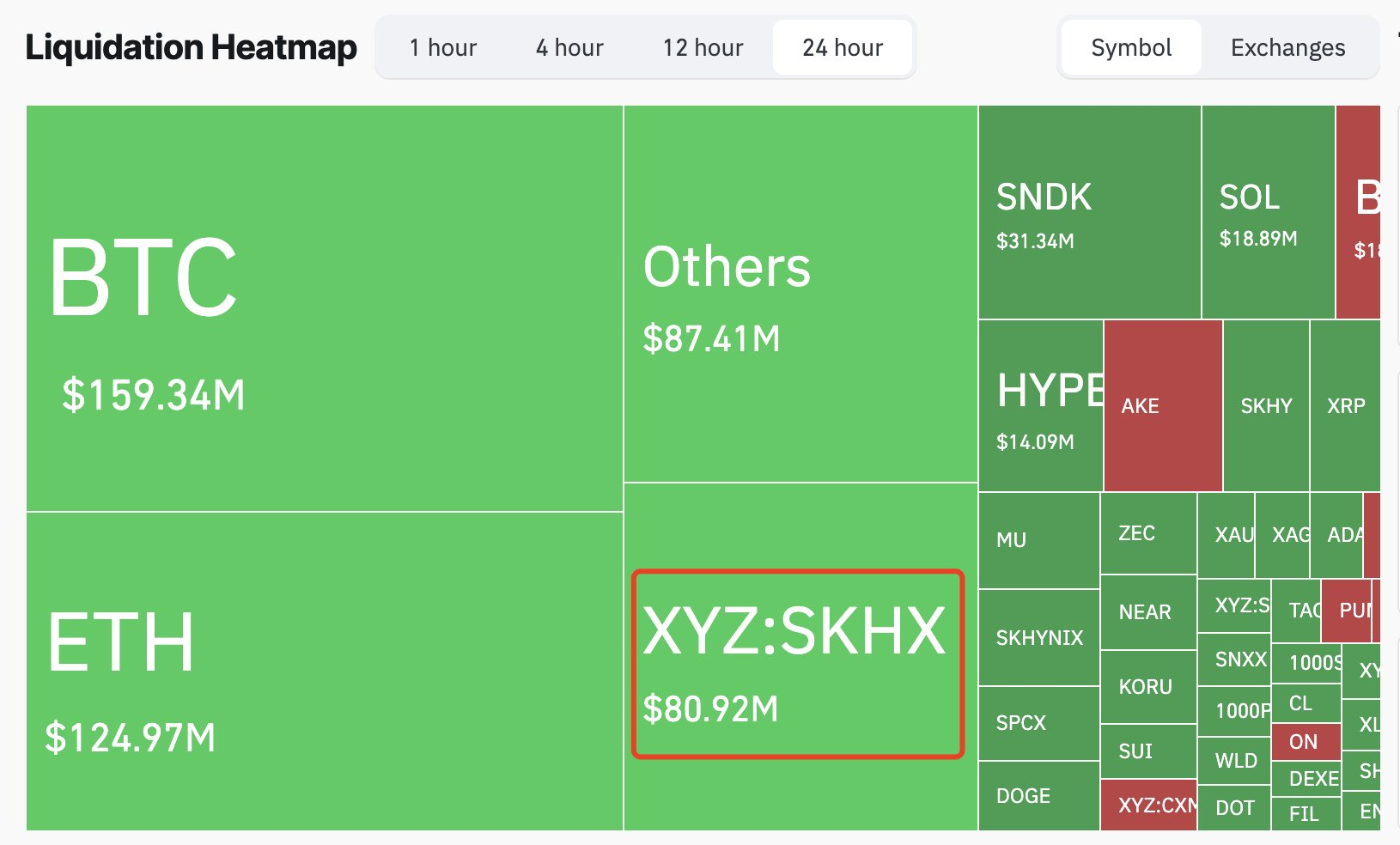
According to on-chain analyst @ai_9684xtpa, during the SK Hynix spike incident, three major addresses on Hyperliquid were liquidated for $4.7263 million, while three other addresses profited $6.958 million by shorting at the low through ADL.
- Address 0xd04…3ecad triggered ADL shorting 4,510 SKHX at $931.36, profiting $2.185 million;
- Address 0xcaf…a7b3b shorted 5,920 SKHX, profiting $2.55 million;
- Address 0x84a…f4d37 shorted 6,010 SKHX, profiting $2.223 million.
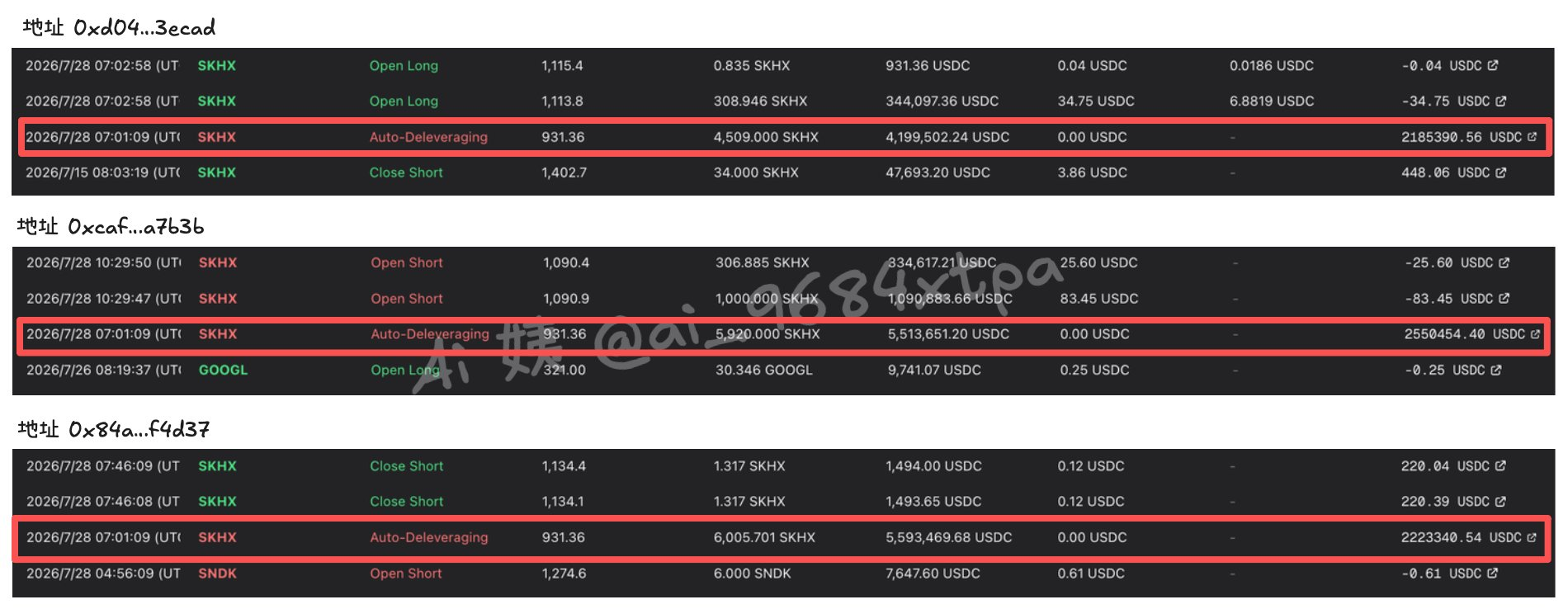
All three addresses triggered ADL at 07:01, and due to the rapid price correction after the flash crash, they were forced to liquidate their positions at the low for profit.
Hyperliquid Clarifies, Trade.xyz Takes Responsibility
Immediately after the incident, the market pointed fingers at Hyperliquid. However, Hyperliquid team members quickly clarified that this market was not deployed by the platform and is not operated by the platform, but was the responsibility of the independent team Trade.xyz under the HIP-3 framework.
HIP-3 is Hyperliquid's permissioned framework that allows independent teams to create perpetual contract markets on Hyperliquid, reusing the platform’s order book, margin system, and liquidation engine, while the oracle selection, leverage limits, and settlement parameters are controlled by the deploying party. Trade.xyz is the deploying party for this type of pre-market perpetual contract xyz:SKHYNIX, where two of the three oracle inputs used to synthesize the marked price in the SK Hynix market are controlled by Trade.xyz, holding the channel that feeds NXT pricing into the pricing system.
In pure protocol logic, the matter should end here. The HIP-3 framework did not design a compensation channel for liquidated users; its only punitive tool is confiscation, where the deploying party must stake 500,000 HYPE (approximately $27.4 million at the time of the incident), locked for at least 183 days, and can be confiscated anytime during the seven-day unstaking queue period. However, even if validators actually exercised their confiscation rights, the confiscated HYPE is destroyed, not distributed to the victims. Following the complete protocol process, the 960 liquidated accounts will not retrieve a single penny.
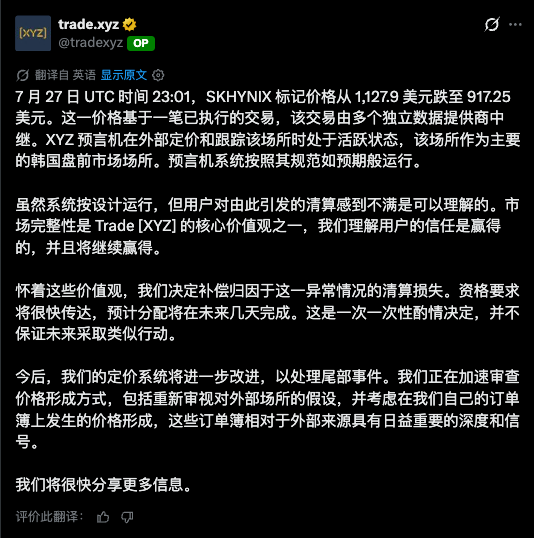
As a follow-up, Trade.xyz announced it would cover all liquidation losses caused by this price anomaly in a discretionary one-time manner, with specific eligibility requirements to be announced soon, expected to complete the compensation within a few days, but stating that this decision “does not constitute a guarantee for similar situations in the future.” At the mechanism level, the platform will accelerate the review of pricing methods, including reassessing the reliance on external venues and assigning greater weight to its own order book price discovery (its order book depth and signal strength have significantly risen relative to external sources), to more effectively handle tail events.
One Share Price Can Crash a Market
An easily overlooked background is that SK Hynix was indeed falling. On July 28, the Korean stock market suffered a sharp decline, with SK Hynix’s stock closing at 1.55 million Korean Won, down 14.65% for the day, while Samsung Electronics dropped 13.39%. Together, the two companies accounted for nearly half the weight of the KOSPI, which fell 10.84% that day. The catalyst for the sell-off included Chinese manufacturers catching up in photolithography equipment and memory chips, along with market concerns regarding AI data center financing models.
In other words, the long positions in SK Hynix were already precarious that day. The spike altered the timing and price of settlements, forcing the liquidated accounts to exit at a price supported by only one share transaction, which was subsequently proven to be unrealistic, an hour before the underlying stock officially opened. The difference between the real drop of 14.65% and the spike drop of 18%, combined with the depriving of the opportunity to adjust positions during the day, constituted the actual damage of this incident.
However, the larger issue still stands for the entire stock perpetual track; contracts run 7×24 hours while reliable price discovery for the underlying only happens for six and a half hours daily. During the remaining time, price feeds either rely on liquidity-thin alternative venues like NXT or continue through mathematical interpolation, with the liquidation engine enforcing both states with identical intensity.
Trade.xyz obtained official authorization from S&P Dow Jones Indices in March this year, bringing the S&P 500 into the 7×24 perpetual market for the first time. The faster this product line expands, the more unavoidable the pricing issues during the market closure periods become.
As of the time of publication, the eligibility criteria and total amount for compensation have not yet been announced. How the future compensation list will be determined, whether the weight of the self-order book will indeed increase after the review of the pricing mechanism, and whether Hyperliquid will modify the pricing authority for deploying parties under HIP-3 remain to be seen.
免责声明:本文章仅代表作者个人观点,不代表本平台的立场和观点。本文章仅供信息分享,不构成对任何人的任何投资建议。用户与作者之间的任何争议,与本平台无关。如网页中刊载的文章或图片涉及侵权,请提供相关的权利证明和身份证明发送邮件到support@aicoin.com,本平台相关工作人员将会进行核查。


