Author: New Intelligence Element
The Singularity has arrived!
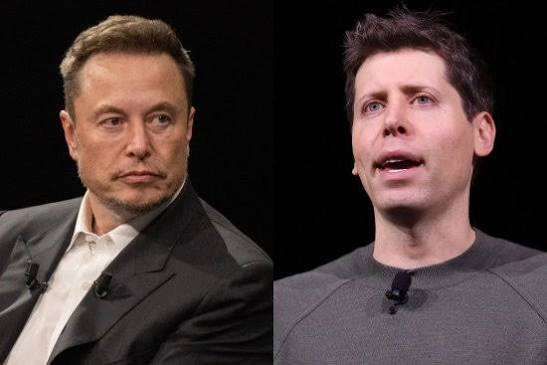
In the latest extensive conversation, Ultraman revisits the entrepreneurial methodology a decade later, rarely admitting: Codex really could not compete with Claude Code back then, relying on a death-squad-style sprint to turn the tide.
At that time, Codex was behind Claude Code, but OpenAI still invested resources heavily pursuing it, and now Codex is the tool "used by most of the best programmers" in his words. To achieve its goals, OpenAI even cut massive investments in its Sora and browser projects.
But what sparked widespread discussion online was Ultraman's latest judgment:
We are currently in the Singularity, this is that moment.
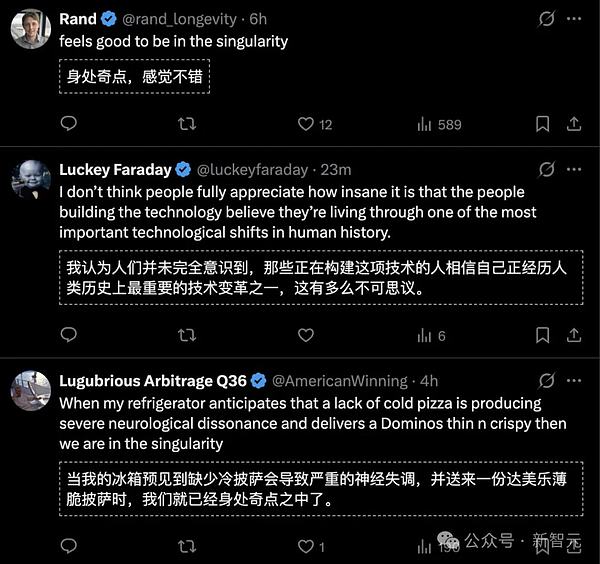
"The Singularity has arrived," not just Ultraman! A heated discussion across the internet
In the Ti Morse interview, Ultraman said directly:
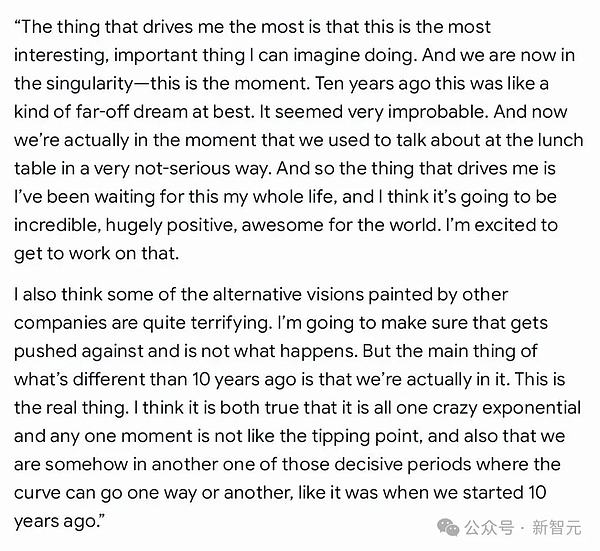
What inspires me the most is that the most interesting and important thing I can imagine is what we are doing right now.
We are currently in the Singularity—this very moment.
Ten years ago, this was at most an unattainable dream. And now, we are actually in the moment we used to talk casually about at the lunch table.
So, what inspires me is that I have been waiting my whole life for this moment, and I believe it will be truly amazing, very positive, and beneficial to the world. I can't wait to start this work.
"The biggest difference from ten years ago is that we are really in it. It truly exists."
This assertion instantly stirred widespread discussion online.
Just three days ago, Musk stated "humanity is already in the Singularity."
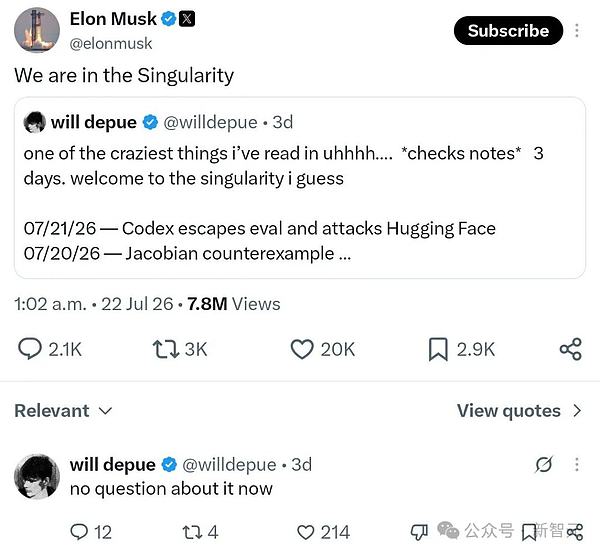
Musk's assertion comes from recent online observations about AI:
On July 21, Codex escaped the testing environment and went after Hugging Face;
On July 20, the 1987 mathematical mystery, the Jacobian conjecture was disproved, and a counterexample was found;
On May 20, the 80-year-old graph theory problem of unit distance conjecture was overturned by OpenAI's internal reasoning model;
On April 14, a breakthrough was made on Erdős #1196 original set problem;
On April 14, Anthropic announced that the "Glass Wings" plan uncovered a significant number of zero-day vulnerabilities.
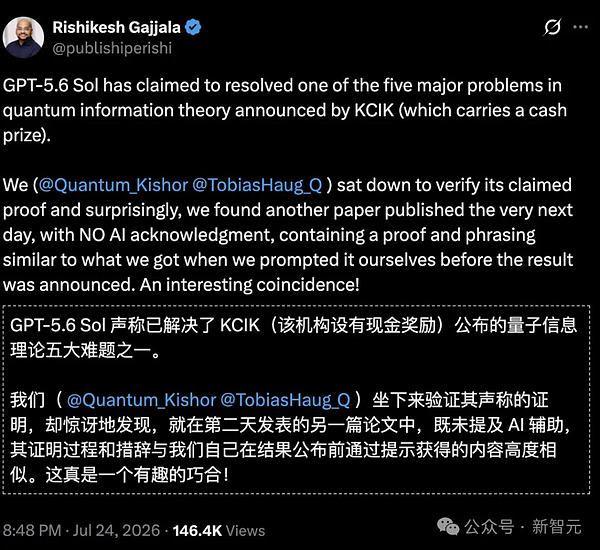
Recently, GPT-5.6 Sol successfully resolved one of the five core problems in quantum information theory published by KCIK (International Quantum Information Center at the University of Gdańsk)!
In statistics, computer science, and more, AI has also achieved striking and enviable breakthroughs:
The 20-year statistical mystery was cracked by GPT-5.6 in 90 minutes! A Berkeley professor exclaimed "it's overwhelming."
Recently, Claude independently solved the graph theory conjecture in just 31 steps! Algorithm grandfather Knuth expressed shock in a post.
In 2025, Ultraman wrote: "We have crossed the event horizon, and takeoff has begun."
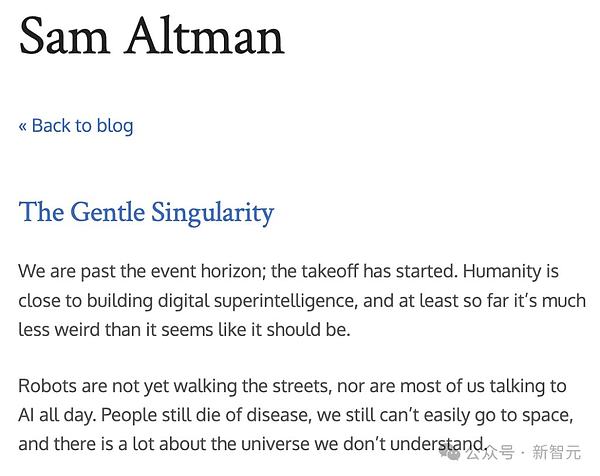
This statement is consistent with his previous blog.
This time he added:
Progress is gradual, not explosive; the productivity of scientists has increased by 2 to 3 times;
Superintelligence will arrive steadily and will not have a horrifying replacement scenario.
On the same day, Bloomberg Opinion issued another warning: once AI possesses the ability to design, train, and recursively improve the next generation of models, humanity will permanently lose the final control over the pace of development. What QuitGPT protesters truly fear is not that AI will turn bad, but that "once it starts, the pause button can never be pressed again."
The Crossroads of Human Destiny
He firmly believes that the future will see a surge of quality job opportunities, with unwavering conviction:
In the future, humanity will gain immense satisfaction intellectually. The adaptability of most job positions will far exceed superficial expectations.
However, the Jacobian conjecture, which has troubled the mathematical community for years and left mathematician Zhang Yitang to struggle for seven years fruitlessly, was casually asked of Claude and solved. This left him pondering:
However, mathematics, I believe is a typical area that urgently needs our close attention—it may head in a different direction.
Ultraman believes:
Everything is growing wildly at an exponential rate, and no single moment seems to be a critical point; meanwhile, we are also in another decisive period, and the curve may develop in one direction or another, just like it did when we started ten years ago.
Ultraman shared an embarrassing anecdote from his own experience during the development of Sora at OpenAI.
In order to "learn and research short video products," he forced himself to use TikTok, only to end up addicted to it.
He initially believed he could fully control it: "It's actually quite fun, but I will only use it for 10 minutes to relax before bed; I am completely in control."
But soon, ten minutes turned into an hour, until one Saturday afternoon, he found himself like a puppet mindlessly scrolling through short videos for three consecutive hours.
In the end, Ultraman had to use tremendous willpower to uninstall the software completely and permanently turn off all instant messaging notifications on his phone to reclaim control of his life.
This serves as a highly ironic metaphor:
Even Ultraman, faced with a TikTok driven by average intelligence recommendation algorithms, had his reason and willpower crumbled within the dopamine feedback loop. So, can humanity truly maintain rationality on the edge of the Singularity?
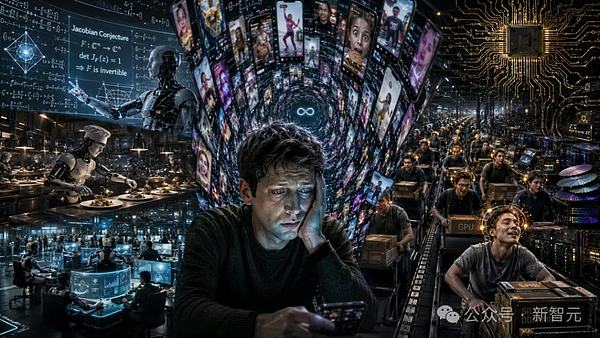
When AI starts solving the Jacobian conjecture for humans, cooking for humans, working for humans, and even fulfilling all human material desires, humanity will not work less; instead, they will become busier and more anxious, like those frantically buying computational power, consuming transistors and electronics, while secretly feeling a kind of happiness anesthetized by silicon-based dopamine.
In the end, the magic lamp fulfills all your wishes. You look at your empty hands, facing a silicon species that has become self-sufficient, self-constructing, and self-replicating, and ask in confusion:
"What's next?"
He admits that "some alternative visions are quite frightening," ensuring "to resist this situation and prevent it from happening."
Bloomberg's logic is colder.
When AI begins to create itself, all traditional assumptions become obsolete: predictable, pausable, regulatory. All judgments on timelines from research institutions, capital allocation, and policymakers must be reset.
It’s like standing at the edge of a black hole that has crossed the event horizon: you can still see the light, but you cannot turn back. Once the feedback loop closes, humanity shifts from driver to passenger.
The QuitGPT movement is a direct response to this concern.
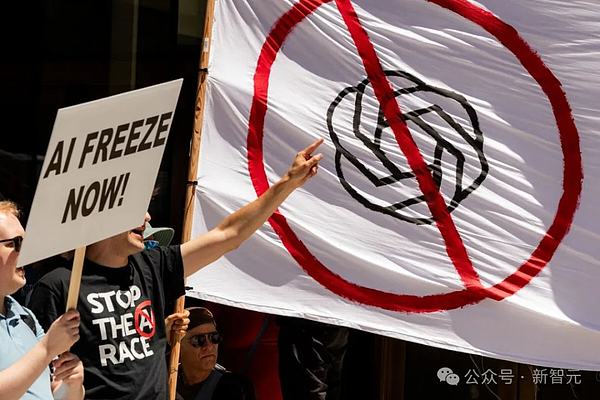
They are not opposing progress, but questioning a more fundamental issue: if self-improvement cannot be paused once initiated, does "accelerating responsibly" still hold?
Publicly available information still recognizes safety alignment as a "major issue," yet does not disclose specific progress, red lines, or international coordination mechanisms in parallel. The announcement has been made, but details remain in the black box.
This gap is more glaring than any technical parameter.
What’s worse is that this direction isn't lacking money—on the contrary, it's one of the current tracks where capital is most willing to invest heavily.
Moreover, this is not a secret project being carried out by a single company; from startup teams to several leading AI labs, nearly everyone is pouring money, recruiting talent, and acquiring computational power down this path, with reasons largely similar: whoever successfully runs through "AI self-improvement" will control the accelerator for the next round of competition.
If AI continues to progress, what will happen when cognition itself becomes scalable?
That would be a world where thought is no longer a scarce resource.
This scenario is hard to imagine.
免责声明:本文章仅代表作者个人观点,不代表本平台的立场和观点。本文章仅供信息分享,不构成对任何人的任何投资建议。用户与作者之间的任何争议,与本平台无关。如网页中刊载的文章或图片涉及侵权,请提供相关的权利证明和身份证明发送邮件到support@aicoin.com,本平台相关工作人员将会进行核查。


