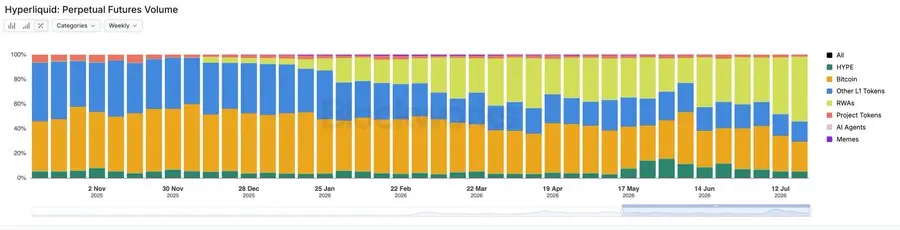
Image: Hyperliquid: Composition of perpetual futures trading volume
The categories in the legend are HYPE, Bitcoin, other Layer 1 tokens, real-world assets, project tokens, AI entity tokens, and Meme coins.
1. Original text translation
We are entering a new era of DeFi.
For the first time in history, Hyperliquid has seenweekly trading volume from real-world assets (RWA) surpassing that of crypto assets. RWA accounts for 54% of total trading volume.
Another noteworthy trend is that since June, individual stock trading volume on HIP-3 has exceeded that of indices and commodities. Currently, 61% of total RWA trading volume comes from individual stocks.
I am no longer convinced that RWA trading will naturally gravitate toward the same trading platforms as crypto assets. There are likely to be different category leaders within RWA. The importance of capturing BTC, ETH, SOL order flow may be much lower than many people expect.
To better understand this scale:
Last week's perpetual contract trading volume across all DEXs was $79 billion.
Hyperliquid’s volume was $50 billion.
Of this, HIP-3 RWA trading volume was $26 billion.
In other words, the RWA market on Hyperliquid alone has already surpassed the total perpetual contract trading volume of crypto assets on all other DEXs combined.
If you are still only focusing on crypto token trading, I believe you are looking at the wrong market.
Data source: Blockworks.
2. What this chart really illustrates
From the weekly trading volume structure in the chart, before the end of 2025, Hyperliquid’s trading volume will be primarily driven by Bitcoin and other Layer 1 tokens. Into 2026, the proportion of RWA will continue to rise, reaching about 54% in the most recent week, becoming the largest trading category on the platform.
This means Hyperliquid’s product positioning is undergoing a significant transition:
Hyperliquid is evolving from a “on-chain crypto perpetual contract exchange” to a “global, round-the-clock, multi-asset derivatives trading platform.”
This strategic change holds high value. The variety of tradable crypto assets and total market size are relatively limited, whereas the derivatives markets for stocks, indices, commodities, foreign currencies, and other traditional assets provide a much larger potential trading pool. Thus, Hyperliquid’s growth ceiling is no longer solely constrained by the cryptocurrency market.
Notably, the core growth of RWA has shifted from macro assets like gold, crude oil, and the S&P 500 to individual stocks. Current third-party market snapshots show that in the daily trading volume of Hyperliquid HIP-3, stocks account for about 63%, indices about 20%, and commodities about 16%, which aligns closely with the 61% mentioned in the original text.
This indicates that on-chain users' strongest demand may be:
For leverage price exposure to U.S. stocks traded around the clock using stablecoins as collateral.
What users are really purchasing is global access, 24-hour trading, leverage, low-friction capital transfer, and a self-custody experience.
3. The term “RWA trading” needs to be understood accurately
The stocks, indices, and commodities on HIP-3 are primarily perpetual contracts. Traders obtain synthetic exposure to the prices of the underlying assets, with no actual stock delivery, nor do they have shareholder voting rights, claims to company assets, or other rights. Prices are maintained close to external markets through oracles and funding rate mechanisms.
Therefore, this set of data proves that:
On-chain synthetic stock derivatives have generated strong trading demand.
It cannot directly prove that real stock tokenization, on-chain equity registration, and securities atomic settlement have achieved the same level of adoption.
This represents two different development paths:
Synthetic asset path: Users trade stock prices using USDC as collateral.
Securities tokenization path: Users actually hold on-chain securities with legal rights.
The former has rapid initiation speed and high capital efficiency but also faces the risks of oracles, funding rates, market manipulation, and regulation. The latter requires cooperation from custodians, issuers, brokers, transfer agents, clearing systems, and securities regulations, making the advance slower.
4. The original author’s judgment on “platform differentiation” only tells half the story
The author believes RWA might form independent category leaders, and stocks, commodities, and crypto assets may not necessarily end up on the same platform. This judgment holds some truth, as different assets require different oracles, market makers, trading session handling, risk parameters, and regulatory arrangements.
However, the HIP-3 architecture allows for such specialization to occur within Hyperliquid.
HIP-3 allows third parties to deploy their own perpetual contract markets. Deployers are responsible for defining contracts, oracles, leverage limits, and market operation while inheriting HyperCore’s order book and margin infrastructure. The current deployment threshold is staking 500,000 HYPE, with deployers fixed to receive 50% of the related trading fees.
Thus, a two-tier structure may form in the future:
Underlying trading infrastructure leader: Hyperliquid.
Segment asset operation leaders: trade[XYZ] and other HIP-3 deployers.
In the current snapshot, trade[XYZ] contributes about $5.577 billion in HIP-3 daily trading volume, while the total HIP-3 trading volume is about $5.585 billion, accounting for nearly 99.9%. This indicates the current growth of RWA is highly concentrated in a single deployer.
Therefore, the emergence of category leaders in RWA does not necessarily weaken Hyperliquid. As long as these leaders continue to utilize HyperCore’s matching, margin, and settlement infrastructure, Hyperliquid will still control the critical underlying aspects.
5. There is a clear arithmetic issue with this set of numbers
According to the numbers given in the original text:
Total DEX perpetual trading volume is $79 billion.
Hyperliquid’s volume is $50 billion.
The remaining DEX total should be $29 billion.
Hyperliquid’s HIP-3 RWA trading volume was $26 billion.
Therefore:
$26 billion is less than $29 billion.
The final statement in the original text that “Hyperliquid’s RWA trading volume is greater than the combined perpetual trading volume of crypto assets on all other DEXs” cannot be directly concluded from the aforementioned three sets of numbers.
This may stem from different statistical time windows, different data sources, or the $79 billion statistic not including part of the HIP-3 trading volume. The original text did not clarify this. Simple rounding cannot explain the discrepancy of about $3 billion.
6. The impact on HYPE’s investment logic
This is a positive signal for HYPE’s long-term fundamentals, with three core values.
First, TAM expansion. Hyperliquid is starting to enter stock, index, commodity, and forex derivative markets, with a potential trading pool much greater than that of the pure crypto perpetual market.
Second, income sources diversifying away from cryptocurrency cycles. Individual stock earnings reports, macro data, commodity fluctuations, and geopolitical events can independently generate trading demand, potentially reducing the platform’s dependence on BTC bull and bear cycles.
Third, enhanced network effects. More markets attract more traders, market makers, collateral assets, and developers, further increasing the difficulty for new platforms to cold start.
However, trading volume cannot be directly equated to revenue and token value capture. HIP-3 deployers receive 50% of trading fees, and trade[XYZ] has also enabled Growth Mode for some contracts, resulting in trading fees being reduced by over 90%. During rapid trading volume growth, per-unit volume revenue may simultaneously decline.
The next most important indicators should be:
RWA fee revenue, open interest, active trader retention, bid-ask spreads, the share of non-incentivized trades, and the amount of RWA fees ultimately entering the HYPE value capture mechanism.
7. The impact on USDC and Circle
trade[XYZ] currently uses USDC as collateral for its stock perpetual contracts, with stock prices denominated in USD.
This represents a direct benefit for USDC, as USDC begins to take on three roles:
Trading collateral.
Profit and loss settlement unit.
Unified fund account across stocks, crypto assets, and other assets.
However, a weekly trading volume of $26 billion does not mean an increase of $26 billion in USDC demand. Perpetual contract trading volume is a nominal amount that revolves repeatedly; the same USDC collateral can support multiple trades within a week.
The true extent of Circle's benefit depends on:
Average collateral balance, the long-term scale of USDC in Hyperliquid, and whether USDC can continue to maintain its status as a primary collateral asset on HIP-3.
Final judgment
This set of data is highly significant, but the most accurate conclusion should be:
The first RWA application to explode in on-chain finance may be round-the-clock synthetic stock trading using USDC as collateral, rather than the on-chain migration of real stock ownership.
Hyperliquid has preliminarily demonstrated that the same set of on-chain order books and stablecoin margin systems can accommodate both crypto and traditional asset price exposure. It is moving closer to a combination of an open, global on-chain CME and Nasdaq derivatives platform.
The original author's concern about “only focusing on crypto trading may miss the larger market” is worth noting. The judgment that “BTC, ETH, SOL order flow will no longer be important” still feels premature. Crypto trading flows provide Hyperliquid with initial users, market-making capital, collateral, branding, and liquidity, which are essential cold-start advantages for entering the RWA market.
It is recommended to set up weekly monitoring to continuously track HIP-3’s RWA trading volume, open interest, fee revenue, trade[XYZ] concentration, and USDC collateral balances.
-------------
Hyperliquid's RWA Landscape: What stocks, indices, and commodities are being traded on HIP-3
As of the real-time data around July 24, 2026, there are about 115 HIP-3 markets on Hyperliquid, involving 4 deployers. RWA trading volume is almost entirely concentrated in XYZ, with the current structure roughly being: individual stocks 63%, commodities 19%, indices 17%, and other categories about 0.4%. (OAK Research)
1. Individual stocks and stock ETFs
This is currently the largest and fastest-growing category.
Semi-conductors and AI industry chain
NVDA, AMD, MU, INTC, SNDK, MRVL, TSM, ASML, AVGO, QCOM, WDC, SKHX, SMSN, KIOXIA, DRAM, SMH, LITE.
Among these, SK Hynix SKHX, Micron MU, DRAM index, SanDisk SNDK have performed exceptionally well in terms of recent trading volume, indicating that the growth of individual stocks on HIP-3 is largely driven by the AI, storage, and semiconductor market trends. (OAK Research)
Large technology and software
AAPL, MSFT, GOOGL, AMZN, META, ORCL, NFLX, PLTR, NOW, IBM, ARM.
Crypto finance and high volatility stocks
CRCL, COIN, HOOD, MSTR, STRC.
These assets have a highly overlapping user base with the crypto market, making them particularly suitable for using USDC as collateral for round-the-clock trading. (OAK Research)
New energy, space, AI infrastructure, and other hot stocks
TSLA, RIVN, RKLB, SPCX, CRWV, NBIS, CBRS, BOT, HIMS, LLY, GME, DKNG, DELL, BX, BABA, SOFTBANK, etc. (OAK Research)
Asian stocks and country ETFs
SKHX, SK Hynix SMSN, Samsung Electronics HYUNDAI, Hyundai Motor TSM, Taiwan Semiconductor ADR BABA, Alibaba EWY, Korea stock ETF EWJ, Japan stock ETF EWT, Taiwan stock ETF
trade[XYZ] will convert the KRW prices of Korean stocks into USD prices through the USD/KRW exchange rate, and then settle margin and profit-loss using USDC. (Trade Docs)
2. Stock indices
Mainly includes:
XYZ100, a large non-financial technology growth stock index similar to the Nasdaq 100
SP500, the S&P 500 index
KR200, the Korea KOSPI 200 index
JP225, the Nikkei 225 index
Some third-party deployers also offer similar products like USA500
XYZ100 and SP500 are currently among the largest markets in terms of HIP-3 trading volume. (OAK Research)
3. Commodities
HIP-3 has formed a relatively complete macro commodity product line:
Energy
CL, WTI crude oil BRENTOIL, Brent crude oil NATGAS, Henry Hub natural gas
Precious metals
GOLD, gold SILVER, silver PLATINUM, platinum PALLADIUM, palladium
Industrial metals
COPPER, copper
Currently, one of the highest trading volume HIP-3 markets is WTI crude oil, with Brent crude oil, silver, and gold also seeing substantial volume. Commodities can continue to be traded on HIP-3 during traditional futures market closures, allowing for price discovery during weekend geopolitical and macro events. (OAK Research)
4. Forex
Currently mainly includes:
EUR, EUR/USD JPY, USD/JPY GBP, GBP/USD
Maximum leverage can reach approximately 50 times, with normal external price coverage time close to the traditional forex market's 24 hours, five days a week. (Trade Docs)
5. Industry and thematic ETFs
In addition to country ETFs, HIP-3 has also launched some industry and thematic ETFs:
URNM, uranium mining and nuclear energy ETF SMH, semiconductor ETF XLE, U.S. energy sector ETF EWY, Korea ETF EWJ, Japan ETF EWT, Taiwan ETF
These products are sometimes classified under “Stocks” in statistical breakdowns, so the 61% stock trading volume in the chart may strictly include some ETFs and stock-like products. (OAK Research)
6. Pre-IPO and special assets
HIP-3 can also launch contracts for the valuation of unlisted companies.
Currently, relevant examples in the trade[XYZ] documents include:
QNT, Quantinuum pre-IPO contracts
Historically, contracts for private companies such as OpenAI, Anthropic, SpaceX, and Cursor have also appeared. However, Ventuals has ceased operations, and its previous HIP-3 market arrangements were settled and suspended by June 19, 2026, so OpenAI and Anthropic can no longer be considered part of the currently active market. (Trade Docs)
After completing their IPO, companies like SpaceX can be converted or reclassified into regular stock price perpetual contracts.
7. Current assets that really contribute major trading volume
From recent 24-hour rankings, high trading volume RWAs on HIP-3 include:
WTI crude oil CL
SK Hynix SKHX
Nasdaq 100 type index XYZ100
Brent crude oil BRENTOIL
Micron MU
S&P 500 SP500
DRAM storage index
SpaceX SPCX
Silver SILVER
SanDisk SNDK
Therefore, the current core growth of RWA on HIP-3 can be summarized as:
AI semiconductor individual stocks, U.S. stock indices, energy commodities, and precious metals.(OAK Research)
It is important to note that all of the above are synthetic perpetual contracts. Traders obtain price exposure to the corresponding assets without holding real stocks, ETFs, or commodities and without dividend rights, voting rights, or legal ownership. Trading usually uses USDC as collateral and tracks external asset prices through oracles, funding rates, and market-making mechanisms. (OAK Research)
I can track HIP-3's added assets, individual stock trading volume rankings, and RWA fee revenue changes weekly.
免责声明:本文章仅代表作者个人观点,不代表本平台的立场和观点。本文章仅供信息分享,不构成对任何人的任何投资建议。用户与作者之间的任何争议,与本平台无关。如网页中刊载的文章或图片涉及侵权,请提供相关的权利证明和身份证明发送邮件到support@aicoin.com,本平台相关工作人员将会进行核查。


