Author: Li Jia
Under the dual impact of rising oil prices and the absence of clear guidance from the Federal Reserve, the market has begun to re-evaluate policy risks.
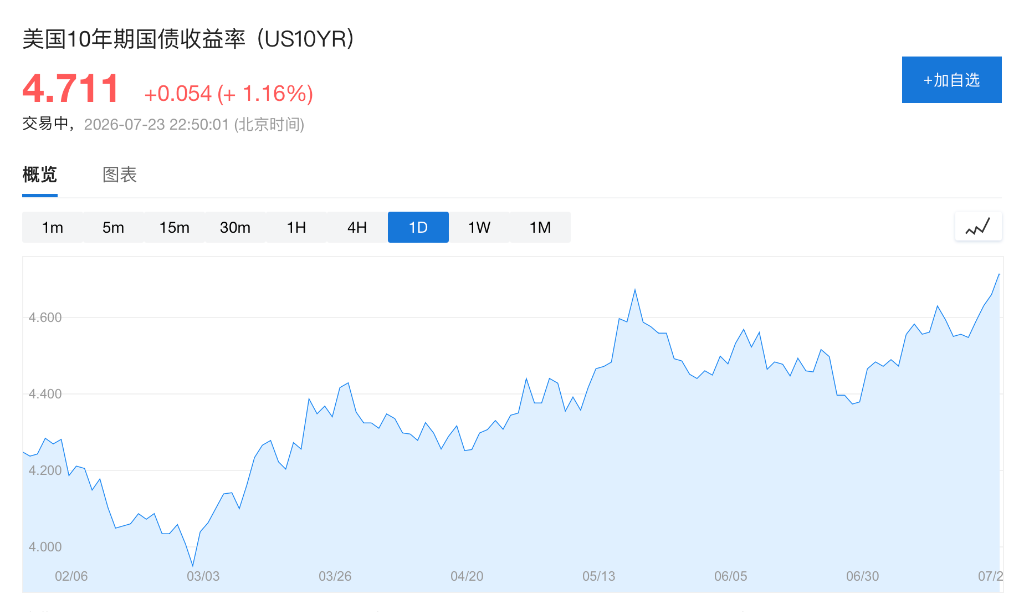
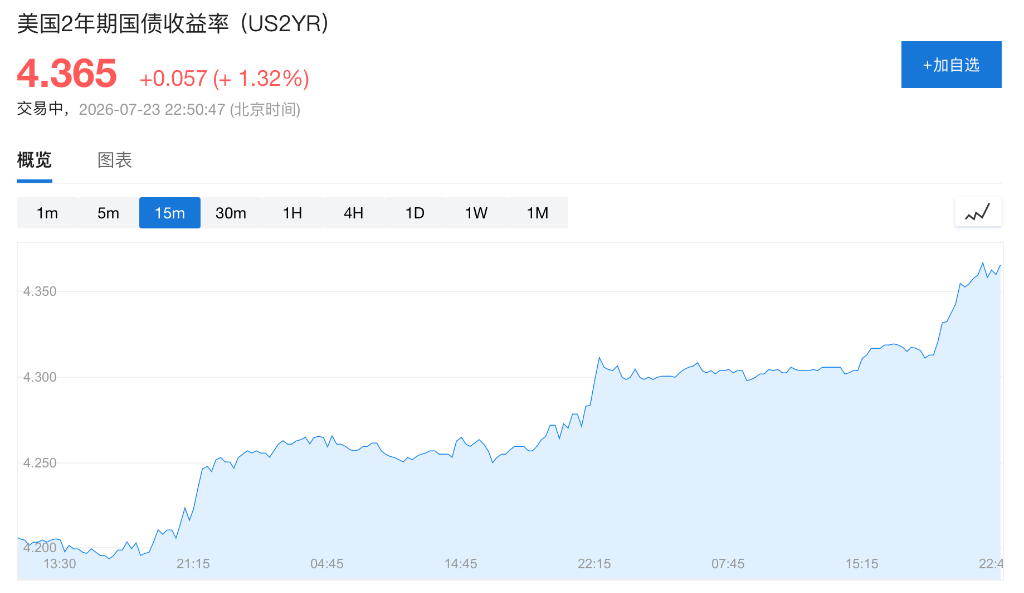
Although mainstream economists unanimously expect the Federal Reserve to remain steady next week, the implied probability of an interest rate hike in the rate markets has risen to about 30%, pushing up U.S. Treasury yields across the board. Among them, the two-year Treasury yield has reached a new high since early 2025, the ten-year yield has risen to a yearly high, and the thirty-year yield is approaching its highest level since 2007.
A research report released by Citigroup on July 23 believes that this market pricing does not mean that investors broadly bet on the Federal Reserve raising rates soon, but more reflects that, in the context of increasingly vague forward guidance and inflation risks driven by rising oil prices, investors are demanding higher risk premiums to cope with policy surprises.
U.S. Treasury Yields Rise, Market Prices in About 30% Chance of Rate Hike
Recently, escalating tensions in the Middle East have driven international oil prices higher, rekindling market concerns about resurging inflation, which has led to a continuous rise in U.S. Treasury yields.
On Thursday, the two-year Treasury yield, which is most sensitive to monetary policy, rose to around 4.365%; the benchmark ten-year Treasury yield similarly set a new high for the year; the thirty-year Treasury yield climbed to 5.19%, just a step away from its high since 2007.
At the same time, interest rate futures indicate that the upcoming meeting of the Federal Reserve already implies about a 30% probability of a rate hike. However, this pricing deviates significantly from mainstream expectations. A Bloomberg survey shows that of 70 economists surveyed, none expect the Federal Reserve to raise rates next week.
Citigroup: 30% Not Market Prediction, But Risk Premium
For this seemingly contradictory phenomenon, Citigroup provided a different explanation.
Citigroup economists Andrew Hollenhorst, Veronica Clark, and Gisela Young pointed out that the 30% in market pricing does not represent that investors genuinely believe there is a 30% probability of a rate hike by the Federal Reserve, but rather includes an additional risk premium.
The report posits that since there is virtually no possibility of a rate cut during next week's meeting, policy risks are naturally skewed to one side. If the Federal Reserve unexpectedly raises rates, the impact on the bond market will be far greater than if they remain steady; therefore, investors are willing to pay extra costs to price in this tail risk in advance.
Citigroup noted that historically, the risk premium associated with Federal Reserve meetings typically ranges from 1 to 2 basis points, but as the Federal Reserve has reduced forward guidance in recent years and its policy communications have increasingly relied on data, uncertainty has risen, leading to an expanded risk compensation demanded by the market.
This logic also helps explain the current trends in long-term rates. Citigroup believes that if a future meeting does unexpectedly raise rates, the market will often view it as the beginning of a new rate hike cycle rather than an isolated event, which will lead to a corresponding increase in terminal rate expectations. Because of this, the market has already priced in cumulatively more than a 50 basis point hike by March next year, but this does not mean it is the baseline scenario for investors.
Citigroup: The More Vague the Forward Guidance, the Easier It Is to Maintain High Rates
Citigroup believes that the recent rise in oil prices is merely a catalyst for the market to reassess the policy path; the deeper reason lies in the changes in the Federal Reserve's communication framework.
The report points out that the situation in the Middle East is pushing up oil prices and U.S. gasoline prices, reinforcing market concerns about the revival of inflation risks. In the absence of clear policy guidance from Federal Reserve officials, this uncertainty has further amplified the market's fears of policy surprises.
Citigroup emphasizes that during periods when forward guidance is clear, market risk premiums can usually be ignored; however, currently, each policy meeting carries greater uncertainty, and investors need to pay risk compensation in advance for potential surprises.
This means that even if the Federal Reserve ultimately stays steady, U.S. Treasury yields may not significantly retreat due to the fading expectations of a rate hike. Citigroup believes that until the Federal Reserve re-establishes a clearer communication framework, the phenomenon of risk premium pushing rates higher may continue to exist.
免责声明:本文章仅代表作者个人观点,不代表本平台的立场和观点。本文章仅供信息分享,不构成对任何人的任何投资建议。用户与作者之间的任何争议,与本平台无关。如网页中刊载的文章或图片涉及侵权,请提供相关的权利证明和身份证明发送邮件到support@aicoin.com,本平台相关工作人员将会进行核查。


