- Charles Schwab shows bitcoin allocations up to 22.4% depending on return assumptions.
- Bitcoin allocations reach 16.9% for moderate portfolios when expected returns climb to 25%.
- Risk-based models show 1.2% bitcoin exposure can account for 10% of total portfolio risk.
Cryptocurrency allocations are increasingly being formalized within portfolio construction as investors move from curiosity to structured exposure. Charles Schwab, a major financial services firm, examined this shift in a report released April 6. The analysis outlines two primary approaches for incorporating bitcoin and ethereum, while highlighting how allocations change under different assumptions.
The first approach is a traditional allocation model based on expected return, volatility, and correlation assumptions. This framework produces highly variable outcomes depending on investor conviction. The report states:
“Allocations are highly sensitive to, and dependent on, an investor’s subjective view of expected return.”
As illustrated in the chart below, allocation outcomes vary significantly based on return assumptions. At a 10% expected return, bitcoin allocations remain minimal, at 0% for conservative portfolios, 1.5% for moderate portfolios, and 1.9% for aggressive portfolios. When expected returns increase to 15%, allocations rise to 1.0% (conservative), 6.6% (moderate), and 8.8% (aggressive). Under a more bullish 25% return scenario, allocations expand sharply to 3.1%, 16.9%, and 22.4% across conservative, moderate, and aggressive portfolios, respectively.
Schwab added: “A moderate investor’s exposure with a 25% expected return from bitcoin implies a 16.9% allocation, versus only 1.5% if the investor expects a 10% return.”
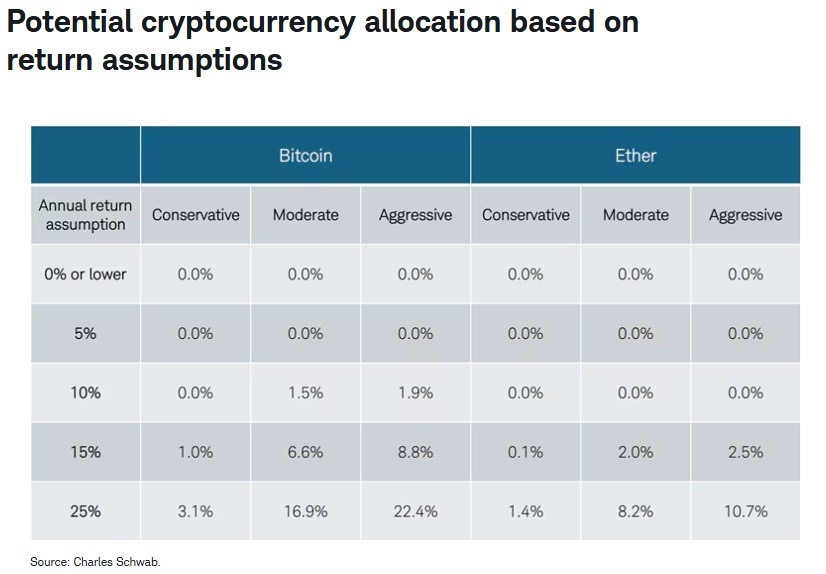
The same pattern applies to ethereum, though at smaller weights due to its higher volatility. At a 15% expected return, ethereum allocations reach 0.1% (conservative), 2.0% (moderate), and 2.5% (aggressive). In a 25% scenario, those figures increase to 1.4%, 8.2%, and 10.7% respectively. Notably, at 5% or lower expected returns, both bitcoin and ethereum receive 0% allocations across all portfolio types. This reinforces a key threshold in the framework.
The report states: “Our analysis suggests that neither bitcoin nor ether offers a large enough risk-adjusted return to justify any allocation if return expectations are less than 10%, even for an aggressive investor.”
The analysis is based on Schwab Asset Management capital market expectations as of Oct. 31, 2025, using bitcoin data from Jan. 1, 2015, to Oct. 31, 2025, and ethereum data from Feb. 8, 2018, to Oct. 31, 2025. The chart reflects three investor profiles: conservative (8% equity/92% fixed income), moderate (64% equity/36% fixed income), and aggressive (96% equity/4% fixed income), where crypto allocations replace a portion of equities.
The second approach is a risk-budgeting framework that allocates crypto based on its contribution to total portfolio risk rather than expected returns. Rather than relying on return assumptions, this approach focuses on how much volatility an investor is willing to allocate to crypto. This method highlights how little capital is required for meaningful exposure.
Schwab further noted: “It takes only a 1.2% allocation to bitcoin and a 0.9% allocation to ether to reach the 10% risk level.” Across both approaches, the conclusion remains consistent. The report states: “There is no ‘correct’ allocation to cryptocurrencies, and we believe the decision is largely a personal one.” The analysis also emphasizes impact, noting:
“Even small allocations to bitcoin or ether can significantly affect portfolio performance.”
免责声明:本文章仅代表作者个人观点,不代表本平台的立场和观点。本文章仅供信息分享,不构成对任何人的任何投资建议。用户与作者之间的任何争议,与本平台无关。如网页中刊载的文章或图片涉及侵权,请提供相关的权利证明和身份证明发送邮件到support@aicoin.com,本平台相关工作人员将会进行核查。


