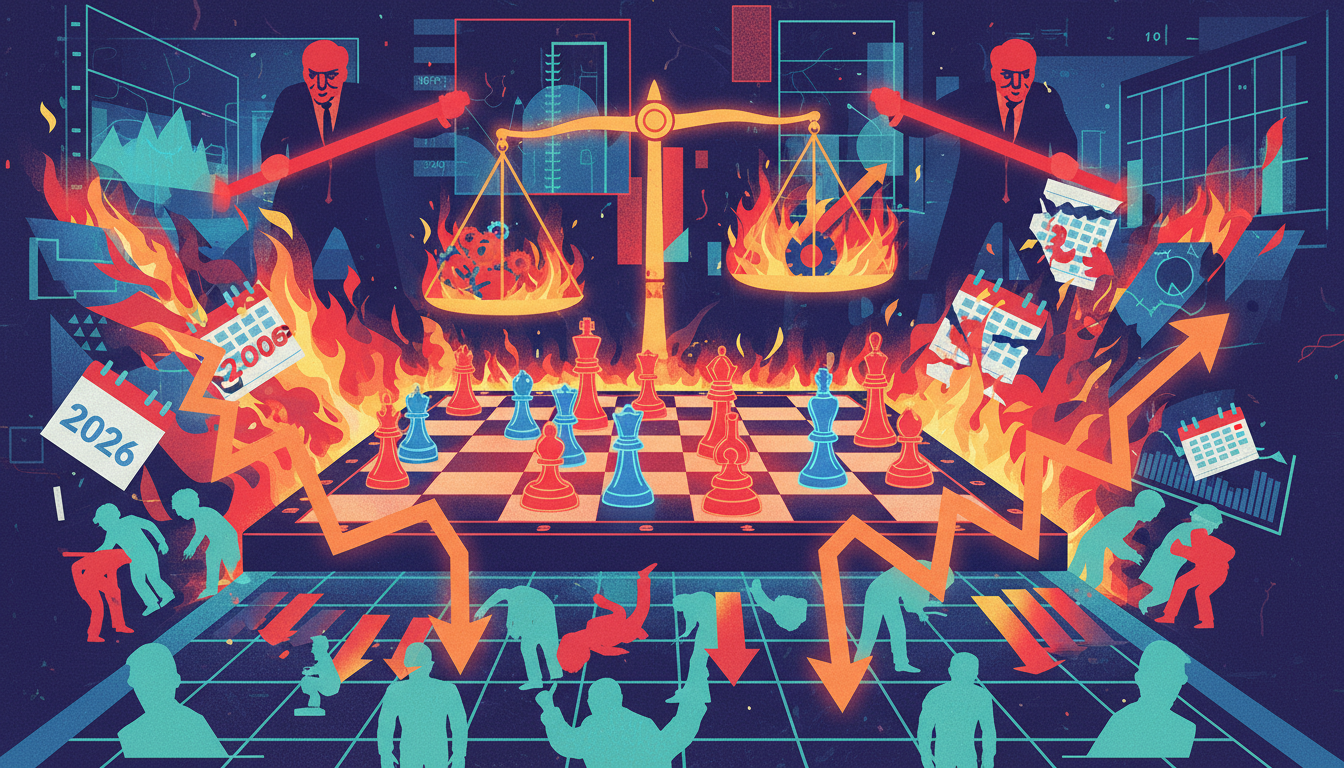
The Trump administration announced the 2027 fiscal year budget proposal forecast, which immediately became a highly sensitive political issue in Washington. On one hand, this budget centers on the assumptions of 3.1% real GDP growth and 2.3% CPI inflation rate, depicting a macro blueprint of high growth and moderate prices, regarded as a declaration of the new administration's economic direction; on the other hand, the handling of a 19% cut to the discretionary budget of the U.S. Department of Agriculture—a direct reduction of 4.9 billion dollars from the previous fiscal year, leaving only 20.8 billion dollars—has triggered intense controversy in the traditional "Rust Belt" and major agricultural production areas. The expectation of high growth paired with a tight agricultural stance on the same budget sheet constitutes the real highlight of this policy gamble.
3.1% High Growth Blueprint: The White House's Ideal Macroeconomic Script
Surrounding the core assumptions of 3.1% real GDP growth and 2.3% inflation rate, the White House attempts to convey an idealized narrative of “high growth + low inflation”: the economy is expected to expand at a pace far exceeding most developed economies in the coming years, while prices remain slightly above the Federal Reserve's long-term target range, providing enough momentum without triggering uncontrolled inflation. This indicates a high level of confidence in productivity improvement, supply-side recovery, and policy coordination capabilities, and can even be viewed as an optimistic pricing of the American economic foundation for the coming years.
The market voices generally note that the budget proposal "outlines macro expectations of high growth and moderate inflation alongside expansive fiscal policy". Within the framework of 3.1% growth, it is difficult for fiscal policy to truly contract; it more resembles a structural rearrangement of expenditures to support manufacturing repatriation, industrial upgrades, and investments in key areas while betting that a 2.3% CPI implies limited interest rate pressure and a relatively friendly financing environment. This combination attempts to strike a balance between the growth narrative and moderate prices, tying fiscal expansion and controllable inflation together to present to voters and the market.
In the ideal path, this setting implies stronger employment and consumption, with businesses willing to increase capital spending and expansion investments under the premise of confidence in future demand and reasonable financing costs, thus solidifying the growth foundation. However, the risk of reality is equally clear: if the 3.1% growth rate is overly optimistic and the 2.3% inflation is underestimated, the expansive fiscal policy could, in actual operations, push up prices and interest rates, squeezing the private sector, leading to a dual gap of “growth falling short and inflation exceeding expectations.” Therefore, the numbers in the budget are not just technical assumptions; they represent a political wager on the future economic trajectory.
A 19% Cut to the Department of Agriculture: Who is Making Way for High Growth
In stark contrast to the high growth blueprint, the handling of the U.S. Department of Agriculture's discretionary budget in the budget is extremely aggressive: it only retains 20.8 billion dollars, reducing 4.9 billion dollars compared to the 2026 fiscal year, a cut of approximately 19%. While the overall macro narrative is upward and fiscal orientation has not "entirely contracted," agriculture has been singled out for significant cuts, sending a very clear signal regarding policy priorities—agriculture is clearly no longer one of the highest-protected sectors in the budget hierarchy under the Trump administration.
Why choose to "tighten agriculture" under the high growth narrative? From the perspective of policy trade-offs, this looks more like a resource reallocation: with the total pie unable to expand indefinitely while still having to sell a good economic story, some traditional expenditures are seen as sacrificial buffers, with agriculture falling into this category. Compared to expenditures related to manufacturing, technology, or security, the political symbolism of agriculture has been weakened in the new administration's narrative, and its economic return cycle and contribution to the competitiveness of frontier industries are harder to quantify directly into the "growth story," making it easier to land on the cut list.
Such cuts have multifaceted impacts on the real level. Farm subsidies may face tightening, with price fluctuations and extreme weather risks disproportionately shifted to production entities; funding sources for rural infrastructure and related service projects may tighten, potentially slowing the pace of improvements in roads, irrigation, power grids, broadband, etc.; expectations surrounding the upstream and downstream industrial chains of agricultural machinery, agricultural materials, logistics, and food processing may also be affected, leading businesses to become more cautious in decisions about expansion and hiring. The contraction of policies itself is likely to amplify pessimistic sentiments; in the current context where agricultural product price cycles and climate risks are not yet clear, the 19% budget cut is undoubtedly a startling shock signal.
From Cornfields to Wall Street: Where are Resources Slipping Towards
If we place the reduction in agricultural budgets back onto the chessboard of the overall federal budget game, it appears more like a posture of "creating space for other priority areas". While the total scale remains undisclosed, it is clear that the government needs to compress spending in certain traditional sectors to make room for new policy focuses while backing the 3.1% growth rate and unwilling to overtly acknowledge a rapidly expanding deficit. Agriculture is no longer seen as an untouchable rigid sector but has been treated as an adjustable variable.
Without fabricating specific amounts, the market will naturally link the space created to directions such as defense, infrastructure, and technology. On one hand, issues surrounding geopolitical security and supply chain security are gaining traction, with the external expectation that defense and related safety investments will remain relatively prioritized; on the other hand, the long-term competition surrounding infrastructure upgrades, chips and semiconductors, artificial intelligence, and energy transition is viewed as the "hard core foundation" supporting the expectation of 3.1% growth, thus quickly amplifying the narrative space in which budgets are tilted toward these sectors. The cut to agriculture is packaged in this narrative as a price of ramping up investment in "future industries."
This rearrangement creates a significant disparity in gain and loss expectations between urban and rural areas and different industries. Urban areas, especially major metropolitan areas concentrated in technology and finance, are more likely to see potential benefits from infrastructure, technology, and industry support; whereas rural areas, supported by agriculture, more intuitively feel the pressure from budget cuts and public service strain. In the long run, this difference may ferment in congressional debates and local elections, further amplifying the divisions between representatives from agricultural states and city-based legislators during budget negotiations, with Washington's budgetary technical discussions ultimately manifesting in sharper political friction.
The Vote Calculation and Policy Gamble Behind the Numbers
From the perspective of voter demographics, reducing agricultural budgets will undoubtedly bring pressure on rural voters and agricultural state legislators. For many counties and cities reliant on federal subsidies and project funding, the Department of Agriculture's budget is not just an economic issue, but also a guarantee for social stability and public service levels. Once subsidies are cut and projects are delayed, local politicians must choose between "securing more resources for their states" and "staying aligned with the White House." For agricultural state voters who supported Trump in past elections, this budget will be precisely dissected and cross-checked against campaign promises, generating tension between reality and expectations.
The high growth forecast itself also bears obvious political functions: beneath the halo of 3.1% growth, the ruling team can more easily narrate stories of "America prospering again" and "economic performance exceeding that of other developed economies," thus boosting business and consumer confidence while scoring points for their governance performance. The macro assumptions in the budget, therefore, carry the dual attributes of an economic roadmap and campaign material—more optimistic forecasts contribute to short-term sentiment, but if actual performance does not meet expectations, the backlash will be equally swift.
At the same time, it must be noted that the federal budget is essentially a starting point for negotiation rather than a final text. The proposal submitted by the president will undergo a lengthy process of review, modification, and even rewriting in Congress. The 19% cut to the agricultural budget is likely to be repeatedly attacked by agricultural state legislators in both the House and Senate and may be partially adjusted in negotiations in exchange for their compromises on other items. Similarly, the tilt toward defense, technology, and infrastructure will also require continuous fine-tuning amid party negotiations and regional interest distributions. What is currently presented to the public is merely the initial layout of a budget battle; it is far from a settled matter.
Observing the Cryptocurrency Market: How Macroeconomic Expectations Convey Risk Appetite
For the cryptocurrency market, the budget itself does not directly determine prices, but the macro expectation combination of high growth + moderate inflation is highly correlated with changes in overall risk asset preferences. If the market believes that 3.1% growth and 2.3% inflation can be broadly achieved, the interest rate environment is expected to remain in a zone that is friendly to the economy and provides strong support for asset valuations—this usually means enhanced valuation elasticity for stock markets, growth stocks, and technology stocks, and improvements in sentiment in these sectors often spill over into high-volatility risk assets like cryptocurrencies.
Meanwhile, the fiscal orientation and focus on industry support presented by the budget will affect investors' long-term perceptions of technology and innovation assets. If the market believes that more resources are flowing toward technology, infrastructure, and strategic industries, asset classes surrounding narratives of the internet, AI, and digital infrastructure may gain a higher risk appetite premium. Cryptocurrency assets, as part of a "technology-finance composite target," while not formally mentioned in the budget report, will feel indirect influence from the valuation environment of technology as a whole and the strength of innovation narratives.
It is important to emphasize that at this stage, the total scale of the budget and the detailed allocations of各 departments are yet to be fully disclosed, meaning we cannot confirm the specific size of the overall reallocating space nor break down the precise adjustments in sectors like education and healthcare. This suggests that the impact on cryptocurrency assets can only remain at the emotional and directional level: first, assessing whether the budget reinforces the "U.S. economy still has growth resilience" narrative, thereby supporting a higher global risk appetite; second, observing whether technology and innovation-related sectors can gain sustained support at the funding and policy levels. Any market projections based on specific amounts and precise allocations currently lack reliable data support.
A Piece of Budget Cannot Determine the Universe: The Story is Just Beginning
In summary, this 2027 fiscal year budget superficially tells an optimistic story of 3.1% high growth and 2.3% moderate inflation, yet structurally, through the 19% reduction of the Department of Agriculture and the compression of 4.9 billion dollars, reveals a harsh policy prioritization: to leave enough space for betting on directions of national defense, infrastructure, and technology for "future competitiveness," traditional agriculture has been pushed under the adjustment knife. The brightness of the macro blueprint against the tightening of agricultural expenditures forms the core contradiction of this budget narrative, imbuing the so-called "high growth" with stronger regional and industry redistribution implications.
At the same time, the budget projections themselves remain at an early stage marked by significant data gaps and intense political maneuvering. The total scale is yet to be disclosed, and some key departments' detailed allocations are not public, making any interpretation attempting to treat this as a final policy resolution overly hasty. The presidential budget is merely the starting point for negotiation; the real bargaining will continue in Congress, among interest groups, and in the public opinion arena involving voters and media, with numbers likely to shift direction during revisions.
For investors focusing on macroeconomics and asset allocation, the key points to follow next will be three clues: first, whether agricultural and other traditional sectors can regain部分 of the budget during the Congress revision process and which sectors ultimately become the true beneficiaries of funds; second, how the departmental implementation details surrounding key areas like agriculture, technology, and defense are implemented, and how they will specifically alter cash flow expectations for certain businesses and regions; third, as the budget maneuvering progresses, the secondary reaction of market sentiment—including reassessments of the credibility of the U.S. growth story, whether concerns over fiscal sustainability increase, and the repricing of risk premiums for risk assets. What truly determines market direction is not the budget itself, but how the political and capital worlds transform these numbers into actions in reality.
Join our community to discuss and become stronger together!
Official Telegram community: https://t.me/aicoincn
AiCoin Chinese Twitter: https://x.com/AiCoinzh
OKX Welfare Group: https://aicoin.com/link/chat?cid=l61eM4owQ
Binance Welfare Group: https://aicoin.com/link/chat?cid=ynr7d1P6Z
免责声明:本文章仅代表作者个人观点,不代表本平台的立场和观点。本文章仅供信息分享,不构成对任何人的任何投资建议。用户与作者之间的任何争议,与本平台无关。如网页中刊载的文章或图片涉及侵权,请提供相关的权利证明和身份证明发送邮件到support@aicoin.com,本平台相关工作人员将会进行核查。