From DeFi Summer to the NFT frenzy, from GameFi to meme coins, and now to the rise of AI, RWA, PayFi, and Agent economy, new hot topics emerge in the market almost periodically. When narratives keep rotating, where does the real alpha come from?
As one of the most active native investment institutions in the crypto market, HTX Ventures deeply participates in the early innovations, emerging narratives, and long-term infrastructure layout of the global Web3 ecosystem.
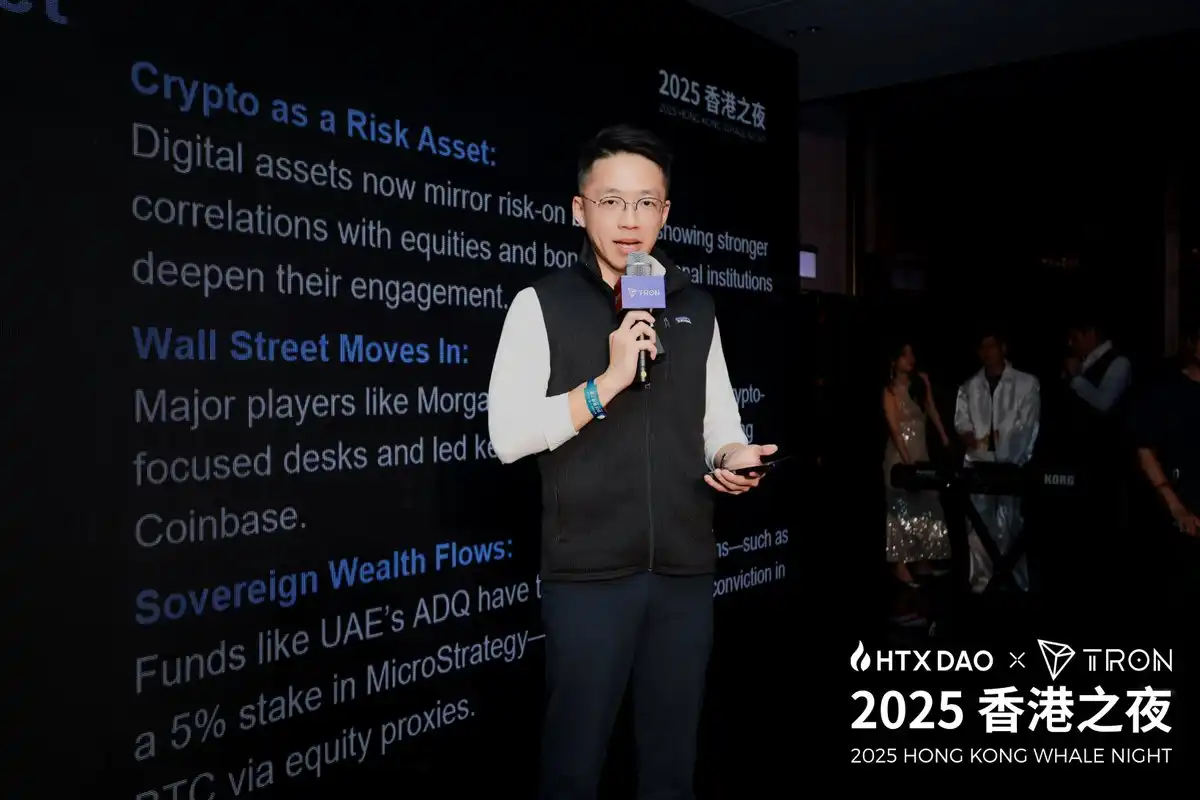
In this interview, we had an in-depth conversation with Alec Goh, head of HTX Ventures: This dialogue not only reviewed his transition from traditional finance to the crypto industry but also systematically discussed HTX Ventures' investment research framework: how they identify early narrative signals, how they seek long-term alpha in a rapidly rotating market, and how they establish investment judgments between technological narratives and real needs. Below is the original interview text:
The Collision of TradFi and Crypto
Rhythm BlockBeats: Before we start, could you introduce yourself?
Alec Goh: I am Alec, currently in charge of the HTX Ventures team. HTX Ventures is the strategic investment department of the Huobi HTX platform, which is currently one of the top ten crypto trading platforms in the world, with a daily trading volume of about $1 billion, operating for about 13 years. In terms of investment, we have invested in 200 to 300 crypto projects so far, and as of last year's Q3, our net asset value multiple was about 2.4 times, with relatively good returns and quality.
Personally, before joining Huobi HTX, I came from the traditional financial sector, working in investment banking at Deutsche Bank for 6 years, and then focused on commodities-related areas at an institutional investor for 4 years. Later, I began my career transition into the crypto industry and have been working in this field ever since.
Rhythm BlockBeats: You have worked at top institutions like Goldman Sachs for many years. What do you think is the biggest disconnect between traditional finance and crypto? How do you navigate between the two worlds?
Alec Goh: I believe there are many differences between the two, but if I had to say the biggest difference, I think it is the way investment opportunities are accessed. In the traditional financial world, many quality investment opportunities are often only open to high-net-worth individuals. Ordinary retail investors usually have difficulty accessing complex or higher-yield investment products.
In contrast, the crypto industry is different. The crypto market is essentially open to everyone. Almost anyone can participate in various investment opportunities. However, this openness also means that investors have to take on more responsibility; they need to understand what they are doing and manage their own risks.
Another important difference is the method of investment. In traditional finance, many investment decisions are made through intermediaries, such as banks, fund managers, or asset management firms. Investors typically rely on these intermediaries for research and asset allocation. In the crypto industry, many investments are actually self-directed, where individual investors can conduct their own research and then directly deploy funds into projects. This means the role of intermediaries is significantly reduced in the crypto industry.
These two systems also have significant differences in risk culture. In traditional finance, capital preservation and regulatory certainty are usually the top priorities. In contrast, in the crypto industry, people are more willing to pursue higher returns while also being more open to experimental innovations and participation.
As for how I navigate between these two worlds, I think the key lies in understanding one core issue: these two systems ultimately solve the same problem, which is how to allocate capital and coordinate resources more efficiently. Their differences are more about their underlying architectures. Traditional finance is a system that has existed for a long time, while the crypto industry is a new technological frontier.
In practical investments, I don't simply move traditional finance's frameworks into the crypto industry. That usually doesn’t work. What I tend to do is "translate frameworks." That is, I retain the analytical discipline from traditional finance, but use the terminology of the crypto industry to understand it. For example, we focus on tokenomics, incentive mechanisms, and governance structures, all of which need to be understood in the context of decentralized systems, rather than analyzed using traditional equity or bond frameworks.
Rhythm BlockBeats: With giants like BlackRock deeply involved, do you think this is "traditional finance assimilating crypto," or "traditional finance being restructured by on-chain technology"? Investor Peter Thiel has expressed similar views; how do you see it?
Alec Goh: I think a more accurate description is that it's a mutual restructuring of both systems, rather than one replacing the other.
As I mentioned earlier, traditional financial structures like tokenized private equity and tokenized debt are being integrated with crypto, which reflects the reformation of traditional finance entering the crypto world. Meanwhile, traditional finance is becoming more efficient under the pressure of the crypto world: banks are improving infrastructure, reducing costs, and providing more new products. So to some extent, this is actually two systems learning from each other and gradually merging their respective advantages.
I think there is a very interesting example recently. When significant macro events occur over the weekend (after the US stock market closes), traditional financial assets cannot be traded. However, since some relevant assets have now been brought on-chain, even when traditional markets are closed, markets can still discover prices on-chain to some extent. Of course, this mechanism is not yet perfect, but it is beginning to evolve into a 24/7 trading market. I believe this is actually a very encouraging development.
Rhythm BlockBeats: From your current perspective, what is the core focus of traditional finance? How does their risk appetite fundamentally differ from crypto-native capital like HTX Ventures?
Alec Goh: I believe traditional financial institutions focus on three core elements:
The first is regulatory clarity. They need clear rules to deploy capital. It's like traffic lights; they avoid any area prohibited by regulatory frameworks, such as those explicitly forbidden by MiCA or the stablecoin-related frameworks like the "Genius Act." The boundaries of regulation are their boundaries for action.
The second factor is market structure. Traditional financial institutions pay more attention to whether the market structure is sound, not just the rate of return. They focus on many infrastructure issues, such as liquidity, settlement systems, and custody mechanisms, all of which are prioritized when entering a new market.
The third factor is the long-term sustainability of assets. Unlike many crypto-native funds, traditional institutions typically do not chase after 10x or 20x short-term narratives. They care more about sustainable returns, long-term infrastructure, and stable cash flow. This is also why they are more inclined to invest in areas like stablecoin infrastructure, RWA, and related protocol layers.
How Does HTX Ventures Identify Early Trends?
Rhythm BlockBeats: Let's talk about Huobi HTX itself. Recently, many people in the market have praised Huobi HTX's ability to list projects. What is the decision-making mechanism behind this? Is it driven by data monitoring or a unique community intuition?
Alec Goh: I need to clarify that I am responsible for the Ventures investment team, which is relatively independent from Huobi HTX's listing team, to avoid potential conflicts of interest. So I cannot fully represent the listing team, but I can share what I know.
From what I understand, we have a strong internal listing team that works closely with the research team, aiming to identify emerging narratives and potential projects ahead of the market. Generally speaking, they judge from several dimensions.
The first is research and market signals. They combine research analysis, on-chain data, and market trends to determine where new liquidity and narratives may emerge. Secondly, we place a high value on community signals. The crypto market is driven by the community, and we pay great attention to grassroots momentum at the community level, closely monitoring hot topics, frequently appearing keywords, and sentiment trends.
More importantly, as a trading platform, we are deeply embedded in the ecosystem. We spend a lot of time not only tracking the community but also maintaining deep communication with developers and early projects in the ecosystem, which allows us to discover projects before they are widely discussed.
From the Ventures perspective, when we see an interesting trend that we believe could trigger a new narrative, we pass this signal to the listing team for their independent analysis before deciding whether to list it on the trading platform.
Rhythm BlockBeats: You place great emphasis on the value of early alpha. Can you share a significant success story where HTX Ventures identified an early non-consensus asset through research and eventually achieved significant success on Huobi HTX?
Alec Goh: As a venture capital-focused institution, our focus is on identifying infrastructure narratives ahead of market consensus. From our experience, the most durable values in the crypto field usually come from the infrastructure layer that can open up new markets rather than those fleeting narratives.
For a concrete example: we recognized early that Bitcoin was becoming a quality store of value asset, with the narrative of digital gold becoming increasingly clear and solid. Based on this judgment, we further deduced that as more people hold Bitcoin, they will eventually generate the demand for "how to create yields while holding Bitcoin."
Based on this deduction, we deeply researched the Bitcoin staking sector and invested early in this ecosystem. This layout has now brought about very good returns.
With the rise of AI and agentic AI, we are now focusing on the "machine economy" and the Agentic AI payment sector, believing that this will be the next core battlefield for the integration of crypto and AI. So to summarize, our core framework for generating alpha is to identify early signals of network formation, finding the initial signs before projects are widely discussed and before narratives are formally shaped.
Rhythm BlockBeats: Can you share with us the most important signals that HTX Ventures looks for in identifying the network formation you just mentioned?
Alec Goh: In terms of signals, we typically focus on several key dimensions. The first is where developers are directing their attention. If you observe that leading developers or core technical teams start to focus on a specific direction, that is generally a very early signal indicating that this area may become the next trend.
The second signal is the community's focus. Of course, community signals may come slightly later, but if you can capture early community interest in certain keywords or directions, that's also a very valuable signal. For example, if the community starts to frequently discuss certain new concepts or shows clear interest in certain technological directions, these are all important clues that help us deploy capital in advance.
Rhythm BlockBeats: We all know that narratives in the crypto market change very quickly. Some narratives may even last only a few weeks or even shorter. In such an environment, how does HTX Ventures adjust its research strategy? How do you continue to search for alpha in such a rapidly changing market?
Alec Goh: Indeed, over the past year and a half, we have seen markets continuously rotating between different sectors. From an investment perspective, our approach is to maintain a longer-term time horizon. We usually think about: what factors will fundamentally change this industry. Then we research along those directions instead of chasing short-term market trends.
We do not chase short-term trends. Our framework allows us to focus on fundamentals and long-term sustainability. For instance, we typically steer clear of projects that only want quick TGE or fast cash-out. Our investment cycle is usually three to five years, rather than a short-term cycle of one to two years.
Another reason is that we invest through our own balance sheet rather than managing external LP funds. This means we do not have time pressure to report to LPs; we are creating returns for the company and can genuinely afford to wait patiently for annual cycles, choosing projects we truly have high confidence in.
Industry Outlook for 2026
Rhythm BlockBeats: Recently, there has been much discussion about the integration of AI and Web3. Currently, there are many AI projects in the market, but many are actually AI memes. A new narrative has recently emerged: AI Agents using crypto networks for payments. From your perspective, where are the real wealth effects most likely to occur in the integration of AI and Web3?
Alec Goh: The integration of AI and crypto indeed has several different verticals. One is the tokenization of computing power, and the other, which I believe is a more robust direction, is AI Agents becoming economic participants and autonomous on-chain actors.
When AI Agents eventually become users of crypto networks, the most valuable layers will be those that allow machines to: pay, settle, and interact.
Additionally, regarding the tokenization of AI computing power, this topic is also very popular in traditional financial markets. Many companies are competing for AI computing resources, and we have seen many crypto mining companies transform into AI data centers. From a technical stack perspective, computing power is actually at the very bottom of the entire AI technology stack. So I believe there are indeed many opportunities here. But at the same time, this sector has become quite crowded now. Many teams are trying to enter this field.
In contrast, autonomous payment systems for AI Agents have not yet seen many mature projects. So from an opportunity perspective, we are currently more excited about Agent payment infrastructure. Of course, this does not mean that there are no opportunities in computing power tokenization. I believe both directions have the potential to create wealth effects; it’s just that at this current stage, we are more optimistic about the latter.
Rhythm BlockBeats: Justin Sun tweeted "Going all-in on Web 4.0." What do you think of this concept? And how is HTX Ventures embracing these cutting-edge ideas like the emerging protocol standards under the Web 4.0 framework, such as x402?
Alec Goh: We are very excited about the concept of Web 4.0. In a sense, it represents a new phase shift of the internet. Transitioning from human-centered interaction models to machine-centered interaction models. Web 2.0 brought data, Web 3.0 brought digital ownership, and Web 4.0 introduces autonomous economic actors with the rise of AI Agents.
Web 3.0 introduced the concept of digital ownership, while Web 4.0, with the rise of large language models and the eventual emergence of AI Agents, introduces a brand new role: "autonomous economic actors." In the world of Web 4.0, AI Agents become first-class citizens in the internet economy; they can purchase computing power, pay data fees, autonomously trade assets, automatically rebalance portfolios for us, and directly interact with protocols.
This is where crypto becomes extremely relevant. I have been working in the crypto field for seven years, and to this day, sending a transaction to a new wallet sometimes still fills me with anxiety; I must verify each letter in the address to ensure there are no errors. Meanwhile, machines can accomplish this task in an instant without making mistakes. This is the perfect application scenario for the programmability of blockchain.
We have been considering this direction for quite some time. At the end of last year, we published a research report discussing protocol standards such as x402 and ERC-7521, as we firmly believe the internet is gradually transitioning to an agent-driven model where machines will ultimately become real users of the blockchain.
Rhythm BlockBeats: The whole industry has been discussing PayFi recently. We have also seen some new products emerging, such as Anthropic's Claude launching crypto cards. These sectors may not have the explosive potential of Memecoin or Agent Payment in the crypto industry. But can you explain why HTX Ventures believes PayFi and RWA are the keys for the crypto industry to enter the mainstream?
Alec Goh: I think this question is actually related to several previous questions you asked. Things like Memecoin can indeed bring attention in a very short time and generate explosive returns in the short term. But if we look at it from a longer-term time perspective, we firmly believe that PayFi and RWA can bring real and sustainable economic activities to the entire industry.
We have previously discussed the integration of TradFi and Crypto. If we want to build truly long-term sustainable, cash-flow-generating business models in this industry, then fields like PayFi and RWA are the most likely to succeed.
These sectors are also easier for business users and mainstream markets to understand. For instance, stablecoin payments and asset tokenization are concepts that the traditional financial system can comprehend. In contrast, concepts like Memecoin are something that many traditional institutions find difficult to understand. This will actually impact how capital is allocated in the future. If you look back at the last two to three-year cycle, you'll find that many projects have underperformed because they are still using the playbook from last cycle.
This is also why many crypto-native users feel somewhat disappointed in this cycle. Because the entire industry is transitioning towards a more sustainable direction. So from our perspective, what really matters is: real use cases, real assets, and real institutional needs—these are key to driving the long-term development of the industry.
Rhythm BlockBeats: If you could give Web3 investors a piece of advice for 2026, beyond chasing the latest hotspots, what fundamental capability should they not overlook?
Alec Goh: I believe that the most important capability in current crypto investments, compared to previous cycles, is First Principles Thinking.
Every cycle brings forth new narratives: two cycles ago it was NFTs, before that was DeFi Summer, and this cycle we are seeing meme coins and RWA. Some narratives will persist, while others will fade away. But the underlying logic that drives these narratives often remains consistent.
I believe every investor should ask themselves three core questions when analyzing a project. First: does this project create a brand new market in the long term? Second: does it enable a new economic network? Third, and most importantly: does it generate real economic activity? Projects that can meet these three criteria are often able to survive and continue to grow after the narrative tide recedes.
The biggest opportunities in the crypto field usually emerge when new networks create new forms of economic coordination and economic activity. Therefore, my advice is to return to first principles instead of chasing every five-minute trend.
Rhythm BlockBeats: Last question: What are the three core narratives HTX Ventures is most optimistic about for 2026? What signals should investors focus on when conducting due diligence?
Alec Goh: My three major bets for 2026 are: first, Agentic payments, which is the direction I discussed the most during today's interview, as I believe it is the most explosive sector for the integration of AI and crypto; second, stablecoin infrastructure, although the stablecoin sector has taken off somewhat in the past year or two, there still exists a large unmet demand and opportunities at the infrastructure layer; third, RWA, which serves as the most structurally valuable bridge connecting traditional finance to the crypto world.
So my core judgment for 2026 is: Agentic payments, stablecoin infrastructure, RWA. In terms of signals for due diligence, to determine whether a project can genuinely generate good long-term returns, I believe the most important signal is: will institutional capital allocate into it?
If the answer is no, then this project is basically just a trading opportunity rather than a true long-term investment opportunity. Institutional capital will not allocate to projects that lack long-term viability, do not generate cash flow, or are non-compliant.
Therefore, my advice to every investor is: when conducting due diligence, first ask yourself this question, "Can institutional capital invest in this project?" This is an extremely effective filter to help you find truly worthy long-term holdings amid a sea of noise.
I believe the coming year will be extremely explosive. Not only in the crypto industry but also in the entire technology sector. Therefore, in such a market environment, I think capital protection will become very important. Investors should focus on teams and projects they truly believe in, rather than blindly chasing short-term trends.
免责声明:本文章仅代表作者个人观点,不代表本平台的立场和观点。本文章仅供信息分享,不构成对任何人的任何投资建议。用户与作者之间的任何争议,与本平台无关。如网页中刊载的文章或图片涉及侵权,请提供相关的权利证明和身份证明发送邮件到support@aicoin.com,本平台相关工作人员将会进行核查。


