Original Title: The Base Residency Problem
Original Author: Thejaswini M A, Token Dispatch
Original Compiler: Chopper, Foresight News
A few days ago, I read about a concept in Japanese philosophy: basho. The rough translation is "place," but the philosopher Nishida Kitarō imbues it with a meaning that extends far beyond a geographical location; it is more akin to a situation: a field that allows all things to become themselves. In other words: people do not appear in a certain place by chance, but are shaped by the place they inhabit. Today, I will use this theory to interpret Base.
Last month, its active address count dropped to an 18-month low. Reflecting on this phenomenon, I realized: Base created merely a location, yet never fostered the conditions for things to grow and take shape.
When Coinbase launched Base in 2023, a rare faith emerged in the crypto-native community. Everyone believed it could finally solve Ethereum's oldest problem: an abundance of infrastructure without real users. With Coinbase holding 100 million users and unparalleled distribution capability, this was a unique advantage. As soon as the doors opened, the users were already waiting outside.
For a time, this confidence seemed validated. Base's growth rate surpassed that of all previous Layer2s. By October 2025, its total locked value (TVL) reached $5.6 billion, with transaction fee income unmatched across the entire L2 space. Thus, in September 2025, Base confirmed the issuance of its token, as if heralding an inevitable successful experiment. Yes, a place was becoming basho.
Then, the users left.
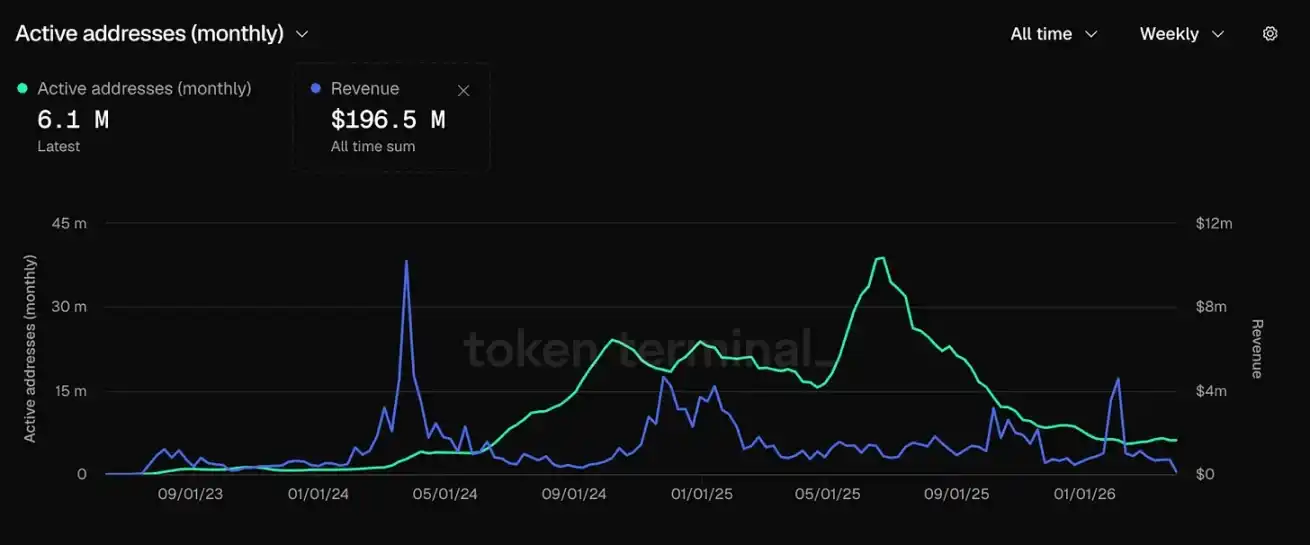
Looking at the data provides a clearer picture: Base's active addresses returned to the levels of July 2024. The token issuance expectations neatly met the demands of airdrop parties: collect the last reward, then leave.
Base's bet on the creator economy in 2025 also failed. Its core was the Zora protocol, which defaults to tokenizing content. By the end of the year, 6.52 million creator and content tokens were issued on Base through Zora, of which only 17,800 remained continuously active throughout the year, accounting for 0.3%. The remaining 99.7% went unnoticed.
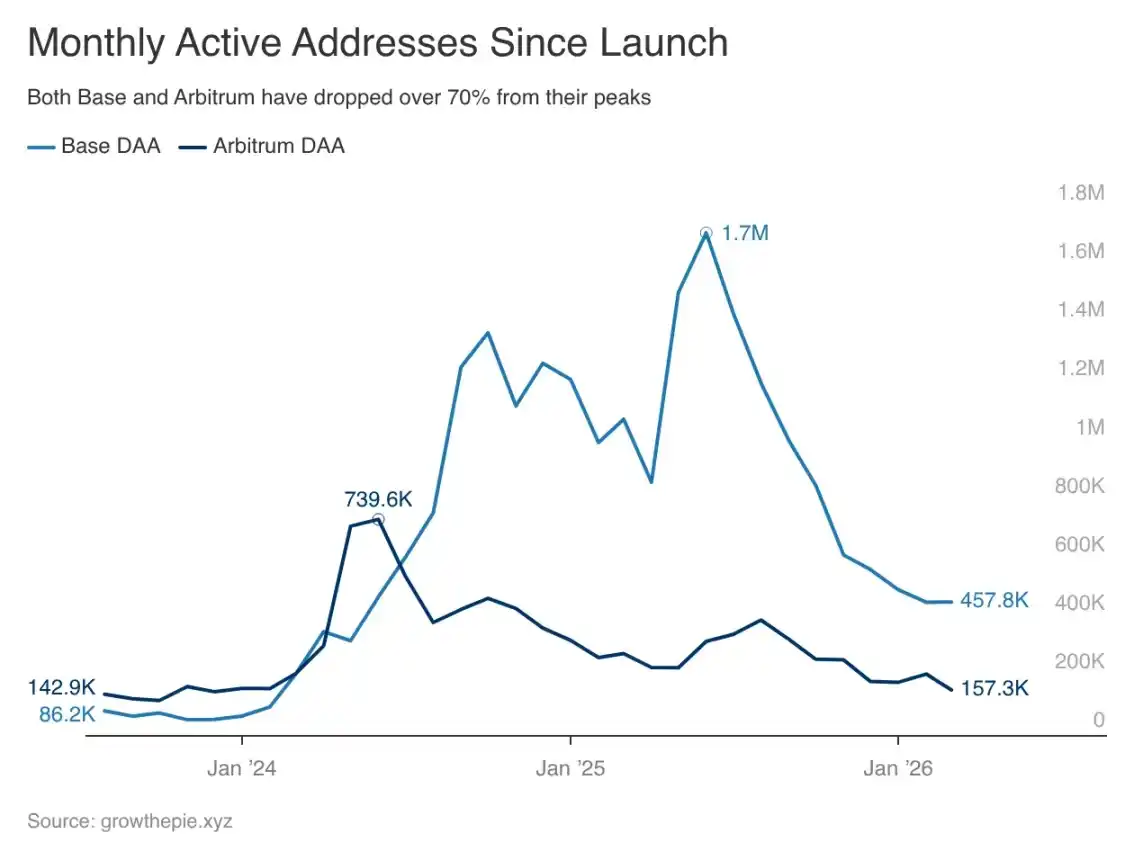
Base's daily active addresses peaked at 1.72 million in June 2025. By March 2026, only 458,000 remained, plummeting 73% from the peak. After Armstrong announced in September 2025 that Base was considering token issuance, the number of active addresses dropped by 54% within just six months, indicating that speculative funds had completely exited.
Sociologist Ray Oldenburg once studied what makes people return to a place repeatedly without expectation of reward. He called it the third place, such as bars, barbershops, and town squares. They are not spaces of efficient production, yet offer a reason to return that is unrelated to incentives. The core idea is: the desire to return cannot be artificially manufactured; it must naturally grow from the possibilities that a place consistently provides over time. The cryptocurrency industry designs places to extract users, then wonders why no one stays.
This is a location without basho: people pass through, take what they need, and then leave, because leaving costs nothing. There is no formation of identity, no ability established elsewhere that cannot be replicated within three weeks, and nothing to make leaving feel like a loss. Are there unique relationships existing on this chain? We have never constructed things with this mindset, have we?
You cannot build basho with financial incentives. Incentives can certainly draw people in, but they cannot make them want to stay. The desire to remain must stem from the long-term possibilities that a place nurtures. Nishida Kitarō referred to this as "the logic of place," which describes how relational fields shape the things that emerge within them. The crypto industry designed fields to extract, only to be surprised to find that all that emerged was extraction.
Brian Armstrong publicly stated that the Base App is now focused on becoming a self-custody, trading version of Coinbase.
The previous vision aimed at creating social stickiness and allowing users to forge identities worth protecting on-chain has disappeared. Data shows this is a rational decision, yet also acknowledges: this vision never truly formed. Base has a location; it is now only focused on serving past users, because that is all it can offer.
A Chain, A Track
Base is the most prominent epitome of the entire L2 model.
Since June 2025, the overall usage rate of small and medium L2s has declined by 61%. Most chains outside the top three have turned into zombie chains: active enough to avoid shutdowns, yet desolate enough to be insignificant. The daily active ratio of L2s relative to L1s has dropped from 15 times in mid-2024 to 10–11 times now. The usage rate of most new L2s has plummeted directly after the incentive cycle ends. The entire L2 ecosystem is cooling down, not just Base.
The roadmap centered around Rollup was once a theory about user adoption: lowering participation costs → user influx → ecosystem formation → compound growth. The Ethereum Foundation released a 38-page vision document this year, outlining the future direction of Ethereum. Meanwhile, the largest L2's activity has bottomed out and left OP Stack, while the second-largest L2's growth has stagnated.
Lowering the entry cost does not equate to creating the conditions for things to take shape. The industry solved the "entry" problem but naively assumed that a "sense of belonging" would follow suit. It will not appear automatically, because a sense of belonging is not a feature that can be launched.
Farcaster is the product closest to constructing basho in the crypto world. A specific group of people has built a specific culture on it: developers share their work, discuss Ethereum, and form opinions about each other over months. This takes time, and competitors cannot replicate it with higher rewards. Friend.tech tried to do the same with an incentive mechanism, reaching the top in a week, only to vanish in a month. The same mechanism did not foster culture. The difference lies not in the product but in whether people stay long enough for something to genuinely take shape.
What Keeps People?
Chains that retain users during the winter do not rely on more generous incentives.
Arbitrum's daily active addresses peaked at 740,000 in June 2024 and have now fallen to 157,000, also plummeting 79%. Both chains are declining, but the underlying logic is completely different.
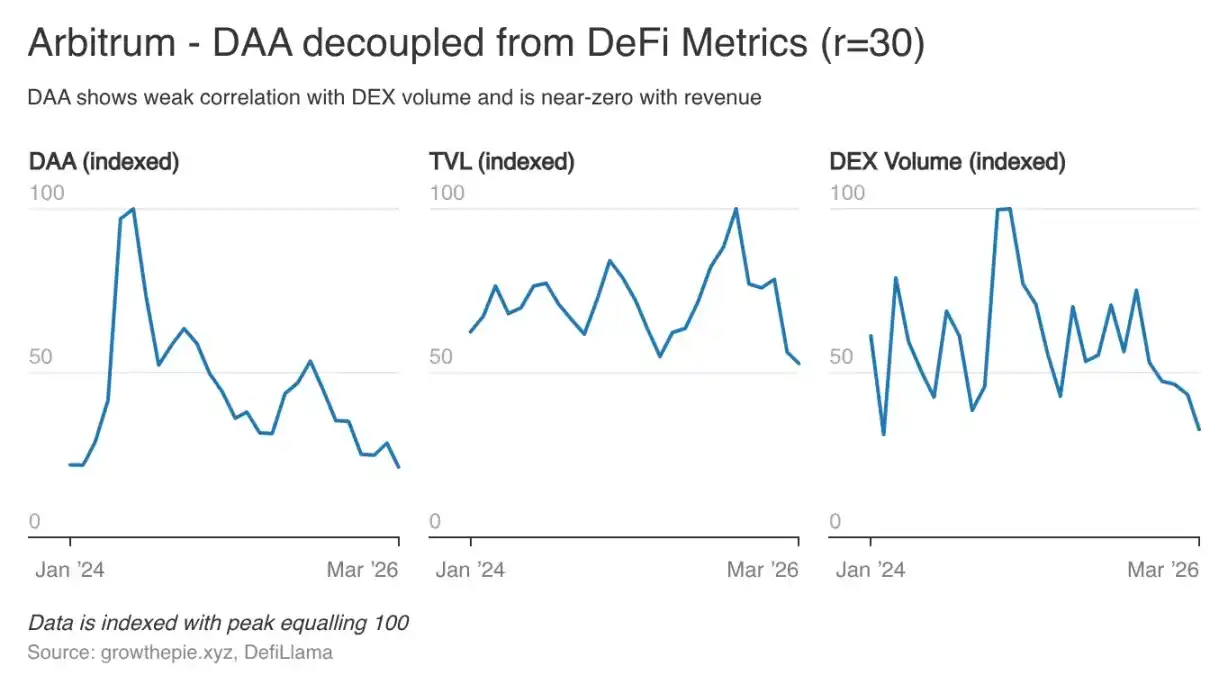
Base's users came on board for trading, and they will leave when trading volume decreases. In contrast, Arbitrum's users are unaffected by transaction fee levels; the correlation between user count and transaction fee income is almost zero. Base attracts tourists, while Arbitrum somehow manages to retain users.
Hyperliquid's stability stems from its unique trading experience, where the community has formed an identity recognition that is non-existent elsewhere. Token incentives are almost irrelevant; being part of it has become a part of their identity and behavior. Things shape users, and users, in turn, shape things.
The crypto industry continues to optimize "how to get people in," while the issue of "how to create an environment" is only remembered after data collapse and has never been considered from the outset of chain design.
I believe Base possesses the strongest distribution capability in history and could have solved this problem better than any other chain.
Now, it is a trading application. This is a reasonable product direction, but it is also what over 40 products are already doing. A trading application cannot create basho; it only generates conversations: users come in when they have trading needs and leave after completing transactions.
To truly become a successful application, a lasting connection must be established. Users need to build a relationship between each visit to make the next visit feel like a return, not just an arrival.
Armstrong's transformation is largely based on the lessons Base learned from the data. The social layer, creator economy, on-chain identity; these should have facilitated Base's transition from "being used" to "being inhabited," all require patience, and systems do not reward patience.
The Ethereum ecosystem needs Base to be more than just a trading venue. The foundation of the entire L2 narrative lies in the chain's ability to serve as the infrastructure around which people build their lives. If the L2 with the strongest distribution capability in crypto history ultimately settles for being a faster Coinbase, then the narrative itself collapses.
Nishida Kitarō believed that the deepest basho is where the boundaries between self and place begin to dissolve. You cannot completely separate "who you are" from "where you are shaped." This sounds abstract, but applying it to a public chain means: a user cannot imagine their financial life after leaving a chain; a developer's entire toolkit is based on a particular ecosystem; their identity can barely exist elsewhere.
To my knowledge, such things have never been built on any L2. They might not be constructible under incentive schemes at all.
Even if you have 100 million potential users, without something worth staying for, ultimately, there will still be an empty shell. Base understands this now.
免责声明:本文章仅代表作者个人观点,不代表本平台的立场和观点。本文章仅供信息分享,不构成对任何人的任何投资建议。用户与作者之间的任何争议,与本平台无关。如网页中刊载的文章或图片涉及侵权,请提供相关的权利证明和身份证明发送邮件到support@aicoin.com,本平台相关工作人员将会进行核查。


