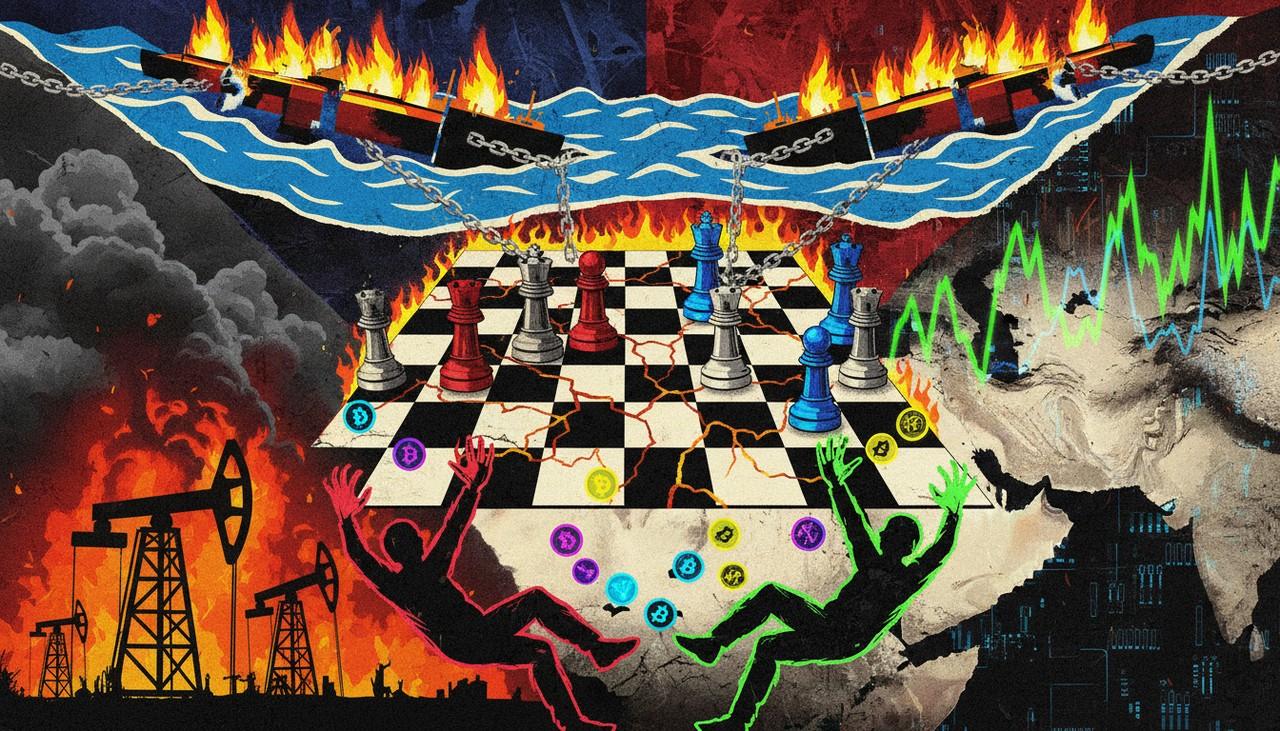
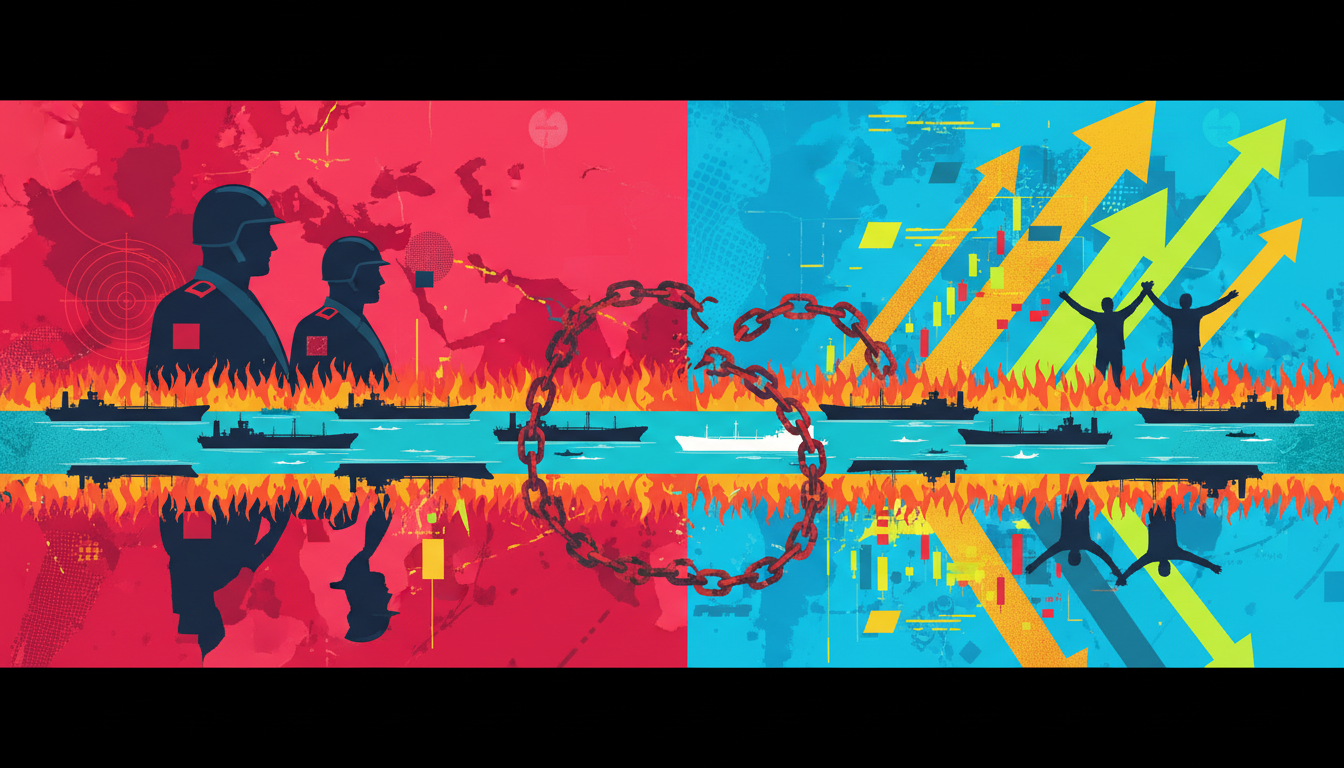
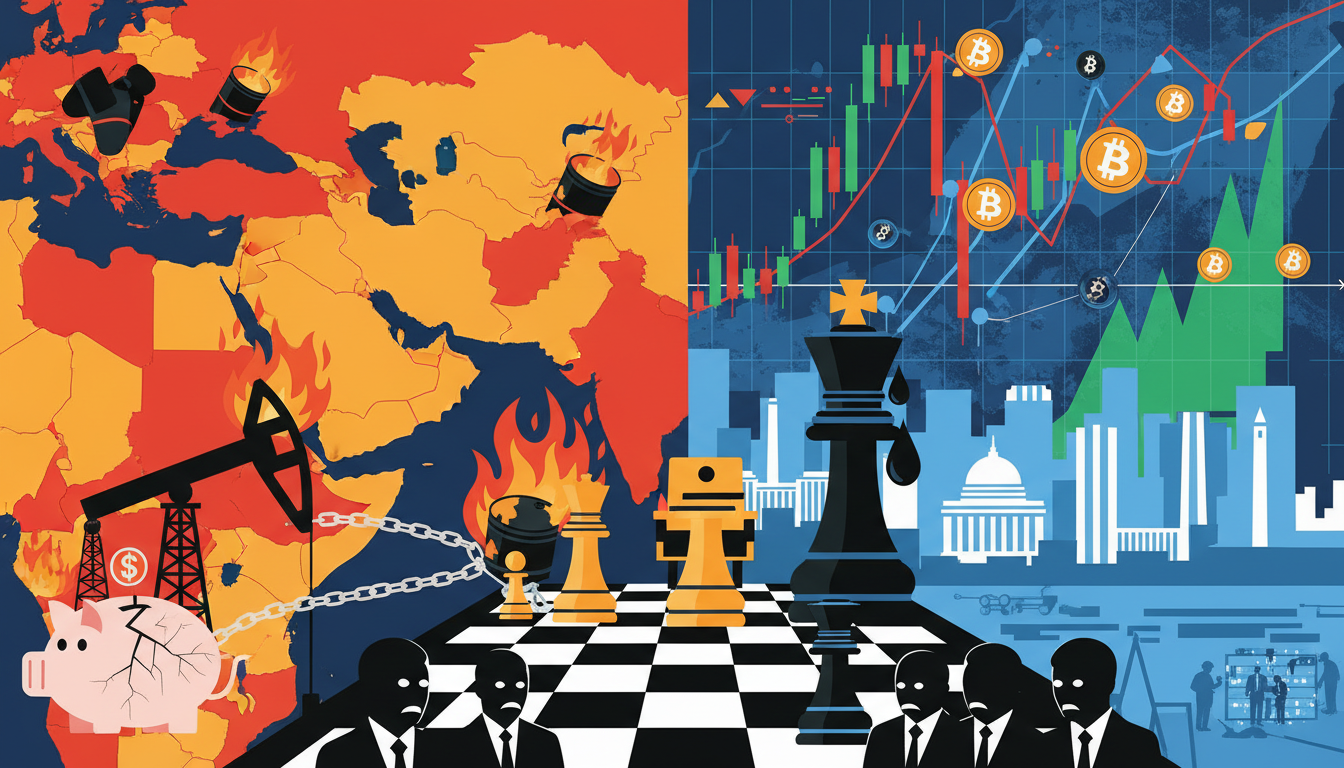
On April 1, 2026, Eastern Time, Trump responded to the so-called "Iran ceasefire request" on his personal platform Truth Social, naming the security passage of the Strait of Hormuz as a prerequisite for any ceasefire arrangement, directly linking it to the trajectory of conflicts in the Middle East. At the same time, Iran denied that it had made a ceasefire request to the U.S. This narrative clash was further amplified by the sensitive date of April Fool's Day, creating a fog of opinion that is difficult to discern. The background is that since the new round of conflicts in the Middle East began, global oil prices have surged over 50%, while U.S. retail sales in February, unadjusted for inflation, still grew 0.6%, indicating the coexistence of resilient consumption and inflationary pressures, with macro sentiment highly tense. In such a dynamic, the risk premium of a strait is rapidly seeping from energy pricing into liquidity and emotional games in the crypto market—whether Hormuz will be "locked" is becoming the starting point for traders to reprice Bitcoin and risk assets across the entire blockchain.
Ceasefire Verbal War: Trump's and Iran's Narrative Experiment
At the start of this storm, it was still Trump's public statement on Truth Social. He claimed that the U.S. would only seriously consider ceasefire arrangements on the condition that the "Strait of Hormuz is open, free, and clear", elevating a specific maritime passage to a core condition of ceasefire negotiations. This statement tightly binds energy security to military ceasefire, making it clear to the market that what truly dictates the flames of war is the accessibility of the passage, not abstract diplomatic rhetoric.
In stark contrast, Iran quickly denied through external channels that it had "actively requested a ceasefire from the U.S." Due to the lack of authoritative, complete official texts and multiple sources for cross-verification, this denial can currently only be regarded as information pending verification, creating an information vacuum between it and Trump's high-profile statement. For traders, this vacuum itself is seen as a risk: on one side, the U.S. President continually emphasizes conditions, while on the other, the opponent denies the existence of a request, indicating that the situation is far from entering a real de-escalation pathway.
All of this coincides with the timing of April Fool's Day, further complicating the already intricate geopolitical narrative with a sense of ridicule. Some voices on social media question whether Trump's statement is exaggerated for the occasion, even interpreting it as "an emotional joke," while other market participants insist that the seriousness of the wording and topic selection is sufficient and should not be simply seen as sarcastic remarks. This divergence regarding "seriousness" directly reflects differences in the pricing of risk assets: is this a probing statement before negotiations, or a groundwork for escalation? In a short period, no one can provide an answer.
Because of this, the verbal war has not provided any "imminent peace talks" imagination for the market; rather, it has amplified worries over the continued escalation of the Middle East situation. The public elevation of the threshold for ceasefire to "absolute safety" in the Strait of Hormuz implies that any news about threats to the strait will be interpreted as a direct blow to the prospects of a ceasefire. For oil prices, shipping, and financial markets, this narrative that binds military issues and energy hubs constitutes a new source of instability.
Hormuz Pricing Surge: Oil Prices Skyrocket and the Invisible Data Gap
To understand why the market is highly sensitive to this strait, we must return to its position in the global energy map. The Strait of Hormuz connects the Persian Gulf to the Gulf of Oman and is a critical choke point for Middle Eastern oil and gas exports, regarded as one of the most important energy transportation arteries in the world. Even if the market does not see any conclusive evidence of a "substantial blockade," as long as there exists an imaginative space of being "stuck," prices will react in advance, as this is the most irreplaceable link in the global transportation chain.
According to reports, since the outbreak of the new round of conflicts in the Middle East, global oil prices have surged over 50%, which is not marginal fluctuation but will penetrate into industrial costs, transportation prices, and even end consumption. For enterprises, the rise in energy costs will squeeze profit margins; for consumers, it means higher commuting and living expenses, all of which will ultimately be reflected in macro data and policy choices. In this round, the market unexpectedly discovered: every mention of Hormuz could almost be traced back in the oil price curve.
Meanwhile, the U.S. domestic demand side has provided a set of "resilient" signals—February's unadjusted retail sales increased by 0.6%. With high oil price pressure still transmitting, the consumer data has not shown a significant slowdown, reinforcing the judgment that "the economy still possesses resilience," leading some traders to reevaluate the pace of Fed easing. High energy prices add to inflation pressures, while consumption remains notably strong, making the combination likely to push up bets that "interest rates will remain high for longer," thereby raising the funding costs of all risk assets.
What truly unsettles the market is that we have almost no usable public data on the actual passage conditions of Hormuz. Whether it is the number of ships, any potential detours, or the days of potential military intervention, external parties cannot access enough detail due to safety and compliance constraints. Under this information black box, prices and policy expectations become the "only readable indicators": the surge in oil prices is interpreted as a premium for blockade risks, while subtle shifts in the Fed's stance are used to infer how decision-makers perceive this risk. However, it needs to be emphasized that such reasoning is more of a market pricing behavior than a direct description of factual states.
Hedging or Speculation: Crypto's Dual Role in Geopolitical Conflicts
Whenever oil prices soar and geopolitical tensions escalate, the hedging pathways in traditional financial markets are traceable: funds flow out of high beta stocks into government bonds, gold, and certain defensive sectors. In this round, this pathway still exists, but an important incremental variable is that crypto assets are being included in the "option set" by more funds, especially among participants questioning sovereign credit and fiat purchasing power.
High energy prices and macro uncertainties are weakening the appeal of certain stock assets. Those companies struggling to maintain margins and already having expanded valuations are more likely to encounter a double whammy in such environments. Relatively, the traditional hedging attribute of gold has been reinforced, while several leading crypto assets have gained more exposure through the narrative of "decentralization and scarcity." For some funds, when they worry about political games and currency oversupply, they will naturally seek assets with a lower correlation to sovereign risks.
In this context, the notion that assets like Bitcoin are packaged as "dual hedges against political and monetary risks" is gaining traction. On one hand, some argue that U.S.-Iran confrontations and the heightened risks in Hormuz amplify the potential for regional wars to spill over, threatening the dollar-driven energy settlement system; on the other hand, high oil prices and resilient consumption are interpreted as signals of stubborn inflation pressures and that the Fed is forced to stay in high-interest areas for longer. Within this narrative framework, crypto is seen by some investors as a tool to hedge both the political uncertainties arising from geopolitical conflicts and the long-term inflation and currency devaluation risks.
However, in the crypto market, so-called "hedge assets" and "high-leverage speculative tools" often belong to the same batch of targets. The escalation of geopolitical conflicts attracts a large influx of short-term funds attempting to gain excess returns from volatility amplified by narratives. Thus, we observe price behaviors where hedge funds slowly build positions at lower levels while speculative funds engage in high multiples of longs and shorts at higher levels, with repeated leverage amplifying any directional volatility into sharp fluctuations. This dual role makes crypto a "harbor of emotions" during geopolitical turbulence, while often evolving into an "emotional amplifier."
New Three Coins on Coinbase: Narrative Amplifier for Compliant Platforms
Interestingly, on the same day that Trump brought the Strait of Hormuz into the spotlight, Coinbase announced the launch of spot trading for three trading pairs: CHECK, SIGN, and MEZO. In terms of timing, this is clearly a "coincidence," but in the storytelling-rich crypto market, such coincidences are quickly incorporated into a narrative framework: at a time of escalating geopolitical tensions, leading compliant exchanges provide the market with new targets, interpreted by some as an expansion of hedging tools and seen by others as an update on "emotional outlets."
As the Middle East situation sways oil prices and interest rate expectations, the actions of compliant platforms frequently carry additional significance. For incremental funds seeking safety, encountering new coins on familiar compliant platforms is more controllable than pursuing high risks in gray areas; for old players, new coins represent higher volatility potential, which can leverage geopolitical newsflow to increase trading heat. Thus, the same event can be viewed by different groups as "a new risk hedging option" by some, while others understand it as "a chip pool serving short-term narratives."
Functionally assessing from a calm perspective, these new coins are unlikely to bear the true "geopolitical hedging" role in the short term. They lack long-term price histories and have not established correlations with macro variables, existing more as narrative carriers and toolkits. The so-called "binding with the Middle East situation" is often just a packaging of short-term funds searching for trading rationales. However, it cannot be ignored that when the rhythm of new listings on compliant platforms coincides with geopolitical event timelines, it indeed amplifies the market's sensitivity to news flow—every macro headline may quickly be grafted onto coin prices.
Looking more broadly, the pace of new listings in the compliant market itself is constrained by the regulatory environment. In a context where scrutiny is tightening and compliance demands are increasing, each new listing, especially during sensitive macro periods, is interpreted as a sign of "regulatory tacit approval." If regulators maintain a relatively neutral or slightly friendly stance, compliant platforms can more frequently provide new targets for funds, thus allowing crypto to have more "stories to tell" in the face of geopolitical events; conversely, if new listings are noticeably tightened, it will weaken the function of crypto as an outlet for geopolitical narratives, squeezing more emotions into existing leading assets.
Macro Crossfire: The Symphonic Resonance of the Fed and Middle Eastern Narratives
Bringing the perspective back from Hormuz to Washington, another timeline is interweaving with it—the public speeches of Federal Reserve officials and the release of retail sales data. In the first quarter of 2026, consumption data and official wording almost simultaneously enter the market's field of view, while Trump's statements about the Middle East and strait security generate an unexpected cumulative effect with this series of macro signals: monetary policy, energy prices, and war expectations are being put into the same trading equation.
U.S. February retail sales grew by 0.6%, which many see as evidence of resilient consumption, indicating that the demand side has not been completely suppressed by previous rate hikes. Correspondingly, due to tensions from the Middle Eastern conflicts, oil prices have risen over 50%, significantly increasing the potential pressures for imported inflation. When these two sets of data combine, market imaginations about interest rate paths naturally shift: the space for easing is considered more limited, and even voices have begun to reprice scenarios where "high rates persist longer than expected." For crypto, this is not only a change in discount rates but also a substantial rise in the costs of leverage and market-making funds.
Under the triple resonance of "geopolitical conflict + inflation pressures + policy uncertainty," the emergence of extreme emotional trends in the crypto market becomes more understandable. On one hand, war and strait risks increase the imaginative space for systemic shocks, prompting some funds to seek alternative assets for hedging; on the other hand, high oil prices and resilient consumption also make it more difficult for the policy layer to quickly turn to ease, suppressing the "mindless risk appetite" brought by liquidity floods. In this tug-of-war, any news leaning towards one side could trigger violent fluctuations in crypto prices—either being understood as "easing is imminent, risks are released," or viewed as "pressure intensifies, valuations are hard to sustain."
More troubling is that currently, whether it is the trend of the Middle Eastern conflict, intra-Fed policy games, or the actual operational status of the Strait of Hormuz, all are in a state of dynamically evolving. Investors cannot wait for all information to settle; they must be forced to price ahead amid high uncertainty. This "preemptive pricing" behavior inherently amplifies the market's volatility. For crypto, characterized by 24-hour trading and high participation from global retail investors, this amplifying effect is even more pronounced.
The Strait Becomes an Emotional Valve: The Anchor for Crypto's Next Risk Premium
Connecting the above clues, it is not difficult to find that the Strait of Hormuz has already transformed from a geographically significant passage into a financial market emotional valve. Trump made "open, free, and clear" a prerequisite for the ceasefire, directly linking strait security to the escalation of conflicts; the market further transmits this linkage to oil prices, interest rate expectations, and the discount rates for risk assets. Whenever tense expressions about Hormuz increase, the risk premium on oil prices is reignited, and the volatility expectations for crypto assets rise accordingly.
In this process, it must be repeatedly emphasized the boundary of information sources: currently, the specific content regarding whether Iran has requested a ceasefire, its official attitude, and some media interviews related to Trump are still in a pending verification state. We lack a complete original document of the Iranian official statement and do not have enough multiple-source cross-evidence to restore all details. For investors, the most important thing is to learn to distinguish between facts that have been well verified and statements still lingering at the levels of opinion and social media noise, avoiding treating the latter as a foundation for certainty to leverage bets.
In the forthcoming market evolution, three clues are worth tracking closely: first, the passage conditions and oil price trends—despite the lack of specific passage data, oil prices will continue to reflect the market's dynamic pricing of blockade risks; second, U.S. policy and interest rate expectations—the evolution of retail sales, inflation data, and Fed officials' wording will determine funding costs and the tone of risk appetite; third, crypto fund flows on compliant platforms—including the new listing rhythm of leading exchanges like Coinbase, changes in spot and derivatives trade structures will reveal whether funds view crypto as a risk anchor or merely as an emotional amplifier.
For crypto investors, this round of "Hormuz risk" does not offer simple buying or selling guidance, but a lesson on the boundaries of narratives and data. In times of extremely captivating stories and an abundance of conflict narratives, it is essential to deliberately slow down, returning to verifiable data and clear position management. High geopolitical risk premiums mean that any abnormal volatility can occur without warning; what is truly worth adhering to is not betting on any grand narrative, but maintaining a trading discipline that respects risks even in the most uncertain phases.
Join our community to discuss and grow stronger together!
Official Telegram community: https://t.me/aicoincn
AiCoin Chinese Twitter: https://x.com/AiCoinzh
OKX welfare group: https://aicoin.com/link/chat?cid=l61eM4owQ
Binance welfare group: https://aicoin.com/link/chat?cid=ynr7d1P6Z
免责声明:本文章仅代表作者个人观点,不代表本平台的立场和观点。本文章仅供信息分享,不构成对任何人的任何投资建议。用户与作者之间的任何争议,与本平台无关。如网页中刊载的文章或图片涉及侵权,请提供相关的权利证明和身份证明发送邮件到support@aicoin.com,本平台相关工作人员将会进行核查。