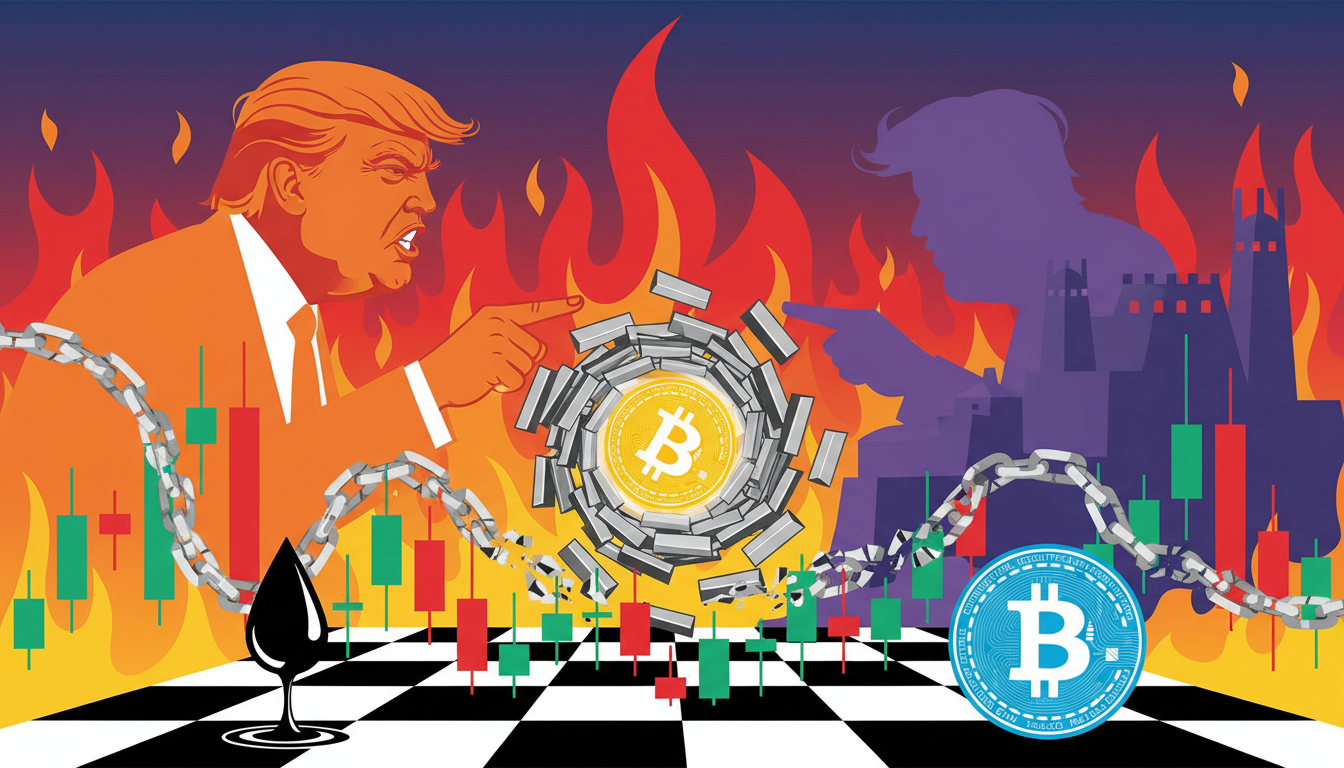
On March 31, 2026, in the evening Eastern Eight Time, former U.S. President Trump provided his latest statements regarding the Iran and Strait of Hormuz issue during an interview with CBS. On one hand, he emphasized that he is “not ready” to take action to compel Iran to reopen the Strait of Hormuz, while on the other hand, he claimed that “there is no real threat from the Strait of Hormuz” and made the blunt remark “if they want oil, they can go get it themselves.” The core conflict is clearly laid out: whether the U.S. is still willing to bear the security costs of this critical oil transport route for its allies, or if it views it as a strategic burden that other countries must pay for themselves. For a market that has long viewed the Strait of Hormuz as a global energy artery, this political narrative downplaying potential risks as “no real threat” stands in stark contrast to the high sensitivity to geopolitical shocks at the transactional level.
From Escorting to Letting Go: The Shift in U.S. Role on Oil Routes
Since the late Cold War, the U.S. has maintained a significant naval presence in the Strait of Hormuz, through aircraft carrier battle groups, allied joint formations, and maritime patrol operations, shaping the role of the “world police” as an energy escort. Whether facing pirate threats, regional conflicts, or imposing sanctions on Iran, the permanent presence and rapid response capability of the U.S. Navy have long been regarded as the last bastion of safety for this “global oil route choke point.” It is in this context that the security of the Strait of Hormuz has been implicitly assumed to be tied to U.S. maritime power, becoming a hidden “public good” in the global energy system.
In the CBS interview, Trump continued his consistent “America First” approach. According to a research brief, he clearly stated that he is currently “not ready” to take action to force Iran to reopen the Strait of Hormuz, indicating that even if there are obstacles or threats to this route, he is not eager to use U.S. military and diplomatic leverage to dominate the situation. This statement distances itself from the traditional image of the “U.S. protector” and is closer to that of a transactional state: no longer automatically bearing the expensive costs of global public safety.
The statement “if they want oil, they can go get it themselves” pushes his logic to the extreme. Here, “they” refers specifically to those allies and partners who highly depend on Middle Eastern energy imports but have long relied on the U.S. for “free rides” in terms of security. Through this provocative statement, Trump has redefined the boundaries of U.S. responsibilities toward its allies: the security of oil routes is no longer a public guarantee provided by the U.S. at no cost, but rather an actual price that each country must pay for its own supply lines.
The deeper implication of this shift is that the global discourse on energy security may potentially begin to diffuse from a “U.S. single center” towards regional countries and major importing nations. The relative withdrawal of the U.S. implies that in future decision-making regarding the security of the Strait of Hormuz, there will likely be a greater presence of oil-producing countries, coastal nations, as well as European Union and Asian buyers. This may lead to more complex coordination games, and could give rise to new regional security mechanisms, changing the past oil route security structure centered around the U.S.
Trump Downplays the Iranian Threat and the Gap in Market Perception
In this interview, Trump not only “hit the brakes” on intentions to act, but also significantly “lightened the throttle” on threat assessments. According to the brief, he claimed that “there is no real threat in the Strait of Hormuz” and reiterated that Iran has been “severely weakened/damaged.” Such statements mainly stem from a single media source and his own claims, lacking cross-validation by multi-source intelligence and official reports, and their reliability and completeness are clearly limited, resembling political rhetoric serving his own policy stance.
In contrast, the market has long regarded the Strait of Hormuz as a typical high geopolitical risk area. From energy traders to shipping insurance companies, and various macro hedge funds, once there are expectations of blockades or military friction in Hormuz, risk premiums in oil prices often rise rapidly, driving an uptick in safe-haven asset transactions. This inertia of “pricing risk first, validating facts later” embeds the route itself into the risk framework of global asset portfolios, rather than simply being understood as a stretch of water that can be easily overlooked.
Trump's verbal downplaying shows a clear disconnect with any potential disruption of oil transport in reality. Even without a public conflict, if there is merely disruption of shipping, soaring insurance costs, or partial rerouting of shipowners, it will create a chain reaction of costs and time consequences for the supply chain. Relying solely on the political statement of “no real threat” is evidently insufficient to offset these structural risks, nor can it serve as a sufficient basis for the market to lower risk premiums. In risk management, investors often prefer to “overestimate threats and underestimate commitments” rather than easily follow a political figure's optimistic judgment.
Therefore, it is important to remind that political rhetoric and risk pricing are two separate systems. Trump's remarks may influence short-term sentiment, causing some disturbances in futures curves, energy stocks, and related currencies, but what truly determines pricing is whether navigation is obstructed, whether insurance terms tighten, and whether production and inventory undergo substantial changes. The market will respond to such bold or optimistic statements, but will not “buy the whole thing,” especially in the absence of independent intelligence and data support.
The Responsibility Gap on the Global 20% Oil Route
According to recent statistics from the International Energy Agency and several authoritative energy research institutions, the Strait of Hormuz accounts for approximately one-fifth of the world's crude oil maritime transport volume. Given that specific proportions may vary according to years, production, and trade structures, the research brief also indicates that relevant data needs to be updated according to the latest reports and should not be locked into overly precise annual or daily figures. However, even when measured by this rough scale, Hormuz remains one of the main bottlenecks in global oil and gas logistics, and its strategic position is undeniable.
On such a route, once the U.S. reduces military deployments and political commitments, the safety guarantee's “underpinning role” will inevitably present a vacuum. In the future, more responsibility may fall upon the Gulf oil-producing countries themselves, as well as the European Union and major Asian importing countries that are highly dependent:
● For oil-producing countries, the security of Hormuz is a financial lifeline; they cannot afford to overlook any long-term disruption; however, their escort and deterrent capabilities as individuals or small alliances are difficult to fully replace the U.S.’s long-range strike and global supply system.
● For importing countries, the security of the route is a lifeline for stable supply, yet they lack a nearshore military presence and willingness to intervene, and can only seek alternative options in dimensions such as diplomatic coordination, military sales cooperation, and joint exercises.
The research brief specifically mentions that the jet fuel supply crisis in 2025 has sounded the alarm for countries regarding the fragility of their supply chains. At that time, it was not due to a blockade from Hormuz itself, but the event exposed the vulnerable structure of shipping routes, refinery capacity, and inventory management under multiple disturbances. Aviation fuel, ocean shipping, and global logistics rely heavily on the stability of critical corridors including Hormuz, and once this link is seen as “high risk, low escort,” systemic spillover effects will quickly transmit to ticket prices, freight costs, and even the consumer end.
In the context of the U.S. “taking a step back,” regional countries, the EU, and Asian buyers are bound to engage in a new round of negotiation around the questions of “who contributes manpower, who pays, and who commands.” Possible directions include: coastal countries pushing more binding regional security mechanisms, the EU amplifying its presence based on its experiences in anti-piracy operations in the Gulf of Aden, and Asian buyers locking in minimum safety thresholds through joint military exercises, base agreements, or multilateral dialogues. These trends currently remain at the level of speculation, with no public, specific agreements or military arrangements available for confirmation, but they constitute a necessary question in the reshaping of the global energy security framework after the gradual withdrawal of the U.S.
The Resurgence of Unilateralism: Reevaluating the Security Accounts of Allies
To understand Trump’s statement regarding Hormuz, it must be placed back into his consistent policy framework. Whether it is demanding Europe “to pay more” on NATO military expenditure or emphasizing cost-sharing in negotiations for U.S. troops in Japan and South Korea, the essence of “America First” is to deconstruct past expenditures that were packaged as “collective security” or “values alliance” into negotiable price tags. This time calling the security of the Hormuz oil route “if they want oil, they can go get it themselves” is a reiteration of the same logic on energy corridors — the U.S. no longer automatically provides a protective umbrella but will choose to intervene selectively following a calculation of interests.
From the allies' perspective, the security of oil routes is a lifeline, not an elective course. For countries that heavily rely on Middle Eastern crude and liquefied natural gas, any sustained blockage in Hormuz signifies pressure on refinery operations, power generation security, industrial production, and even social stability. For decades, they have become accustomed to packing this portion of risk into the premium of “allying with the U.S.,” whereas Trump’s statement now implies that this is no longer a fixed content covered by “collective security,” but closer to individual responsibility of “each paying their own way.”
This transfer of responsibility may trigger a series of chain reactions in the coming years:
● Military negotiations and defense clauses rewriting: The U.S. will have more leverage in bilateral defense agreements and arms sales to demand allies increase military expenditure and purchase more American equipment, shifting financial and political burdens in the name of “self-reliance.”
● Upgrading regional defense cooperation: Without relying entirely on the U.S., regional countries may accelerate the establishment of localized defense networks, from intelligence sharing to joint patrols, and to coordinated limited air defense and maritime blockade capabilities, striving for some form of “de-Americanization but not completely decoupling” middle path.
It should be emphasized that currently, no major allies have provided systematic, formal public responses to these remarks, and the research brief also clearly categorizes the related content as “information missing, fabrication prohibited.” Therefore, the truly valuable observation point lies not in how “explosive” this interview segment is, but in how allied governments and parliaments adjust their rhetoric and policies during debates on defense budgets, foreign deployments, and energy security strategies in the coming weeks to months. Those seemingly technical military expenditure figures and energy reserve plans may very well be the profound responses to Trump’s signal.
How Statements Influence Oil Price Expectations and Asset Pricing
At this stage, there have been no confirmed major military escalations or new rounds of official sanctions introduced regarding the Strait of Hormuz; instead, information mainly lingers in political statements and media interpretations. In this environment lacking hard-event triggers, market re-evaluation of risks is primarily accomplished through expectation channels: investors will reassess the U.S.'s future willingness to invest in Middle Eastern security based on Trump’s remarks, and convert this tendency of “possible withdrawal” into changes in oil prices and related assets that reflect longer-term risk premiums.
If investors gradually believe that the U.S. will no longer be willing to provide strong guarantees for Hormuz, the market pricing logic may evolve along two intertwined paths: on one hand, in the short term, in the absence of substantial conflict, price reactions may be mild or even momentarily ignored; on the other hand, the risk premium in the medium to long term may quietly rise at the far end of the curve, evident in the structural upward shift of long-term contracts, energy stock valuations, and shipping insurance costs. Such changes often do not occur in just a day or two, but are gradually written into the “new normal” of asset prices as multiple statements and policy signals accumulate.
The research brief also points out that there is currently a lack of real-time, reliable U.S. domestic oil price and inventory data to precisely measure the immediate impact of these remarks, and the extent of their effects still needs to be validated by subsequent market trends and monthly and quarterly reports from energy agencies. In the absence of complete data, excessive interpretation of short-term price fluctuations may amplify small sample noise, while neglecting more critical structural expectation changes.
For high-risk assets such as cryptocurrency, the combination of geopolitical tension and upward energy price expectations typically implies two things: first, rising macro uncertainty guiding some capital towards assets seen as “digital safe havens,” increasing volatility; second, an extension of the duration of high rates and high-cost environments suppressing risk appetite, leading some speculative capital to withdraw. These two factors combined often do not simply equate to “rise or fall,” but rather widen the fluctuation range and intensify tail risks, enhancing the probability of liquidation for leveraged funds and derivative positions.
The Game of Oil Routes is Not Over: Real Variables After U.S. Exit
In summary of this CBS interview, Trump released three interrelated key signals on the issue of Hormuz: first, there is no rush to take action, responding to expectations of whether the U.S. will compel Iran to open the strait with “not ready”; second, downplaying threats, attempting to reshape public and allied perceptions of risk through statements like “there is no real threat in the Strait of Hormuz” and “Iran has been severely weakened”; third, letting allies bear the burden, pushing the security responsibility from the U.S. onto importers and regional partners with the remark, “if they want oil, they can go get it themselves.”
What truly determines the future direction is not the interview itself, but rather how allies and regional countries respond to these signals and reshape the energy and security framework accordingly. If the EU, major Asian buyers, and Gulf countries choose to increase military spending and deepen cooperation within the existing framework, the relative withdrawal of the U.S. may be partly hedged; if responses are slow and cooperation limited, Hormuz may remain in a state of “high risk, low escort” for a longer period, exposing global energy and various risk assets to a new wave of re-pricing in the coming years.
For investors, it is important not to chase the optimistic or pessimistic narratives of a political figure in times of heightened emotion, but to track the evolution of subsequent military deployments, diplomatic consultations, and institutional arrangements over a longer time horizon. Whether it is new base agreements, joint patrol mechanisms, or adjustments in energy reserve policies and shipping insurance terms, these will provide more informative content than a single interview segment. In an era of increasingly intertwined geopolitics and markets, maintaining a calm analysis of information sources is crucial, avoiding treating transient hardline or comforting rhetoric as an “investment guide” that can replace data and structural analysis.
Join our community to discuss and become stronger together!
Official Telegram community: https://t.me/aicoincn
AiCoin Chinese Twitter: https://x.com/AiCoinzh
OKX Benefits Group: https://aicoin.com/link/chat?cid=l61eM4owQ
Binance Benefits Group: https://aicoin.com/link/chat?cid=ynr7d1P6Z
免责声明:本文章仅代表作者个人观点,不代表本平台的立场和观点。本文章仅供信息分享,不构成对任何人的任何投资建议。用户与作者之间的任何争议,与本平台无关。如网页中刊载的文章或图片涉及侵权,请提供相关的权利证明和身份证明发送邮件到support@aicoin.com,本平台相关工作人员将会进行核查。