
Daily market highlights data review and trend analysis, produced by PANews.
Macroeconomic Market
Following the joint military strike by the United States and Israel that led to the death of Khamenei, the Middle Eastern powder keg has been completely ignited. Trump's hardline statements have heightened market anxiety, as he explicitly stated that military actions may last for four weeks and will not cease until objectives are met; Iran, on the other hand, has responded sharply, declaring that the timing for a ceasefire will be determined by Iran.
Panic spread across traditional financial markets instantly, with US stock index futures opening lower across the board on Monday, the S&P 500 futures, Nasdaq, and Dow Jones futures all falling by over 1%. Short-term Treasury yields briefly dropped to their lowest level since 2022, as capital fled high-valuation risk assets in a frenzy.
In a wave of risk aversion, precious metals undoubtedly became the global capital's "ultimate safe haven," with spot gold surging 2% to $5,390 per ounce and spot silver climbing 2.6% to $96 per ounce. Analysts from Saxo Bank and KCM Trade stated that this concerning escalation will prompt gold to regain its status as the preferred safe haven; City Index even predicted that strong safe-haven buying could push gold prices to $5,500, potentially breaking historical highs.
The choke point of the energy market—Strait of Hormuz—fell into a "de facto standstill," with panic buying propelling international oil prices to surge by $8 at the opening. Brent crude oil jumped 9% to $82.37 per barrel, while WTI crude rose to $75.33 per barrel. Despite OPEC's emergency announcement of an average daily output increase of 206,000 barrels in April, it still struggled to quell the market's anxiety over supply disruptions.
Wall Street investment banks are highly vigilant about the subsequent trends in oil prices, with tail risks fully priced in. JPMorgan warned that if the strait is completely closed, oil-producing countries in the Middle East, limited by storage capacities, could only maintain production for up to 25 days; Citigroup and Rystad Energy projected that if energy infrastructure is attacked or shipping disruptions continue for several weeks, oil prices will undoubtedly break through $100, with the possibility of skyrocketing to $120.
Goldman Sachs' strategy team pointed out that the "duration" of the conflict has replaced "the outbreak itself" as the core variable determining asset direction. If the interruption of crude oil supply escalates into a prolonged conflict, elevated inflation expectations will completely lock the Federal Reserve's capacity for interest rate cuts, sharply increasing interest rate volatility, leading the global market to likely replay the energy shock scenario of 2022.
AI Sector Dynamics
On February 28, US Department of Defense negotiations with AI company Anthropic for a $200 million contract broke down due to differences, with the Pentagon announcing the designation of Anthropic as a "supply chain risk," severing collaboration. On the same day, Anthropic's competitor OpenAI quickly reached an agreement with the Defense Department to meet its "all lawful purposes" AI usage requirements while retaining technology protection rights.
Despite the controversy surrounding its collaboration with the Pentagon, the market attractiveness of Claude has not diminished but instead driven a significant increase in downloads and the willingness to pay, topping the Apple US App Store free application rankings, surpassing OpenAI's ChatGPT.
Bitcoin Market
Under the extreme pressure of warfare in the Middle East, Bitcoin's spot market did not replicate the "312" crash of 2020 but has been slowly declining. Over the weekend, while the price dipped to a low of $63,000, the confirmation of Khamenei's death quickly led to a "V-shaped" reversal, with February ending nearly 15% lower, marking the third-worst February performance in history. Since reaching a new high, Bitcoin has now fallen for the fifth consecutive month, with March beginning with a continued downward trend.
In terms of options, the implied volatility (IV) for March 27 settlement soared to 51.3%, with maximum pain lingering around $76,000. Among a total open interest of 167,000 BTC (over $11.2 billion), the put/call ratio (PCR) stands at only 0.75, but the 24-hour trading volume PCR has surged to 1.37. The current market sentiment is extremely fragmented: long-term institutions are holding onto their bullish positions fiercely while short-term speculators are frantically buying put options for tactical hedging in the "meat grinder" range of $67,000 to $70,000. According to Unbias data, 61% of analysts currently hold a short-term bullish view on the market.
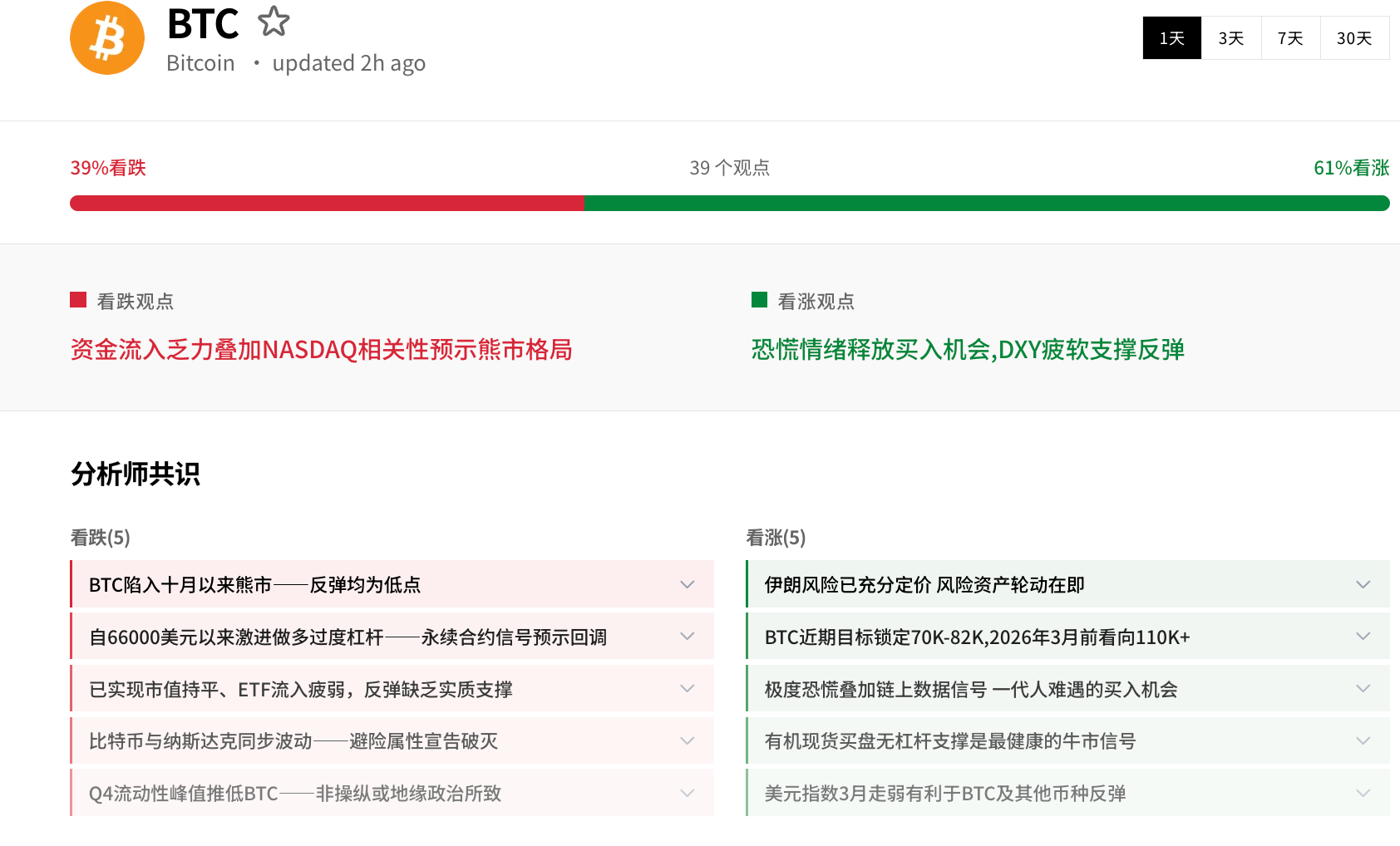
Bearish Viewpoint
Core Logic: The risk aversion withdrawal of macro funds and the options market makers' pressure have locked the potential for short-term rebounds, with the market facing the risk of a liquidity negative feedback loop.
GodotSancho: Main funds have shifted from buying puts for defense to selling calls to suppress prices, sealing off upward space; long-term maintains deep negative premiums, with a clear bet that there will be deeper dives this week. It is recommended to slow down on bottom fishing and to focus on watching the $66,000 defense line.
Skew: The spot market encounters passive selling around $68,000, with the market chasing prices with leverage, making a short-term pullback unsurprising.
Bulllish Viewpoint
Core Logic: The inflation expectations and currency trust crisis brought about by the war will reshape Bitcoin's "borderless hard asset" value from the ground up and compel the Federal Reserve to release liquidity.
Arthur Hayes: The longer the US intervenes in the Iranian situation, the more likely the Federal Reserve will cut rates and print money to support war spending; the best strategy is to buy Bitcoin heavily after the Fed cuts rates.
Samson Mow (CEO of Jan3): Compared to gold and global currency supply, Bitcoin is severely undervalued, and the current Z-score falling below -2 indicates a potential significant price reversal.
Henrik Zeberg (macroeconomist): With rising risk appetite and ETF fund inflows, Bitcoin's main target price is looking at $110,000 to $120,000.
Alex Krüger: The target price by the end of the first quarter is $78,000 to $82,000, and breaking above $71,000 will trigger market FOMO.
Mercado Bitcoin research team: If priced in gold, Bitcoin's bear market cycle may bottom out between February and March, as whales are using panic sentiment to build positions at lower prices.
BitBull / Michaël van de Poppe: The market is about to迎来修复性反弹, short-term target prices are seen at $73,000 to $74,000.
Ethereum Market
Compared to the extreme volatility of Bitcoin, Ethereum's start in 2026 appears quite challenging, with a year-to-date decline of 36%, as its price has retreated to around $1,900. Market data shows that Ethereum's trading volume on DEX has plummeted 55% in the past six months, recording only $56.5 billion in February, far below the peak of $128.5 billion last August. This sharp decline in on-chain activity has directly dragged down network fees and DApp revenues, making the psychological barrier of $3,000 increasingly unattainable.
However, behind the disappointing price trend, Ethereum's underlying fundamentals and institutional consensus remain rock solid. It still firmly controls a TVL of $52.4 billion; if accounting for Layer 2 networks like Base and Arbitrum, its TVL market share reaches as high as 65%, completely crushing Solana's $6.4 billion and BNB Chain's $5.5 billion. Not only that, Ethereum also monopolizes up to 68% of the RWA market share, becoming the preferred choice for Wall Street giants like JPMorgan, Citigroup, and BlackRock to issue tokenized funds. Current market sentiment towards Ethereum is quite complex, as retail investors are extremely pessimistic due to price weakness and liquidity depletion, but traditional financial giants are accelerating their bottom-fishing efforts.
Bearish Viewpoint
Core Logic: The decline in on-chain activity and prolonged price weakness severely undermines the willingness to hold capital and short-term explosive potential.
Crypto Seth: Since December 2024, Ethereum has had 12 months of bearish performance out of the past 15 months, with price performance consistently weak.
Bullish Viewpoint
Core Logic: The absolute leading locked value, irreplaceable institutional adoption rate, and ongoing evolution of the underlying architecture have created a high long-term moat for Ethereum.
Vitalik Buterin: Focusing development on base layer scalability and ZK-EVM, ensuring long-term on-chain efficiency and security through parallel block validation and quantum-resistant cryptography.
Investor Jordan: Increasing positions in the extremely oversold zone around $1,800, with Ethereum's position as a stablecoin and DeFi backbone remaining unshakeable, with a target price of $20,000 in the next 5 years.
Traditional financial institutions (JPMorgan/Citigroup/BlackRock): Putting aside short-term price fluctuations, they still choose Ethereum as the preferred innovative platform for tokenized funds and banks to issue stablecoins.
Key Data (As of March 2, 13:00 HKT)
(Data Source: CoinAnk, Upbit, SoSoValue, CryptoBubbles)
Bitcoin ETF: This week net inflows of $787 million
Ethereum ETF: This week net inflows of $80.46 million
SOL ETF: This week net inflows of $44.44 million
XRP ETF: This week net inflows of $9.5545 million
Fear and Greed Index: 10 (Extreme Fear)
Upbit 24-hour trading volume rankings: XRP, BTC, SAHARA, ETH, CFG
Market sector changes: The cryptocurrency market is down across the board, with the NFT and GameFi sectors down over 3%
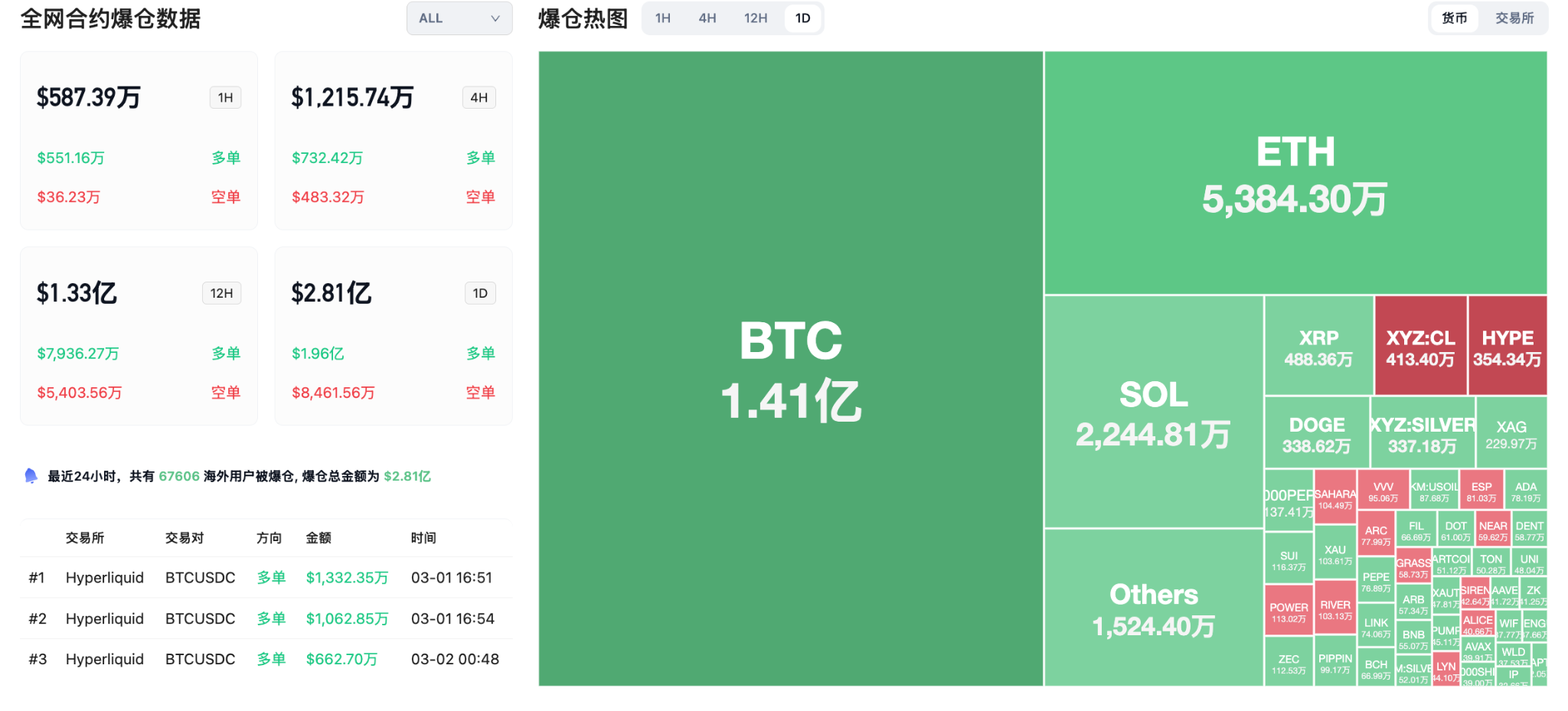
A total of 67,606 people globally were liquidated, with a total liquidation amount of $281 million, including $141 million in BTC liquidations, $53.84 million in ETH liquidations, and $22.44 million in SOL liquidations.
Today's Outlook
Binance: Bitway (BTW) tokens will start circulating at 16:00 on March 2
MANTRA token upgrade will be executed on March 3, including renaming and a 1:4 split
Upbit will delist GoChain (GO) on March 3
ENA will unlock approximately 40.63 million tokens on March 2, worth about $4.3 million.
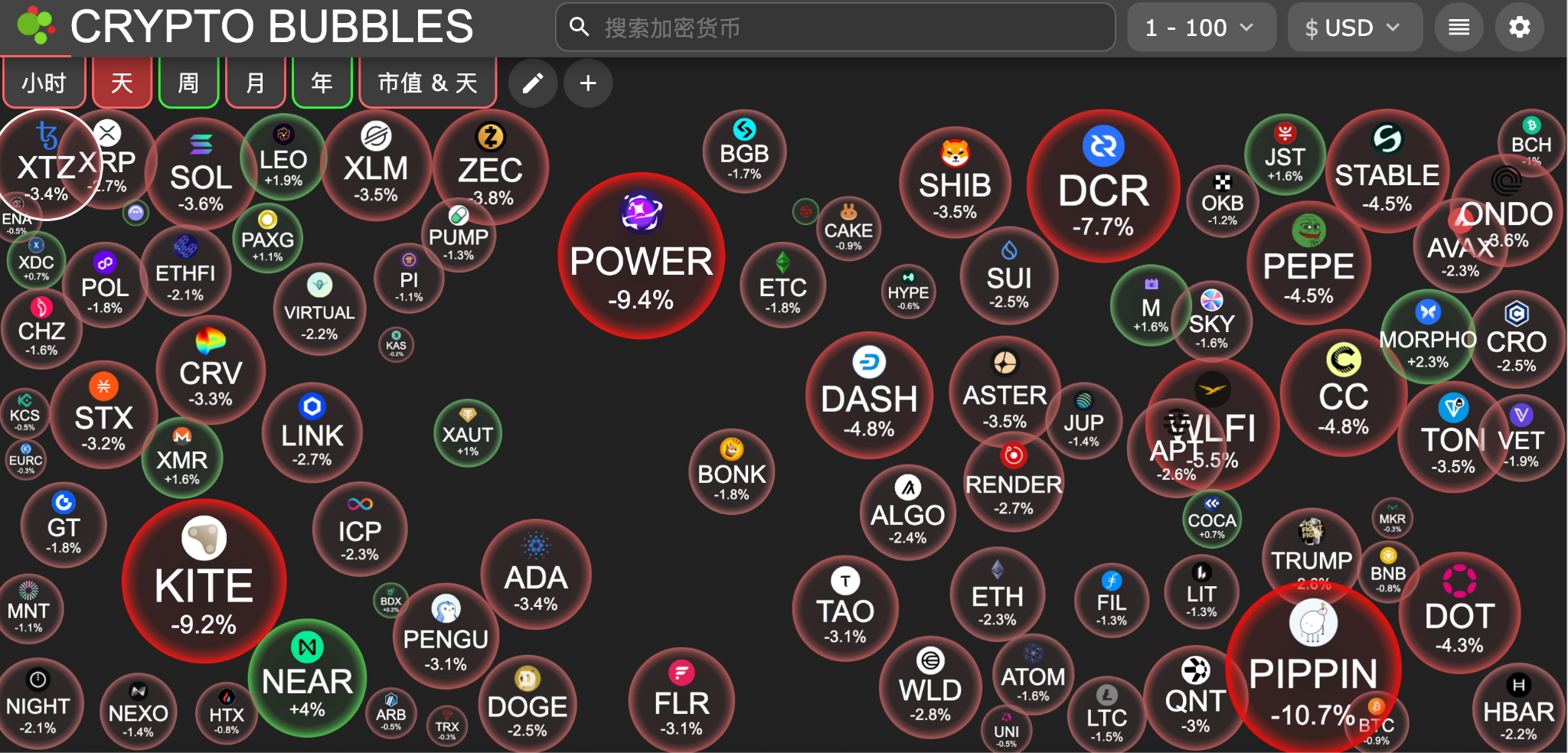
The largest declines among the top 100 cryptocurrencies today: Power Protocol down 9.4%, Decred down 7.7%, Stable down 10.7%, Internet Computer down 9.2%, MemeCore down 5.5%.
Hot News
Data: Tokens like RED, HYPE, ENA will see large unlocks, with RED unlocking worth about $6.2 million
Trump reveals that Iranian insiders have actively made contact
Arthur Hayes releases a bullish signal for HYPE, stating the target price could reach $150
Strait of Hormuz oil tanker transport has come to a standstill
免责声明:本文章仅代表作者个人观点,不代表本平台的立场和观点。本文章仅供信息分享,不构成对任何人的任何投资建议。用户与作者之间的任何争议,与本平台无关。如网页中刊载的文章或图片涉及侵权,请提供相关的权利证明和身份证明发送邮件到support@aicoin.com,本平台相关工作人员将会进行核查。


