Have you ever thought about becoming a shareholder of SpaceX before landing on the moon, or of ByteDance before it goes public?
In the context of traditional finance, this kind of opportunity is known as "Pre-IPO" private equity investment, usually occurring in the last mile before unicorns like SpaceX and ByteDance officially go public. At this point, the business model is extremely mature, the risks are far less than those of early-stage venture capital, yet the return on investment after the company goes public remains astonishing—at least doubling, and potentially increasing several times or even tens of times.
However, for a long time, this juicy cake has been monopolized by private equity (PE) and venture capital (VC), with ordinary retail investors kept outside high, closed walls, waiting to buy into the secondary market after companies officially list. Ultimately, the "Pre-IPO" opportunity has long not belonged to the majority.
Today, Maitong MSX has decided to overcome this high wall through a combination of tokenization and a Wall Street compliant platform.
1. The trillion-dollar cake behind the wall: visible, but untouchable
According to data, the size of the "Pre-IPO" market has long exceeded expectations.
The "2025 Global Unicorn Enterprises 500 Report" shows that the total valuation of the 500 global unicorns will reach 39.14 trillion yuan in 2025, a 30.71% year-on-year increase, far exceeding the GDP of Germany, the world's third-largest economy. The average valuation has also risen from 59.883 billion yuan to 78.276 billion yuan, also a 30.71% increase year-on-year.
Yann Robard, managing partner at Dawson, noted in "Why Private Equity Wins: Reflecting on a Quarter-Century of Outperformance" that over the past 25 years, the value generated by the private market is about three times that of the stock market during the same period. In other words, the stage that truly creates excess returns often occurs before the public listing.
Taking the current world's number one unicorn, SpaceX, as an example, Maitong MSX's exclusive research found that its primary market valuation in 2024 is only $180 billion, then steeply climbing, and by early 2026, after completing the share exchange integration with xAI, its private valuation has reached $1.25 trillion, increasing 6 times in just 2 years.
Further, the private equity transfer price for SpaceX has also soared from about $56 per share in October 2021 to about $527 per share in February 2026, nearly a 9-fold increase over 4 years.
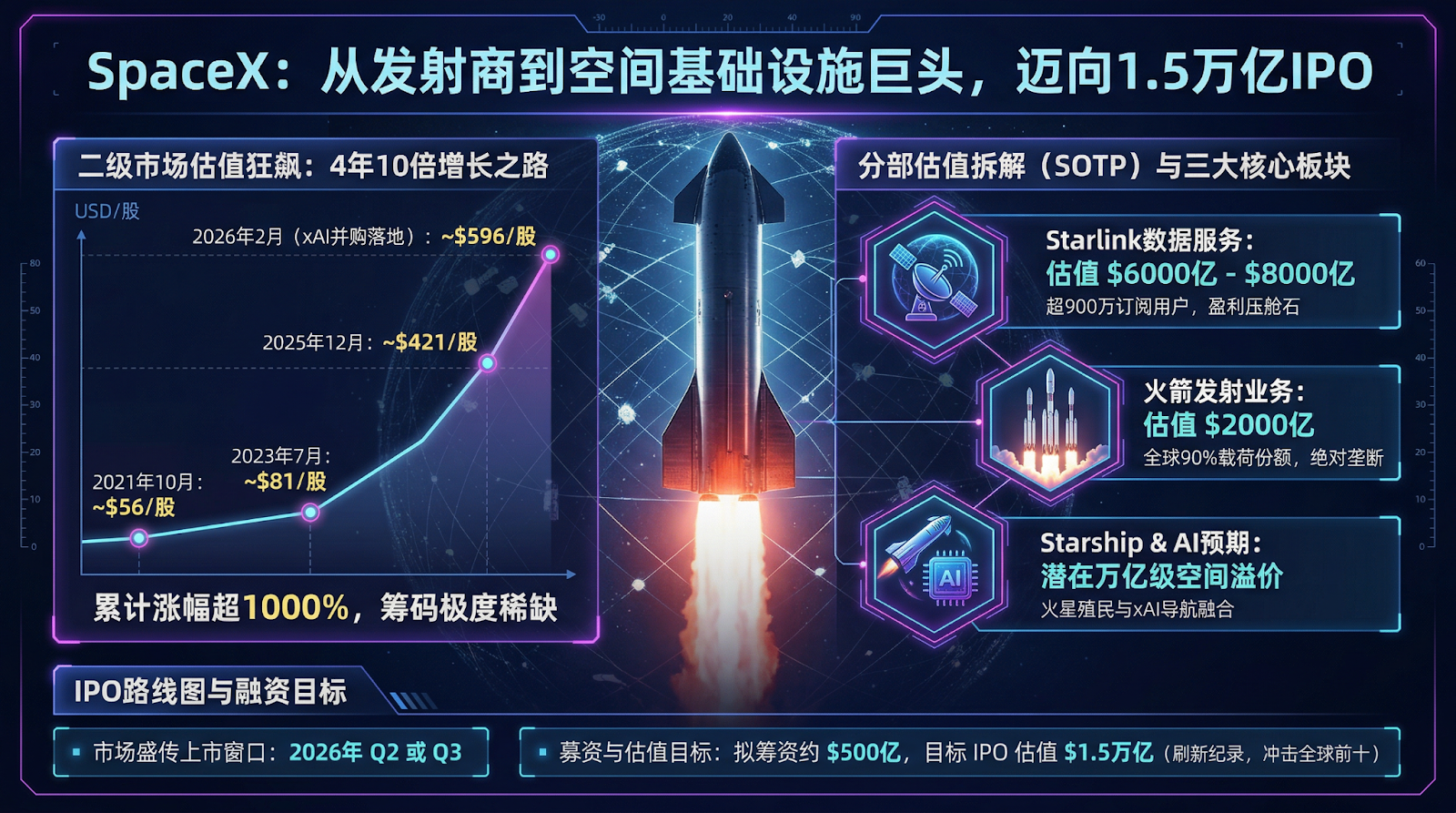
It can be said that the equity of privately held unicorn companies has always been a super Alpha in global asset allocation. Everyone knows it; it's just that the entry barriers in this trillion-scale, rapidly growing valuation sector are very high:
- Financial threshold often starts at "one million": entry fees often amounting to tens to hundreds of thousands or even millions of dollars directly deter 99.9% of individual investors;
- Liquidity's "opportunity cost": once invested, funds are often locked for a long time, sometimes 5-10 years, making it difficult to liquidate;
- Extreme inequity in allocation: hot items like OpenAI, SpaceX, and ByteDance always circulate within the small circle of top PE and VC funds.
In other words, this is a trillion-dollar market with potential high returns, yet it has long only been open to institutional investors and ultra-high net worth individuals.
This is also why, when Internet brokerage giant Robinhood offered European users the chance to trade "stock tokens" of OpenAI and SpaceX in June 2025, the market paid high attention, considering it as the first large-scale trial of traditional internet brokers on the tokenization of private assets.
Because it released an important signal: using RWA tokenization to dismantle the wall of the primary market, mapping real equity onto on-chain, splittable tokens, the limitations of entry barriers, liquidity restrictions, and exit efficiency could all be redefined.
2. Partnering with Republic, how does MSX break down the "Pre-IPO" high wall?
Today, Maitong MSX has established a strategic partnership with the compliant asset tokenization platform Republic in the U.S., and will soon launch a Pre-IPO section to provide private equity tokenization services for qualified platform users of top unicorns like SpaceX and ByteDance, with an initial quota exceeding $10 million, covering more than 10 global top unicorns. The specific target list and details of the released quota will be announced at the official launch.
However, when it comes to the equity going on-chain for "Pre-IPO," your first reaction may be to ask: Is it safe? Is it legal? Is it just a "virtual mapping"?
Here, it is necessary to supplement the background of Republic's project. Operating under the supervision of the U.S. Securities and Exchange Commission (SEC), Republic has long provided private equity financing channels for global investors, aiming to help personal and institutional investors participate in the private market and alternative assets typically only open to a few professional investors. Its private assets are held through regulated third-party custodians (like licensed institutions such as BitGo Trust Company).
It is worth mentioning that Republic is also the core service provider behind Robinhood's launch of the unlisted unicorn stock token project in Europe.
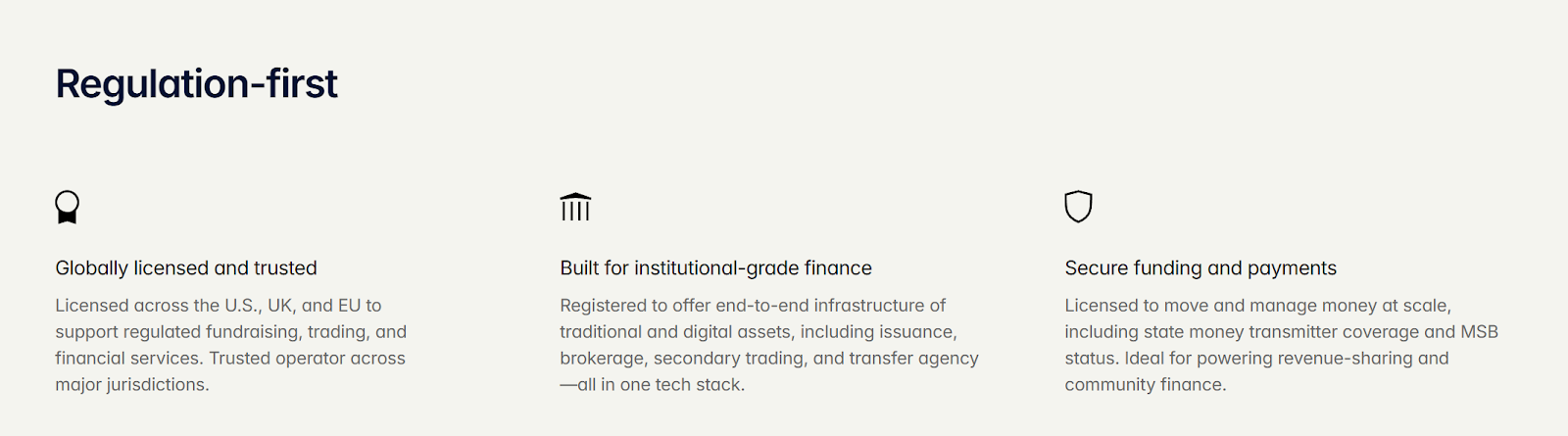
Source: Republic
This means that MSX's Pre-IPO section is conducting structural innovation on a mature compliance framework, allowing users to enjoy services on par with top global brokerages: All unicorn equity assets are connected through the same compliance channels as Robinhood, with the real existence of the underlying shares behind the mapped tokens, held by regulated third parties, providing a legal and asset-supported foundation.
Ultimately, when tokenization technology meets a compliant private platform under SEC regulation, the equity of unlisted giants will no longer be the monopoly of top venture capital.
3. What does it mean for ordinary users?
The launch of the Pre-IPO product will bring three-dimensional structural changes for ordinary users.
First, it is the "equalization" of entry barriers, bidding farewell to entry tickets often amounting to one million dollars.
As mentioned above, the starting price of traditional private equity markets is usually hundreds of thousands to millions of dollars, while tokenization can fragment the once unattainable unicorn shares, allowing qualified ordinary users on the Maitong MSX platform to participate at a very low threshold, sitting at the same table with top venture capital to equally share the growth premium of SpaceX or ByteDance in secondary markets.
Second, it is the "source-based" advantage of valuation, avoiding the emotional tax of the secondary market.
It is well known that the explosive growth on the first day or in the early stages of an IPO is often accompanied by huge emotional bubbles, and when ordinary retail investors enter, they are usually at high price points. Participating in the Pre-IPO stage means capturing the most real valuation range. In simple terms, ordinary users can finally set up positions in the undervalued stage before a company goes public, rather than acting as the buyers after the listing frenzy.
Finally, it is the "reconstruction" of the liquidity structure, breaking the imagination space of multi-year lock-ups.
The most frustrating aspect of traditional private equity investment is the 5-10 year exit lock-up period. To address this pain point, Maitong MSX plans to be the first to launch quality Pre-IPO targets with short-term redemption mechanisms, and will continue to explore more technical paths to enhance asset liquidity in the future, likely reconstructing the exit logic of the primary market.
In conclusion
The launch of the "Pre-IPO" section also marks that Maitong MSX's tokenization landscape for U.S. stocks has deepened and expanded from "secondary market asset trading" to "primary market share distribution."
In the trend of global asset tokenization, Pre-IPO tokenization has become a widely discussed focus for the next phase of the industry. As one of the earliest trading platforms deeply engaged in U.S. stock tokenization, from breaking down barriers to U.S. stock trading to dismantling the walls of private equity, MSX has always been committed to one thing:
Allowing ordinary people to have the opportunity to share in the growth dividends of the most scarce quality assets of this era.
Just as five years ago, ordinary people could not imagine they could instantly trade U.S. stocks through on-chain wallets; before today, you might also find it hard to imagine that you could become a shareholder of SpaceX or ByteDance with a very low threshold.
免责声明:本文章仅代表作者个人观点,不代表本平台的立场和观点。本文章仅供信息分享,不构成对任何人的任何投资建议。用户与作者之间的任何争议,与本平台无关。如网页中刊载的文章或图片涉及侵权,请提供相关的权利证明和身份证明发送邮件到support@aicoin.com,本平台相关工作人员将会进行核查。


