Original|Odaily Planet Daily(@OdailyChina)
Author|Wenser(@wenser 2010)
Recently, after the release of the Q4 2025 financial report, the stock price of Circle (CRCL), known as the "first stock of stablecoins", has experienced a much-anticipated strong rebound, rising over 45% in two days, and today it once touched $90, a new high since last November. In the declining cryptocurrency concept stock market, Circle (CRCL) is momentarily the focus, with various institutions and analysts starting to rally behind it, with many traders even declaring "the price of Circle still has tenfold room for growth".
Behind the enthusiasm, the market is perhaps more concerned about the underlying reasons for this price rebound, as this directly determines whether the rise in Circle (CRCL) stock price can continue. Odaily Planet Daily will briefly analyze this issue from the perspectives of Circle's business performance, institutional views, AI "ticket", and the prediction market, attempting to clarify where Circle's next growth point will originate from.
Transformation of Circle's Business Fundamentals: From Stablecoins to Internet Financial Infrastructure
When mentioning Circle, many may still have the stereotype of it being “the perennial number two in the stablecoin sector,” but in terms of performance and data growth in 2025, Circle’s stablecoin USDC is rapidly catching up with Tether's stablecoin USDT.
Circle's Recent Achievements: USDC's Trading Volume Reaches $18.3 Trillion in 2025, Ranking First in the Industry
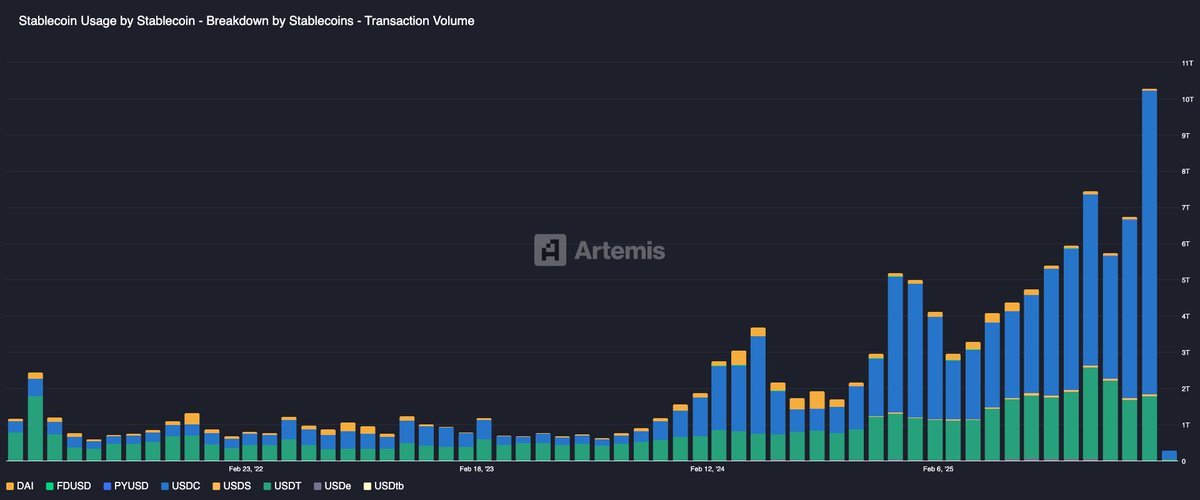
According to data from Artemis, the global trading volume of stablecoins surged 72% year-on-year in 2025, reaching a record $33 trillion; among them, Circle's USDC trading volume reached $18.3 trillion, ranking first; in contrast, Tether's USDT trading volume was only $13.3 trillion.
As we enter 2026, the trading volume of USDC is still growing exceptionally fast: at the beginning of February, Circle's CEO Jeremy Allaire stated that according to Artemis data, the on-chain transaction count for USDC in January exceeded 8.4 trillion, while the total on-chain transaction count for the stablecoin market was 10 trillion, meaning that USDC accounted for 84% of the overall market share in terms of on-chain transaction count. In other words, unnoticed, the trading activity of USDC has been quietly climbing. Additionally, the issuance of USDC has also been increasing rapidly, with a reported increase of about 2.6 billion coins in the week leading up to February 12.
In comparison, the market cap of USDT, the “leader in stablecoins,” declined 0.8% to $18.361 billion in February, continuing a decline of about 1% from January, marking the first time since the Terra incident in 2022 that it has contracted for two consecutive months.
Finally, a closer look at its 2025 fiscal performance report shows that by the end of 2025, the circulation of USDC was $75.3 billion, a year-on-year increase of 72%; the on-chain trading volume for Q4 2025 was $11.9 trillion, up 247% year-on-year, with total revenue reaching approximately $770 million, a staggering 77% increase compared to the same period last year; total revenue and reserve income for the 2025 fiscal year reached $2.7 billion, a year-on-year increase of 64%. Although net losses from ongoing operations reached $70 million, mainly influenced by equity incentive expenses related to an IPO that reached $424 million, Circle still expects the circulation of USDC to maintain an annual growth rate of about 40% in the future and estimates that revenues from business other than reserve income will reach about $170 million in 2026, up from around $110 million in 2025.
My personal speculation is that the growth in circulation and transaction counts for USDC may be jointly driven by the demand for crypto payments like AI Agents, the soaring trading volume in prediction markets, and the institutional business needs following the passage of the GENIUS Act. We will elaborate on this later.
Overview of Institutional Views: Some Buy the Dip, Others Remain Optimistic About Circle Outpacing the Market
Currently, there is a clear divergence in the market regarding the future performance of Circle's stock price: some investment institutions are continuously buying the dip; others are optimistic about its business model upgrade, transitioning from a stablecoin to a financial technology infrastructure; but there are also research institutions that believe this stock price rebound is mainly driven by a short squeeze, lacking sustainability.
Bernstein: Circle's Stock Price Aiming for $190, Maintains Outperform Rating
Bernstein pointed out that Circle is no longer seen simply as a "proxy investment target" for crypto assets, but has transformed into a provider of financial technology infrastructure services, indicating a profound shift in the company's business positioning. The firm’s analyst team believes that Circle will play a key role in this "fundamental transformation of the global economic system" and reaffirmed its "outperform" rating with a target price of $190 in its latest research report, suggesting there is still significant room for the stock price to rise.
Furthermore, Bernstein analysts such as Gautum Chhugani noted in the report that Circle's fourth-quarter performance clearly diverged from the overall trends in the crypto market, emphasizing that the company is evolving towards being a core internet infrastructure provider, not just focusing on stablecoins or crypto token business.
Ark Invest: Speaking with Real Money, Circle (CRCL) Stock Holding Total Value of Nearly $350 Million
Unlike research institutions, well-known Silicon Valley investor Cathie Wood's Ark Invest has always been a "major buyer" of Circle.
In early February,trading documents showed that Ark Invest bought about $9.4 million of Circle stock through its two ETFs;
On February 12, Ark Invest increased its holdings by 75,559 shares of Circle (CRCL), worth about $4.4 million.
According to public information compilation, as of the time of writing, Ark Invest holds approximately 4,015,642 shares of Circle (CRCL) across its three funds: ARKK (ARK Innovation ETF), ARKF (ARK Fintech Innovation ETF), and ARKW (ARK Next Generation Internet ETF), totaling about $349 million (based on $87).
Vanguard Group: Circle (CRCL) Holdings Exceed 5.65 Million Shares, Once Paper Loss Over $400 Million
On February 14, the latest 13F documents submitted by the global second-largest fund management company Vanguard Group to the SEC showed that it currently holds 5,653,110 shares of Circle stock CRCL (now worth $339.4 million), with a cost basis of $739.6 million, currently with a paper loss exceeding $400 million.
As the stock price of Circle (CRCL) rebounds to around $87 (at the time of writing), this nearly $740 million investment is now showing a paper gain of over $152 million.
10x Research: Circle Experiences Surge Due to Short Squeeze
Yesterday, crypto research firm 10x Research stated that the core driver behind the recent rise in Circle's stock price is not the financial report data itself, but rather the market's position structure, which is more likely to lead to a high probability of a short covering rally, rather than a simple fundamental re-evaluation. It is reported that some hedge funds established large short positions before the financial report was released; however, as Circle's stock price soared in a single day, a severe short squeeze occurred, causing hedge funds to incur about $500 million in losses in one day. 10x Research added that this round of volatility not only affected Circle (CRCL) but also affected Coinbase (COIN) and Bitcoin, stating that although Circle is clearly a bullish target, the overall magnitude of the market is primarily driven by an imbalance in the overall positioning structure of the crypto market, and new market catalysts may soon emerge that could reshape the market narrative, after which market trading logic may revert to fundamentals. In other words, 10x Research does not have a positive outlook on Circle's (CRCL) future performance.
In summary, Circle is at a critical juncture in transforming from the past concept of "the first stablecoin stock" to "financial technology infrastructure" narrative, with the business performance of its stablecoin USDC being worth looking forward to, and other new revenue streams (non-interest income) have also proven their ability to generate profits to the market with a high gross profit of up to $37 million in Q4.
Whether Circle (CRCL) can continue its current strong rise may be closely related to three key terms—"AI Payments," "Prediction Markets," and "Institutional Adoption".
USDC's "Growth Boosters": AI Payments, Prediction Market Trading, Institutional Mass Adoption
In Circle’s financial reports and CEO Jeremy Allaire’s public statements, we can clearly see that Circle's revenue channels are expanding rapidly, rather than relying heavily on the issuance business of the USDC stablecoin as before.
Previously, Circle announced that the Circle Payments Network (CPN) had registered 55 financial institutions, with another 74 institutions undergoing qualification review; the public test network of the L1 blockchain network Arc has been launched, attracting over 100 participants; USDC's unique adoption rate and integration advantages also give Circle the "automated payment" capabilities geared towards AI Agents. This may become its ticket to the next era of interconnected finance.
Circle's "AI Ticket": x402 Protocol, AI Agent Economy, and A2A Transactions
Circle's first ticket comes from AI payments. The x402 standard, led by Coinbase, became a market hotspot upon its launch in 2025; this protocol allows AI Agents to directly pay for services using USDC through the HTTP 402 status code, such as API data access, computing resources, or content subscriptions, effectively "solving the last mile of payments" for AI Agents. As a result, USDC can seamlessly integrate into the AI Agent economic system, and various trading methods proposed by numerous AI model companies, such as A2A (Agent to Agent) and M2M (Machine to Machine), will also be circulated using USDC.
Previously, analysts predicted that by 2030, the AI Agent economic ecosystem could exceed $30 trillion, with Agentic AI dominating 15% of daily financial decisions; in this regard, USDC has a competitive first-mover advantage.
Circle's "Prediction Market Ticket": Prediction Market Trading Volume Continues to Reach New Highs, Weekly Transaction Count Exceeds 38 Million
Another main driver of the growth in USDC and Circle's business data may be attributed to the continuously rising prediction market sector.
According to Dune data, on February 23, the transaction count on the prediction market last week (February 16-22) hit a historical high of 38.01 million, with Polymarket comprising 22.58 million transactions, ranking first; Kalshi's transactions counted 14.86 million, in second place.
Furthermore, Circle is also actively collaborating with platform-level giants in the prediction market—at the beginning of February, Circle announced a partnership with Polymarket to optimize the stablecoin infrastructure for prediction markets, with Circle introducing a transparent, fully-backed stablecoin infrastructure to enhance settlement reliability and reduce friction to support the next phase of development in on-chain financial markets.
Based on the backdrop of a "prediction year" with prominent sports events like the Winter Olympics and the World Cup, USDC's trading volume and custody income are expected to see further growth.
Circle's "Institutional Adoption Ticket": Legislation, Trust Banks, and Cooperative Ecosystem
For institutional users, Circle and USDC may currently be the only "relatively optimal solution." The main reasons are:
First, the GENIUS Act legislative framework will drive a large inflow of digital dollar reserves into the US Treasury bond market, further boosting the issuance and circulation of USDC;
Second, Circle was approved to establish a national trust bank (First National Digital Currency Bank) in December 2025, expediting its integration into the traditional financial system;
Third, Circle's partners encompass traditional payment institutions (like Visa), financial software companies (like Intuit), leading platforms in the prediction market (like Polymarket), blockchain payment settlement networks (like Morph Network), and cryptocurrency exchanges (like Kraken, OKX, Bybit, Hyperliquid), gradually building its own "ecological moat."
Conclusion: Circle's Stock Price Concerns Amid Coinbase Profit Sharing and U.S. Banking Pressure
In conclusion, Circle's (CRCL) stock price performance may witness a strong rebound, but influenced by factors such as the overall cryptocurrency market conditions and the pending CLARTITY Act, its future performance still carries certain uncertainties.
Specifically, firstly, every year, nearly $1 billion in stablecoin "promotion profits" are distributed among Coinbase. According to BI analysts Paul Gulberg and Samuel Radowitz assess, if payment adoption accelerates under the GENIUS Act framework signed by President Trump in July 2025, Coinbase's stablecoin revenues are expected to grow two to seven times. For a cryptocurrency exchange whose stock is also under pressure, this is undoubtedly a significant piece of the pie.
Secondly, as the "compliant stablecoin first stock", Circle is destined to face collective suppression from the banking industry in the U.S. Although its trust bank application has been approved, as noted in a report by Standard Chartered's analysts stating, stablecoins pose a real risk to bank deposits globally and in the U.S., and bank deposits will decrease with the growth of stablecoin market capitalization, with this decrease proportionate to the stablecoin's market value. Regional banks in the U.S. are expected to be the most impacted, while investment banks the least affected. The report showed that only 14.5% of Circle's reserve assets are bank deposits, representing a very low re-deposit rate. Similarly, traditional banks driven by interests are unlikely to remain indifferent to this.
As for whether Circle (CRCL)’s stock price can once again achieve the "tenfold miracle" mentioned at the beginning of this article, it may require more "regional convenience policies" provided by the U.S. government and regulatory authorities in addition to the "stablecoin boom" of last year.
免责声明:本文章仅代表作者个人观点,不代表本平台的立场和观点。本文章仅供信息分享,不构成对任何人的任何投资建议。用户与作者之间的任何争议,与本平台无关。如网页中刊载的文章或图片涉及侵权,请提供相关的权利证明和身份证明发送邮件到support@aicoin.com,本平台相关工作人员将会进行核查。


