Written by: ChandlerZ, Foresight News
On February 24, the cryptocurrency market continued its weak trend this month. Bitcoin chose to decline after oscillating for several days in the range of $65,000 to $72,000, dropping below $63,000, currently reported at $62,963. The price of ETH fell from around $2,100 to near $1,810. The altcoin market experienced widespread declines. Since briefly dropping below $60,000 on February 6 and rebounding, Bitcoin has still shown weakness. If the month continues on a downward trajectory, it will mark the longest monthly decline since the historical high of $125,000 in October 2025.
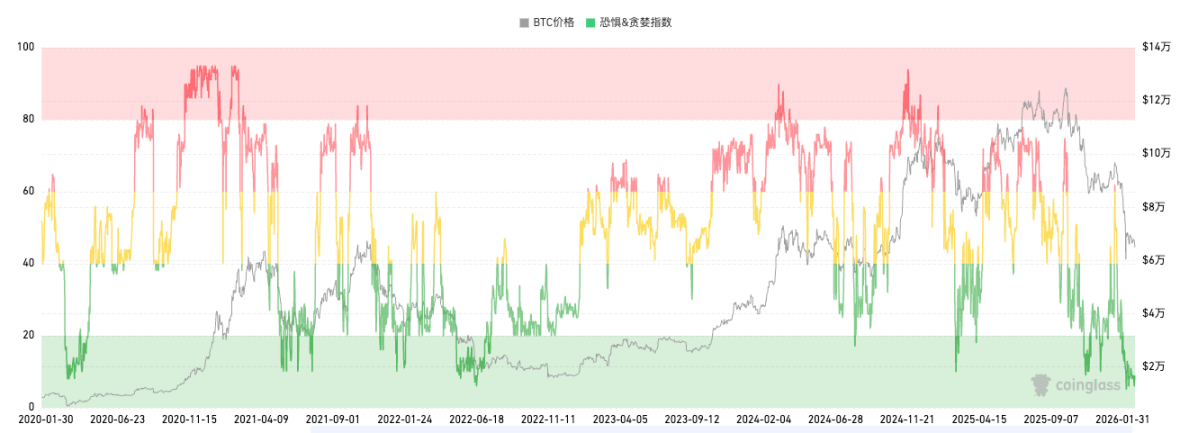
According to Coinglass data, the total liquidation amount in the cryptocurrency market in the past 24 hours reached $327 million, with long positions liquidated totaling $234 million. The fear index is currently reported at 9, falling within the "extreme fear" range. Historical data also indicates that the current fear index has been hovering below the historical low of 10 for several days.
In the global financial market, Citrini Research recently released a report analyzing the potential risks that artificial intelligence (AI) may bring to various sectors of the global economy. The market's anxiety is accelerating due to AI disruption risks, coupled with geopolitical turmoil and new tariff battles. On Monday, the S&P 500 index closed down 71.76 points, a drop of 1.04%, closing at 6837.75 points; the Dow Jones Industrial Average closed down 821.91 points, a drop of 1.66%, closing at 48804.06 points; the Nasdaq Composite Index closed down 258.796 points, a drop of 1.13%, closing at 22627.273 points.
The precious metals market continues to be the preferred choice for safe-haven funds. New York silver increased by 7.5% to $89.22 per ounce; spot silver increased by 5.0% to $88.52 per ounce; spot gold increased by 2.5% to $5227.85 per ounce.
Significant Net Outflow from BTC and ETH Spot ETFs
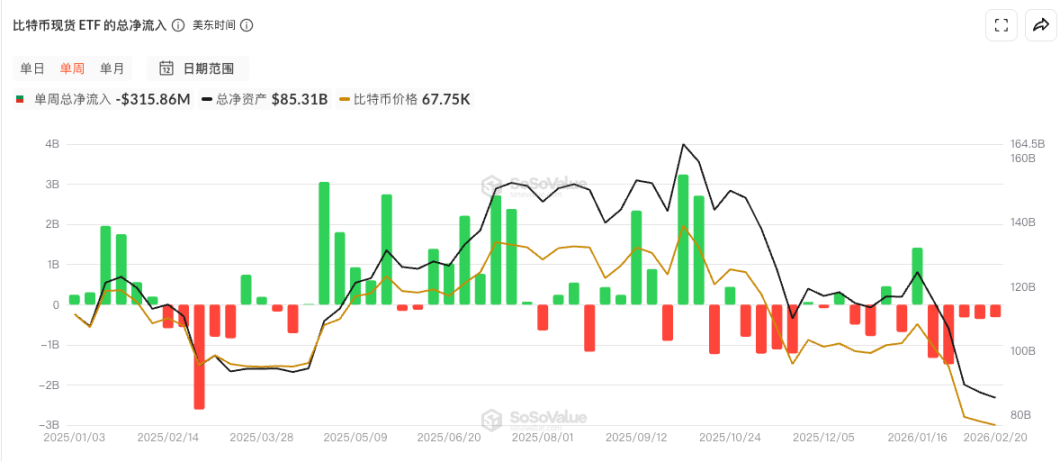
Data from SoSoValue shows that Bitcoin spot ETFs experienced a net outflow of $316 million last week. The Bitcoin spot ETF with the highest net outflow was the Blackrock ETF IBIT, with a weekly net outflow of $303 million, and the historical total net inflow for IBIT currently stands at $61.30 billion. Following that is the Fidelity ETF FBTC, with a weekly net outflow of $19.595 million, and the historical total net inflow for FBTC currently stands at $10.96 billion.
The Bitcoin spot ETF with the highest net inflow last week was the Grayscale Bitcoin Trust BTC, with a weekly net inflow of $35.9735 million, and the historical total net inflow for BTC currently stands at $2.09 billion.
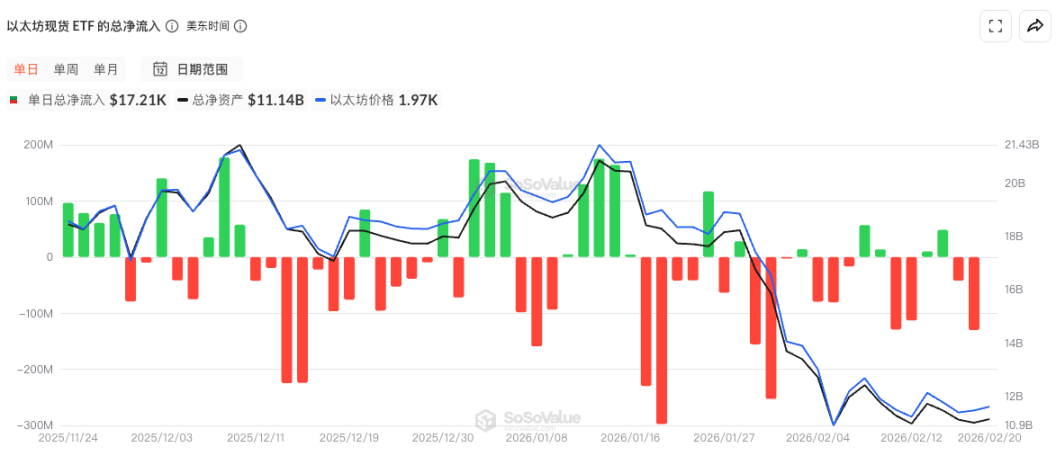
The Ethereum spot ETF experienced a net outflow of $123 million last week, marking five consecutive weeks of net outflows.
Tensions in Iran and New Tariff Battles Continue
On the macro level, the international outlook is not optimistic. According to a report from The New York Times on the 22nd, Trump has told his advisors that he "prefers to carry out a preliminary strike (against Iran) in the coming days" and then launch a larger military strike in the coming months to force Iran to "submit" and reach an agreement according to US demands.
The report cites well-informed sources within the Trump administration, saying that although no final decision has been made, Trump leans toward a preliminary strike on Iran in the coming days to show Iranian leaders that they must agree to relinquish their ability to produce nuclear weapons. The targets under consideration by Trump are broad, including the headquarters of the Iranian Islamic Revolutionary Guard, Iran's nuclear facilities, and ballistic missiles.
If the "targeted" preliminary strike does not force Iran to meet US demands, Trump "reserves the possibility of a (larger scale) military strike later this year" to overthrow Iranian Supreme Leader Khamenei.
Given the escalating tensions with Iran, the US State Department has ordered "non-essential" American diplomats and their families to leave Lebanon.
Additionally, on February 20, the US Supreme Court voted 6 to 3 that the massive tariffs imposed by Trump under the International Emergency Economic Powers Act (IEEPA) are unconstitutional, with the core legal premise being that the power to tax belongs to Congress and that the IEEPA does not authorize the president to bypass Congress to impose tariffs.
On the same day the ruling was announced, Trump publicly condemned two Supreme Court justices he appointed who voted against him as "a disgrace to the country" at a White House press conference and announced that he was prepared. That day, he signed an executive order invoking Section 122 of the Trade Act of 1974 to impose a 10% tariff on all imported goods for a period of 150 days. The next day, he claimed that he would raise the rate to 15%. Were the trade agreements previously reached with the US still valid? Trump's response at the press conference was extremely vague, stating, "Some agreements are still effective, while others will be replaced by new tariffs," but he refused to specify which ones belong to which category.
This ruling has triggered a massive tax refund issue. Economists from the University of Pennsylvania estimate that more than $175 billion in tariff revenue faces refund risks. The Congressional Budget Office previously estimated that all of Trump's tariffs would generate about $300 billion in revenue annually over the next decade. If the $175 billion were fully refunded, it would account for more than half of the total tariff revenue.
On Monday, Trump also warned that any countries trying to exploit the Supreme Court ruling will face higher tariffs and harsher consequences. Due to the uncertainty surrounding US trade policy, market risk aversion has intensified, causing US Treasury prices to rebound and gold to rise for four consecutive days.
Subsequent Market Trends
The cryptocurrency market analysis platform Santiment reported on social media that Bitcoin plummeted by 4.5% to $64,200 in just two hours, marking a new low since February 5. Many long positions were liquidated, and the open contract volume for Bitcoin fell to $19.5 billion, close to half of its peak of $38.3 billion in 2026.
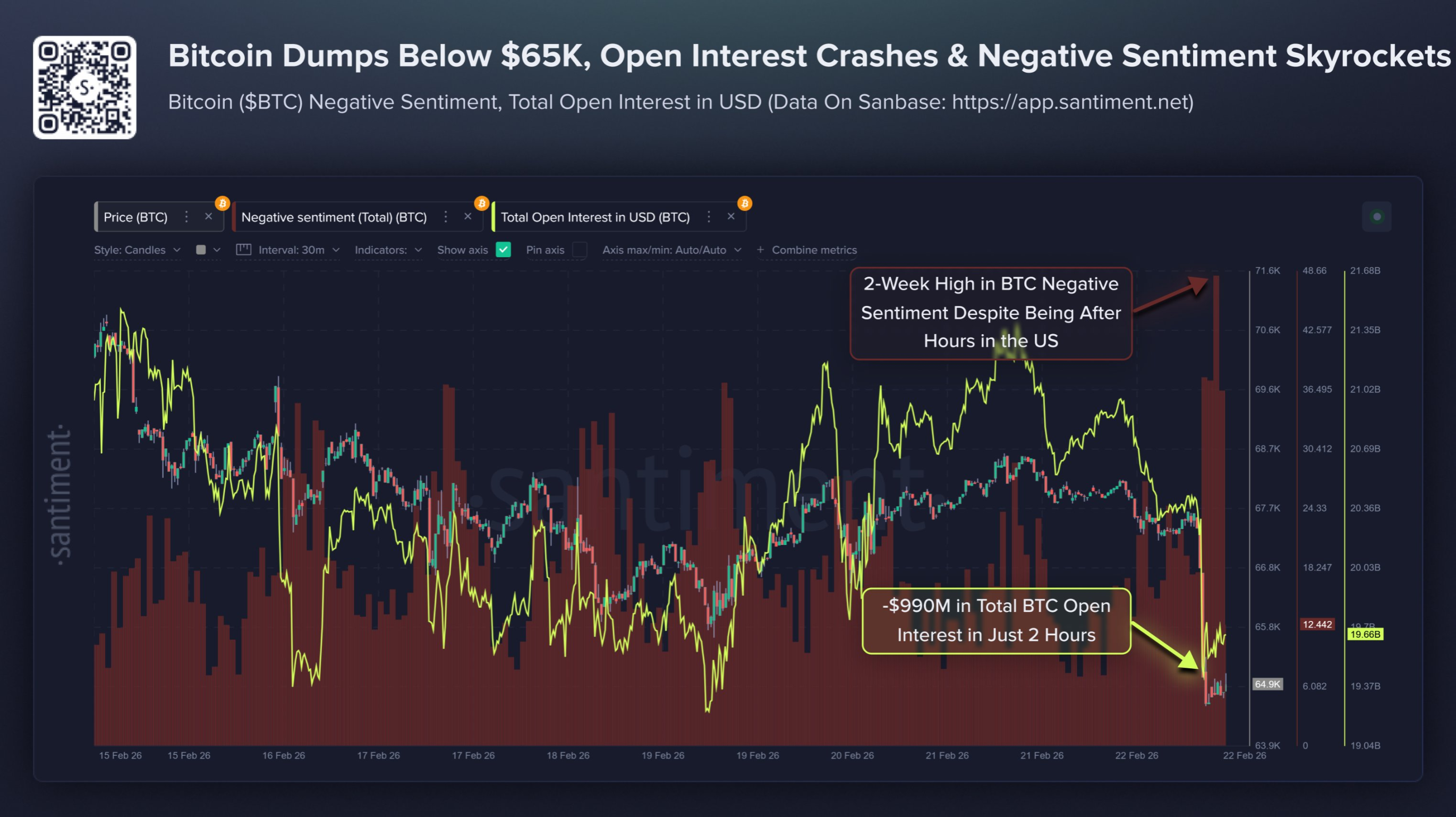
Santiment stated that despite this correction occurring on Sunday evening in the US (when social media activity is typically low), market negative sentiment surged to the highest point in two weeks. With the breach of the $65,000 support level, retail investors quickly fell into panic, and historically, this emotion often helps drive prices to rebound rapidly.
Glassnode analyzed that the recent condition of spot, derivatives, ETFs, and on-chain indicators still leans toward a defensive position. Selling pressure has slightly eased, momentum has improved, but participation and capital flow remain weak, and the market is susceptible to volatility. A more sustained recovery may require a restoration of spot demand and a significant increase in on-chain participation.
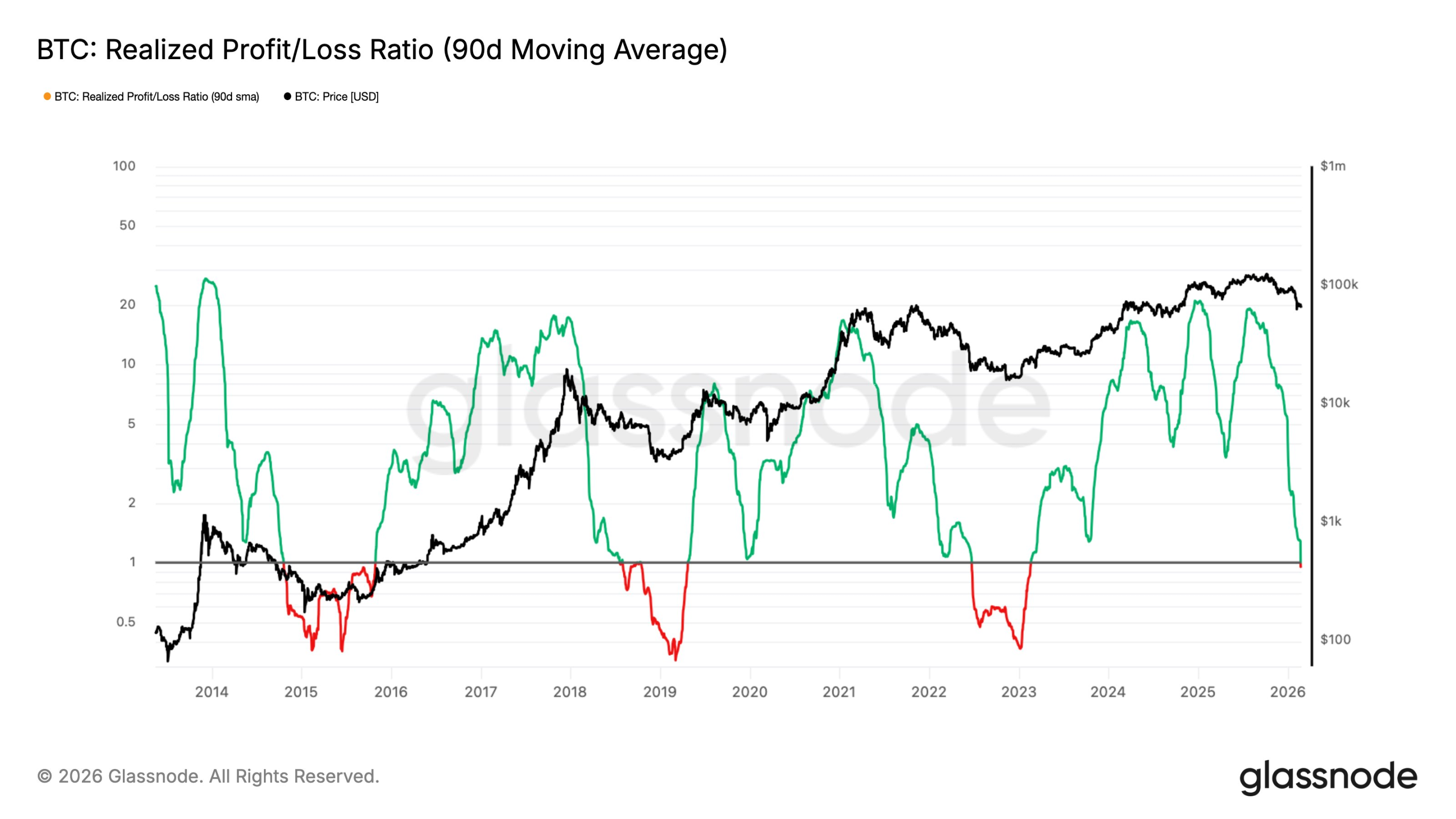
At the same time, Bitcoin's realized profit and loss ratio (90-day moving average) has now dropped below 1, indicating that the market has fully entered a stage of excessive realized losses. Historically, when this indicator falls below 1, it usually takes more than 6 months to return above 1. This suggests that liquidity will gradually recover.
免责声明:本文章仅代表作者个人观点,不代表本平台的立场和观点。本文章仅供信息分享,不构成对任何人的任何投资建议。用户与作者之间的任何争议,与本平台无关。如网页中刊载的文章或图片涉及侵权,请提供相关的权利证明和身份证明发送邮件到support@aicoin.com,本平台相关工作人员将会进行核查。


