In February 2026, when the price of Bitcoin hovered around $65,000 amid the controversy of a "crypto winter" in market sentiment, Michael Saylor once again declared his faith to the market with action. On February 22, Strategy, led by Saylor, announced the completion of its 100th Bitcoin purchase since August 2020.
This is not just a numerical game. Behind this seemingly ordinary "buy buy buy" is Strategy's staggering $7 billion unrealized loss, the lurking eyes of shorts, and the company's almost obsessive insistence on its "Bitcoin treasury" strategy.

1. The 100th Move in the "Orange Century"
● Just this past weekend, a document submitted by Strategy to the U.S. Securities and Exchange Commission unveiled a low-profile but milestone transaction. Between February 17 and 22, the company sold nearly 300,000 shares of Class A common stock through its "at-the-market" issuance program, cashing in about $39.7 million, and then immediately purchased 592 Bitcoin for approximately $39.8 million.
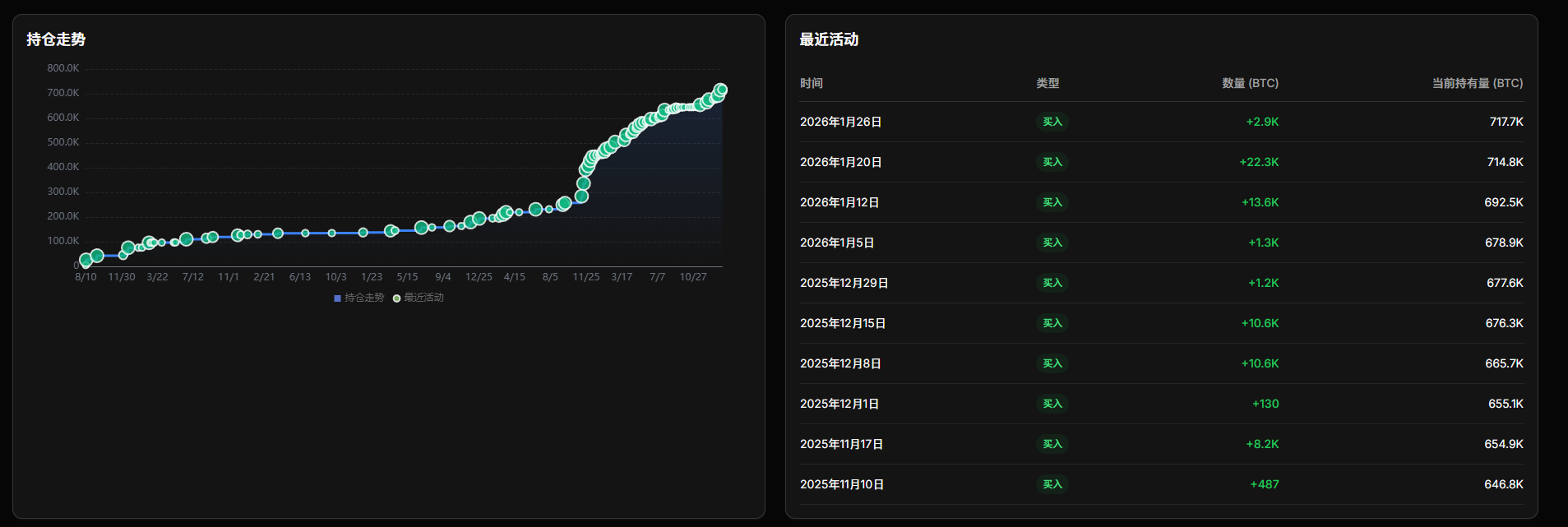
● This indeed reflects the precise operation of a "ruthless buying machine." The average cost of this purchase was about $67,286 per coin. Although the amount of this transaction is less than the hundreds of millions of dollars from previous purchases, the special significance of this 100th time prompted the usually high-profile Saylor to "show off" on the X platform. He released a chart recording the company's past Bitcoin purchases, accompanied by the meaningful two words: "Orange Century".
● The addition of these 592 Bitcoins brought Strategy's total holdings to an astonishing 717,722 coins. Based on the current market price, this batch of Bitcoin has a total value of about $47.5 billion, accounting for a significant proportion of the total Bitcoin circulation. For a publicly traded company, this represents not only a complete reconstruction of the balance sheet but also an unprecedented experiment binding the company's fate entirely to a single crypto asset.
2. "Faith Recharge" Amid $7 Billion Unrealized Loss
● However, in stark contrast to Saylor's enthusiasm, are the cold data reports. With this round of purchases, Strategy's cumulative purchase cost has climbed to approximately $54.56 billion, and the average holding cost has consequently been slightly diluted to $76,020.
● The problem is, as of the time of writing, the price of Bitcoin has not been able to stabilize above $70,000. The current trading price of Bitcoin hovers around $66,000, which means that Strategy's average holding price is nearly $10,000 higher than the market price. According to estimates, the company’s unrealized loss has approached $7 billion, with a loss margin exceeding 12%.
● In the traditional financial world, an investment experiencing such a scale of unrealized loss would probably have left management in a state of panic. But for Saylor, this is merely a rough patch on the road to the "digital treasury." In fact, this is already Strategy's 12th consecutive week of purchasing Bitcoin, even as the price has dipped below its cost line and the market commonly believes that a bear market is upon us, the company has not paused its steps.
● Earlier in an interview, Saylor boldly stated: "Even if the price of Bitcoin drops 90% in the next four years, we can resolve our debt issues through refinancing." This "perpetual bull" stance has left market observers both amazed by his boldness and concerned about potential liquidity risks.
3. Debt Games and Cash Flow "Safety Net"
Concerns from the outside regarding Strategy mainly focus on high leverage and debt repayment capability. After all, even the most steadfast faith requires real money to repay interest.
● From the perspective of capital structure, Strategy indeed walks a tightrope, but there is a safety net beneath the wire. According to public data, MSTR's total debt is about $8.2 billion, while the value of its held Bitcoin assets is approximately $48.7 billion, making the asset value nearly six times the debt. More critically, these Bitcoin assets are "clean"—not one has been used as collateral, hence posing no risk of forced liquidation due to price declines.
● To alleviate market concerns about liquidity depletion, Strategy's CEO Phong Le previously calculated that the company needs to pay about $888 million in dividends annually. To this end, the company reserved $2.25 billion in cash reserves in the fourth quarter of 2025. This means that even if the company ceases operations entirely, without any new revenue, this cash is sufficient to cover more than 30 months of dividends without selling a single Bitcoin.
● Additionally, the company still has about $37.4 billion in securities available for future market sales, providing ample backup for its subsequent "firepower." The next significant debt maturity date is in September 2027, giving Saylor enough time to wait for a bull market return.
4. The "Lonely Buyer" in a Bear Market and Market Role
● Interestingly, Strategy's continued buying has not managed to reverse the decline in stock price. MSTR stock, which is linked to the price of Bitcoin, has fallen about 64% over the past six months and currently hovers around $127. Shorts are also ramping up their attacks, with data showing that MSTR's short positions have increased by about 40% since last September.
● Yet in this sub-sector of publicly traded companies, Strategy remains the absolute leader. Data speaks volumes: in January of this year, Strategy alone accounted for 97.5% of the net Bitcoin purchases made by all publicly traded companies. While competitors collectively increased their holdings by only 3,080 Bitcoins, Strategy alone purchased 40,150 Bitcoins.
● This phenomenon has been interpreted by the market as a "leading solo dance." Amid the subdued Bitcoin prices and pessimistic market sentiment, most businesses have shied away from Bitcoin, while Strategy has leveraged funds raised through stock issuances and preferred shares (such as STRK) to almost single-handedly carry the flag for publicly traded companies increasing their Bitcoin holdings. Saylor is not only buying for himself but also plays the role of the "last buyer" for the entire industry.
5. The Gamble Has No Endgame
● With the dust settling on the 100th purchase, Saylor and his Strategy have been walking down this controversial path for almost six years. From the initial mockery by institutions to the later scramble to imitate, and now back to renewed skepticism, Strategy has maintained its composure as "they are strong, I am calm."
● The biggest challenge facing Strategy right now may not be its repayment capability, but the ability to continue growing in a bear market. Looking back at the previous bear market of 2022, Strategy only increased its holdings by about 10,000 Bitcoins throughout the year, and its stock price was below the value of its held Bitcoin assets for most of that year. Today, history seems to be repeating itself, but the script is different—this time, Strategy possesses a larger scale, more diversified financing tools (such as STRC preferred shares), and a more stubborn helmsman.
● At the upcoming "Strategy World" conference in Las Vegas, Saylor will continue to promote his "digital credit" philosophy. For this Bitcoin evangelist, as long as fiat currency continues to be issued and Bitcoin still has believers, his purchases will not stop.
The 100th time will not be the end. As Saylor said, "If it doesn't go to zero, then it will rise to a million."
Join our community to discuss and grow stronger together!
Official Telegram community: https://t.me/aicoincn
AiCoin Chinese Twitter: https://x.com/AiCoinzh
OKX Benefits Group: https://aicoin.com/link/chat?cid=l61eM4owQ
Binance Benefits Group: https://aicoin.com/link/chat?cid=ynr7d1P6Z
免责声明:本文章仅代表作者个人观点,不代表本平台的立场和观点。本文章仅供信息分享,不构成对任何人的任何投资建议。用户与作者之间的任何争议,与本平台无关。如网页中刊载的文章或图片涉及侵权,请提供相关的权利证明和身份证明发送邮件到support@aicoin.com,本平台相关工作人员将会进行核查。


