Kalshi (Prediction Market) and the Rise of the Macro Market — — Federal Reserve Commentary
I didn’t pay much attention when I saw the CFTC discussing prediction markets yesterday, after all, the CFTC is the superior authority of prediction markets, but when I suddenly saw the Federal Reserve's assessment of Kalshi and prediction markets while reviewing the meeting minutes in the early morning, I was very interested.
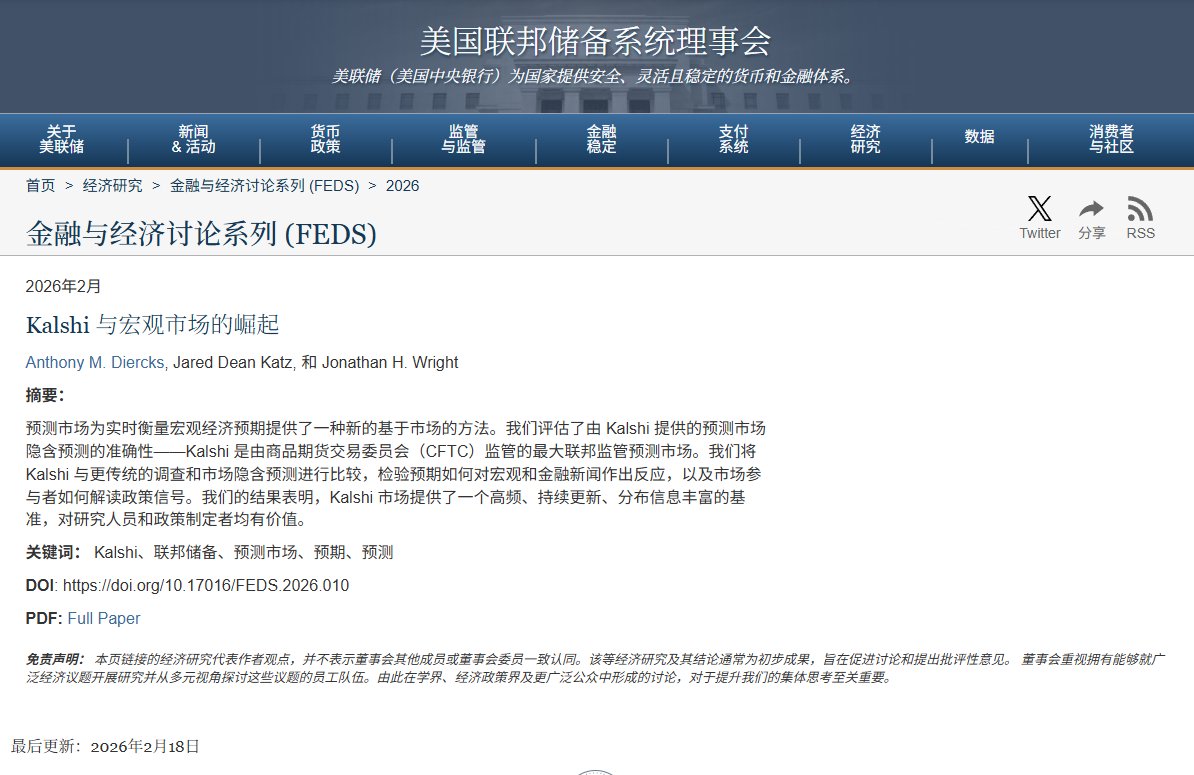
Firstly, the Federal Reserve believes that prediction markets are becoming a new tool for measuring macro expectations, compressing participants' judgments into prices with real funds, and being able to update in high frequency, real-time, and continuously, which is very scarce in traditional macro expectation frameworks.
More critically, the Federal Reserve emphasizes that the value of macro prediction markets like Kalshi is not merely that it provides another point forecast, but that it offers a distributional forecast method.
Users not only know whether the market bets that the CPI will be 3.1% or 3.2%, but they can also see the probability weights for every segment from 3.0–3.1, 3.1–3.2, and 3.2–3.3, and view how tail risk is actually priced. For policymakers, distributions are more important than points because the essence of policy is to manage tails and uncertainty.
PS: This statement from the Federal Reserve is very important; it even indicates that Federal Reserve policymakers will look at distributions within prediction markets to determine tail risks.
Secondly, the Federal Reserve believes that a killer advantage of Kalshi is its ability to turn "how expectations are rewritten by news" into observable intraday data.
The biggest problem with surveys is their low frequency; often what you see is just "the results following the last meeting," whereas Kalshi allows users to directly see how a statement from an official changes the market's perception of the likelihood of a future interest rate cut, how an employment report re-prices the market, and even how expectations fluctuate back and forth and finally converge within the same day.
This is very useful for understanding the transmission chain of "communication—expectations—asset prices."
Thirdly, the Federal Reserve believes that Kalshi's predictive accuracy is not poor, and in some dimensions, it can compare favorably with traditional tools, and even perform better on certain indicators.
In particular, regarding predictions of the Federal Reserve's interest rate path, Kalshi's error performance is very close to that of professional forecasts, with minimal discrepancies for core CPI, unemployment rates, and consensus expectations like those from Bloomberg, while for overall inflation predictions, Kalshi performs even better.
In simple terms, the Federal Reserve believes that prediction markets are not sentimental betting markets but are already approaching a referable source of macro expectation data in terms of availability.
Fourthly, the Federal Reserve specifically emphasizes that Kalshi allows researchers and policymakers to systematically study how macro data influences the shape of the policy rate distribution for the first time.
For example, after inflation data is released, uncertainty (distribution variance) usually decreases, but the impacts of inflation's "positive surprises" and "negative surprises" on interest rate means are not symmetrical; exceeding inflation expectations often pushes the interest rate mean upward more aggressively, while "dovish positives" when inflation is below expectations do not pull it back as symmetrically.
In simple terms, the market is more sensitive to the pricing of "bad inflation" and is more stingy with rewards for "good inflation."
However, at the same time, the Federal Reserve also reminds that the prices in prediction markets reflect risk-neutral probabilities, not purely real probabilities. Traders have risk preferences and risk premiums, and a participant structure that is biased toward retail investors may lead to systematic deviations. The liquidity of tail contracts is weak, and the probabilities of extreme outcomes may be quoted outdatedly.
Therefore, prediction tools like Kalshi are more suitable as windows for real-time sentiment and risk pricing rather than being viewed as the sole truth.
Fifthly, the Federal Reserve positions Kalshi as an upgrade of macro expectations from low-frequency point forecasting to high-frequency distribution forecasting.
It can separate what the market believes and what the market fears, making macro narratives closer to real capital behavior rather than remaining in rhetoric and sentiment.
In summary, the significance of prediction markets is not to tell us whether something will happen, but to show us what probability the market is willing to assign to an event happening in terms of real money; and for policymakers, what often truly determines the difficulty of policy is that little bit of tail probability.
@bitget VIP, lower rates, better benefits
免责声明:本文章仅代表作者个人观点,不代表本平台的立场和观点。本文章仅供信息分享,不构成对任何人的任何投资建议。用户与作者之间的任何争议,与本平台无关。如网页中刊载的文章或图片涉及侵权,请提供相关的权利证明和身份证明发送邮件到support@aicoin.com,本平台相关工作人员将会进行核查。


