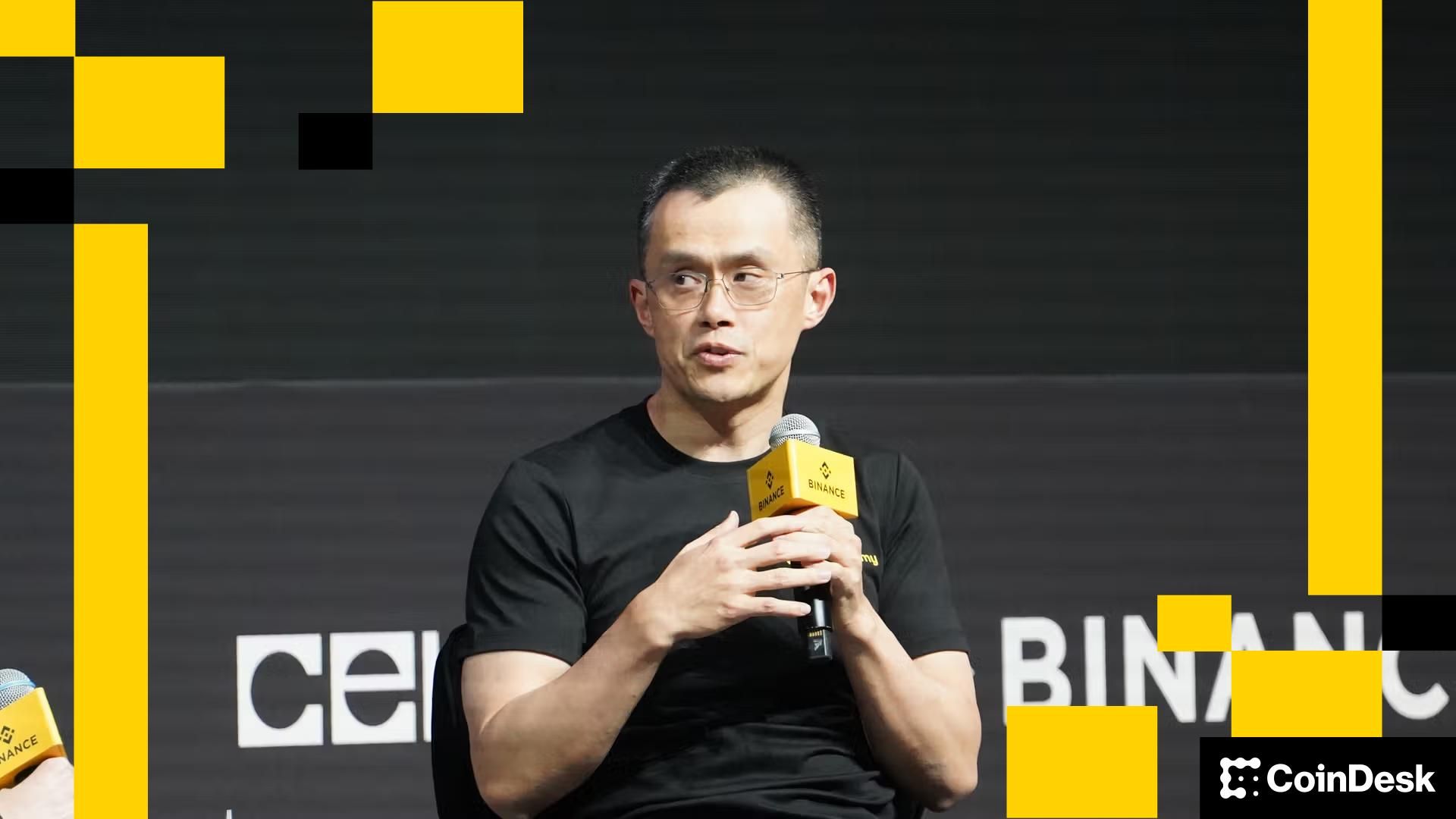
What to know : Crypto leaders including Binance co-founder Changpeng Zhao warn that the radical transparency of public blockchains is deterring mass adoption of crypto. Institutional executives at firms such as Abraxas Capital, JPMorgan and B2C2 say large transactions require privacy so that only authorized parties can see who is behind deals, even as activity remains auditable. A recent $50 million commercial paper issuance on Solana by JPMorgan and Galaxy Digital showcased the promise of tokenized debt but also underscored that institutions will not move assets on-chain at scale until privacy and execution certainty improve.
Binance co-founder Changpeng "CZ" Zhao warns crypto's lack of privacy blocks everyday adoption, echoing CoinDesk Consensus Hong Kong panelists who called it a barrier to widespread institutional use.
Blockchain's total transparency gets hyped as the ultimate democratization middle finger to shady banks and Wall Street fat cats operating in the dark. But here's the catch: it means anyone globally can snoop on your send amounts, wallet balances, and deals.
Picture wiring your salary or sealing a big business move that has the whole world reading every digit – not desirable, right?
That's precisely the issue here. Crypto's been screaming for Main Street and Wall Street adoption for years, yet this same "killer feature" of zero privacy is slamming the brakes hard.
"(Lack of) Privacy may [be] the missing link for crypto payments adoption. Imagine, a company pays employees in crypto on-chain. With the current state of crypto, you can pretty much see how much everyone in the company is paid (by clicking the from address)," CZ said on X on Sunday.
Institutions share that concern
Fabio Frontini, chief executive officer of Abraxas Capital Management, highlighted the need for privacy in large institutional transactions if the use of public blockchains on Wall Street is to become the norm.
"The privacy—especially for large transactions—is the key point, I think, particularly for institutional players," says Abraxas Capital Management CEO Fabio Frontini. "Total transparency isn't particularly good. Actually, you want transactions to be auditable and visible, but only to certain people who should know exactly who's behind them," Frontini said during the panel "The 2026 Outlook: The Institutional Market Cycle," in Hong Kong last week.
Frontini was responding to a question about when institutional use of blockchain to issue traditional instruments like commercial paper will go from an experimental stunt to an everyday norm. Wall Street giant JPMorgan tested these waters in December by arranging a landmark $50 million U.S. commercial paper issuance for Galaxy Digital Holdings LP on the Solana blockchain.
Coinbase Global and Franklin Templeton snapped it up, with issuance and redemption settled in Circle's USDC stablecoin for near-instant delivery-versus-payment. JPMorgan handled structuring and on-chain token creation, while Galaxy Digital Partners LLC acted as the structuring agent.
The landmark deal highlighted the use of public blockchains like Solana for tokenizing debt, but also exposed the lack of transparency.
Emma Lovett, the credit lead for the Markets Distributed Ledger Technology team at JP Morgan, who was one of the panelists, stressed that institutions won't shift massive assets on-chain at scale until they can trust the system won't expose them.
"They need to be confident that it's not going to take one person to find out what their address is and then know all the transactions they've done—that's really key," Lovett said.
Thomas Restout, group CEO of institutional-grade liquidity provider B2C2, agreed that privacy is key while highlighting "certainty of execution" as another key factor.
"It's still a space that institutions aren't comfortable with. They also need partners. You look at other chains that have gone private and are developing a lot for institutions. So if you're a large institution, you always have to imagine that you're not going to try this for $10,000—you're going to have to do this for $10 trillion. And therefore, the level of certainty you need to achieve to operate at that scale is very high," he explained.
免责声明:本文章仅代表作者个人观点,不代表本平台的立场和观点。本文章仅供信息分享,不构成对任何人的任何投资建议。用户与作者之间的任何争议,与本平台无关。如网页中刊载的文章或图片涉及侵权,请提供相关的权利证明和身份证明发送邮件到support@aicoin.com,本平台相关工作人员将会进行核查。


