Author: Hua Lin Dance King, Geek Park
Editor: Jingyu
Just as Musk was preparing to merge SpaceX and xAI to create a cosmic AI giant valued at $1.25 trillion, he did not expect that his grand vision is not something everyone can digest.
On February 10, 2026, local time, Tony Wu, co-founder of xAI, announced his departure from Musk's AI company.
This marks the second co-founder to leave xAI since Igor Babuschkin departed last August. Wu was responsible for AI reasoning capabilities—a key technical direction considered by the industry to be the core competitiveness of the next generation of AI systems.
With founders leaving one after another, can Musk's AI ambitions continue?
01. Reasoning Expert Departs
Tony Wu's role at xAI is far more important than it appears on the surface.
As the technical lead responsible for reasoning capabilities, Wu reported directly to Musk. At this stage of AI development, reasoning capabilities are considered the critical bridge between large models like GPT-4 and Claude and true "general artificial intelligence."
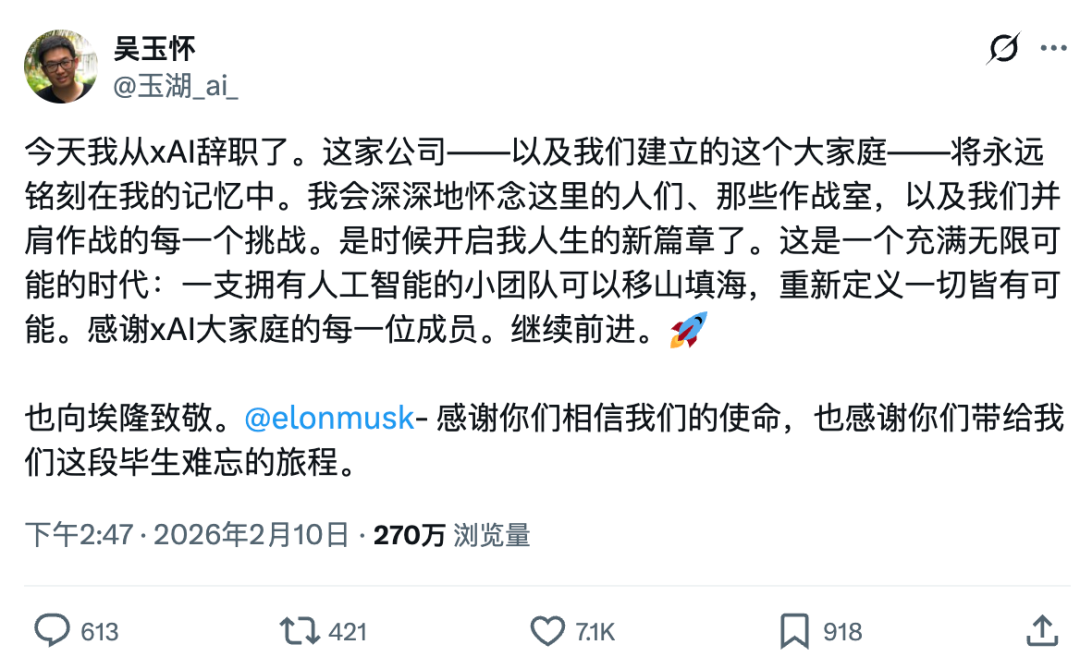
Tony Wu announced his departure on X | Image Source: X
What is even more concerning is the timing. OpenAI has just released a new code model, achieving significant breakthroughs in AI coding; Anthropic's Claude is also performing increasingly well on reasoning tasks. Losing the core member of the reasoning team at this moment, xAI is likely to fall behind in the most critical technical race.
Why are top AI talents unwilling to follow Musk's AI vision?
02. The "Side Effects" of Musk-style Management
Although the official reasons for the departures have not been disclosed, looking at Musk's management style in Twitter, Tesla, and SpaceX, the issue may not lie in compensation but in conflicting management philosophies.
Musk has publicly stated that xAI aims to pursue "maximum reality" and "understanding the universe." Such grand visions are inspiring, but in terms of specific technical implementations, they often require more pragmatic path choices.
In traditional AI research institutions, technical experts usually have more say. But in Musk's companies, the ultimate decision-making power often rests with him.
03. The "Talent Bloodbath" in AI
An excellent AI researcher may receive offers from OpenAI, Anthropic, and Google DeepMind simultaneously, with annual salaries easily exceeding $500,000, and equity worth astronomical sums.
From this perspective, OpenAI and Anthropic indeed have advantages.
A Reddit user pointed out succinctly: "Musk excels at engineering and productization, but the early stages of AI research resemble scientific research more, requiring patience and space for trial and error."
In the "winner-takes-all" game of AI, falling behind by six months could mean complete exclusion. Losing two co-founders can carry costs much heavier than one might imagine for an AI company still searching for technical breakthroughs.
免责声明:本文章仅代表作者个人观点,不代表本平台的立场和观点。本文章仅供信息分享,不构成对任何人的任何投资建议。用户与作者之间的任何争议,与本平台无关。如网页中刊载的文章或图片涉及侵权,请提供相关的权利证明和身份证明发送邮件到support@aicoin.com,本平台相关工作人员将会进行核查。


