整理 & 编译:深潮 TechFlow
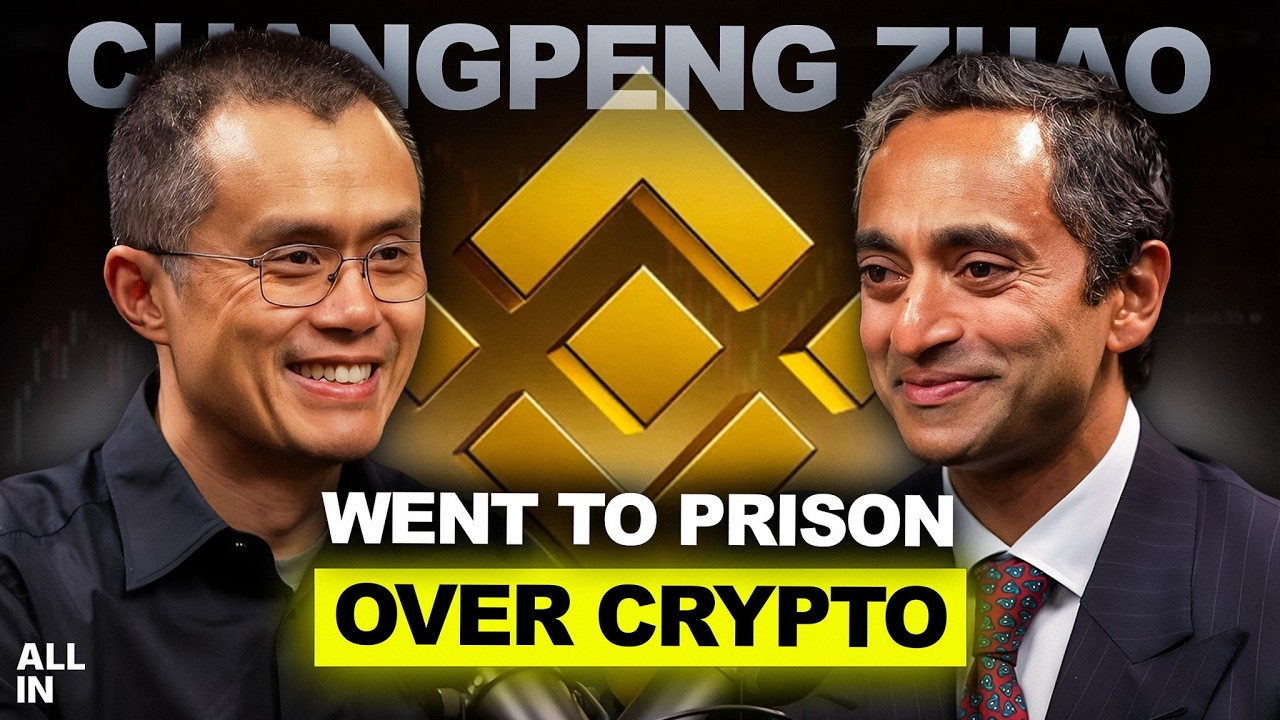
Guest: CZ
Host: Chamath Palihapitiya
Podcast Source: All-In Podcast
Original Title: Binance CEO: 4 Months in Prison, $4 Billion Fine, and What Comes Next
Airing Date: February 10, 2026
Key Takeaways
4 months of imprisonment, $4 billion fine—this costly tuition in crypto history has given CZ a new perspective on the world.
In this episode, Binance founder CZ publicly shares for the first time his journey from an ordinary immigrant child to the founder of the world's largest cryptocurrency exchange. He no longer shies away from sensitive topics: life in detention with limitations on exit, the cold “gang advice” from prison guards, and the true story of his fallout with SBF. From working at McDonald's to stepping down as CEO of Binance, CZ shares his growth story, career turning points, and insights into the future of the cryptocurrency industry—a non-token education empire Giggle Academy, and a vision of next-generation payments led by AI agents.
深潮 TechFlow organized this two-hour dialogue, attempting to penetrate the mist surrounding billions in valuation.
Highlights: Five “Confessions” from CZ after His Return
1. About Life Behind Bars: Fear, Misunderstanding, and “Luxury” of Freedom
The outside world is filled with curiosity about CZ's life in prison, but he admits to real fears and absurd experiences.
- Fear of Extortion and “Gang” Misunderstanding: CZ confesses that after the verdict, the media exaggeratedly portrayed him as “the richest prisoner in history,” making him extremely worried about becoming a target for extortion in prison. On the first day of his imprisonment, a guard suggested he “join the Pacific Islanders gang for protection,” which made him panic initially. However, he later realized this only stemmed from the rarity of Asian faces, as he was assigned to a minority group of only six people, and he did not experience bullying.
- Redefining “Luxury”: The taste of freedom is reflected in the smallest details. CZ recollects that the showers in prison were cramped like a box, with walls that one would touch while turning. Upon release, he found the most luxurious enjoyment was “taking a shower in a spacious shower without hitting the walls” and “seeing a plate of fresh fruit.”
- 26 Minutes of Leaving: On the day of his release, it took only 26 minutes from walking out of the prison gates to boarding the flight leaving the United States.
2. About Regulatory Games: Psychological Warfare, Handcuffed Photo Ops, and Forced Letting Go
Reveal the negotiation details behind the $4 billion fine and the toughest compromises as a founder.
- The DOJ's “Psychological Warfare”: The negotiation process was described by CZ as “hell.” He revealed that the DOJ excels at using “silence tactics”—maintaining silence for two weeks after refusing conditions, using that time to break the opponent's psychological defenses. He believes the other party was very aware that “two weeks is the best time to exert pressure.”
- Failed “Handcuff Stunt”: Although the judge ruled no need for supervision, the DOJ strongly insisted on putting handcuffs on him right there for a photo op. CZ suspected this was purely for the purpose of capturing a photo of his arrest for publicity, fortunately, the judge rejected the request.
- Tearfully Resigning as CEO: Resigning from the management position at Binance was not a voluntary choice but part of the plea agreement. CZ admitted this was the hardest decision, and he even cried at the time. However, he realized that only by letting go could Binance survive in an anti-cryptocurrency regulatory environment.
3. About SBF and FTX: Refusing to Take the Blame and Restoring Relationships
Responding directly to the conspiracy theory that “Binance brought down FTX,” CZ clarifies.
- Exited Early: CZ stressed that Binance had completely exited equity before FTX's crash a year and a half prior (in July 2021) and had no knowledge of its internal financial condition.
- “He Wanted to Kill Us in This Industry”: CZ revealed details of the fallout with SBF: even though Binance was once a shareholder of FTX, SBF was still slandering Binance behind its back in Washington, even poaching Binance's VIP client managers with five times the salary. CZ bluntly stated that SBF was using regulatory attacks against competitors.
4. About Future Pathways: AI Agents Will Reshape Crypto Payments
After stepping down, CZ turns his gaze to the longer-term future, which is the biggest Alpha (wealth key) of this interview.
- AI Agents Are the Largest Crypto Users: CZ proposed a forward-looking view: in the future, everyone will have hundreds or even thousands of AI agents working in the background. These AIs cannot open accounts in traditional banks (as they cannot pass KYC), so they are destined to use cryptocurrency for value exchange.
- Explosion of AI Transaction Volume: He predicts that in the future, the vast majority of on-chain high-frequency trading and capital transfers will be completed by AI agents, with frequencies and scales far exceeding human activity.
- Giggle Academy Will Not Issue Tokens: Regarding his new educational project, CZ emphatically stated “no tokens will be issued.” He believes that once token incentives (Learn-to-Earn) are introduced, users will turn into “sheep-mining miners,” thus deviating from the original educational intent.
5. About Wealth and Life: Leaky Roofs and “Ordinary People”
Stripping away the “richest person” label reveals a low-profile CZ who seeks inner peace.
- The Metaphor of “Leaky Roof”: Despite his billionaire status, CZ revealed that the house he lives in is a “third or fourth-hand old house,” and the living room ceiling leaks every month, but he does not mind, believing “as long as it is functional, it's enough.”
- Money is Just “a Line”: He candidly said that once wealth reaches a certain level (for him, after appearing on the Forbes cover in 2018), money becomes just a line and can no longer bring more happiness.
- Contentment in the Present: Compared to the pressure of managing a trillion-dollar empire, CZ enjoys his current life of not having to attend 20 meetings a day. He believes real success is not about being a genius, but about persisting in doing what you love and having good luck.
From China to Canada
Chamath: CZ, welcome to the “All In Podcast.” I want to start from the beginning. What interests me is your early experience in Canada, which is somewhat similar to mine; you worked at McDonald's while I worked at Burger King. But before that, your parents immigrated from China to Canada, right?
CZ:
My father actually went to Canada to study as early as 1984. He was a professor in China and later participated in an exchange program at the University of Toronto. After a few years, he went to the University of British Columbia (UBC) in Vancouver. We were also applying for immigration at the time, but getting passports was very difficult. We started applying around 1985 and it took two to three years to get our passports, followed by several more years to obtain visas.
Afterward, new passport issuances were not given so easily, and it became more difficult to reapply for a passport. But we were fortunate to obtain our passports a year before the event, making it easier to get visas afterward. In a sense, that helped us secure visas.
Chamath: After your family reunited, did your parents work? What jobs did they have?
CZ:
My father continued to work as an assistant professor at the university, earning a living allowance of 1,000 CAD per month. We also lived in a low-rent faculty dormitory provided by UBC, so we were on campus. I remember that on the third day after we arrived in Canada, my mother went to work at a sewing factory making clothes. She was a math and history teacher in China but could not find a corresponding job due to her poor English and had to work in a factory for minimum wage. She worked there for seven to ten years.
My first job was at McDonald's. I remember I was 14 or 15 years old at the time, and the minimum wage was 6 CAD, but McDonald's only paid 4.5 CAD, which was even lower than the minimum wage. They seemed to had some special exemption allowing them to hire many young people. I applied for this job on my 14th birthday, and started flipping burgers there a week later; it was my first income in life.
CZ's Ordinary Early Career
Chamath: You’re not one of those genius tech kids who locked themselves in a room coding and studying computer science all day, are you?
CZ:
I wouldn’t describe myself that way, I think of myself as a tech-oriented person. I studied computer science and became interested in programming in high school, where I also learned some programming. However, I wasn’t a genius programmer, nor particularly skilled. I’d say I was a decent programmer and wrote some good code during my career. By the time I was around 28 to 30 years old, I gradually moved away from programming toward more business development and sales work for about eight years.
Chamath: So you were just an ordinary immigrant kid trying hard to adapt to life in Canada. Did you have many friends?
CZ:
I had many friends, both Asian and non-Asian. However, in our school, most Asians tended to hang out with each other, but I was the exception; I had white friends and friends from other backgrounds. My teenage years in Canada were truly wonderful; it was one of the best times of my life. I believe those years made me an outgoing, happy person; I’ve always felt that I was a very happy person.
Chamath: Was your university experience a typical college experience? How did you pay for tuition?
CZ:
I worked every summer and also had part-time jobs during the semester, so I graduated without debt. I did not apply for student loans. In my first year, I borrowed about 6,000 CAD from my father. In the second year, I was still a bit tight on funds, so my sister lent me 3,000 CAD. After that, I never asked anyone for money again and supported myself completely.
Chamath: So you graduated from McGill University majoring in computer science?
CZ:
Actually, I did not graduate from McGill University. I studied there for four years but found an internship in my third year. I kept extending my internship and ended up never returning to school. Later, I discovered that to apply for a job visa in Japan, a bachelor's degree is required, so I got my degree through an online education program called the “American College of Computer Science.”
Chamath: Where did you intern at the time?
CZ:
I found an internship job in Tokyo. In fact, I started working in programming from my freshman year. Initially, I wrote simulation software for a company called Original Sim, and by the third year, I joined a company in Tokyo called Fusion Systems Japan, which developed order execution systems for brokers at the Tokyo Stock Exchange.
Chamath: What were you thinking at that time? Did you think it was an adventure, wanting to live in Tokyo for a summer?
CZ:
Yeah, I was still a college student then, and living in Tokyo felt like a dream; it was like entering a future world the first time I went there. At that time, I primarily wrote order execution software, similar to what is used by Binance now.
Chamath: Did you feel “Wow, I love this” the first time you encountered such software? Or did you just understand the concept because it was part of the job?
CZ:
At first, it was just my job. I was young and didn’t know much about the industry. When I joined the company, they had me develop a digital imaging storage system, similar to the photo app on iPhones, but it was for a medical imaging system for Nikon. However, I soon got involved in the development of the company's main product—the order execution system. This later became the focus of my career. I enjoyed this field because it required high technical ability, and everything revolved around efficiency, making the system as fast as possible and minimizing latency. This pursuit of efficiency fascinated me because I am inherently focused on efficiency.
Chamath: When you see those high-frequency trading firms designing their own circuit breakers and building their own fiber optic networks to reduce latency by a few milliseconds for the sake of optimizing efficiency, how does this need manifest in software? When you write such software, how do you optimize those boundary conditions in the code?
CZ:
First, you need to ensure your software is efficient and fast, for example, by eliminating all database queries and storing all data in memory. Then minimize extra computation steps and simplify pre-trade risk checks. A more advanced optimization involves using FPGAs (Field Programmable Gate Arrays), which are network chips installed on network cards, so you don't have to transfer data from memory to the processor and back to memory.
At that time, I was still writing code, about a decade ago, and this round-trip latency was around 100 microseconds. By avoiding this back and forth, latency can be reduced to 20 microseconds. Next, you could further optimize speed by upgrading physical infrastructure, such as colocating at data centers.
Chamath: In the AI field, we discovered ten years ago that the efficiency of GPUs is very low, such as the inefficiency of transferring data from the GPU to HBM and back, so we directly use SRAM to perform all operations on the chip, which is very efficient in the decoding process during the inference phase. So why hasn’t there been a similar attempt in high-frequency trading? I know FPGAs are common, but why hasn’t anyone designed dedicated ASICs (Application-Specific Integrated Circuits)? Or has someone done it, but we don’t know?
CZ:
I think this approach has not been widely applied mainly because the algorithms in high-frequency trading evolve too rapidly. Hardware design is indeed efficient, but once a redesign is required, it is very time-consuming. FPGA is already a compromise, and even with FPGAs, the reprogramming cycle is about ten times slower than software.
Chamath: Did the company you worked for in Japan succeed?
CZ:
Yes, it was very successful. That company was acquired by a NASDAQ-listed company for $52 million before the year 2000. After the acquisition, there was a cultural clash between the parent company and the original company. This was my first experience realizing that not all mergers are successful. Later, the partners of the company founded a new company, but it lasted only a year because it incurred high costs without generating revenue.
After that company went bankrupt, I started looking for a new job. At that time, Bloomberg was hiring, and I received a job offer and later moved to New York. New York after 9/11 was quiet but quickly regained its vitality. I worked at Bloomberg for four years, doing similar things to before.
Founding His First Company in Shanghai
Chamath: Later, you resigned and moved to China. What happened?
CZ:
In early 2005, some friends I met in Japan were discussing starting a new fintech company. They were all in Asia, considering several locations, such as Tokyo, Shanghai, and Hong Kong, and felt Shanghai might be the future center for fintech development. In hindsight, we should have chosen Hong Kong because the fintech industry developed faster there afterward. So, I moved to Shanghai in 2005, and we were a total of six people looking to establish a new IT startup; we had rich experience in Wall Street trading technology. Our idea was to bring Wall Street trading technology into China and service Chinese brokerage firms and exchanges.
After arriving in Shanghai, they rented a luxurious office, but other matters, such as shareholder rights and the differences between preferred and common stock, I knew nothing about.
I had no clue about the differences between common and preferred stock. I just thought, let’s do it. I was a small partner in the team. Once we arrived in China, since I could speak Chinese, I started communicating with potential clients. I went to talk business with brokerage firms only to find that our company was registered as a Wholly Foreign-Owned Enterprise (WFOE), and Chinese brokerage firms and financial institutions could not cooperate with WFOEs.
We discovered this issue after the company was established, so we pivoted to provide IT system services for any company, similar to outsourcing. We might repair printers or implement SAP systems for clients; we did various things.
But we survived on this, and many of our clients were from the automotive industry, like Shanghai General Motors, Shanghai Volkswagen, and Shanghai First Automobile, who all became our clients. About three to four years later, we opened an office in Hong Kong and started collaborating with Morgan Stanley, Deutsche Bank, and Credit Suisse. The company gradually developed and was considered a success. The company is still operational; I left in 2013 after eight years, but the company is still active today.
Chamath: How big did that company grow later?
CZ:
At its peak, there were about 200 employees, and as far as I know, the company still maintains that scale today.
Chamath: As a small partner, did you earn income through dividends?
CZ:
Yes, but we didn’t actually receive too much profit. I reinvested most of my savings back into the company and didn’t cash out at all. However, after a few years, the company became stable enough to pay partners decent salaries, even allowing us to send our kids to international schools, with annual salaries around six figures.
Chamath: Were you already married at that time? How did you meet your ex-wife?
CZ:
I met her when I first went to Tokyo. It was 1999; I met her during my internship in Tokyo. Later, she came to see me, and we got married in New York and had a child, but we have since separated.
Initial Encounter with Bitcoin
Chamath: So what happened in 2013 and 2014?
CZ:
I encountered Bitcoin.
免责声明:本文章仅代表作者个人观点,不代表本平台的立场和观点。本文章仅供信息分享,不构成对任何人的任何投资建议。用户与作者之间的任何争议,与本平台无关。如网页中刊载的文章或图片涉及侵权,请提供相关的权利证明和身份证明发送邮件到support@aicoin.com,本平台相关工作人员将会进行核查。


