Prediction Markets Had Their Breakout Year in 2025 — and There Was No Going Back

CN
2 hours ago

What began as a niche experiment in forecasting elections and sports quietly evolved into a multibillion-dollar ecosystem touching Wall Street, media giants, professional sports, and crypto infrastructure.

From regulatory victories and courtroom battles to record volumes, blockbuster fundraises, and mainstream media integrations, prediction markets spent 2025 elbowing their way into the center of the conversation—and mostly winning the fight.

A Strong Start, With Lawyers in the Background

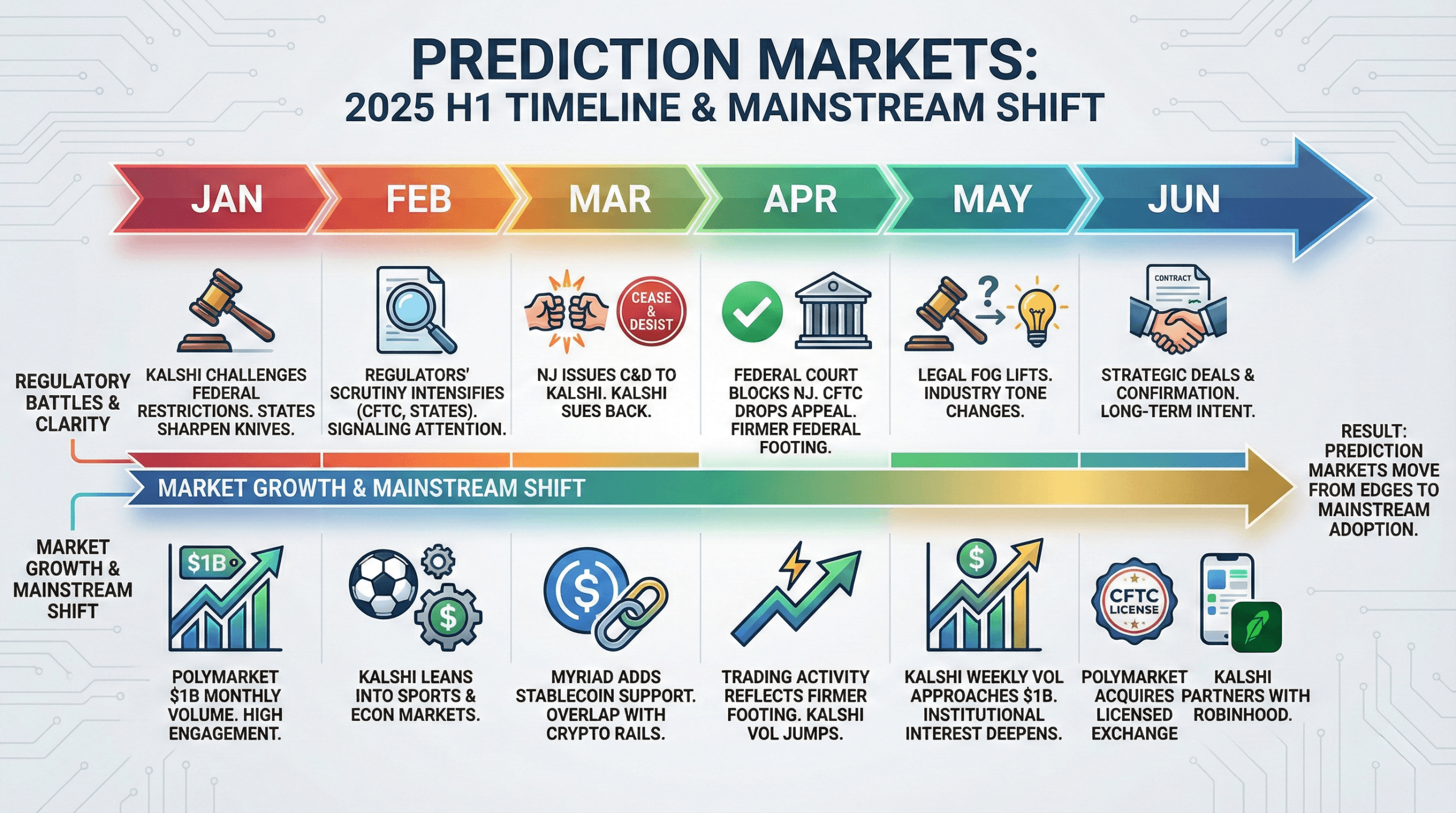
The year opened with momentum already in motion. Polymarket entered January averaging more than $1 billion in monthly trading volume, riding engagement that never faded after the 2024 election cycle. Kalshi, meanwhile, leaned harder into sports and economic markets while preparing for legal tests that would define its future.

Those tests arrived quickly. In January, Kalshi found itself back in court challenging federal restrictions on political event contracts, while state regulators sharpened their knives. The legal uncertainty did little to slow participation, but it ensured that prediction markets would spend much of 2025 proving they belonged.

Regulation Tightens—Then Starts to Blink

By February, regulators were paying closer attention. The Commodity Futures Trading Commission scheduled public discussions around event contracts, signaling that prediction markets were no longer flying under the radar. State-level scrutiny intensified, setting the stage for clashes that would unfold over the spring.

March delivered both innovation and confrontation. Blockchain-native protocol Myriad launched with an onchain, non-custodial model using stablecoins, reinforcing prediction markets’ growing overlap with crypto rails. At the same time, New Jersey regulators issued a cease-and-desist order against Kalshi, accusing it of operating unlawful gambling markets.

Kalshi responded the way it would all year: by suing back.

Prediction Markets Had Their Breakout Year in 2025 — and There Was No Going Back

Courtrooms, Clarity, and a Federal Green Light

April marked a turning point. A federal judge blocked New Jersey’s enforcement action, siding—at least temporarily—with Kalshi’s argument that federal commodities law preempts state gambling statutes. Days later, the CFTC dropped its appeal in Kalshi’s election-contract case, effectively leaving a pro-market ruling intact.

The message was unmistakable: prediction markets had found firmer footing at the federal level, even if states continued to resist. Trading activity reflected that shift almost immediately, with Kalshi posting hundreds of millions in volume tied to fast-resolving sports events.

Growth Accelerates as Legal Fog Lifts

By May, participation accelerated. Kalshi reported weekly volumes approaching $1 billion, a staggering jump from the prior year. Sports accounted for most activity, but economics, crypto, and political markets quietly gained traction beneath the headline numbers.

Industry-wide, the tone changed. Venture capital interest deepened, institutional observers began framing prediction markets as information tools rather than novelty bets, and whispers of partnerships with mainstream platforms grew louder.

Deals, Integrations, and Wall Street Curiosity

June brought confirmation. Polymarket revealed it had acquired a small CFTC-licensed exchange to facilitate a U.S. return, a strategic move that signaled long-term intent rather than regulatory brinkmanship. Kalshi, meanwhile, inked a distribution partnership with Robinhood, pushing prediction markets directly into a retail trading app used by millions.

The subtext was clear: prediction markets were no longer content living at the edges of the internet.

Summer Funding and the Push Toward the U.S.

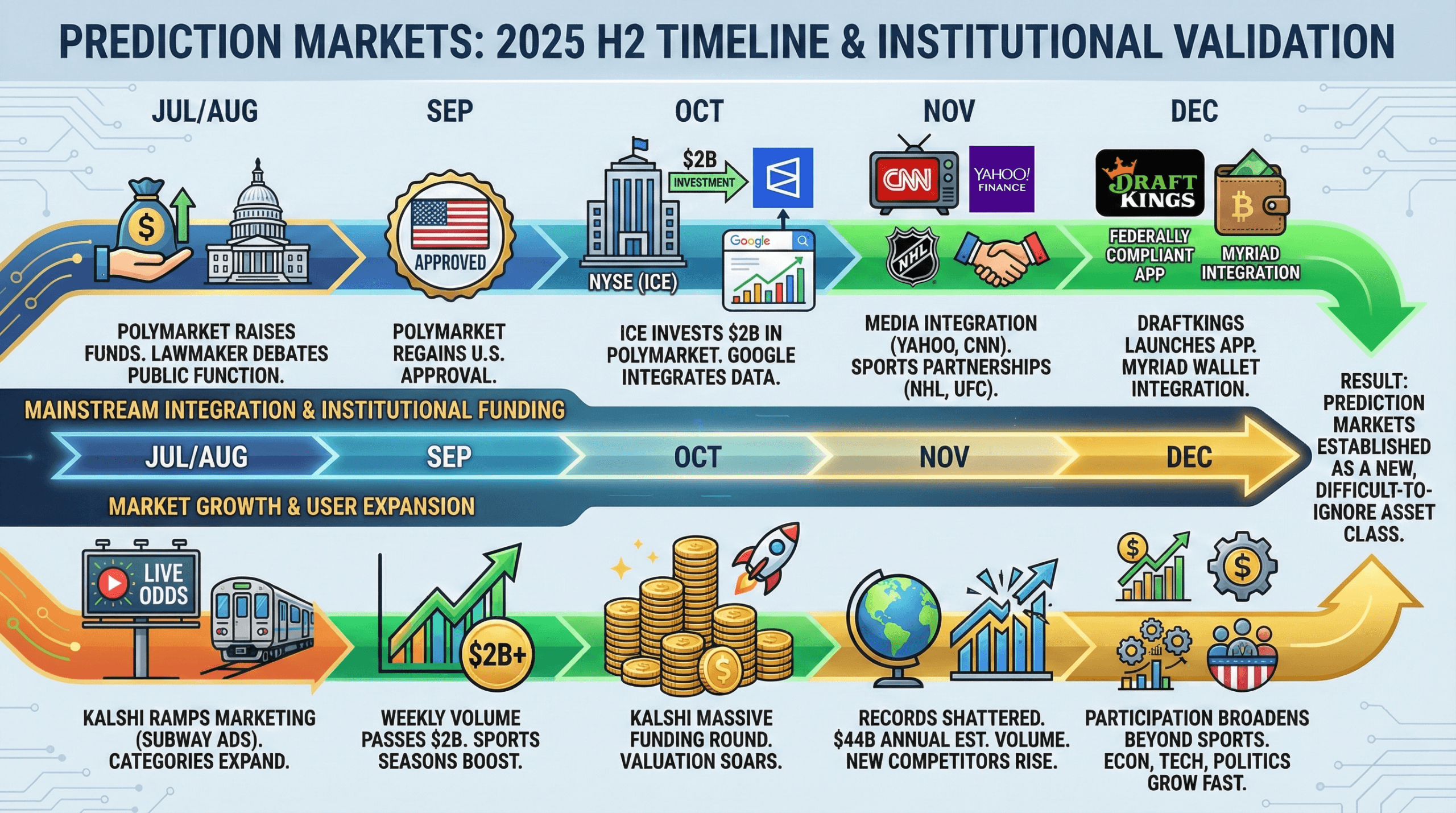
Throughout the summer, capital flowed in. Polymarket raised additional funding while preparing for its U.S. relaunch, attracting backers spanning crypto-native funds and traditional venture firms. Kalshi ramped marketing and expanded categories, even turning live odds into subway ads—a subtle flex that would have seemed absurd a few years earlier.

Behind the scenes, lawmakers debated whether these markets could serve public forecasting functions. No laws changed, but the conversation itself marked progress.

The U.S. Door Reopens

September delivered one of the year’s defining moments: Polymarket regained approval to operate in the United States. The timing aligned neatly with major sports seasons and renewed political speculation, pushing combined weekly volume across leading platforms past $2 billion.

State battles continued, but user growth did not wait for unanimous permission.

October’s Capital Floodgates Open

October was the month when prediction markets went unmistakably big. Intercontinental Exchange (ICE), owner of the New York Stock Exchange (NYSE), announced plans to invest up to $2 billion in Polymarket, valuing the company in rarefied territory and cementing Wall Street’s interest in event-driven data.

Kalshi followed with a massive funding round of its own, pushing its valuation into fintech’s upper tier. At the same time, Google began integrating prediction market data into search and finance tools, ensuring millions would encounter probabilistic forecasts whether they asked for them or not.

November Sets Records Across the Board

November shattered expectations. Combined platform volumes reached historic highs, with industry-wide trading estimated at roughly $44 billion for the year. Kalshi and Polymarket each cleared multibillion-dollar monthly totals, while new competitors crossed billion-dollar weekly thresholds.

Major media outlets followed suit. Yahoo Finance integrated prediction market data directly into its pages, while CNN prepared on-air odds segments. Sports partnerships expanded, including high-profile deals with the NHL and UFC, pushing prediction markets into live broadcasts.

Prediction Markets Had Their Breakout Year in 2025 — and There Was No Going Back

December Brings Expansion—and Competition

By December, prediction markets were no longer alone. Draftkings launched a federally compliant prediction app in dozens of states, validating the regulatory path pioneered earlier in the year. A newly launched competitor, Myriad, integrated directly into a major crypto wallet, bringing event trading into a native Web3 environment.

The year closed with optimism, but not without tension. State-level resistance persisted, and lawsuits lingered. Still, participation broadened beyond sports, with economics, tech, and politics showing the fastest growth rates.

A New Asset Class Finds Its Place

By year’s end, prediction markets looked less like a curiosity and more like an emerging asset class. They blended regulated exchanges, blockchain settlement, real-time data, and crowd-based forecasting into something difficult to ignore—and increasingly difficult to stop.

If 2025 proved anything, it’s that prediction markets are done asking whether they belong. The only remaining question is how far they push next.

  • What are prediction markets?
    Platforms where users trade contracts tied to real-world event outcomes.
  • Why did prediction markets grow so fast in 2025?
    Regulatory clarity, major partnerships, and rising demand for probabilistic data fueled expansion.
  • Which platforms dominated 2025?
    Kalshi and Polymarket led by volume, funding, and mainstream integrations.
  • How are prediction markets connected to crypto?
    Many platforms use blockchain infrastructure, stablecoins, and decentralized settlement tools.

免责声明:本文章仅代表作者个人观点,不代表本平台的立场和观点。本文章仅供信息分享,不构成对任何人的任何投资建议。用户与作者之间的任何争议,与本平台无关。如网页中刊载的文章或图片涉及侵权,请提供相关的权利证明和身份证明发送邮件到support@aicoin.com,本平台相关工作人员将会进行核查。

Share To
APP

X

Telegram

Facebook

Reddit

CopyLink