Written by: Liu Honglin
I don't know why, but recently, documents related to the cryptocurrency industry tend to be released on Fridays.
Just now, a post from Lawyer Honglin's social media suddenly circulated a joint announcement from seven financial industry associations titled "Risk Warning on Preventing Illegal Activities Related to Virtual Currencies." The China Internet Finance Association, Banking Association, Securities Association, Fund Association, Futures Association, Listed Companies Association, and Payment and Clearing Association all signed it together.
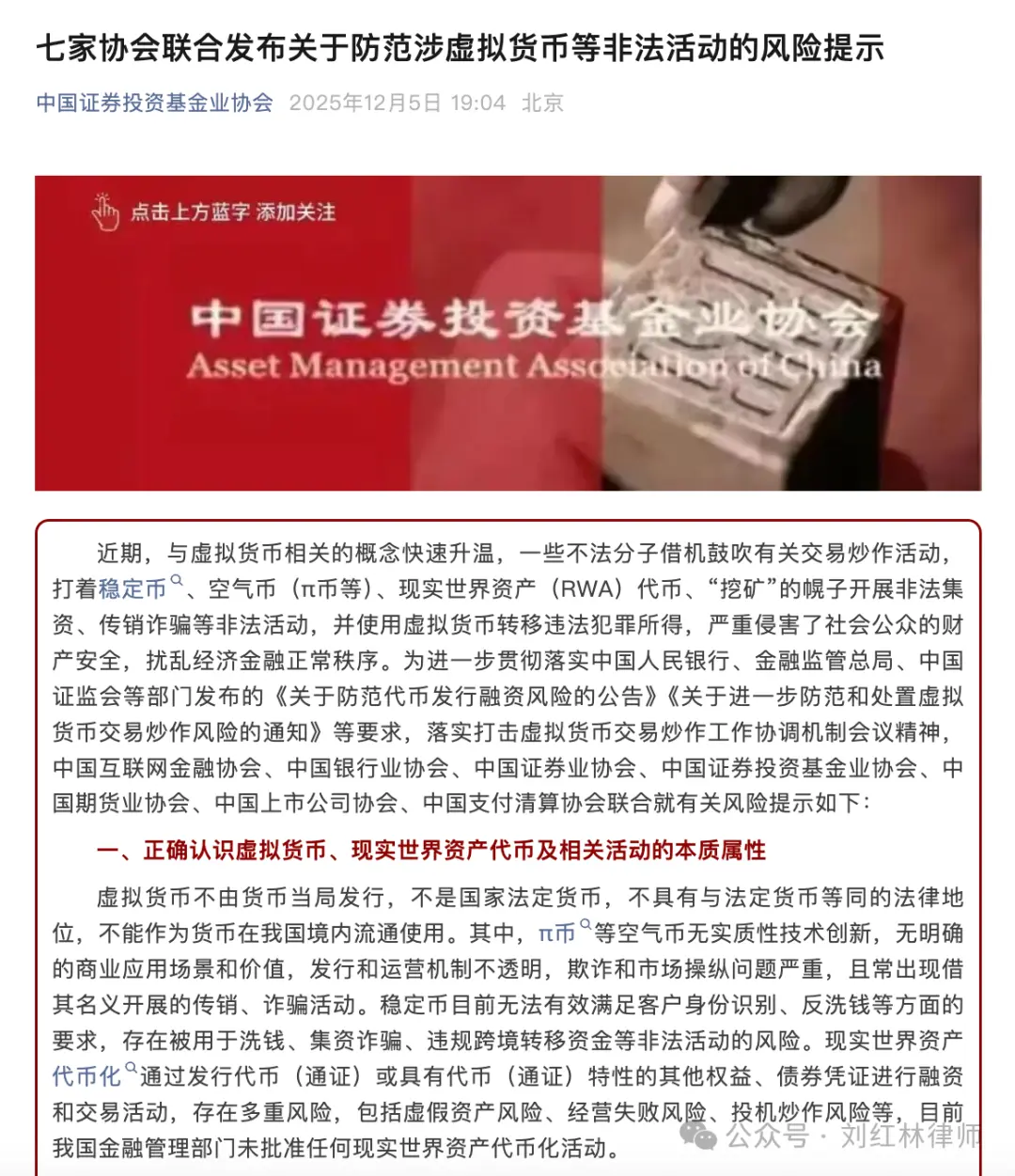
After reading the document, Lawyer Honglin looked bewildered.
This is not just a simple statement from industry associations; it is a blatant cross-industry, cross-regulatory system "unified stance" action. Such combinations of associations often occur at significant nodes in systemic financial risk prevention.
It raises the question: Can RWA really have such destructive power?
The most notable aspect of this document is its first-time explicit mention of RWA (Real World Asset tokenization) and its qualitative opinion. In the full text, RWA is listed alongside stablecoins, air coins, and mining as one of the main manifestations of "illegal activities related to virtual currencies," thus being explicitly criticized.
This wording itself sends a strong signal: RWA is no longer a "new technology" awaiting regulatory clarification, but has been directly included in the regulatory crackdown list as a "risky business model."
Specifically, the document describes RWA as follows: "Real World Asset tokenization involves financing and trading activities through the issuance of tokens (certificates) or other rights and bonds with token-like characteristics, which carry multiple risks, including false asset risk, operational failure risk, speculative risk, etc. Currently, no Real World Asset tokenization activities have been approved by China's financial management departments."
This statement clearly delineates three bottom lines:
First, RWA is explicitly defined as "financing and trading activities." This means that regardless of whether it is anchored to real assets or uses blockchain technology, it is essentially a fundraising mechanism. As long as it involves token issuance, asset trading, and profit distribution, it naturally falls under the regulatory framework of existing financial laws, particularly those prohibited by relevant laws such as the "Securities Law" and the "Measures for the Prohibition of Illegal Financial Institutions and Illegal Financial Business Activities."
Second, the regulation emphasizes "false asset risk," "operational failure risk," and "speculative risk." This is not only a qualitative assessment targeting fraudulent projects but also a denial of the potential market risks of so-called "normal projects." Even if the project party believes its assets are real, its technology is transparent, and its structure is compliant, the regulatory judgment remains: this token structure cannot guarantee the legal ownership and liquidation capability of the underlying assets, and its risk spillover is uncontrollable.
Third, a more critical statement is: "No Real World Asset tokenization activities have been approved by China's financial management departments." This directly declares that all tokenized assets, services, matching, and trading platforms in the market under the name of RWA currently have no legal operating basis. There is no room for interpretation of "currently in the regulatory exploration stage," nor is there a possible path of "waiting for filing."
In fact, RWA has been treated as an "alternative token path" within the industry for some time. Especially after stablecoins were officially included in the virtual currency regulatory framework, many teams chose to shift to RWA, attempting to evade regulation with terms like "real asset anchoring," "overseas compliance paths," and "technical service output." This document has systematically dismantled these expressions.
The document clearly points out that RWA-related activities carry legal risks such as "illegal fundraising, unauthorized public issuance of securities, and illegal operation of futures business." These statements are not vague but are directly correlated with explicit provisions in criminal law and securities law:
- If you issue RWA tokens to unspecified members of the public and raise funds, you are suspected of illegal fundraising;
- If you facilitate transactions or distribute tokens without permission, you may constitute illegal issuance of securities;
- If your token trading involves leverage or betting mechanisms, it may be suspected of illegal operation of futures business.
These charges are already very clear in terms of legal application, and in recent years, there have been multiple court rulings based on similar logic for convictions. RWA is not a new species existing outside the law but is classified by regulators as a "familiar target" within the existing financial enforcement toolbox.
The timing of this risk warning is closely related to the frequent fraudulent activities operating under the name of "RWA" in recent times. Previously, Lawyer Honglin was invited to participate in a program on Shanghai People's Broadcasting Station, with the theme "Preventing RWA Financial Scams." Who would have thought that this topic has now risen to a national level?
In the document from the seven associations, the first paragraph mentions, "Criminals take the opportunity to promote trading and speculation activities, engaging in illegal fundraising, pyramid schemes, and other illegal activities under the guise of stablecoins, air coins (such as π coins), Real World Asset (RWA) tokens, and 'mining'." It seems that regulatory authorities have placed RWA in the same dimension of judgment as air coins and pyramid schemes, reflecting the actual case frequency and social harm observed by law enforcement.
It is also important to note that this notice particularly emphasizes the joint liability of service institutions and intermediaries. The original text states: "Domestic staff of relevant overseas virtual currency and Real World Asset token service providers, as well as domestic institutions and individuals who knowingly or should have known that they are providing services for virtual currency-related businesses, will be held legally accountable."
This statement has far-reaching implications and deserves special attention.
First, it targets not only project parties but also service providers in the ecosystem, including project planning, technical outsourcing, market agency, KOL promotion, payment interfaces, etc.; second, "knowingly or should have known" is a legal presumption of responsibility, no longer limited to subjective intent; as long as there is a reasonable basis for objective judgment, responsibility can be recognized; third, it clearly denies the common operational model of "overseas entities + domestic personnel" in the Web3 industry. Even if your company is registered overseas and your team operates in the mainland, you cannot escape the classification of "providing services within the country."
In other words, there is no so-called exemption logic of "pure technology companies are not involved" or "I am just doing infrastructure." As long as you know that this project is doing RWA in the mainland and choose to provide services, you may be held accountable.
This also means that the entire Web3 service chain built around RWA has almost completely terminated within China. Not only are there no projects to pursue, but there is also no continued business logic for supporting services. In the future, teams wanting to engage in RWA have only one choice: "completely go overseas": from legal structure, asset custody, user access, compliance auditing, to financial services, every link must be detached from the Chinese market, with no residual points or links. Otherwise, even hiring an operator in China could trigger legal risks.
Currently, there are still many projects attempting to gain policy space for RWA from the perspective of "technological innovation." They emphasize the efficiency of on-chain settlement, the transparency of asset circulation, or propose "technical solutions" such as KYC integration and multi-layer auditing structures. However, the signal released by the regulators this time is very clear: it is not a technical issue, nor a mechanism issue, but rather that the financial risks in reality far outweigh these technical benefits. Throughout the risk warning document, there is no mention of "technical pilots," "differentiated regulation," or "prudent development," indicating that the regulatory goal is not to optimize the operation of RWA but to explicitly exclude it from the legal boundaries.
This is not a tightening of policy but a complete directional denial. It ends the foundational assumption of the entire RWA model—whether you distribute tokens using an SPV structure or manage underlying rights with on-chain contracts, as long as the final structure possesses the attributes of "financing + trading," it cannot escape the regulatory definition of illegal financial activities. Those projects still expanding the market under the names of "node partners" or "regional representatives" in WeChat groups, Telegram groups, or X (Twitter) are no longer considered marginal explorations from the regulatory perspective but are directly classified as participating in illegal activities.
For teams within China, this also means that an entire narrative surrounding RWA—from asset parties, technology development, market matching, to the consulting, outsourcing, and promotional services supporting it—no longer possesses any sustainable business logic. As long as there is a Chinese node in the chain, it will constitute a potential risk.
For overseas projects, the situation is not much better. The mainland Chinese market is no longer a region "waiting for regulatory clarification," but rather a region that clearly expresses a rejection attitude; it is not a pause, not a wait-and-see, nor a delay, but a clear exclusion.
In this context, the choices left for practitioners are very clear: either completely relocate the business system to a compliant framework with no intersection with Chinese regulation, or completely abandon RWA.
免责声明:本文章仅代表作者个人观点,不代表本平台的立场和观点。本文章仅供信息分享,不构成对任何人的任何投资建议。用户与作者之间的任何争议,与本平台无关。如网页中刊载的文章或图片涉及侵权,请提供相关的权利证明和身份证明发送邮件到support@aicoin.com,本平台相关工作人员将会进行核查。


