SpaceX's Mega IPO has provided ordinary retail investors an additional channel to participate in popular US stock IPOs early.
In the past, such opportunities were primarily monopolized by brokerage firms (like Robinhood), but now crypto exchanges like Kraken and Bybit have brought the SpaceX IPO directly on-chain via the xStocks framework. This means Web3 users can participate in IPO subscriptions using stablecoins from the comfort of their homes.
Faced with these two completely different channels, how should ordinary retail investors choose? Biteye will help you compare them comprehensively.
The core difference actually lies in the "nature of the underlying asset":
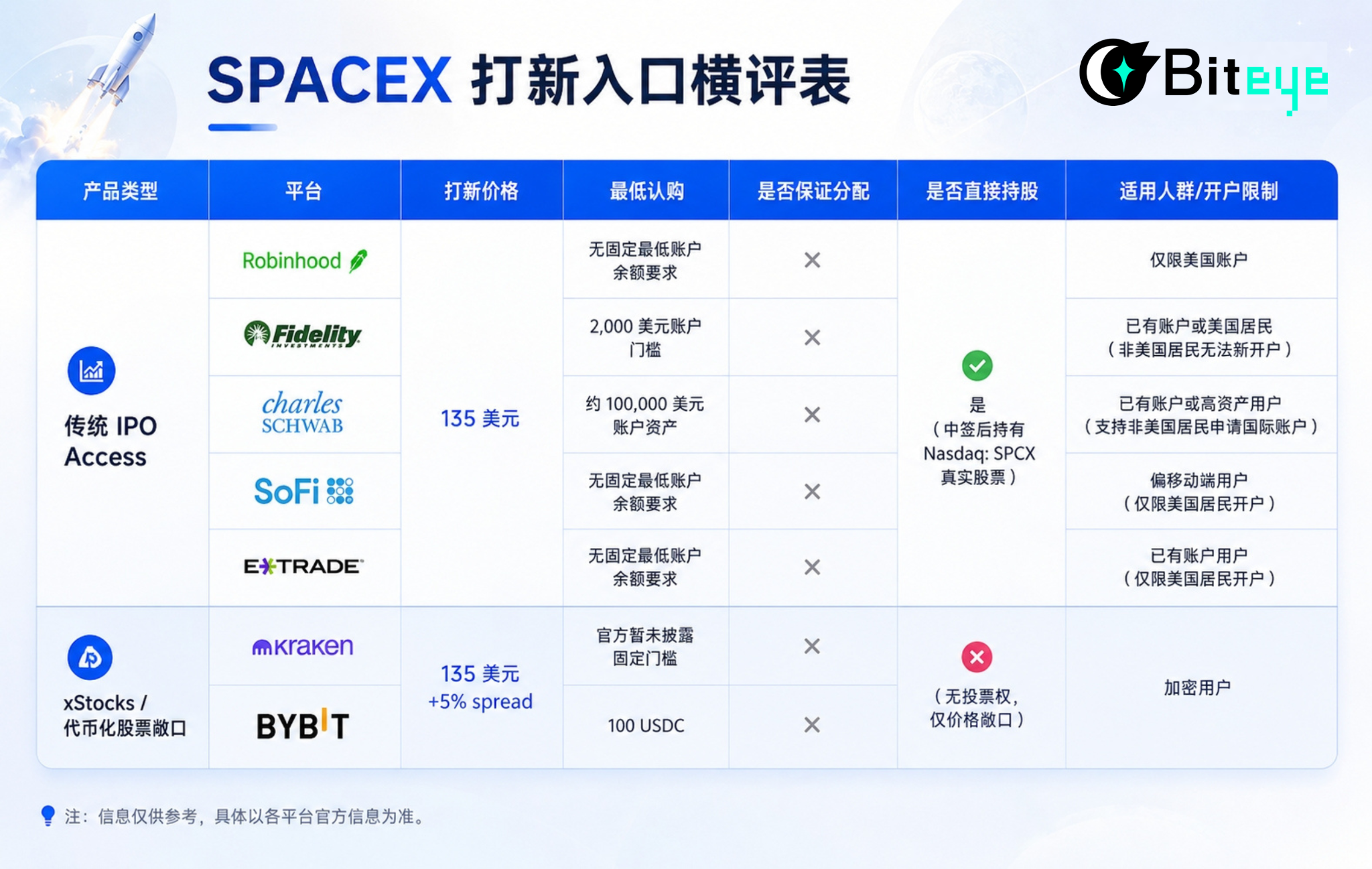
Brokerage entrance (such as Robinhood, Fidelity, Schwab, SoFi, E*TRADE, etc.): Follows the standard traditional US stock IPO Access path, where you are subscribing to and holding real stocks of Nasdaq (code: SPCX).
Crypto exchange entrance (Kraken, Bybit channel): Provides "tokenized stock exposure" through xStocks. If you successfully get allocated, you will receive SPCXx / Tokenized Shares. Although its price will be pegged 1:1 to the real stock performance of SpaceX, it is essentially an on-chain derivative and does not represent direct ownership in the traditional sense.
Next, we will help you clarify 6 key aspects from categories of products, subscription price, minimum subscription, fees, stock rights, and allocation mechanisms. 👇
1️⃣ Kraken: Closer to the IPO allocation entrance
Kraken is responsible for providing the entrance and account experience, where users submit subscription intentions in the Kraken App. The underlying stocks are tokenized by the relevant issuers of xStocks, eventually forming IPO xStocks like SPCXx.
If users are ultimately allocated, they will receive SPCXx on the day of listing. It will track the price performance of SpaceX stocks and provide the corresponding economic exposure.
This time, Kraken disclosed about $400M in SpaceX IPO Access quota. However, this does not mean users will definitely get allocation upon submission, as it ultimately depends on total subscription demand and allocation rules.
Product type: IPO xStocks / Tokenized stock exposure
Subscription price: $135, final price subject to official pricing
Minimum subscription: Not yet disclosed
Fees: The issue price includes a 5% spread
Guaranteed allocation: No guarantee
Direct stock ownership: No, only price exposure, no voting rights
2️⃣ Bybit: Bringing SpaceX IPO Express into Bybit accounts
Bybit's SpaceX IPO Express accesses xStocks, allowing users to submit subscription intentions using USDC.
If ultimately allocated, users will receive SpaceX tokenized shares, not real stocks in a traditional brokerage account. This asset is pegged 1:1 to the underlying stock and provides economic exposure to SpaceX, which can be traded through Bybit Spot after launch.
Product type: xStocks / Tokenized SpaceX exposure
Subscription price: $135, final price subject to official pricing
Minimum subscription: 100 USDC
Fees: The issue price includes a 5% spread
Guaranteed allocation: No guarantee
Direct stock ownership: No, does not represent direct ownership of SpaceX shares
3️⃣ Robinhood: Real US stock IPO Access, low barrier but only for US accounts
The main difference between Robinhood and Kraken/Bybit is that it follows the traditional brokerage IPO Access path.
The SpaceX IPO will allocate some stocks to retail investors, and Robinhood is one of these retail allocation channels. Users can submit IPO subscription requests in Robinhood, and if ultimately allocated, they will receive real Nasdaq: SPCX stocks, not tokenized proxy assets.
However, Robinhood also does not guarantee allocation. After users submit requests, they may receive full allocation, partial allocation, or no allocation at all.
Product type: Traditional IPO Access
Subscription price: $135, final price subject to official pricing
Minimum subscription: No fixed minimum account balance requirement
Fees: No additional IPO participation fee, pay at IPO price
Guaranteed allocation: No guarantee
Direct stock ownership: Yes, if allocated, hold real Nasdaq: SPCX stocks
4️⃣ Fidelity: Traditional big brokerage entrance, relatively friendly barrier this time
Fidelity is a well-established large US brokerage with a mature account system and IPO participation process.
In this SpaceX IPO, one point worth noting about Fidelity is that the participation threshold is relatively friendly, with a minimum account threshold of about $2,000 to submit subscription intentions. For users who already have a Fidelity account, it is a more stable traditional brokerage entrance.
However, only Americans (US residents) can open a new Fidelity account, and non-US residents cannot open accounts.
Product type: Traditional IPO Access
Subscription price: $135, final price subject to official pricing
Minimum subscription: $2,000 account threshold
Fees: No additional IPO participation fee, pay at IPO price
Guaranteed allocation: No guarantee
Direct stock ownership: Yes, if allocated, hold real Nasdaq: SPCX stocks
5️⃣ Charles Schwab: Real stock entrance, but higher threshold
Charles Schwab is a large comprehensive US brokerage, known for its mature account system and wide range of services, and also provides relatively comprehensive US stock and global account services.
In this SpaceX IPO, Schwab's participation threshold is relatively higher, with about $100,000 in account assets, making it more suitable for users who already have higher asset scales within the Schwab system.
Schwab supports account opening for non-US residents through Schwab International, but requires a passport/ID proof, address proof, and W-8BEN, with a process that may take 1-2 weeks for review.
Product type: Traditional IPO Access
Subscription price: $135, final price subject to official pricing
Minimum subscription: Approximately $100,000 in account assets
Fees: No additional IPO participation fee, pay at IPO price
Guaranteed allocation: No guarantee
Direct stock ownership: Yes, if allocated, hold real Nasdaq: SPCX stocks
6️⃣ SoFi: Real stock entrance, suitable for users with existing SoFi accounts
SoFi is a more internet-oriented financial platform, with a relatively lightweight entrance and mobile-oriented operation.
In this SpaceX IPO, SoFi does not have a fixed minimum account balance requirement. For users who already have a SoFi Active Investing account and are accustomed to using the app, submitting subscription intentions will be more convenient.
However, only US residents can open a SoFi Active Investing account, and non-US residents cannot open accounts.
Product type: Traditional IPO Access
Subscription price: $135, final price subject to official pricing
Minimum subscription: No fixed minimum account balance requirement
Fees: No additional IPO participation fee, pay at IPO price
Guaranteed allocation: No guarantee
Direct stock ownership: Yes, if allocated, hold real Nasdaq: SPCX stocks
7️⃣ E*TRADE: Traditional brokerage entrance under Morgan Stanley
E*TRADE is a traditional US stock brokerage under Morgan Stanley, suitable for users who already have E*TRADE accounts and are familiar with the traditional brokerage subscription process.
In this SpaceX IPO, E*TRADE does not have a fixed minimum account balance requirement; users generally need to submit subscription intentions through the relevant new stock subscription entrance and complete the related investor information confirmation.
Only US residents can open accounts to participate in E*TRADE's IPO subscription, and non-US residents cannot open new accounts or meet participation qualifications.
Product type: Traditional IPO Access
Subscription price: $135, final price subject to official pricing
Minimum subscription: No fixed minimum account balance requirement
Fees: No additional IPO participation fee, pay at IPO price
Guaranteed allocation: No guarantee
Direct stock ownership: Yes, if allocated, hold real Nasdaq: SPCX stocks
🌟 How should individual investors choose?
Currently, the planned issue price for the SpaceX IPO is $135, but the final IPO price will be confirmed after the official pricing on June 11.
If we consider the additional 5% fee on this type of xStocks product from Kraken/Bybit, the actual participation cost is approximately:
135 × 1.05 = $141.75
Currently, some pre-market related trading prices for SpaceX are around $167, which is higher than the planned issue price of $135.
If allocation is received near the issue price, it theoretically has an advantage over directly purchasing in the secondary market after listing.
However, the main uncertainty in such a hot IPO is whether you can receive an allocation and, if so, how many shares.
So how to choose is actually quite simple:
If you already have a US brokerage account, prioritize traditional brokers. Because platforms like Robinhood, Fidelity, Schwab, SoFi, and E*TRADE will provide real Nasdaq: SPCX stocks if allocated.
If you do not have a US stock brokerage account, or opening an account with a traditional broker is unrealistic, then look at Kraken/Bybit.
They are more convenient for crypto users.
🌟 Be clear about these points before participating
Before participating in the SpaceX IPO, do not solely look at "can I get allocated" or "what is the current price difference."
The three main factors that truly affect the results of such popular IPOs are: what the final price is, when the allocation is confirmed, and how many shares can flow in the initial phase of listing.
1️⃣ $135 is not the final transaction price
Currently, the planned issue price for the SpaceX IPO is $135, and the $135 or 135 USDC on the Kraken/Bybit page is better understood as the current reference price.
The final IPO price will still need to be confirmed after the official pricing. If the final price changes, the actual subscription cost will also change accordingly.
2️⃣ Pay attention to IPO timeline
The current key time points of interest in the market are:
June 7, 16:00: Bybit opens registration/subscription, and users can submit subscription intentions using USDC.
June 11: Final pricing confirmation for SpaceX IPO, with platforms starting to calculate allocation based on underwriter results.
June 12: SpaceX is expected to list and trade on Nasdaq with the code SPCX.
June 12, 20:30: Bybit distributes tokenized SpaceX shares, and users who received allocation can see the corresponding assets in their accounts.
3️⃣ Pay attention to chip distribution
This SpaceX IPO plans to raise about $75 billion, roughly calculating based on $135 per share, approximately 556 million new shares will be issued, accounting for about 4%-5% of a $17.5 trillion valuation. This part will be the primary new circulating shares at the initial listing.
Among these, up to 30% may be allocated to retail investors, about 167 million shares; about 5% reserved for some employees and designated parties, about 27.78 million shares, with the remaining approximately 65% primarily allocated to institutions and other public offering investors.
🌟 In conclusion
The most noteworthy aspect of this SpaceX IPO is the change in participation methods.
In the past, US stock IPOs resembled a closed game within the traditional financial system. Now, stablecoins, exchange accounts, and tokenized stocks are starting to open up this type of asset entrance. For ordinary users, this is certainly a new opportunity.
However, more entrances do not mean less risk. The more popular the project, the more likely it is that people will only see price differences and presume they can get allocations.
This is somewhat similar to the previous Pump.fun IPO. Initially, everyone thought they could grab the public offering shares, and some even hedged around the IPO results. But when the public offering actually happened, the core issue was whether they could grab any shares.
The logic for SpaceX is similar: the final pricing has not been confirmed, the allocation rules are not entirely transparent, and neither Kraken, Bybit, nor traditional brokers guarantee allocations.
Therefore, it's best not to make trading arrangements based on the assumption of "I will definitely get allocated." Opportunities can be monitored, but first, understand the product structure and allocation rules before deciding how much to participate.
免责声明:本文章仅代表作者个人观点,不代表本平台的立场和观点。本文章仅供信息分享,不构成对任何人的任何投资建议。用户与作者之间的任何争议,与本平台无关。如网页中刊载的文章或图片涉及侵权,请提供相关的权利证明和身份证明发送邮件到support@aicoin.com,本平台相关工作人员将会进行核查。


