When risk is no longer about "sudden liquidation," perhaps that will be the starting point for the next evolution of DeFi.
Written by: imToken
If you have been in the industry for more than one cycle, you have definitely seen this repeatedly played out:
In extreme markets, prices suddenly crash, then oracles distort price feeds, liquidation bots swarm in, and a batch of positions gets liquidated in a matter of minutes, with selling pressure continuing to drive down prices, eventually evolving into a liquidity crunch across the entire ecosystem. Starting from the "312" event in 2020, to "519", "1011" and multiple other sell-offs, forced liquidation has always been the most criticized culprit.
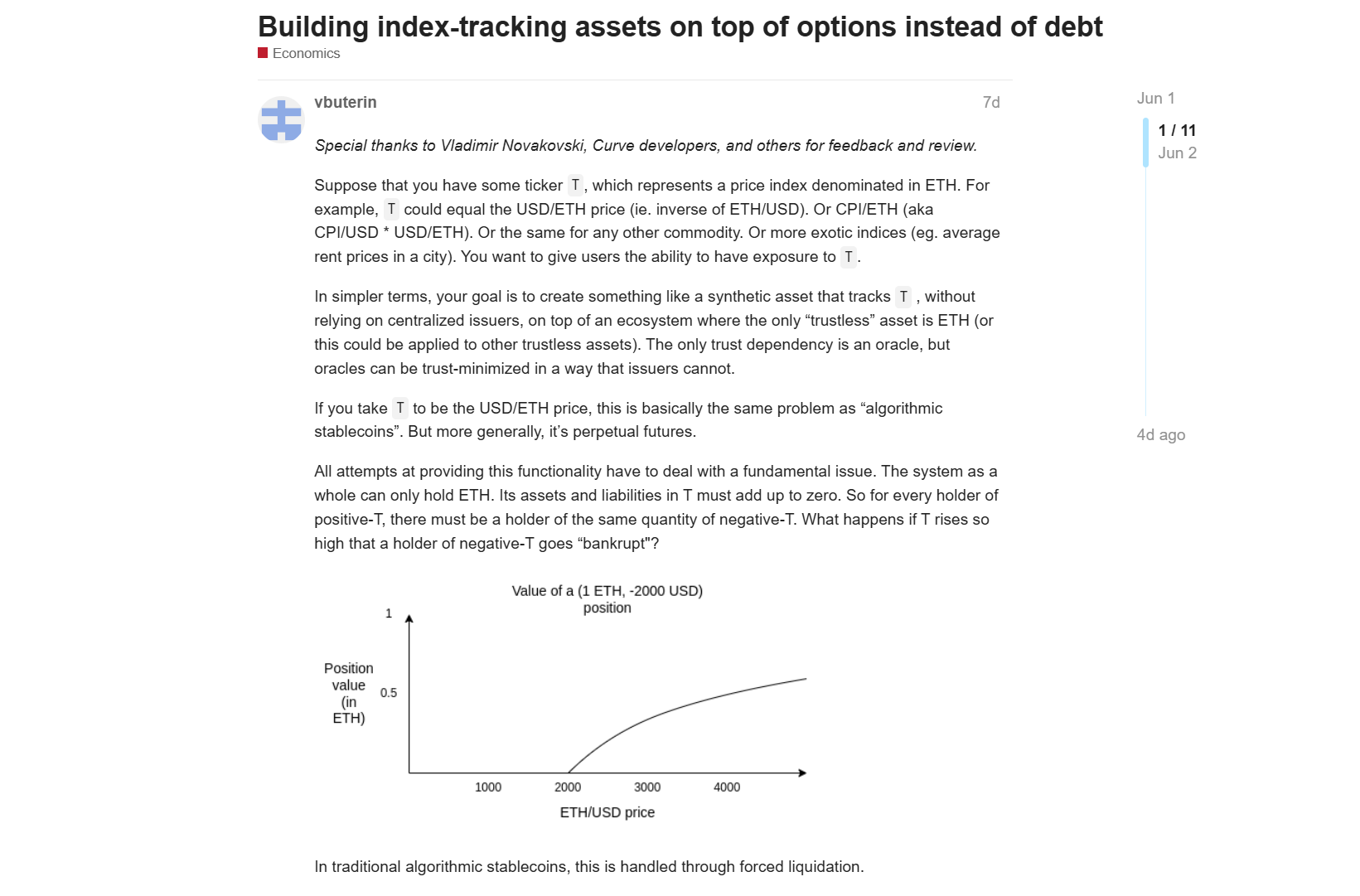
Faced with this predicament, Vitalik Buterin published a research proposal earlier this month entitled "Building index-tracking assets on top of options instead of debt," raising a rather disruptive question: Can DeFi completely replace the traditional CDP (Collateralized Debt Position) and forced liquidation model with an options-based mechanism?
According to Vitalik's vision, the core advantage of this design lies in using "slow oracles" to replace real-time oracles, significantly reducing the risk of oracle manipulation, allowing users' exposure to the index to gradually deviate from the target in a smooth (approaching a quadratic curve) manner, rather than facing sudden forced liquidation.
1. The Achilles' heel of traditional DeFi
Before discussing Vitalik's new idea, it is necessary to review why "CDP + forced liquidation" became the core model of DeFi, and why it has turned into its Achilles' heel.
It is well known that classics such as MakerDAO/Sky, Aave, and Compound represent one of the most important financial innovations in early DeFi, allowing users to collateralize on-chain assets to borrow another type of asset.
This mechanism can be simply understood as users depositing assets like ETH into the protocol to obtain a loan limit. As long as the collateral value is high enough, the position is secure; however, once the collateral price falls below a certain threshold, the protocol will trigger liquidation, selling off the collateral to repay the debt and protect the system's solvency.
This may seem unremarkable today, but this mechanism was crucial for early DeFi. It allowed on-chain assets like ETH to transform from "passive holding" to "reusable" financial assets, enabling them to enter more complex systems like lending, leverage, stablecoins, and yield strategies.
It can be said that it was the CDP and lending protocols that laid the earliest and most critical groundwork for the composability of DeFi.
However, its problems are also quite obvious:
- Forced liquidation relies on real-time and necessarily reliable oracles: The protocol must rely on external oracles for second-level price feeds. If the oracle encounters delays, manipulation, or extreme network congestion, or if certain assets themselves lack liquidity, the protocol may execute liquidation based on distorted prices over a short time;
- Forced liquidation amplifies pressure in extreme markets: When collateral prices drop rapidly, liquidators and MEV bots will concentrate on competing for liquidation opportunities. Collateral is sold off in bulk, further exacerbating market pressure, and may even trigger a liquidity crunch across the entire ecosystem;
- Illusion of liquidity: Traditional lending protocols assume "there is always enough liquidity in the market to absorb liquidation selling pressure," but in truly extreme market conditions, liquidity can evaporate instantly, leading to a situation where the harder the prices fall, the fewer people are willing to take on risk, making it increasingly difficult for liquidations to occur smoothly. If the protocol cannot handle bad positions in a timely manner, it may end up with bad debts.
Therefore, objectively speaking, CDP + forced liquidation is not a flawed design; it is an extremely important and effective foundational module for early DeFi. However, as DeFi enters a stage where funding scales and structures become more complex, the costs of this model become increasingly apparent:
It concentrates risk on a single liquidation threshold—before this threshold is triggered, everything seems normal; once the threshold is touched, users are often left to passively bear the consequences.
2. Vitalik's new idea: reconstructing lending with "options thinking"
Vitalik's new approach aims to change the underlying way DeFi handles risk.
We can summarize his idea in one sentence: Can DeFi not use "debt" as the underlying component, but instead use "options" as the underlying component?
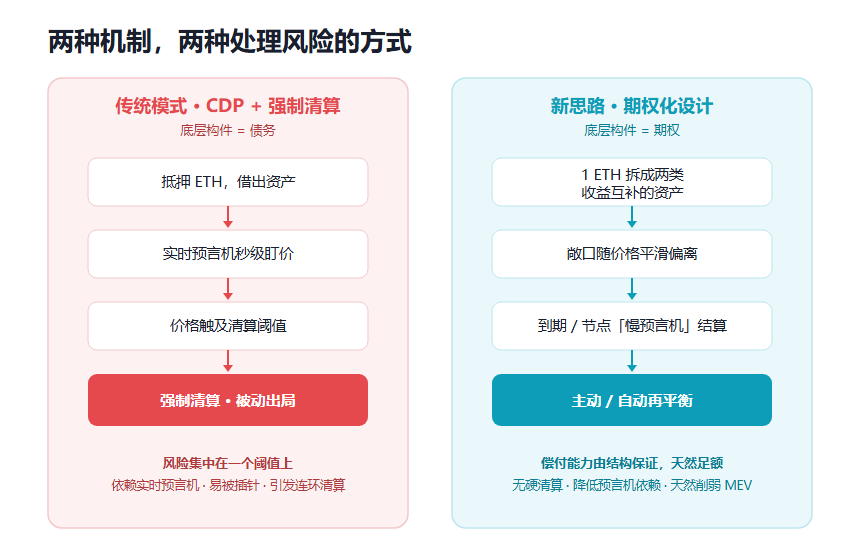
Because the traditional CDP model is based on debt, users must have a mechanism to ensure that debts are always sufficiently collateralized. Once collateral is insufficient, the protocol can only avoid bad debts through forced liquidation.
In contrast, the options-based design takes a completely different approach. It does not require users to create a debt that must be protected in real-time but instead splits the underlying assets into a set of contracts with complementary yields. In simple terms, 1 ETH can be split into two types of assets: one type is closer to stable or index-tracking exposure, while the other bears risk and returns in the opposite direction. Regardless of price changes, the combined return of these two types of assets will always correspond to the underlying 1 ETH.
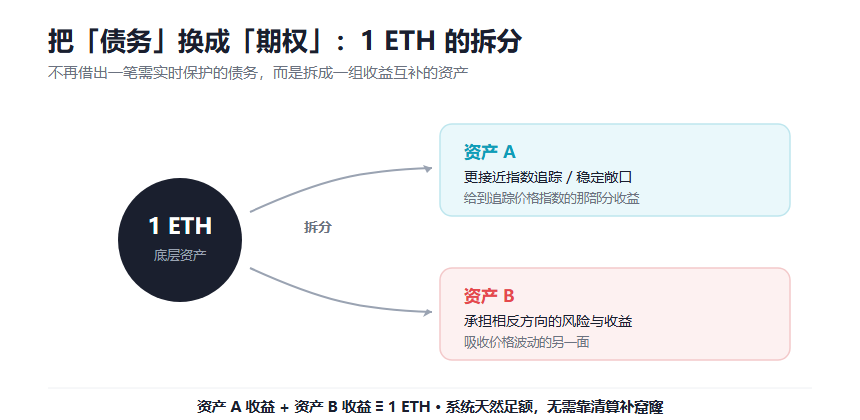
This means the system no longer needs to suddenly force liquidation at a specific price point. In traditional liquidation models, users may suddenly exit at the touch of a price line; in the options model, users face a gradually diverging exposure from the target and need to rebalance at the appropriate time. A simpler analogy can be used to understand this:
- In the traditional mode (CDP), it's like you deposit ETH worth $10,000 with a lending protocol and borrow $5,000. The lending protocol watches the price through the oracle; once ETH drops to a critical point, it immediately sells your ETH and charges you a hefty fee, leaving you with no ground for defense.
- In the new options-based mode, you deposit ETH, similarly obtaining $5,000, but this isn't called borrowing; rather, it's more like a time-limited "right": before a specified time, regardless of how much ETH drops, your position will not be forcibly wiped out midway, and the initiative remains in your hands—upon expiration, if the price rebounds, you can redeem the collateral. If the price drops, you can choose to not exercise, allowing the protocol to take the collateral while you keep your $5,000, thus avoiding being forcefully liquidated while asleep by a pin manipulation.
Of course, this is just a simplified analogy for understanding; Vitalik's original design is closer to a "holding deep in-the-money options and rolling into a lower exercise price as prices approach."
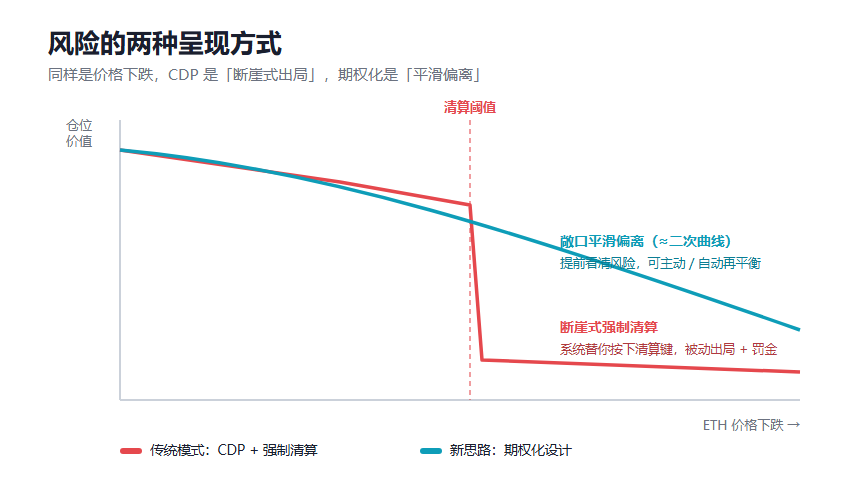
Overall, the former resembles "the system presses the liquidation button for the user," while the latter looks like "the user clearly sees the risk curve and decides when to adjust positions." This shift in mechanism will undoubtedly bring profound changes to DeFi on several levels:
- No more "hard liquidation": As the lending positions are transformed into options with temporal cycles, protocols no longer need to set a "once touched, immediately explodes" liquidation line. Users will no longer have to nervously watch K-lines every day, nor will they be forced to liquidate due to a malicious flash crash while sleeping;
- Significantly reduced dependence on oracles: The new mechanism greatly minimizes the reliance on high-frequency, real-time oracle feeds. The protocol only needs to settle at expiry or specific time points, directly compressing the space for hackers to launch attacks using "flash loans + oracle manipulation";
- Inherent resistance to MEV: Without instantaneous forced liquidation, there will no longer be Gas bidding wars triggered by "cascading liquidations" on-chain. MEV bots lose the most lucrative liquidation arbitrage scenarios, and the value created by the protocol is more likely to genuinely flow back to users and LPs, rather than being siphoned off by arbitrageurs and orderers;
The significance of this change goes far beyond mere "enhanced security."
Because the future of DeFi aims to serve not only high-risk traders but also more ordinary users and real payment scenarios, for these groups, what truly matters is often not pushing capital efficiency to the extreme, but whether the choice can be retained in extreme markets, and whether it can avoid being forcibly kicked out of the system due to a short-term fluctuation.
3. Do users still need Ethereum DeFi?
This question has become more realistic today.
With the rise of emerging ecosystems like Hyperliquid, users are witnessing another form of DeFi product that can offer faster matching experiences, interactions closer to centralized exchanges, more concentrated liquidity, and more direct fulfillment of trading needs.
This poses a real pressure for Ethereum.
If we simply compare transaction speed, fees, and frontend experience, Ethereum's mainnet and some traditional DeFi protocols may not always have the advantage. Users will not automatically believe that a protocol is better just because it is deployed on Ethereum, nor will they ignore cheaper and more convenient alternatives simply because a product is more "orthodox."
Therefore, Ethereum DeFi needs to answer a new question: why do users still need Ethereum DeFi?
The answer is certainly not just "because Ethereum is the safest," nor merely "because Ethereum has the largest TVL." The truly persuasive answer should come from deeper financial design capabilities.
I believe that for Ethereum DeFi to continue being the core battleground of on-chain finance, it cannot merely stop at replicating traditional financial products to simply increase leverage efficiency, but must establish advantages in harder areas, such as more transparent risk boundaries, more robust oracle mechanisms, fewer mandatory system actions, stronger user autonomy, and protocols capable of withstanding extreme scenarios.
In other words, the competition focus of the next generation of Ethereum DeFi may no longer be who can make users earn more, but who can minimize users' passive exits in a complex financial environment and truly understand what risks they are taking on.
For ordinary users, Vitalik's proposed options-based DeFi design may still seem distant, and it may not quickly become a mature product, but the direction it conveys is clear: DeFi should not only pursue higher yields but also aim for clearer, more explainable, and more manageable risk structures.
Final thoughts
To be realistic, after frequent security incidents, a common voice is that, given the numerous risks in DeFi, does it mean that on-chain finance itself is not feasible?
This judgment may be overly simplistic.
The issues in DeFi are not due to the direction of "decentralization" itself, but rather that many products have yet to truly complete the evolution from high-risk experimentation to robust financial infrastructure. In the past, the industry has been too accustomed to proving value through growth and TVL but has relatively underestimated risk design and resilience to extreme scenarios.
Vitalik's new idea is precisely a reminder to the industry that DeFi's evolution is not just about moving old finance onto the chain, but about utilizing the programmable and composable features of the chain to design new risk structures that traditional finance may find difficult to achieve.
If it's just a race of speed and speculative efficiency, Ethereum will have a hard time winning; Ethereum must return to its core narrative, which is the foundational innovation of security, decentralization, and financial paradigms.
This may be where the true opportunity for Ethereum DeFi lies.
免责声明:本文章仅代表作者个人观点,不代表本平台的立场和观点。本文章仅供信息分享,不构成对任何人的任何投资建议。用户与作者之间的任何争议,与本平台无关。如网页中刊载的文章或图片涉及侵权,请提供相关的权利证明和身份证明发送邮件到support@aicoin.com,本平台相关工作人员将会进行核查。


